• Obama is Still Killing It on InTrade

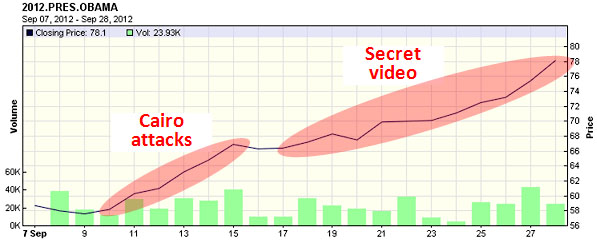
    I don’t really have any big point to make here, I’m just following up on a post I did last week that compared President Obama’s standing among the InTrade punters at two points in time: (a) after Mitt Romney’s flubbed response to the Cairo attacks, and (b) after MoJo’s release of the secret fundraising video. Last week we only had a couple of days of data following the video release, but how we’ve got a full ten days. And it sure looks like the video has had a sustained effect that’s even bigger than the Cairo gaffe.

    I don’t know if InTrade trends are very meaningful, so take this with a grain of salt. But it sure looks like that video has caused Romney a world of hurt.

  • Will Suburban Wingnuts Descend on the Inner City on November 6th?


    Ed Kilgore writes today about True the Vote, a Houston-based tea party group that plans to deploy a million poll watchers to make sure that Democratic thugs don’t try to steal the election this November. Ed is….concerned:

    It’s hard to imagine a more dangerous scenario than that of hundreds of thousands of self-righteous suburban wingnuts showing up in poor and minority neighborhoods to hassle would-be voters, with Fox News cameras on hand to record any random examples of Solid Citizens experiencing resistance from annoyed locals.

    And if we head towards Election Day with Obama still enjoying a clear lead in the polls, you have to figure True the Vote’s shock troops will be loaded for bear, viewing themselves as the last desperate defenders of “their” country against the barbaric hordes of looters and baby-killers who are already plotting to herd them into concentration camps during Obama’s second term, after they close the churches and shut down radio talk shows. At a minimum, we can expect “poll-watchers” to come up with enough “documented” example of “voter fraud” to support a general post-election effort to de-legitimize the results.

    I’ll confess that I’ve excerpted this mainly because of the sheer rolling majesty of Ed’s prose. Enjoy! But I’m going to officially dissent from both of the actual predictions here. First, my gut tells me that all these tea partiers are going to find their little field trips to the inner city a wee bit less exciting than they think. Organizers won’t be able to round up as many volunteers as they think, and the folks who do head into the valley of the shadow of death probably aren’t going to make much trouble. They’ll be too busy being terrified of getting mugged.

    Second, I’ve been hearing a lot about this idea that conservatives are gearing up for a huge effort to “delegitimize” the election if Obama wins. I don’t see it. I think you can explain all their current actions as pretty standard fare for a hard-fought election. Poll watchers are nothing new, allegations of voter fraud are nothing new, smears are nothing new, racially motivated attack ads are nothing new, and even poll denialism isn’t really all that new. If the election is as close as 2000, then sure: Republicans will fight to the death. But they fought to the death in 2000 too. Remember? More than likely, Obama will win by a modest but unchallengeable margin in November, and conservatives will despairingly accept the results and then repair to their dens to figure out what to do next. In other words, pretty much the same thing liberals will do if Romney wins.

  • Chart of the Day: The Afghanistan Surge Didn’t Work

    On purely military terms, the 2007 surge in Iraq was pretty successful. But as a lot of people pointed out at the time, that success was due to more than just the surge itself. A lot of it was due to specific local conditions, which I usually added together and called The Four S’s (Surge, Sadr, Sectarian cleansing, and Sunni awakening). Those additional conditions never existed in Afghanistan, which made the surge there a lot more difficult.

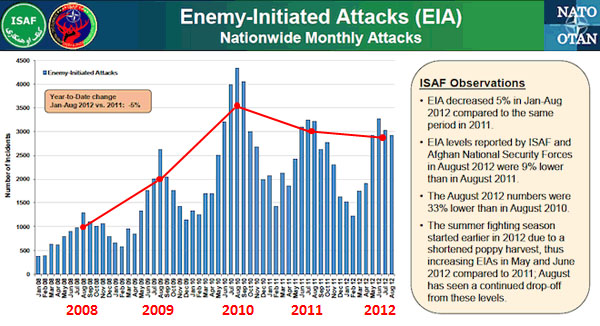
    So with the Afghanistan surge now over, how did it work? As Spencer Ackerman reports, by the military’s own metrics, it hasn’t. Insurgent attacks are down slightly compared to last year, but they’re still way up compared to 2009, the year before President Obama doubled our troop presence there:

    The chart [below, with red line added] measures the various attacks the Taliban and associated insurgents launched against NATO forces, month by month. In August 2009, the peak of the fighting season and the height of the internal Obama administration debate over a troop surge, insurgents attacked U.S. and allied troops — using small-arms fire, homemade bombs, mortars and more — approximately 2,700 times. In August 2012, they attacked just shy of 3,000 times.

    In August 2009, insurgents used just under 600 homemade bombs on U.S.-aligned forces. They used just over 600 homemade bombs on U.S.-aligned forces in August 2012.

    The same trend holds for every other month in 2009 compared to every month in 2012 for which there is data: The insurgency launched more attacks this year. In some cases, substantially more: insurgents attacked about 2,000 times in July 2009 and a shade over 3,000 times in July 2012. ISAF registered about 475 attacks from homemade bombs in July 2009; and about 625 in July 2012.

    Perhaps Obama should take a hint from Apple CEO Tim Cook, who said today that he is “extremely sorry” for subjecting his customers to a new, bug-ridden maps app. Obama ought to be sorry too.

  • The Republican Brain: Constructing an Alternate Polling Reality for 2012

    One of the odder little subplots of the 2012 election has been the growth of poll denialism among Republicans. As Mitt Romney’s chances have grown ever dimmer, a cottage industry has sprung up on the right claiming that presidential polls suffer from liberal bias and Romney is really doing better than they say. “When the published poll shows Obama ahead by, say, 48-45,” explains conservative pundit Dick Morris, “he’s really probably losing by 52-48!”

    Now, this is hardly in the same league as climate denialism or evolution denialism. What’s more, it’s perfectly understandable. It’s human nature to cast around for reasons to stay optimistic about a political contest that you feel deeply about. I remember a milder version of the same thing happening in 2004, as liberals dug deep into the October poll numbers trying to convince themselves that John Kerry had a better chance to beat George Bush than the topline numbers suggested. One poll had a small sample size. Another one had a bad likely voter screen. A third one suffered from a known house effect. Etc.

    But it’s what happened next that’s instructive. A couple of years after the 2004 election, a guy named Nate Silver started deconstructing polls in minute detail and explaining exactly what made some polls good and others bad. His approach was unsparingly rigorous and his overarching message was: don’t kid yourself. The numbers are what the numbers are, and they don’t care if you’re a liberal or a conservative. Week after week, Silver dug deep into the minutiae of how polls are put together and how they’re conducted, writing lengthy, table-laden posts that often meandered through several thousand words. Liberals loved it. Before long he was, for all practical purposes, the liberal patron saint of polling.
    So far at least, the conservative approach has been….different. Their patron saint going into the last few weeks of the 2012 campaign is Dean Chambers, a blogger who runs a site called UnSkewed Polls. Chambers does not dig deep into the numbers. He doesn’t explain sample sizes and cell phone biases. He does just one thing: he reweights all the polls so they have the same proportion of Democrats and Republicans estimated by Rasmussen Reports, a pollster with a longstanding Republican house effect. Then he announces what the numbers are after his reweighting is done. Romney is a big winner every time.

    Chambers doesn’t even pretend that his approach has any rigor. He adopted it, he told BuzzFeed, after seeing a poll that “just didn’t look right.” After a closer look, he decided that none of the others looked right either. And what does he think accounts for this widespread blundering among the nation’s pollsters? Not simple incompetence, Chambers says. It’s all quite deliberate. “Any poll that says NBC, CBS, or ABC is going to be skewed and invested in trying to get this President re-elected,” he explained.

    This is, to put it bluntly, nuts. And it suggests a fundamental difference between left and right, one that Chris Mooney wrote about earlier this year in The Republican Brain. Neither side has a monopoly on sloppy number crunching or wishful thinking, but liberals, faced with a reality they didn’t like, ended up accepting reality and deciding to learn more about it. That’s the Nate Silver approach. Conservatives, faced with a reality they didn’t like, invented a conspiracy theory to explain it and then produced an alternate reality more to their liking. It’s a crude and transparently glib reality, but that’s apparently what the true believers want.

  • The Backstory Behind QE3

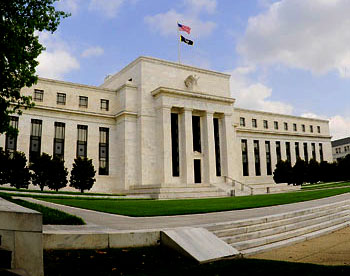
    I suppose this is a sign that I’ve been well and truly pulled down the rabbit hole, but I’m sort of excited that today brings a behind-the-scenes tick-tock from Jon Hilsenrath about the September 13th Fed meeting. These kinds of pieces are three-a-penny for decisions made in the White House or on Capitol Hill, but not so common for decisions made in the inner sanctums of the Eccles Building. But as you’ll recall, September’s meeting is the one where the Fed finally decided to implement QE3, and Hilsenrath has the skinny about how it happened:
    For weeks, Mr. Bernanke made dozens of private calls on days, nights and weekends, trying to build broad support for an unusual bond-buying program he wanted approved during the Fed’s September meeting, according to people familiar with the matter.

    ….Interviews with more than a dozen people involved in the Fed decision, both supporters and opponents, show how Mr. Bernanke won over skeptics to advance his policy—a distinction in a Washington era marked by rancor and gridlock. These people also gave a rare view of the low-key persistence of the former economics professor.

    Mr. Bernanke didn’t see inflation as a threat but viewed unemployment as a deeper problem than he had realized. The central bank, in his view, needed to act. The Fed chairman listened to colleagues’ concerns during the calls, people familiar with the matter said, drawing out their reservations and probing for common ground. He eventually seized on a compromise that came from a little-known Fed governor.

    ….Drawing broad support for the plan was important to Mr. Bernanke in part because the policies he was formulating could outlast him. His term as Fed chairman ends in January 2014. Seeing a return to U.S. full employment as a distant goal, Mr. Bernanke needed the support of officials who might remain at the Fed after he left.

    That last bit is an important point. Part of the September 13th announcement included an effort to persuade the market that Fed policies will remain relaxed for many years, even after the economy has started to pick up steam, and to do that Bernanke knew that he needed near unanimity. If the FOMC were bitterly split, after all, who would believe that Bernanke’s policies would genuinely last through 2015 and beyond? So he spent weeks working on his colleagues and fashioning a compromise.

    And that, I think, is the key takeaway from Hilsenrath’s piece. Bernanke may not be managing monetary policy as aggressively as a lot of us would like, but he’s really not the roadblock here. His colleagues on the FOMC are.

    BY THE WAY: The “little-known” Fed governor who produced the winning compromise turns out to be Elizabeth Duke, a Bush nominee. Go figure.

  • Silicon Valley Is Still Slightly Less Powerful Than the Federal Reserve

    One of the knocks on the digital ecosphere is that it doesn’t really employ very many people. Facebook might be cool, but it doesn’t do much for the real economy. Ezra Klein grabs my attention today with a suggestion that this might be about to change:

    Square, a company led by Twitter co-founder Jack Dorsey, has the potential to be a gamechanger. It wants to do nothing less than change how we pay for everything. In doing so, it has the potential to vastly lower transaction costs for businesses that accept credit, and to significantly increase the number of transactions that happen, period. If it works, that could be a transformative advance.

    Wait. Seriously? Is that what people are saying? So I clicked on the Farhad Manjoo piece in Slate that Ezra was referring to:

    If you study Square’s products and its pricing, and if you talk to Dorsey about his plans, you’ll find that the company’s real mission is to alter the psychology of consumption. Dorsey is bent on creating frictionless commerce….Its pay-by-name system is so much of an improvement over the current way we pay that, over time, Square believes it will raise transaction volumes—people will buy more stuff because buying stuff is easier.

    The ability of Silicon Valley entrepreneurs to hold reporters in some kind of satanic thrall as they spin their mesmerizing tales is nothing short of awe-inspiring. Square might very well be a great company. Making it easier to pay for stuff is a terrific idea. But will this actually cause us all to buy more stuff?

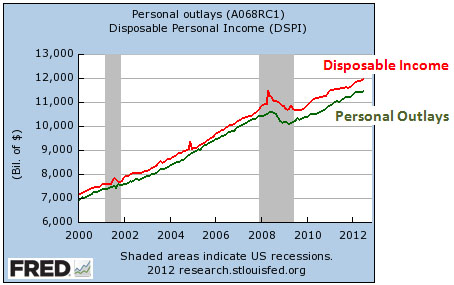
    In a word, no. Putting aside changes in fiscal and monetary policy, consumer expenditures are constrained by (a) net income and (b) our desire to save for the future. That’s it. Right now, the personal savings rate is around 4%, which means we collectively spend about 96% of what we earn. Nothing that Square does will change that.1 It might be a great company — maybe even a game changer on a number of levels — but it’s not going to increase consumer spending at a macro level. Even Silicon Valley doesn’t have quite that much clout.

    With that off my chest, however, I recommend clicking on both links above. They have interesting things to say.

    1You can, perhaps, spin a tale about dramatically lower transaction costs putting more money in the hands of consumers and small business owners and less in the hands of Wall Street banks. This would be a good thing, and might even be a net positive for economic growth. But it’s a stretch, and I don’t think it’s the story Dorsey is telling anyway.

  • Quote of the Day: Romney Is Ruining Things For All the Other Rich Guys


    Today’s QOTD comes from Stephen Breitstone, co-head of the taxation and wealth preservation group at Meltzer, Lippe, Goldstein & Breitstone LLP, commenting on one of the tax avoidance schemes that Mitt Romney used in the $100 million trust he set up for his children and grandchildren:

    It’s going to be harder to do tax planning in the future. He’s bringing attention to things that weren’t getting attention.

    This comes from a Bloomberg story about Romney’s use of an “I Dig It” trust, which Breitstone says is so important to the wealthy that ending its tax benefits “would put an end to much of estate planning as we know it.” Here’s how it works:

    The person setting up the trust, like Romney, contributes assets such as an interest in a fund or shares in a company. If he makes that contribution before those assets appreciate — particularly when they are privately held and difficult to value — he can claim the gift tax obligation is low or non-existent since the declared value is low or zero.

    If the trust generates any income — such as by selling stock — the eventual tax bill is the responsibility of Romney, not the trust. By paying the capital gains tax, which was 20 percent in the late 1990s and is now 15 percent, he can avoid depleting the funds in the trust — in essence making an additional donation that’s free of gift taxes….Gains in the trust for Romney’s heirs remain free of gift taxes and potential estate taxes.

    Very cool, no? First, Romney undervalues the assets he puts into the trust so he owes little or no gift tax. Then, later, when the assets appreciate, he pays only the capital gains tax, which is considerably lower than the gift tax. And to make it even better, he pays the capital gains tax out of his own pocket, so the trust owes nothing. It’s like making a second gift to his kids free and clear.

    Bloomberg says Romney did this with some DoubleClick shares he got in 1997, back when he was CEO of Bain Capital, but that’s undoubtedly just the tip of the iceberg. The DoubleClick payday amounted to a piddling $674,000 out of a trust worth over $100 million. Sadly for our nation’s ultra-wealthy, though, the spotlight Romney is shining on stuff like this might spur Congress to close some of these loopholes. Maybe.

  • Why You Should Always Account for Inflation: A Case Study

    Ryan Chittum points out a good example today of how misleading news reports can be when they fail to account for inflation. Here’s a sentence from a recent Wall Street Journal piece on cell phones:
    Americans spent $116 more a year on telephone services in 2011 than they did in 2007, according to the Labor Department, even as total household expenditures increased by just $67.

    And here’s what that sentence would look like if those numbers were adjusted for inflation:

    Even as total household expenditures plummeted by $4,146, spending on phones continued to rise, with Americans shelling out $22 more a year on telephone services in 2011 than they did in 2007, according to the Labor Department.

    So the Journal missed a bet. The gist of their piece is that phone bills are eating up a bigger chunk of middle-class incomes, and for my money, the inflation-adjusted figures make that point a lot better. After all, which is more dramatic? Spending $116 more while incomes are flat, or spending $22 more even as your income falls through the floor? Your mileage may vary, but I’d choose the latter.

    Not that it really matters. The inflation-adjusted figures are the more accurate ones. Whenever possible (and with occasional exceptions for specific reasons), they’re the ones you should always use.

  • 4 Years After Meltdown, Wall Street Still Calling the Shots

    The New York Times reports today that other countries are way ahead of us when it comes to regulation of high-frequency trading. So why are we so far behind? There are “many” reasons, says the Times. Let’s count them up:

    There are many explanations for the slower pace of reform in the United States, including the crush of work the S.E.C. has had to deal with in completing regulations under the Dodd-Frank financial overhaul law. In addition, many of the largest American market participants, including the big banks, have built high-speed trading desks and dark pools and as a result have a vested interest in protecting them against new regulations.

    Hmmm. That’s two reasons. And while I don’t doubt that the SEC is pretty busy these days, I’m going to go with Door #2 here. I think we all know perfectly well why no one is seriously trying to regulate HFT in the United States. Sure, we don’t really understand HFT — just like we never really understood all those synthetic CDOs and naked CDSs — and sure, there might be a big tail risk that could someday do worse than put Knight Capital out of business. But in the meantime, there’s money to be made! And who wants to get in the middle of that?