• Does the American Public Really Support Bowles-Simpson?

    Andrew Sullivan thinks that defeat in November will chasten Republicans and make them more likely to compromise. I doubt it. I think it takes several successive defeats to accomplish that (think Democrats under Reagan/Bush or Labor under Thatcher/Major), and at least one of those defeats needs to be a big one. But Republicans won the 2010 midterms, and if they lose this year it will probably be close. That’s just not enough to convince them that they need to change.

    But who knows? Maybe a few of them will see the writing on the wall, and Obama will certainly have more leverage over Congress in January if he lets the Bush tax cuts expire in December. That might force some tax compromises in the short term. But I’m even more skeptical of Sullivan’s followup:

    I think Americans want a fiscal compromise on a sane, Bowles-Simpson line. And radical tax reform is an area of common ground. That kind of deal is normally only possible in a second term, when the president is not going to get political capital for it, and if it is bipartisan, which was the idea behind Bowles-Simpson as well.

    ….And on immigration, all you need is a few Republicans to absorb the lesson of alienating the critical Latino constituency. If Jeb Bush and Karl Rove came out for a deal, and they both support one, politics change change. In other words, as I wrote, this is about the shift in thinking, a change in leverage after an election, not before it. Elections can concentrate the mind. The GOP loves to win and if it sees its current path is doomed, the fever, in Obama’s metaphor, might break.

    Do Americans really want Bowles-Simpson? I guess anything’s possible, but if something like this passes it will most likely be in spite of the American public, not because of it. I know that “compromise” sounds great, and lots of Americans say they’re in favor of it, but when push comes to shove what that usually means is that they think the other guys should compromise. The tax jihadists still won’t want tax increases and the interest groups still won’t want spending cuts and old people will still fight Medicare and Social Security reform to their dying breath. It’s not impossible for some kind of Bowles-Simpson-ish thing to happen, but the truth is that it will almost certainly be unpopular. Politicians will have to drag the public into it, not the other way around.
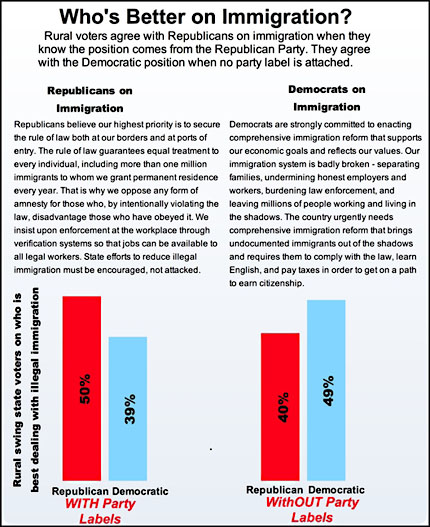
    Immigration might be a different story, though. I think a lot of Republican pols really do understand that diehard opposition to immigration reform is killing them, and the political calculus is different too. At this point, I suspect that big business would mostly be willing to support a reasonable bill, even if it contains tough employer sanctions; e-Verify continues to generate opposition, but it’s declining as the accuracy of the system gets better; Obama has spent four years amping up border security; and hardcore opposition to immigration may well be smaller than we think. Yesterday, for example, Bill Bishop reported on a very interesting poll that asked rural voters about immigration policy. It turns out that if you read them the Democratic position, only 39% support it. But if you read it to them without telling them it’s the Democratic position, 49% support it. That could well go up to 60% or higher if compromise language became the de facto Republican position.

    So then: short-term tax compromise? Quite possible. Immigration reform? Somewhat possible. Bowles-Simpson? Not impossible, but the public will have to be dragged into it kicking and screaming.
  • Cut Mitt Some Slack on His Airplane Window Gaffe


    Last Friday, after smoke from an electrical fire forced Ann Romney’s plane into an emergency landing, Mitt Romney told reporters that airplane fires were a big problem because “you can’t find any oxygen from outside the aircraft to get in the aircraft, because the windows don’t open. I don’t know why they don’t do that.”

    That was dumb. But I’m with James Fallows: I think everyone should settle down about this. I wouldn’t be at my best if Marian had just made an emergency landing either, and I might easily say something a little incoherent. Fallows has more:

    1) Cut Mitt some slack. His wife had been through an upsetting and potentially dangerous episode. However stressed she was, he might have felt even worse — because he wasn’t there, and because of reason #3 below.

    ….3) People are afraid of different things, and the reasons aren’t purely logical. Some people are afraid of dogs — or snakes or spiders or rats, or the big needles a doctor uses to give a shot. I don’t mind any of those, but (like many people who fly airplanes) I’m a little queasy with heights. I also get nervous in very tight spaces, and I have an irrational fear and dislike of horses….Here’s why I mention this. I have heard over the years, within the flying world, that Mitt Romney views airplanes more or less the way I view horses. He is (I have heard) not a happy or comfortable flyer, and one who can always imagine things going wrong. Fortunately I don’t actually have to ride horses — but he has no choice but to fly, white-knuckled, from one stop to the next. Someone with this outlook would naturally be all the more rattled by an emergency landing. So cut him all the more slack.

    There are plenty of other reasons to mock Mitt. We don’t really need this one too.

    UPDATE: Dan Amira says there’s an even better reason to cut Mitt some slack:

    The Los Angeles Times story that relayed Romney’s airplane remark to the world was based off a pool report written by the New York Times’s Ashley Parker. When we asked Parker this morning whether it seemed as if Romney made the mark in jest, she left no doubt. “Romney was joking,” she e-mailed. Parker told us that while the pool report didn’t explicitly indicate that Romney was joking, it was self-evident that he was. “The pool report provided the full transcript of his comments on Ann’s plane scare,” she said, “and it was clear from the context that he was not being serious.”

    OK then.

  • Paul Ryan Has Something He Wants to Sell You

    Rebecca Kaplan reports that Paul Ryan is “letting his wonk flag fly”:

    It came to a head on Saturday, when he stepped to the podium for a town hall at the University of Central Florida. In addition to a debt clock — now a must-have prop at Republican political rallies — Ryan was flanked by two large screens that projected a favorite tool of academics and businessmen: a PowerPoint presentation.
    Dave Weigel is unimpressed: “That’s all it takes? Four slides about the size of the debt?” I’m unimpressed, too, but for a different reason: do wonks really use PowerPoint? I think most of them would recoil in horror at the thought. PowerPoint decks are the favored tool of the well-coiffed marketing weenies, not the number crunchers. True wonks would be a lot more likely to either (a) spend hours lovingly kerning their equations in LaTeX and producing 3-D scatterplots in R, or (b) spend five minutes pounding out something unreadable in Emacs, accompanied by a crude line chart generated by some completely inappropriate shell script.

    So then: Ryan isn’t a wonk. He’s a marketing weenie. And here’s a pro tip from a fellow member of the tribe: When you see a PowerPoint presentation, usually the first thing you should do is put your hand on your wallet. I think that’s good advice in Ryan’s case too. He’s not wonking out, he’s trying to sell you something.

  • Being Rich: Not That Tough After All


    I don’t think this will come as a big surprise to anyone familiar with the real world, but it might come as a surprise to the Fox News set that endlessly glorifies all those job creators. It turns out that the rich and powerful don’t lead especially tough lives after all:

    A new study reveals that those who sit atop the nation’s political, military, business and nonprofit organizations are actually pretty chill. Compared with people of similar age, gender and ethnicity who haven’t made it to the top, leaders pronounced themselves less stressed and anxious. And their levels of cortisol, a hormone that circulates at high levels in the chronically stressed, told the same story.

    The source of the leaders’ relative serenity was pretty simple: control. Compared with workers who toil in lower echelons of the American economy, the leaders studied by a group of Harvard University researchers enjoyed control over their schedules, their daily living circumstances, their financial security, their enterprises and their lives.

    ….”People in a company at all levels may be affected by the market and its unpredictability,” she said. But while rank-and-file employees may worry about being laid off, chief executives can pretty much rest assured that “they’ll keep their position in society, their superiority, their lifestyle and their income” even if the organization over which they preside suffers, she said.

    Worrying about whether your division will meet its revenue goals is unquestionably stress inducing. But guess what? Worrying about being laid off, not finding a job, losing your home, and not being able to buy food for your kids — that’s a lot more stressful. People in the middle and at the bottom of the pile live tough lives, and lack of money and control make their lives even tougher. The rich should probably extend them a wee bit more sympathy than they do.

  • Obama’s Lead Is Starting to Look Insurmountable

    Nate Silver has an epic post today about late September polls from past years and how well they predict the eventual winner of a presidential race. Here are the highlights:
    • Obama is currently up by 3.7 percent. No candidate in the past 50 years has lost a lead that big.
    • No candidate with more than 47 percent of the vote in late September has ever lost. Obama is currently at 48.3 percent.
    • Big changes in the final month aren’t impossible, but they’ve gotten rarer in the past 20 years.
    • It’s not true that undecided voters tend to break for the challenger in the last few weeks of a race.

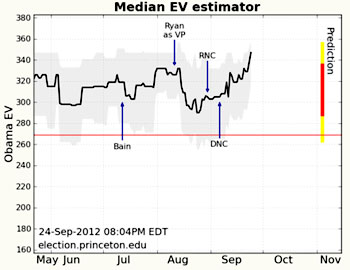
    Read the whole thing for more. At the moment, though, the race is pretty clearly Obama’s to lose. And Sam Wang agrees: his latest electoral vote forecast has Obama winning 347-191. Given all this, I’ll make two predictions of my own:

    • The mudslinging from the Romney campaign is going to get really, really nasty and desperate over the next few weeks.
    • The smart money is shortly going to start deserting Romney and focusing downballot instead. The conservative base never liked Romney all that much to begin with, and I don’t think it will take much for them to abandon him.

    Make your own predictions in comments!

  • National Reporters Should Learn to Be a Little Bit Ruder


    I was pretty unimpressed with the dueling 60 Minutes interviews with Mitt Romney and Barack Obama last night. Just for starters, any time a reporter vaguely summarizes what “your opponent” says and then asks, “How do you respond to that” — well, that deserves an immediate demotion to AA ball. It’s ridiculously amateurish. And yet, that was Steve Kroft’s very first question to Obama.

    But I guess you could write that off as a pet peeve of mine. So instead let’s take a look at a line of questioning that Scott Pelley used on Romney. This comes after he’s noted that Romney is eager to explain his tax rate cuts in detail, but not so eager to explain which tax deductions he wants to eliminate to make up for the cuts:

    Pelley: You’re asking the American people to hire you as president of the United States. They’d like to hear some specifics.

    Romney: Well, I can tell them specifically what my policy looks like. I will not raise taxes on middle income folks. I will not lower the share of taxes paid by high income individuals. And I will make sure that we bring down rates, we limit deductions and exemptions so we can keep the progressivity in the code, and we encourage growth in jobs.

    Pelley: And the devil’s in the details, though. What are we talking about, the mortgage deduction, the charitable deduction?

    Romney: The devil’s in the details. The angel is in the policy, which is creating more jobs.

    Pelley: You have heard the criticism, I’m sure, that your campaign can be vague about some things. And I wonder if this isn’t precisely one of those things?

    Pelley’s heart is in the right place, but come on. Romney has given this answer before. Pelley knew he was going to say this. So why not decide beforehand to get a little tougher? At the very least, suggest that Romney claims to be a leader, and the public has a right to know their leaders’ preferences even if no one expects them to get 100 percent of what they ask for. Or, since you know that Romney won’t say what he will ask for, try a series of questions that makes it plain what’s on the table. Maybe something like this:

    Pelley: Are there any deductions that you’re not willing to consider eliminating? For example the home mortgage deduction?

    Romney: Well, I’d want to consult with Congress….

    Pelley: How about the charitable deduction? Is that off the table?

    Romney: Nothing is off the table, Scott, but….

    Pelley: Would you be willing to consider eliminating the tax exemption for health care benefits?

    Romney: I’m willing to consider anything, but I don’t have a set list in mind….

    Pelley: Retirement income? State tax deductions? Are you open to eliminating any of these?

    I understand that Romney’s actual answers would be longer and more filibusterish than I’ve suggested, but there’s no law that says a reporter can’t interrupt if a candidate isn’t being responsive. One way or another, though, if you already know that Romney isn’t going to tell you what he will do, maybe you should at least try to get him on the record about what he won’t do. Would pressing him on deduction after deduction be a little bit rude? A little bit aggressive? Sure. But isn’t that what a 60 Minutes reporter should be?

    And before anyone asks, yes, this goes for the interview with Obama too. Kroft challenged Obama in some of the right general areas, but his questions were so broad and so timidly phrased that Obama didn’t even have to try hard to evade them. We learned almost nothing from either of these interviews.

  • We Know How to Fight a Financial Crisis. We Should Be Doing It.

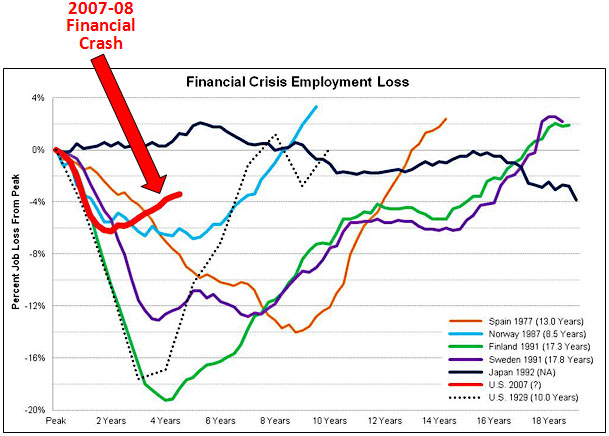
    Here’s an interesting chart from Josh Lerner (via Tim Duy). Instead of comparing the Great Recession to other postwar recessions in the U.S. (which have mostly been ordinary business cycle recessions), it compares the Great Recession to other financial crises. This is a better comparison since the 2007-08 crash wasn’t an ordinary business cycle recession. It was a financial crisis — and by that standard we haven’t done too badly. As Lerner says, this is almost certainly because “the strong policy response employed by nearly all major economies — both monetary and fiscal — helped stop the economic free fall.”

    We could, of course, have done even more, and we still could. And should. The fact that this recession was provoked by a financial crisis is a reason to respond more strongly, not an excuse to throw up our hands and pretend that we don’t have the tools to limit the damage.

  • Breaking: Republicans Like to Spend Lots of Money on the Military


    Stan Collender wants to shriek after reading a New York Times piece about George Allen:

    Former Virginia Governor and Senator George Allen…used to campaign as someone who would make the hard choices and cut spending, that is, as a fiscal conservative. But as [Jonathan] Weisman’s story definitively shows, Allen this year is campaigning against the $55 billion in military spending reductions that will occur if the sequester occurs as scheduled on January 2, 2013.

    I understand: Allen is running for office in Virginia where federal spending is very important to the economy. But the former proudly self-professed fiscal conservative is now trying to run to the left of the Democrat by insisting that he would not have made the hard choices after all and that not a penny of the sequester spending reductions for the Pentagon should go into effect.

    I’m not trying to pick on Stan here, but come on. Can we all stop pretending that we don’t know what Republicans have always stood for? They’ve always been the party of cutting spending but not on the military. They’ve always been the party of small government except on defense. They’ve always been the party of keeping the government out of your life unless the subject is more cops and drug warriors.

    Liberals endlessly try to score debating points on these topics, but it’s kind of silly. Allen isn’t running to the left. Republicans have always been the party of law and order and a strong military, and they’ve always been willing to spend lots of money on it. You can attack this as wrongheaded, but it’s not some kind of inexplicable hypocrisy. Republicans are opposed to social spending, not defense spending. Always have been, always will be.

  • In Most of the Country, the White Working Class Likes President Obama Just Fine

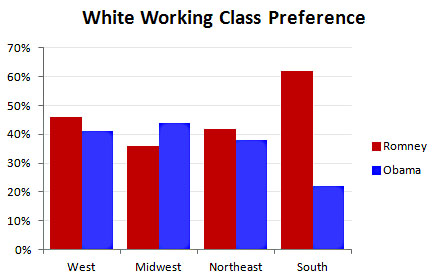
    John Sides points out an important result from a recent survey of the white working class: Democrats in general, and Obama in particular, don’t really have a huge “white working class problem.” What they have is a huge Southern problem.

    The chart on the right tells the story. In the West, Midwest, and Northeast, the white working class vote is fairly evenly split. Romney is slightly ahead in the West and Northeast, while Obama is slightly ahead in the Midwest. It’s only in the South that the white working class vote is overwhelmingly Republican, and this is what skews the national results, which show Romney ahead 48%-35%.

    This is a worthwhile corrective almost anytime you see a national result for any class of voters or any trend over the past 40 years. The massive shift of the Southern vote from Democratic to Republican is, by far, the biggest electoral change in the past few decades, and it often overwhelms national survey results. It’s something you should always at least think about when you read an article about big changes in the electorate: is this really a national change, or is it mostly driven by changes in the South? This is important not just academically, but because if it turns out to be primarily a Southern problem, the solution is going to be a lot different than if it’s truly a broad demographic shift.

    The rest of the survey is here, and it’s interesting throughout. It’s worth a read.

  • Letting the Bush Tax Cuts for the Rich Expire Won’t Hurt Job Growth

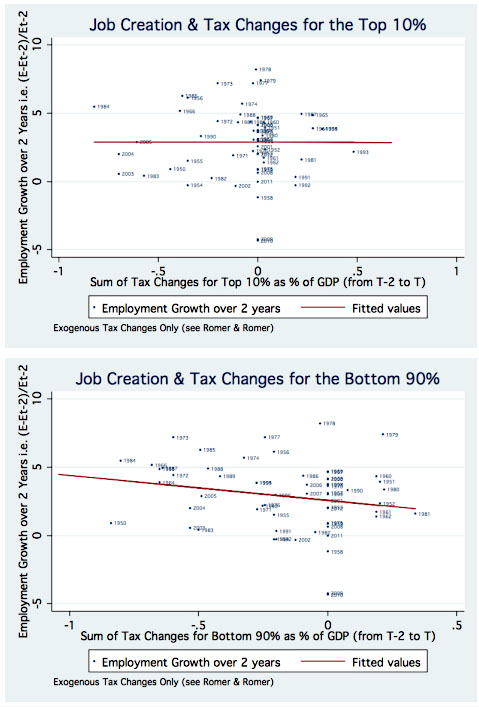
    Via Jared Bernstein, here’s an interesting study from Owen Zidar at UC Berkeley. He examines the conclusions of Romer and Romer that tax increases hurt job growth, and concludes that once you tease apart the effects of tax changes on the rich vs. tax changes on the middle class, it turns out that tax changes on the rich have essentially no effect on job growth:

    Figure 4 shows that there is not a relationship between tax changes for the top 10 percent and employment growth over a 2 year period. Overall, when considering all exogenous tax changes in the post-war period that went to the top 10 percent, the line that best ?ts the data is fairly ?at and insigni?cant.

    Figure 5, however, shows a substantially stronger relationship for the bottom 90 percent….Since tax changes for the top 10 percent are often correlated with tax changes for the bottom 90 percent [], the apparent slight relationship between tax changes for the top 10 percent and output growth seems to result from tax changes for the bottom 90 that have a stimulative e?ect and occur at the same time.

    The two charts below show Zidar’s results, and they’re of more than just academic interest. If Barack Obama wins reelection, he’ll have far more leverage to raise taxes on the rich than he’s had before, because he can simply let the Bush tax cuts expire completely and then go back to Congress in January and propose new tax cuts that include only the middle class. Republicans can refuse to pass them, but that’s a huge political loser since Obama will almost certainly be able to portray this as holding middle class tax cuts hostage to tax cuts for the GOP’s rich pals. That leaves only the usual tired top-marginal-rate-trickle-down economic argument, and Zidar’s results suggest that Obama doesn’t need to worry about that either. Eliminating the Bush tax cuts on the rich probably won’t affect job growth much at all.