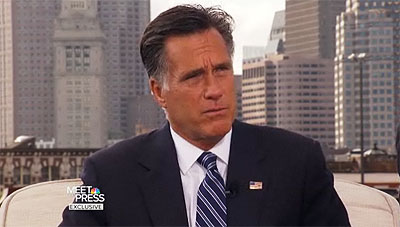
• Mitt Romney Unveils Yet Another Secret Plan

    Now that he’s definitively trailing in the polls and needs to appeal to non-wingnuts, it turns out that Mitt Romney doesn’t hate Obamacare quite as much as he’s been telling the tea partiers for the past year:

    “Of course there are a number of things that I like in health care reform that I’m going to put in place,” he said in an interview broadcast Sunday on NBC’s Meet the Press. ”One is to make sure that those with pre-existing conditions can get coverage.” Romney also said he would allow young adults to keep their coverage under their parents’ health-insurance.

    Under normal circumstances, I’d write a long post about how ridiculous this is. If you guarantee that people with preexisting conditions can get coverage, people will game the system by getting coverage only when they get sick. To avoid that, you have to create a stable risk pool for insurers by mandating that everyone maintain coverage all the time. And if you have a mandate, then you need to subsidize poor people, which in turn means you have to have a funding source for the subsidies. More here.

    Like I said, that’s what I’d do under normal circumstances. But host David Gregory didn’t bother asking Romney about any of these pesky details, and I guess I can hardly blame him since Romney wouldn’t have answered. This is just another one of Romney’s secret plans, like which tax loopholes he’ll close, how he’ll win the war in Afghanistan, and who will pay the price if Medicare costs rise faster than his growth cap. Romney has diligently refused to answer any of these questions, and he’s even been fairly honest about why: if he explained all this stuff, some of the answers would be unpopular and the Obama campaign would point that out.

    So that’s that: in Romneyland it’s ice cream sundaes all day long. And their plan to hit the gym to work off the calories? No need to worry your pretty little heads over that. They’ll tell you about it later.

    UPDATE: Unsurprisingly, a spokesman “clarified” Romney’s statement within hours. It turns out he doesn’t have any intention of making sure that people with preexisting conditions can get coverage after all. More here.
  • Obama is Apparently a Tougher Negotiator Than You Think

    I never have a good sense of how much to trust Bob Woodward, so I’d take the following recreated dialog with a grain of salt. Still, here it is. It’s all taking place at the tail end of last year’s debt ceiling talks, after John Boehner has pulled out of negotiations twice, House Republicans are loudly refusing any compromise at all and threatening to let the nation default, and the only GOP offer on the table would raise the debt ceiling for less than a year. If he agreed to it, President Obama would have to fight the same battle all over again in the middle of an election year:
    “So,” the president said, “if we give $1.2 trillion now in spending cuts” — the amount in the House bill to get the first increase in the debt ceiling for about six to nine months — “what happens next time?” The Republicans would then come back next year, in the middle of the presidential campaign, and impose more conditions on the next debt ceiling increase. He could not give the Republicans that kind of leverage, that kind of weapon. It was hostage taking. It was blackmail. “This will forever change the relationship between the presidency and the Congress.

    “Imagine if, when Nancy Pelosi had become speaker, she had said to George W. Bush, ‘End the Iraq war, or I’m going to cause a global financial crisis.’ ”

    So, Obama said, they had to break the Republicans on this. Otherwise, they would be back whenever it suited them politically.

    They were out of options, Geithner said. The only one might be accepting the House bill, loathsome as it might be. “The 2008 financial crisis will be seen as a minor blip if we default,” he said.

    The president said, “The Republicans are forcing the risk of a default on us. I can’t stop them from doing that. We can have the fight now, or we can have the fight later on, but the fight is coming to us.”

    So, no, Obama said, he was not going to cave. Period. He said good night, got up and left. He was very agitated.

    ….Obama never had to confront the veto question. A few days later, House Republicans dropped their insistence on the two-step plan. The final plan accepted a debt limit increase that would take the country through the 2012 presidential contest. It also postponed $2.4 trillion in spending cuts until early 2013.

    Interesting. If this is really how it all went down, Obama is a harder-nosed negotiator than most liberals have been giving him credit for.

  • Can Spain Get Competitive With Germany Fast Enough to Save the Euro?

    On Thursday I wrote that fiscal imbalances were the eurozone’s fundamental problem. In a nutshell, if the euro is going to survive, either periphery countries have to become more competitive and boost their exports or else core countries will have to subsidize them with gigantic amounts of aid pretty much forever. Unfortunately, neither of those options seems very likely.

    But James Wimberley says things might not be as bleak as I think. Spain is the current epicenter of Europe’s problems, and Gavyn Davies writes in the Financial Times that Spain’s labor costs have been converging toward the European average for the past three years and could become fully competitive within another couple of years. James says this actually understates the improvement Spain is making:

    Spain itself is part of the Euro average. So are the other countries in trouble: Greek and Irish labour costs have also shrunk, and Italian ones have plateaued. If you look at Spanish labour costs relative to the trade-surplus Euro core (France, Germany, Netherlands, etc) the improvement is even sharper.

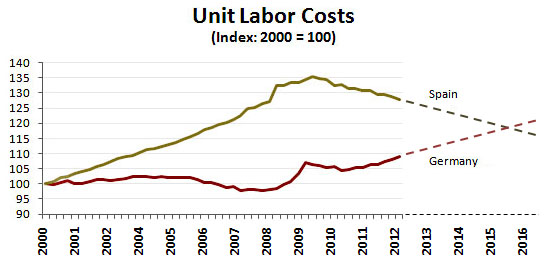
    I was curious about that, so I took a look at a simpler comparison: Spain vs. Germany. In this case, it turns out that convergence is more like three or four years away, not two:

    The main reason the chart begins in 2000 is because that’s when the data series starts, but it’s not a bad starting point anyway. 2000 is just before the big post-euro runup, and represents a time when Spain and Germany were fairly competitive with each other. If they can return to a point where they’re relatively as competitive as 2000, Spain could start digging itself out of its troubles and the euro could survive.

    But that’s a big if. It assumes no big shocks — like, say, Greece exiting the euro. It assumes that both Spain and Germany maintain their paths of the past three years. It assumes that the euro can survive three or four more years of fiscal imbalances. It assumes that austerity doesn’t destroy Spain’s economy completely. It assumes that being competitive with Germany is enough to make Spain competitive with the rest of the world too.

    That’s a lot of ifs, and it’s why I remain fairly pessimistic. Still, it goes to show that, outside of Greece, Europe’s problems may not be impossible. If Germany were willing to do something to accelerate convergence between the core and periphery, not just stay on the present path, and commit to gradually rising cross-country fiscal transfers, then better days might not even be all that far off. I’m not sure what the odds are of that, though.

  • Friday Cat Blogging – 7 September 2012

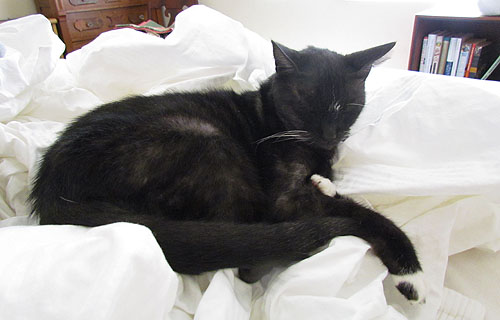
    Today’s catblogging demonstrates the changing of the guard around here. For many years, freshly laundered sheets were Inkblot’s exclusive preserve. In fact, the entire bed was his exclusive preserve. I guess he chased Domino off it once too many times. But that’s slowly changing, and Domino is now spending increasing amounts of time curled up at our feet. Last week, for the first time in years, she gingerly sidled up to a pile of lovely, warm sheets, twirled around a few times to get her bearings, and then promptly fell asleep.

    Today, however, she is being forced to take terrible, nasty, yucky little green pills. It’s for her own good, but she doesn’t believe us and she’s fighting pretty hard against the indignity of it all. It’s only going to get worse over the next ten days, and I’m hoping the vet tells us we can just crush them up and put them in her cat food. We’ll see.

  • Weird Republican Outrage Watch


    Andrew Sullivan just put up a post that happens to include a video of Marco Rubio making a joke a couple of years ago about a blizzard-induced power outage in Washington DC: “The president,” he said, “couldn’t find anywhere to set up a teleprompter to announce new taxes.” It got big yuks from the CPAC crowd.

    Anyway, this reminded me of something: Republicans sure have a lot of bizarrely puerile criticisms of President Obama, don’t they? I don’t mean big policy stuff. I’m not talking about death panels or EPA regulations or Dodd-Frank or any of that. I’m talking about things like this:

    • The endless outrage over his return of a Winston Churchill bust that the British government had loaned to George W. Bush.
    • The never-gets-old tittering over his use of a teleprompter.
    • The talk-radio jihad against the Chevy Volt.
    • The indignation over Michelle Obama’s effort to get kids to eat better.

    This stuff is just weird. I guess there must have been similarly juvenile stuff that animated liberals back when Bush was president, but what? Pretzel jokes?

  • Why Did the Labor Force Shrink So Much in August?


    From the LA Times today:

    The Labor Department said the jobless rate dropped over the month, to 8.1% from 8.3% in July, but that came as many people dropped out of the labor market. In a nation where the population is growing, a shrinking labor force suggests that many workers are giving up job searches because they are striking out in the employment market or don’t see good prospects.

    That’s what you’d think, all right. And yet, although the number of people not in the labor force shot up by about half a million in August, the number of “discouraged workers” didn’t budge. So what caused the labor force shrinkage?

    Beats me. But BLS data does suggest one thing: the shrinkage came almost entirely among those with a high school diploma or less. Among that group, the labor force shrank by 637,000. Among those with bachelor’s degrees, the labor force grew by 707,000. This is for workers 25 and older, so it has nothing to do with an influx of college students graduating this summer (and I’m using seasonally adjusted figures anyway).

    I’m not sure what this means. Maybe it’s just noise. Or maybe I’m not reading the data carefully enough — an occupational hazard among us amateurs. Still, something seems a little off here. Why did so many high school grads (and dropouts) leave the labor force?

  • Quote of the Day: How Does John Kerry Even Know Sarah Palin’s Name?


    From Sarah Palin, responding to a jab from John Kerry at the Democratic National Convention last night:

    I think he diminished himself by even mentioning my name. How does he even know my name? I mean aren’t these guys supposed to be these big wig elites who don’t waste their time on the little people like me — me representing the average American who, yeah I did say in Alaska you can see Russia from our land base and I was making the point that we are strategically located on the globe and when it comes to transportation corridors and resources that are shared and fought over [in] Alaska and I as the governor had known what I was doing in dealing with some international issues that had to do with our resources that could help secure the nation.

    Sorry. I couldn’t resist. This is just such vintage Palin. Word salad? Check. Palin as victim? Check. Average American? Check. Resentment of those highfalutin elites? Check. It’s all there.

  • Chart of the Day: Net New Jobs in August

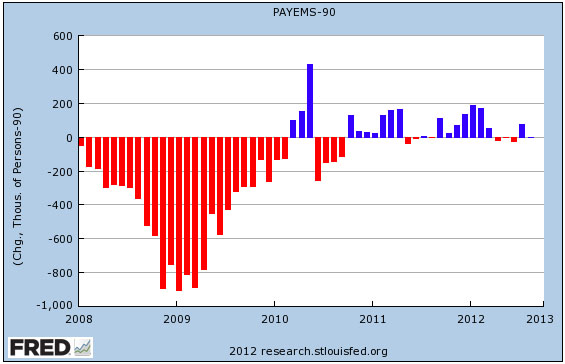
    The August jobs report is out, and it doesn’t have much good news. My usual monthly jobs chart is below: since the economy needs about 90,000 new jobs just to keep up with population growth, I subtract 90,000 from the raw jobs figures to show net new job creation. And what this shows is that we’re treading water: net job creation in August was basically zero. The initial June and July jobs numbers were also revised downward a bit.

    However, in a reversal of last month, when the headline unemployment number went up (from 8.22% to 8.25%) even though more people were working, this month the unemployment number went down (to 8.11%) even though the jobs data was flat. This is because about half a million people dropped out of the labor force. Oddly, though, this is not because they joined the ranks of discouraged workers. In fact, the number of discouraged workers was down a bit. Long-term unemployment was also down. So there are a few small glimmers of good news here. However, when you dig below the surface of the report it mostly stays pretty bleak. Overall, it looks a lot as if net job creation has slowed to nearly nothing in the past five months.

  • Is Fracking Good for the Environment?

    <a href="http://www.shutterstock.com/pic-52776991/stock-photo-land-drilling-rig-surround-by-paddy-field-in-china.html?src=2863b50c95ebaf5b90915a768f082269-1-13">zhuda</a>/Shutterstock

    Is increased production of natural gas from shale deposits good for the environment? At first glance, yes: natural gas releases less CO2 into the atmosphere than coal, so replacing coal-fired electrical plants with gas-fired plants is a win for global warming. And since fracking makes natural gas cheaper, it helps stimulate a switch from coal to gas.

    But wait: It turns out you also have to account for leakage. The problem is that natural gas is methane, a powerful greenhouse gas in its own right, and when you extract natural gas from shale formations, some of it inevitably leaks out. That’s decidedly bad for global warming. But David McCabe, an atmospheric scientist at the Clean Air Task Force, reports that the news is fairly good on this front: “From the best of the collective work, we believe that burning natural gas for electricity produces about 30-50% less greenhouse gas than burning coal, even accounting for the emissions of methane (and carbon dioxide) from producing and transporting the natural gas.”

    Unfortunately, the story doesn’t stop there, and it gets a lot grimmer as you dig deeper. The problem is simple: If you make something cheaper, people will use more of it. In the case of natural gas, this is fine as long as people are using more of it as a substitute for coal. But that accounts for only a small fraction of natural gas usage:

    Less than a third of natural gas is used for electrical generation. Cheap gas will mean more consumption by buildings, industry, and perhaps for transportation. In many of these sectors, cheap gas won’t edge out coal or any other fuel. We’ll just burn more of it.

    So when you make natural gas cheaper, there’s a net benefit from the one-third of it that squeezes out coal but a net loss from the two-thirds that simply represents higher consumption of natural gas. What’s worse, even in the power generation market there are tradeoffs:
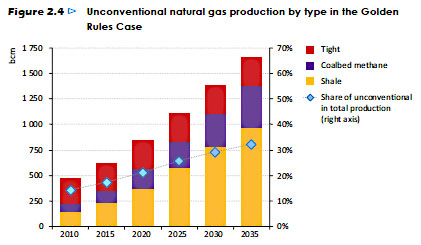
    Cheap shale gas will also make electricity cheaper, increasing consumption, which will chip away at the emission reduction from switching from coal to gas…Quantifying all this requires modeling the effect of unconventional gas on energy markets and emissions, which the International Energy Agency (IEA) recently did. Their report predicts that if these gas resources are widely exploited, globally, CO2 emissions in 2035 will only drop by 1.3%.

    …In short, if we assume current policies, shale gas is almost a wash for global CO2, and methane will decrease or eliminate any small climate benefits of shale gas. If cheap shale gas crowds out renewables or increases energy demand more than IEA predicts, or methane leaks are worse than we think, cheap shale gas will actually hasten climate emissions, even in the short term (2035).

    Via email, McCabe tells me that the most important factor in the IEA model is crowding out: Cheap shale gas will reduce coal usage (good) but will also reduce development of new nuclear, wind, and solar power (bad). So this is your bad climate news for the day—to go along with shrinking Arctic ice, extreme weather, killer droughts, more wildfires, and monsoons increasingly inundating low-lying areas. Natural gas fracking may be good for North Dakota, but the evidence suggests that, in the end, it won’t do much of anything to rein in climate change.

    However, let’s end on a positive note. McCabe (and the IEA) come to their bleak conclusion only “if we assume current policies.” But those policies aren’t written on stone tablets. The IEA has a longish set of “Golden Rules” that could make fracking a better environmental bet, and McCabe highlights the two most important of them: (1) Eliminate leaks completely from the natural gas production process, and (2) use carbon sequestration to substantially reduce carbon emissions from gas-fired electrical plants. If we really are going to drill, baby, drill—and all the evidence suggests we are—these two things should become our touchstones for doing it responsibly.

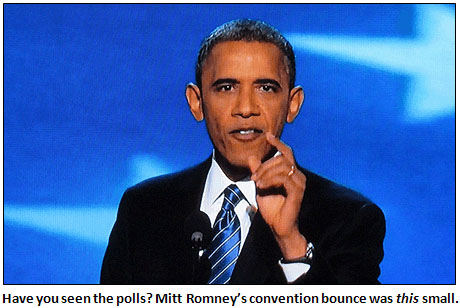
  • Did Obama Phone It In?

    Barack Obama’s speech tonight was….OK. But that was about all. It meandered, it skittered, and most of the time it seemed oddly themeless. It had some good lines, but too often they were left hanging. Take this jab at Republicans, for example:

    They want your vote, but they don’t want you to know their plan. And that’s because all they have to offer is the same prescription they’ve had for the last thirty years:

    “Have a surplus? Try a tax cut.”

    “Deficit too high? Try another.”

    “Feel a cold coming on? Take two tax cuts, roll back some regulations, and call us in the morning!”

    That’s a good riff. But it came early in the speech, and after a couple of pro forma sentences about tax cuts for millionaires (he’s against them) Obama was off on an entirely unrelated riff about common effort, shared responsibility, and bold, persistent experimentation. Then he was off to the car industry. Then energy. Then a throwaway line about global warming. And all of these riffs were just that: short collections of platitudes with no real meat behind them and no promise of what a second term might bring. Here’s the best he could do on deficit reduction:

    Now, I’m still eager to reach an agreement based on the principles of my bipartisan debt commission [Simpson-Bowles]. No party has a monopoly on wisdom. No democracy works without compromise. I want to get this done, and we can get it done. But when Governor Romney and his friends in Congress tell us we can somehow lower our deficits by spending trillions more on new tax breaks for the wealthy, well, what’d Bill Clinton call it? You do the arithmetic, you do the math.

    I refuse to go along with that. And as long as I’m President, I never will. I refuse to ask middle class families to give up their deductions for owning a home or raising their kids just to pay for another millionaire’s tax cut. I refuse to ask students to pay more for college; or kick children out of Head Start programs, to eliminate health insurance for millions of Americans who are poor, and elderly, or disabled, all so those with the most can pay less.

    That’s a workmanlike statement. It checks the right boxes. Like the rest of the speech, it got the job done. But I didn’t feel any real passion in the delivery. It felt more like an actor soldiering through his lines.

    Overall, it was a decent wrapup. It was a decent defense of his first term. It was a decent appeal for votes. But there was nothing memorable, nothing forward looking, and nothing that drew a contrast with Romney in sharp, gut-level strokes. Obama was, to be charitable, no more than the third best of the Democratic convention’s prime time speakers in 2012.