• Tampa vs. Charlotte: What We Care About


    Dylan Matthews writes about the big difference between Tampa and Charlotte:

    We’re two nights into the Democratic National Convention, and the themes could not be more distinct from those championed at the RNC last week. Whereas the RNC heavily emphasized the role of personal initiative in economic success, the DNC’s speakers have focused on the many barriers that keep success away from even determined, hard-working Americans.

    I was thinking about this exact thing last night, and what I was thinking is that it’s a shame. It’s a shame that Republicans think they have to extol personal initiative to the exclusion of all else, and it’s a shame that Democrats feel the same way about the value of collective action and real opportunity for all.

    I understand why this happens. Republicans feel that personal initiative is under such withering attack from liberals that they need to fight back with no quarter given and no ground conceded. Democrats feel the same way.

    There are lots of topics that display the same dynamic. Hell, maybe most of them. But it seems more corrosive than usual in this case, because it does real damage when we disparage either of these things. Personal initiative and personal responsibility really are vitally important, and we should take every opportunity to encourage and praise them. I’ve known plenty of people who have started and run businesses of their own, and they work their asses off and take plenty of personal risks along the way. It’s not an easy road.

    Likewise, lots of people, through no real fault of their own, really don’t have much of a chance in life. Those of us who do should always be keenly aware of just how lucky we are and just how much we’ve benefited not just from friends and family, but from things like clean water, decent healthcare, roads and bridges, public schools and universities, food that’s free of contamination, government-sponsored basic research, public order, and, eventually, retirement security.

    Reverence for personal initiative without a sense of what you’ve gotten from others produces too much petty arrogance and unfeeling entitlement. Concern for equal opportunity and community support without a healthy respect for personal initiative produces too much lassitude and bitterness.

    This is a case where we truly don’t want either side to win — and not out of some misplaced sense of mindless centrism. We really do have to value both, not just pay lip service to them.

    Barack Obama is one of the best at bridging these two worlds. It’s too bad there aren’t more like him.

  • The Eurozone Is Still Doomed, Isn’t It?

    The stock market, a bit to my surprise, has reacted euphorically to today’s official announcement that the European Central Bank will begin unlimited purchases of government bonds from economically depressed countries in the eurozone (though this policy applies only to countries that behave themselves and abide by Germany’s austerity dictates — see yesterday’s post for more on this). This is, of course, not the first time the euro has been rescued. We’ve been treated to a long procession of similar announcements before, and I frankly thought that investors had grown a little more jaded toward them by now. But apparently not. They still want to believe.
    I’ve written enough about the eurozone’s problems in the past that I’m not really in the mood for another long post on the subject of Europe’s currency woes. Instead I’ll do a short one and see if anyone tells me I’m wrong. Start with the following axiom:

    You can’t maintain persistent capital flow imbalances in a fixed exchange rate area.

    This is Europe’s fundamental problem. For years, capital has flowed out of the core (Germany etc.) and into the periphery (Greece, Spain, etc.), and this can’t keep up forever. Basically, one of three things has to happen eventually:

    1. The fixed exchange rate area breaks up. In other words, Europe abandons the euro, the periphery countries readopt their old national currencies, and then promptly devalue them.
    2. The capital flow imbalances have to stop and turn around. This would require that Germany start running a trade deficit and the periphery countries start running trade surpluses.
    3. The capital flow imbalances have to be institutionalized permanently. This can happen either via permanent fiscal transfers from core to periphery (similar to the way the United States maintains permanent fiscal transfers from rich states to poorer states) or via central bank bailouts.

    Let’s take these one by one. European leaders swear on their mothers’ graves that #1 won’t happen. They say the euro is “irreversible.” There’s no sign at all that #2 will happen either. Germany has shown no willingness to abandon its cherished trade surplus, no willingness to tolerate higher inflation, and no willingness to pursue any other course that falls under the general rubric of “internal devaluation.” And option #3 is off the table too. Europe’s rich countries have demonstrated no desire to permanently subsidize their poorer neighbors, and their voters would revolt if they tried — something that’s pretty understandable given the vast sums that would probably be required. Likewise, on the central bank front, today’s ECB action is a temporary measure. No one thinks they can (or should) keep it up forever.

    So we’re in the same place we’ve always been. Either the eurozone breaks up or else capital flows between the core and the periphery have to be reversed. The former is supposedly off the table and the latter is politically impossible. So what gives first?

    My guess is: the eurozone. That seems to be what Wall Street increasingly believes, too. Unless I’m missing something, of course. Am I?

  • Mitt Romney’s Amazing Negative Convention Bounce

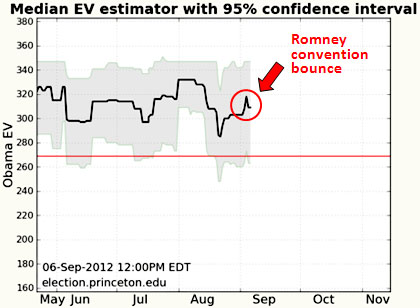
    I thought I’d check in with Sam Wang today to see what he thought about Romney’s convention bounce, and the news for Republicans isn’t good. Not only does he think they got no bounce, he thinks they probably got a negative bounce. In terms of electoral votes, he figures they lost a bit, then gained a bit, and ended up about 10 EV short of where they started:

    Fow what it’s worth, I’d attribute this partly to a weak convention — Hurricane Isaac, mediocre speeches, Paul Ryan getting a little too carried away with his deceptive claims, Clint Eastwood stealing the limelight from Romney — but mostly to the fact that we simply have a very divided electorate these days, and conventions aren’t likely to change too many minds. Add to that the fact that ad campaigns on both sides started running at gale force levels back in May, and the two candidates were pretty well defined long before Romney took the stage in Tampa. My guess is that Democrats will do a little better simply because they have better speakers and are running a tighter convention, but I doubt they’re going to see much of a bounce either. We’ll know by next week.

  • It’s Time to End the Baseline Games


    Comparing different plans to reduce the deficit is maddeningly difficult. This is because any proper comparison between two plans has to be done against the same baseline — and as soon as you say the word “baseline,” you might as well just pack up your bags and go home. You are doomed to a funhouse spiral into insanity as you try disentangle how much Obama’s cuts vs. Obama’s baseline matches up to Paul Ryan’s cuts vs. Paul Ryan’s baseline.

    For example: if the Bush tax cuts are extended, they’ll cost about $4 trillion over the next decade. So if your baseline assumes they get extended, then you can claim $4 trillion in deficit reduction by allowing them to expire. However, by current law they’re going to expire on December 31. If you take that as your baseline, you can’t claim any deficit reduction at all by allowing them to expire.

    There’s a sense — a very big sense — in which this is ridiculous. Who cares what the baseline is? The Bush tax cuts will cost $4 trillion one way or the other. That’s the price tag for keeping them, and it’s the savings for letting them expire. All that matters is one simple thing: what would the deficit be in, say, 2017 if your proposals were enacted? That’s it.

    But Ezra Klein, in an aside to a longer post, very succinctly explains one of the reasons this stuff gets so many people so animated:

    People prefer “tough” cuts to cuts they think are easy (though the cuts in question are rarely tough on the people analyzing them). So they give a lot more credit to, say, raising the Medicare eligibility age, as that hurts seniors, than to officially drawing down the war spending, or cutting interest payments, or banking the results of a deal. But the deficit doesn’t care how much the cuts hurt. It’s all about the bottom-line number.

    It’s sort of pathological, really. If you save money, you save money. Who cares if you go after the low-hanging fruit first? Nobody should, and yet they do. If your proposed savings aren’t something that’s likely to concretely hurt someone, they’re somehow unserious. Raising the Medicare eligibility age is a real cut; reducing reimbursements to hospitals isn’t. Block-granting Medicaid is a real cut; ending the war in Afghanistan isn’t. Slashing NIH funding is a real cut; reinstating PAYGO isn’t.

    But it’s not so. None of us should put up with baseline games anymore. Just show us the proposal and show us what the effect will be in five or ten years down the road. Period. That’s all that matters. And if you can meet your goal without harming too many people in the process? That should be a point in your favor, no?

  • Romney Doesn’t Just Want to Cut Medicare, He Wants to Cut Medicaid Too

    Lots of healthcare wonks have been beating the drums to focus a little more attention on Mitt Romney’s proposed cuts to Medicaid, which acts as an indispensable backstop to Medicare. Last night, Bill Clinton went there:

    Now, folks, this is serious, because it gets worse. And you won’t be laughing when I finish telling you this. They also want to block-grant Medicaid, and cut it by a third over the coming 10 years.

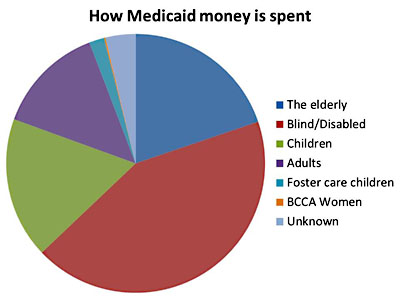
    Of course, that’s going to really hurt a lot of poor kids. But that’s not all. Lot of folks don’t know it, but nearly two-thirds of Medicaid is spent on nursing home care for Medicare seniors who are eligible for Medicaid.

    It’s going to end Medicare as we know it. And a lot of that money is also spent to help people with disabilities, including a lot of middle-class families whose kids have Down’s syndrome or autism or other severe conditions. And honestly, let’s think about it, if that happens, I don’t know what those families are going to do.

    Clinton’s specific number is apparently wrong. According to Sarah Kliff, about 40% of Medicaid dollars are spent on nursing home care for seniors, not two-thirds. But Clinton’s primary point remains true: at the same time that Romney/Ryan would squeeze Medicare, they’d also squeeze the very program that takes care of the elderly who’d be hardest hit by the cuts. This backstopping function is one reason that Medicaid is a surprisingly popular program: it doesn’t just help the poor, it also helps the elderly and the disabled, and is therefore a lifeline for a lot of middle-class families. It’s worth making a little more noise about.

  • Bill Clinton Wows ‘Em in Charlotte

    It’s hard to judge convention speeches when you’re a partisan yourself, but it sure seems as if Democrats have the better of things this year on the rhetorical front. Yesterday Michelle Obama gave probably the best speech a first lady has given since Eleanor Roosevelt, and tonight Bill Clinton gave one of the best speeches he’s ever given. That’s a pretty high bar.

    It went long, of course. It was Bill Clinton, after all. But I’ll bet the viewing audience loved it. And he sure seemed to be having a great time. He went after Republicans about as hard as anyone has done yet, but he did it with a smile and a real sense of joy at being in the arena. Like this:

    In Tampa—did y’all watch their convention? I did. In Tampa, the Republican argument against the president’s reelection was actually pretty simple—pretty snappy. It went something like this: We left him a total mess. He hasn’t cleaned it up fast enough. So fire him and put us back in.

    Later he went after Romney and Ryan on Medicare, making no personal attacks but eviscerating them nonetheless:

    Now, there were two other attacks on the president in Tampa I think deserve an answer. First, both Gov. Romney and Congressman Ryan attacked the president for allegedly robbing Medicare of $716 billion…Look, here’s what really happened. You be the judge. Here’s what really happened. There were no cuts to benefits at all. None. What the president did was to save money by taking the recommendations of a commission of professionals to cut unwarranted subsidies to providers and insurance companies that were not making people healthier and were not necessary to get the providers to provide the service.

    …Now, when Congressman Ryan looked into that TV camera and attacked President Obama’s Medicare savings as, quote, the biggest, coldest power play, I didn’t know whether to laugh or cry—because that $716 billion is exactly, to the dollar, the same amount of Medicare savings that he has in his own budget. You got to get one thing—it takes some brass to attack a guy for doing what you did.

    And welfare reform:

    Let’s look at the other big charge the Republicans made. It’s a real doozy. They actually have charged and run ads saying that President Obama wants to weaken the work requirements in the welfare reform bill I signed that moved millions of people from welfare to work. Wait, you need to know, here’s what happened. Nobody ever tells you what really happened — here’s what happened.

    When some Republican governors asked if they could have waivers to try new ways to put people on welfare back to work, the Obama administration listened…And the administration agreed to give waivers to those governors and others only if they had a credible plan to increase employment by 20 percent, and they could keep the waivers only if they did increase employment. Now, did I make myself clear? The requirement was for more work, not less.

    …I am telling you the claim that President Obama weakened welfare reform’s work requirement is just not true. But they keep on running the ads claiming it. You want to know why? Their campaign pollster said, we are not going to let our campaign be dictated by fact-checkers. Now, finally I can say, that is true. I couldn’t have said it better myself.

    The whole thing was vintage Clinton. There was plenty of detail in the speech, but it was all delivered with a wink and a chuckle while he stuck in the shiv. Republicans will dutifully attack back, but really, most of them are probably just shaking their heads and wishing they had someone like him in their party.

  • Obama’s Rescue of the Auto Industry Starts to Pay Off


    Speaking of things that President Obama doesn’t get enough credit for:

    Total auto sales for the month were just under 1.3 million, 19.9% higher than a year earlier. That would put the annual pace at 14.5 million vehicles, the best of any month since the federal “cash for clunkers” economic stimulus program in August 2009 and a rate 2 million vehicles ahead of August 2011’s.

    ….Fuel-efficient vehicles were especially good sellers as gas prices neared or crossed $4 a gallon in much of the nation. Sales of Toyota’s Prius hybrid more than doubled to more than 21,000 vehicles….General Motors Co. said its Chevrolet passenger car sales jumped 25%, with gas sippers such as the Spark, Sonic, Cruze and Volt plug-in hybrid all posting their best-ever monthly sales.

    I won’t pretend to know whether GM and Chrysler can survive in the long run. Probably not. But then, you know what they say about the long run, don’t you?

    Conversely, in the here-and-now, the Obama administration’s surprisingly dextrous rescue of GM and Chrysler saved upwards of a million American jobs and prevented the economy from tumbling even further toward the abyss than it did. Entire regions of the country would probably be in economic devastation today if Obama hadn’t acted as he did.

    But he did, against the opposition of nearly the entire Republican Party. The Big Three all have at least a fighting chance at long-term survival, a million workers still have jobs, and the economy is starting to recover. Not bad.

  • Deval Patrick Tells Liberals Obama’s Been a Pretty Damn Good President

    I didn’t catch Deval Patrick’s speech last night, but I’m reliably informed that it was a barnburner. And like Michelle Obama, he very directly addressed liberals who feel disappointed in Obama’s first term and unmotivated to work hard for his reelection:

    If we want to win elections in November and keep our country moving forward, if we want to earn the privilege to lead, my message is this: it’s time for Democrats to grow a backbone and stand up for what we believe. Quit waiting for pundits or polls or super PACs to tell us who the next president or senator or congressman is going to be. We’re Americans. We shape our own future.

    Let’s all start by standing up for President Barack Obama. This is the president who delivered the security of affordable health care to every single American in every corner of this country after 90 years of trying. This is the president who brought Osama bin Laden to justice, who ended the war in Iraq, and is ending the war in Afghanistan. This is the president who ended “Don’t Ask, Don’t Tell” so that love of country, not love of another, determines fitness for service. Who made equal pay for equal work the law of the land. This is the president who saved the American auto industry from extinction, the American financial industry from self-destruction, the American economy from full-blown depression. Who added 4.5 million private sector jobs in the last two-and-a-half years, more than in George Bush’s eight years in office.

    The list of accomplishments is long, impressive and barely told—and even more impressive when you consider that congressional Republicans have made obstruction itself the centerpiece of their governing strategy. With a record like that and a vision that hopeful and powerful, I for one will not stand by and let him be bullied out of office—and neither should you.

    It’s true: by ordinary human standards, as opposed to the weird celestial standards some liberals measure him by, Obama has had a damn impressive presidency. Frankly, Republicans whose heads have exploded over Obama’s supposed radicalism are probably closer to the truth than disaffected liberals who think it’s all been a bunch of meh and that a second term will just be more meh. What’s more, there’s the flip side of this: even if you think a second Obama term wouldn’t accomplish much, a first Romney term almost certainly would. Here are a few examples:

    • Obamacare will be effectively repealed.
    • Tax rates will be lowered. Offsetting closure of loopholes will probably never happen, which means the deficit will increase.
    • A fifth conservative might very well be appointed to the Supreme Court, dooming Roe v. Wade at exactly the time that Republican-dominated states have become feverishly committed to banning abortion completely.
    • National security policy probably won’t change much. Romney will continue Obama’s policies just as Obama continued Bush’s.
    • Social spending will be cut substantially. This can be done via reconciliation, so all it requires is 50 votes in the Senate, which Romney has a good chance of getting.
    • “Drill, baby, drill” will become the official energy policy of the United States.

    If DADT repeal, passage of ACA, financial reform, killing Osama, saving the auto industry, and all the rest aren’t enough to get liberals excited — and if they’re still not enough in the face of what a Romney presidency would almost certainly bring us — then I’m stumped. You’re living in some fantasy world of wishes and ponies that I’m not familiar with. Here in the real world, that’s a helluva record and a helluva contrast.

  • Blame Germany for European Austerity Measures, Not Mario Draghi

    Mario Draghi, head of the European Central Bank, has apparently decided to shore up Europe’s weak peripheral economies (Italy, Spain, Portugal) via large-scale purchases of their bonds. This should help to restore investor confidence, prevent interest rates from spiraling out of control, and keep debt service levels tolerable in the affected countries. Dylan Matthews explains more:
    Draghi is announcing his next move tomorrow, and sources inside the ECB say he’ll buy up unlimited amounts of Spanish and Italian debt. But there are catches….The biggest catch [] is that Draghi won’t buy up debt from countries that don’t abide by the euro zone’s new budget rules, which limit deficits to 3 percent of GDP, and “structural” deficits (that is, those not caused by lackluster growth) to 0.5 percent, or 1 percent for countries with a small debt burden. If states don’t meet those standards after he’s bought their debt, he’ll sell it. To be blunt: Spain is not going to meet those standards. This year, it’s on track for a 6.3 percent of GDP deficit, almost double the target. It must either start growing much faster, or institute draconian austerity measures that will cripple growth.

    Matt Yglesias is not amused:

    What the ECB is doing, in essence, is setting itself up as the shadow government of Italy, Spain, Portugal, and perhaps Ireland. If the governments of those countries do what Draghi wants, Draghi will provide them with generous subsidy. If the governments of those countries don’t do what Draghi wants, he’ll use a monetary laser to destroy their budgets. Fear will keep the peripheral states in line.

    True enough. My only disagreement here is with the assumption that this is Draghi’s doing. The ECB is nominally independent, but in reality everyone knows that it lives and dies on sufferance of the German government. Draghi’s policy came about only after a great deal of backroom horsetrading, with the Germans eventually agreeing to it — or at least agreeing not to oppose it too strongly — only on condition that the target countries meet their austerity targets. This is indeed self-destructive, but if I had to guess, the real people to blame for this are Angela Merkel and Jens Weidmann, not Mario Draghi.

  • Making Money the Old-Fashioned Way: By Looting It

    Matt Taibbi has a big cover story in the current issue of Rolling Stone that’s all about the Bain Capital business model. As you might guess, Taibbi is a wee bit critical. Dan Primack offers an assessment of Taibbi’s piece here, and spends a few words responding to Taibbi’s disgust with “dividend recaps”:

    TAIBBI: In the Bain model, the actual turnaround isn’t necessary. It’s just a cover story. It’s nice for the private equity firm if it happens, because it makes the acquired company more attractive for resale or an IPO. But it’s mostly irrelevant to the success of the takeover model, where huge cash returns are extracted whether the captured firm thrives or not.

    PRIMACK: This just isn’t true. The reference here is to dividend recaps, a noxious private equity practice through which firms can actually generate profits off of investments in portfolio companies that later go bankrupt. But the reality is that, for the most part, dividend recaps alone do not generate the types of returns that bring limited partners back for follow-on funds. Moreover, too many post-recap failures and banks are unlikely to make new loans to fund a private equity firm’s future deals (original LBOs or recaps). In other words, the more legitimate wins matter, so long as the private equity firm wants to stick around.

    I would very much like for someone to devote an entire deep dive to this specific issue. Dividend recaps, which Primack agrees are “noxious,” are basically a way for private equity firms to suck money out of a company long before they’re turned it around. Basically, they force the target firm to take on a huge debt load (sometimes more than once) and then use a chunk of the borrowed money to pay dividends back to the private equity investors. Bain Capital did this fairly aggressively in at least a few cases, which allowed them to avoid big losses even on companies that eventually failed.

    I think that Primack’s criticism of Taibbi is basically right: dividend recaps aren’t the primary way that PE firms make money from the companies they take over. The bulk of their profits come from successful turnarounds. At the same time, I suspect that Primack is underplaying the important of dividend recaps. What they do is limit losses on failed acquisitions. If you buy ten companies, and end up with five successes and five failures, you’ll make money, but perhaps not spectacular amounts of money. However, if you buy ten companies and end up with five successes and five breakevens, thanks to the dividends you extracted from the target firms, your rate of return will be a lot higher. It might be the difference between a 10% rate of return and a 30% rate of return.

    At least, that’s my sense of things. But I’d love for someone to write a really detailed piece about this, with particular attention to how aggressively Bain Capital engaged in dividend recaps and how critical they’ve been to its success. This Reuters piece from January is a start, but it’s only about one particular deal. It would be interesting to know just how widespread this practice was and how big a difference it made to Bain’s bottom line.