• Quote of the Day: “The Assumption Was That, Um, the, the, Ah”


    Earlier this morning I wrote that it’s true that Obamacare reduces spending on Medicare. However, it’s also true that the most recent version of Paul Ryan’s budget proposed keeping those exact same cuts. Via Steve Benen, House Majority Leader Eric Cantor offered the following immortal comment when he was asked how to square this with Ryan’s current attacks:

    Asked about the inconsistency of Ryan attacking cuts his own plan embraced, Cantor begged off. “The assumption was that, um, the, the, ah, again — I probably can’t speak to that in an exact way so I better just not,” he said.

    Yeah, I’d beg off too. Even Ryan himself, when he was asked about this, was forced to retreat into some word salad about baselines and the sun being in his eyes and it all being the fault of that tricksy Obama. There’s just no good answer here.

  • Why Simple is Better for Old-Age Insurance Programs

    Matt Yglesias on one reason that it’s probably not a good idea to turn Medicare into a voucher program:

    We all know that some cognitive impairment tends to be a part of the aging process….That’s why elder fraud is a recognized problem. A great study by David Labison finds that about half of 80-somethings have “significant cognitive impairment, effectively rendering them incapable of making important financial choices.”

    ….[This is one of the problems] with the Romney/Ryan plan to replace Medicare with a system of subsidies for the purchase of private health insurance on regulated exchanges. This is essentially the same idea as what ObamaCare will do for the non-elderly, but in the opposite direction. In the case of the Affordable Care Act, it’s not clear to me that there are sound non-political reasons for doing it this way rather than constructing a single public program. But in the case of a program targeted at the elderly, the case for consumer sovereignty is clearly weaker. Insurance forms are confusing, and calculating the real actuarial value of different offers is difficult. This is not an ideal task to assign to a 92 year-old. It’s possible to make it work with adequate regulation, but you really are counting on building a very effective regulatory agency to manage the program. So why not just build an effective agency and manage Medicare?

    If private competition among insurance companies were truly likely to lead to substantial cost reductions, it might be worth doing this regardless. But the evidence we have suggests that competitive bidding, at best, would lead only to modest savings. The reason is simple: The high cost of healthcare in America is mostly related to the high prices we pay to providers — hospitals, doctors, drug companies, device manufacturers, etc. — and only slightly related to insurance company efficiency. There’s just not much reason to think that competition among insurance companies will have a big effect on provider prices.

    It might still be worth trying. That’s a judgment call. But everyone should understand both the tradeoffs and the likelihood that, at most, it will produce only modest savings.

  • Paying for Obamacare


    A couple of nights ago Bob Somerby watched the folks on MSNBC discussing the Ryan/Romney charge that Democrats “funneled” $716 billion out of Medicare to pay for Obamacare. He was unhappy with the liberal response:

    On Wednesday, Rachel Maddow asked Ezra Klein to clear up all the confusion….But uh-oh! Like his blog-mate Sarah Kliff, Klein largely repeated Romney’s Medicare charges—restated those charges in his own voice!

    ….Go ahead—ask yourself this: At any point, does Klein make a clear, concise statement about what Ryan said that was wrong? No such statement ever occurs in this wandering ballad. Instead, Klein throws a bewildering array of figures and claims into a very thick stew.

    The problem here is simple: there is no silver bullet liberal response to Ryan’s Medicare charges. This is because, rhetorical excesses aside, his charges are basically correct.

    Unlike most Republican programs of the Bush era, Obamacare is fully paid for — as Obama himself has boasted repeatedly. This was an act of political courage for which Democrats deserve credit, but it was only courageous because it has a downside. And the downside is that the money to pay for Obamacare had to come from somewhere. In the end, most of it came from two places: (1) an assortment of modest tax increases, and (2) an assortment of modest spending reductions on Medicare.

    There’s really no way around this: Planned spending on Medicare was reduced, and the savings were applied to Obamacare. These savings came from cutting payments to hospitals and insurance companies, not from cutting benefits to seniors, but it’s still perfectly defensible for conservatives to argue that the spending reductions may eventually lead to service or quality cuts in Medicare. There are some strong arguments that this won’t happen, but they’re hardly bulletproof.

    So do liberal responses to Ryan’s charges seem muddled? Of course they do. That’s because people like Ezra don’t like to flatly lie about this stuff, which is the only way to construct a clear and simple rebuttal. Instead, liberal wonks have to explain where the spending reductions came from and why they aren’t likely to have a substantial effect on Medicare beneficiaries. But no matter how you do that — and I agree that we should probably have crisper replies than we do — you’re implicitly acknowledging Ryan’s point that money which would have been spent on Medicare is now going to be spent instead on Obamacare.

    The best response, I suppose, is to either evade the question entirely (the pol’s approach) or to keep things very, very short and simple. For example: “There were no cuts to Medicare benefits. President Obama is dedicated to making Medicare more efficient, and to do that he cut bloated payments to hospitals and big insurance companies. Why does Mitt Romney want to give that money back?” And then move on.

    But the one thing you can’t do is pretend that money wasn’t taken from Medicare to help pay for Obamacare. It was.

  • Bernanke Warns Congress to Stop Stalling on Economy

    In his big speech at Jackson Hole today, Ben Bernanke said that today’s weak economy was due not to structural factors, as some conservatives continue to argue, but is “being held back currently by a number of headwinds”:

    First, although the housing sector has shown signs of improvement, housing activity remains at low levels and is contributing much less to the recovery than would normally be expected at this stage of the cycle.

    Second, fiscal policy, at both the federal and state and local levels, has become an important headwind for the pace of economic growth. Notwithstanding some recent improvement in tax revenues, state and local governments still face tight budget situations and continue to cut real spending and employment.

    …Third, stresses in credit and financial markets continue to restrain the economy. Earlier in the recovery, limited credit availability was an important factor holding back growth, and tight borrowing conditions for some potential homebuyers and small businesses remain a problem today.

    So does this mean that he thinks additional action is necessary? The unwritten rules of being Fed chair say that he can’t just come right out and say this, but he came pretty close:

    Monetary policy cannot achieve by itself what a broader and more balanced set of economic policies might achieve…The stagnation of the labor market in particular is a grave concern not only because of the enormous suffering and waste of human talent it entails, but also because persistently high levels of unemployment will wreak structural damage on our economy that could last for many years.

    …Taking due account of the uncertainties and limits of its policy tools, the Federal Reserve will provide additional policy accommodation as needed to promote a stronger economic recovery and sustained improvement in labor market conditions in a context of price stability.

    The truth is that Bernanke has been saying this for a long time. Today he’s saying it a little more plainly: The economy is still weak; the weakness is mostly cyclical, not structural; that means we can do something about it; that “something” should include both fiscal and monetary action; and if we continue stalling we run the risk that our problems really will become structural and nearly impossible to solve.

    In other words, he’s telling Congress to quit being so stingy because tight budgets are holding back the recovery, and he’s telling his fellow Fed members to stop making excuses and agree to additional monetary easing. Neither one is as effective by itself as they would be together.

  • Paul Ryan’s Grim Vision for America

    Pete Marovich/Zuma

    It’s a struggle to truly explain Paul Ryan. He seems so reasonable. Why, in his speech on Wednesday, he told his audience about all the tough choices ahead but then added, “We have responsibilities, one to another—we do not each face the world alone. And the greatest of all responsibilities is that of the strong to protect the weak.” How could you dislike a Republican who says stuff like that?

    It’s hard. And it’s hard to convince people that this is, basically, an elaborate and finely honed act. After all, we’re not used to politicians getting up on a stage and just flatly hustling us. We give them the benefit of the doubt, especially when they speak in sober tones and make a point of sorrowfully acknowledging how tough things are for everyone.

    Nonetheless, an elaborate act is what this is. You see, Paul Ryan prides himself on being a numbers guy, and his vision for America can best be seen in his long-term budget plan. Here are the two most important numbers, as calculated by the Congressional Budget Office from Ryan’s own plan:

    • Medicaid and the Children’s Health Insurance Program (CHIP): from 2 percent of GDP in 2011 to 1.25 percent in 2030 and 1 percent in 2050
    • Other mandatory spending and all discretionary spending: from 12.5 percent of GDP in 2011 to 5.75 percent in 2030 and 3.75 percent in 2050.

    Take a close look at that. Ryan wants to cut Medicaid and children’s health care by half. These are not especially generous programs in the first place, but in his long-term vision he wants them cut in half.

    But it gets worse: He wants to cut all other spending—aside from Social Security and Medicare—by 70 percent. And even that understates things. He’s made it plain that he doesn’t want to see substantial cuts in the defense budget, which means that the domestic budget would probably have to go down to something like 1.5 percent of GDP. That’s a cut of 80 percent or so and it affects everything. It affects prisons, food assistance, education, the FBI, assistance to the needy, courts, child nutrition, drug abuse counseling, FEMA, rape prevention, autism programs, housing, border control, student loans, roads and bridges, Head Start, college scholarships, unemployment insurance, and job training. Everything. Most of these programs would simply disappear, and the ones that remained would be shriveled and nearly useless.

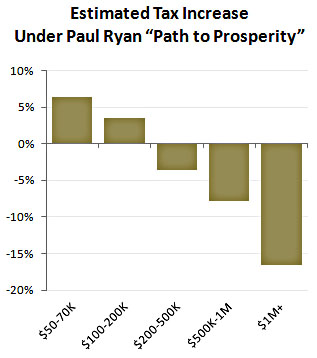
    Nor is that all. Despite his professed concern over the deficit, Ryan also want to cut taxes on America’s richest families. The Joint Economic Committee took a look at Ryan’s tax plan and concluded that it would most likely raise taxes on the poor and the middle classes and cut taxes on the wealthy.

    Let this sink in. This is Paul Ryan’s vision for America. This is what Ryan means by “protecting the weak.” This is the core of Ryan’s tough choices: He wants to cut taxes on the wealthy and cut spending on the poor.

    In fact, for all practical purposes he’d like to see most spending on the poor go away completely. But how do you get that across? It sounds so shrill, so hackish. And Paul Ryan seems like such a nice, earnest young man. Surely this isn’t what he really proposes?

    But it is. There’s nothing shrill here, just the plain facts of Ryan’s plan. This is Paul Ryan’s vision for America.

  • Final Night Wrap-up: Kind of Blah

    I only watched the prime time coverage of the convention tonight, so I saw Clint Eastwood, Marco Rubio, and Mitt Romney but none of the other warmup acts.

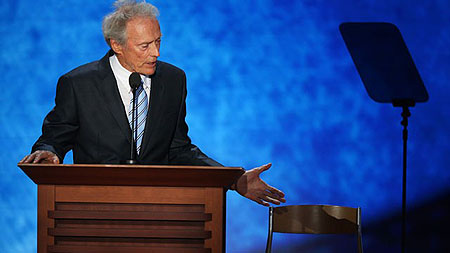
    Clint Eastwood was….about the weirdest thing I’ve ever seen at a convention. (You can watch it here.) Marian and I were just staring at each other with a WTF expression on our faces most of the time. Gesturing to an empty chair and pretending that he was carrying on an imaginary conversation with Barack Obama? Seriously? And wandering off on Afghanistan? What was that all about? As near as I can tell, he was endorsing the idea that we should pull out of Afghanistan immediately, which I’m pretty sure is not the Republican position. The whole schtick was just sort of embarrassing.
    Rubio was fine. He didn’t say anything very memorable, but he did a workmanlike job of revving up the crowd and introducing the candidate.

    As for Romney, he proved me wrong. He didn’t repeat his welfare attack lines at all, not in either a soft soap version or the gruesomely dishonest TV ad version. For the most part, I guess he was OK, but he didn’t really seem to have the crowd eating out of his hand. There were several spots where they seemed a little confused and weren’t sure if they were supposed to cheer or boo or just wait for an applause line yet to come. There were no teleprompter jokes, and no reference to the Winston Churchill bust, but there was a little jibe about Obama giving “Russia’s President Putin the flexibility he desires, after the election.” I guess that stuff never gets old. But like the teleprompter and the Churchill bust, this is just one of those weird inside baseball conservative obsessions. Outside of political junkies and Fox News groupies, I doubt that one person in a hundred watching on TV got the joke.

    Beyond that, the speech felt a little blah to me. More importantly, since my judgment on these things is pretty suspect, Marian apparently found it kind of blah too. About halfway through she started checking football scores on her iPhone. Something tells me a lot of other viewers might have done that too.

    Bottom line: there was nothing wrong with tonight’s performance (except for Clint Eastwood), but I doubt that it really did much for Romney. There just wasn’t enough energy, enough oomph — and the crowd reaction from the convention floor seemed kind of forced and even a little muddled at times. I predict a small bounce for Romney, but no more than a couple of points or so. Overall, it was a missed opportunity.

    UPDATE: A few other reactions:

    Ed Kilgore: “Biggest indication of the power & originality of this speech is that it didn’t even upset me.”

    Alex Massie: “Eastwood plainly giving the father of the bride speech at a wedding at which he dislikes the groom & does not recognise his daughter.”

    Andrew Sullivan: “In a word: mediocre, and deeply dishonest as an argument. As a way to soften his awful image: B +.”

    Jonathan Bernstein: “A generic speech and a generic convention for a generic Republican candidate.”

    The Corner: An hour after Romney’s speech ended, nothing.

    Red State: Ditto.

    Power Line: Ditto.

    Patrick Frey: Ditto.

    Hmmm. Conservatives don’t seem very energized by Romney’s speech. Are there any conservatives with something to say? Wait a second — here we go:

    Erika Johnsen at Hot Air: “Sorry to disappoint you, leftists — but Mitt Romney is a straight-up likeable dude.”

    James Joyner: “If not the ‘grand slam home run’ that most pundits said he needed, at least a stand-up double, hitting the right note and continuing the process of showing that the Republican nominee is what he is: a good husband, father, and citizen.”

    Peter Suderman: “I’m not entirely sure what to say about Mitt Romney’s convention-capping speech tonight, in part because Mitt Romney appears not to have been sure what to say either.”

    Joe Klein: “For the moment, he has staked his claim to decency in a country tired of phoniness and rancor. That was the most important thing about the speech tonight.”

    Josh Marshall: “He’s the underdog and he’s the guy who needs to have a galvanizing introduction to the general public. In those terms, it was a missed opportunity. A pretty big one.”


  • When You Have No Hardship to Boast About, What Can You Do Instead?

    Chris Hayes tweets:

    Amazed that the entire RNC theme is a sustain whine from successful people that the Pres hasn’t given them enough credit for their success….And also this bizarre appropriation of the labor of previous generations. My grandfather owned a small business. He worked really hard. And?

    I noticed that too. But I sympathize. I’d have the same problem dredging up a personal story of hardship if I were running for office. In fact, looking back on my entire life for instances of hardship, I find….nothing. Great parents. Neither of them died. Ordinary middle-class upbringing. Ordinary public education. No serious illnesses. Graduated from college without ever putting in a lot of effort. Had to spend a few years running a Radio Shack store during the Reagan recession (I graduated in 1981), but after that I steadily climbed the corporate ladder: tech writer, product manager, got married, director of marketing, VP of marketing, general manager, money from an IPO, and finally a job as paid blogger through no effort of mine whatsoever. One day I got an email from Nick Confessore asking if he could call me, and a few weeks later I was working for the Washington Monthly.
    How about my father? Nothing there either. His parents were pretty well-to-do. My mother? We’re getting closer: things were a little tight for her growing up during the Great Depression. Nothing serious, though. So now we’re back to grandparents.

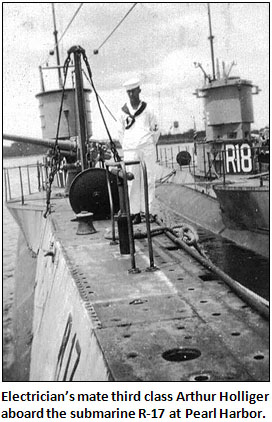
    And now we’re talking. One grandfather grew up in a small town in Illinois, couldn’t go to college because his family couldn’t afford it, moved out West to make his fortune, watched as his wife became seriously mentally ill, remarried, and then started up an advertising agency that made him a prosperous man. My other grandfather grew up in New Jersey, couldn’t go to college because his family couldn’t afford it, joined the Navy because they’d teach him to be an electrician, asked to be discharged in California, and then worked for Western Union his whole life.

    So yeah, if I needed to find some tale of inspiring hardship in my family, I’d have to go back a couple of generations too. Of course, I draw a rather different conclusion from this than folks like Mitt Romney and Paul Ryan seem to draw, but I guess that’s politics for you. If you were born on third base, you still have to pretend that you hit a home run when you slide across the plate.

    Alternatively, we could all grow up and not insist that our presidents have to come from log cabins and 20-mile treks through the snow each day. But I guess that’s not very likely.

  • Will Mitt Romney Back Down Tonight on His Welfare Attacks?

    Anybody want to offer odds on whether Mitt Romney will repeat his dishonest welfare attack during his big prime time speech tonight? If he does, will he go the cowardly route and soften it up so that it’s marginally defensible? Or will he have the guts to dive straight into the gutter and repeat his bald advertising claims that Obama is “dropping work requirements” and “Under Obama’s plan, you wouldn’t have to work and wouldn’t have to train for a job. They just send you your welfare check”?

    My prediction: Door #1. He’ll repeat the claims, but in front of a big audience, with the press hanging on his every word, he won’t have the courage to repeat the specific claims he’s already made 6,000 times so far in his TV ads. With the whole nation watching, he’ll pretend that the ads don’t exist and instead offer up something just hazy enough that only the page A12 fact checkers will bother dissecting it. That’s how Mitt usually plays things, after all.

  • Texas Voter ID Law Goes Down in Flames—For Now


    A three-judge federal court has just ruled that Texas’s new voter ID law violates the Voting Rights Act. Rick Hasen explains the decision (I’ve reformatted his explanation for ease of reading):

    This is a careful, unanimous opinion from a three-judge court which rejects most of the social science evidence submitted by both sides on whether Texas’s voter id law imposes greater burdens on minority voters. Instead, the court bases its analysis on three basically uncontested facts:

    1. Minority voters are at least proportionately as likely as white voters in Texas to lack the documents needed for Texas’s new id law (which the Court calls perhaps the most “stringent” in the nation
    2. The new i.d. law will put high burdens on poor people who lack id (many of whom would have to travel up to 200 or 250 miles at their own expense to get the i.d. as well as pay at least $22 for the documents needed to get the i.d.
    3. Minority voters in Texas are more likely to be poor. Using this simple structure, the court concludes that Texas, which bears the burden of proof in a section 5 case, cannot prove its law won’t make the position of protected minorities worse off. And the court suggests this was a problem of its own making: Texas could have made the i.d. law less onerous (as in Georgia, which the court suggests DOJ was probably right to preclear) and Texas could have done more to produce evidence supporting its side at trial, but it engaged in bad trial tactics.

    So for now, the Texas law is toast. However, it will almost certainly be appealed, with Texas asking for an emergency injunction allowing the new voter ID law to be used in the November election. “Given the closeness to the election,” says Rick, “it is not clear to me that even if the Supreme Court disagrees on some of the analysis with the district court that it would grant such emergency relief. This is a big unknown.” Stay tuned.

  • The National Debt is a Problem, But Honestly, Not That Big a Problem

    Are you worried about our soaring national debt? In the long term, you probably should be. Not because of the debt per se, but because the main cause of a skyrocketing national debt is a weak economy. So if our national debt really does keep going up sharply, it will be because our economy remains sucky for years to come. That really would be a grim problem.

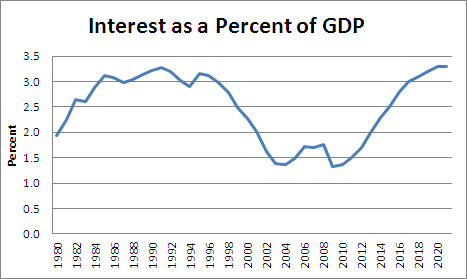
    Still, there are problems and there are problems. As Dean Baker points out today, the thing that debt worriers should really worry about is the interest on the national debt. After all, that’s the part that hits the federal budget. And guess what? It’s not really all that scary looking. CBO estimates that even with all the Bush tax cuts, even with the crappy economy, and even with all the money we’ve spent to deal with the crappy economy, interest on the debt will start to flatten out in 2020 at about the same level it was at after Reagan ballooned the national debt in the 80s. That didn’t seem to hurt us much either then or later during the Clinton boom of the 90s.

    But surely this is all just an artifact of low interest rates? Well, yes it is. But Dean has you covered there too:

    Am I pulling a fast one here by switching from debt to interest payments? Not at all. Suppose we issue $4 trillion in 30-year bonds in 2012 at 2.75 percent interest (roughly the going yield). Suppose the economy recovers, as CBO predicts, and the interest rate is up around 6.0 percent in 4-5 years. The federal government would be able to buy back the $4 trillion in bonds it had issued for roughly $2 trillion, immediately eliminating $2 trillion of its debt. This will make those who fixate on the debt hysterically happy, but will not affect the government’s finances in the least. It will still face the same interest obligation.

    Look: you should be worried about rising debt levels. Even if debt isn’t strangling us right now, a higher debt level gives us less room to maneuver in the future. We should all be in favor of a plan that acknowledges the need for spending now but also takes seriously the need for both higher taxes and lower spending in the future.

    But should we be panicked about this? Not really. If you have any friends who are, show them the chart above. It’s not the end of the world.