• Paul Ryan is the Latest in a String of Honest Men Who Weren’t


    Liberals have spent the past year complaining that Paul Ryan isn’t the courageous truth-teller that the press corps has made him out to be. Today, Bob Somerby reminds us that Ryan is hardly the first to get this treatment:

    For the past twenty years, the press corps has invented a string of Most Honest Men:

    Paul Tsongas, Bill Bradley, Saint John McCain? All were pronounced The Most Honest Man—and all were soon issuing gruesome and weird misstatements.

    Colin Powell was The World’s Most Honest Man too. After that, he made that peculiar presentation at the UN!

    On the bright side, the press corps seems to have caught on to Ryan’s flimflammery a little bit faster than usual. On the not-so-bright side, I can’t tell if this is because the press corps has gotten better or because Ryan’s schtick is more transparent than his predecessors’. Unfortunately, it’s probably the latter. You have to keep the blinders pretty firmly attached these days to keep buying Ryan’s particular brand of happy talk.

  • The Incredible Vanishing GOP Convention Bounce

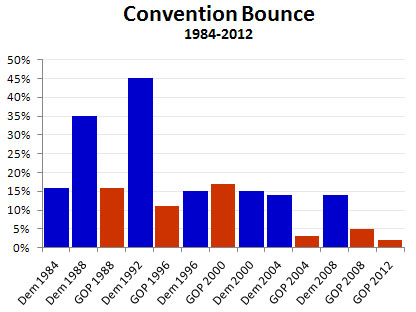
    Gallup is out with a post-convention poll asking people whether last week’s festivities in Tampa have made them more likely or less likely to vote for Mitt Romney. Answer: 40% are more likely, 38% are less likely. This is a net bounce of 2 percentage points, the lowest since Gallup started tracking this question a quarter of a century ago.

    The chart on the right shows the net bounce for most conventions going back to 1984. What I found most interesting is that aside from two outliers with gigantic bounces, every convention has produced a bounce of about 15 percentage points. Every convention, that is, until you get to Republican conventions in the Bush era and beyond. Ever since W stamped his imprint on the GOP, their convention bounces have been nearly invisible. Apparently, putting themselves on display to the American public simply doesn’t make a positive impression anymore.

    Those of us who are liberal hacks will have an obvious reaction: No kidding. Is it any wonder that the American public doesn’t get the warm and fuzzies from watching the parade of rabid true believers that make up today’s GOP? Still, it’s kind of curious, isn’t it?

    In other news, Gallup reports that Romney’s acceptance speech was the most poorly received of any speech since they started keeping track in 1996. In fact, it wasn’t even close. The net positive rating for Romney was nine points lower than the previous worst speaker (John McCain) and a full 13 points lower than the pre-Romney average. Ouch.

  • Myth Busting: The Greenspan Commission Didn’t Save Social Security


    I don’t have a news hook for a post about the Greenspan Social Security Commission of 1983, but I was Googling around this morning for something else and happened to come across an old post from Pete Davis on the subject. The conventional wisdom about the Greenspan Commission is that it beavered away diligently for several months, produced a bipartisan plan to save Social Security from bankruptcy, and Congress passed it. Hooray! But Davis says this version of events is 180 degrees backward:

    Mr. Greenspan and his fellow commissioners had met for months and were secretly deadlocked, despite optimistic public statements. Members of Congress were uniformly terrified of raising payroll taxes or cutting benefits, both of which obviously had to be part of any real solution. Then, one late afternoon, Pat Moynihan (D-NY) walked across the floor to talk to Senate Finance Committee Chair Bob Dole (R-KS). I couldn’t hear what they were saying, but it didn’t take a rocket scientist to realize the topic was Social Security. They cut the deal in broad outline right there, fed it to Mr. Greenspan, and left the details to his Commission.

    So at the last minute, Republicans and Democrats locked arms around a plan “to save Social Security” by raising the payroll tax, to shave benefits, and to very gradually raise the retirement age on future retirees. President Reagan endorsed it, and the rest was history. Like a lot of bad economic theory, the idea that the Greenspan Commission solved the 1983 Social Security crisis has the causality backwards. Dole and Moynihan fed the deal to the Commission, not the other way around.

    Then, in comments, Marc Goldwein says that even this account is too friendly to the Greenspan Commission:

    Great blog post on how the 1983 commission was a cover. But even this post, I’m afraid, perpetuates some of the myth.

    As of the beginning on 1983, the commission was all but dissolved. Understanding the dire political importance of not letting the trust fund run out of money, the White House then began a series of secret negotiations with Pat Moynihan and Former SSA Director Robert Ball (who was basically representing Tip O’Neill). I believe the White House representatives were David Stockman, Dick Darman, sometimes Kenneth Duberstein, and a fourth person.

    Once they had agreed to a basic framework, then Dole was brought in, along with Alan Greenspan, James Baker, and Barber Conable. That group of nine or ten was eventually expanded further, to make sure they’d have the support of the leadership, organized labor, and enough commissioners.

    Only then were the recommendations brought back to the commission to pass.

    I don’t have any particular political point to make here. This just happens to be a piece of political mythology that I’d always vaguely accepted without knowing much about what really happened behind the scenes, and I’ll bet lots of other people believe it too. So I thought I’d pass along this little piece of myth busting.

  • Todd Akin is Slowly Recovering From His “Legitimate Rape” Gaffe

    Public Policy Polling has some new numbers for the Missouri Senate race:

    PPP’s newest poll of the Missouri Senate race finds that Todd Akin is weathering the storm and the contest remains a toss up. Claire McCaskill leads 45-44, just a small change from our poll last week which found Akin ahead by a 44-43 margin.

    ….53% of voters say that they accept Akin’s apology for his comments last week to 40% who do not….Akin’s favorability numbers are still poor with 33% of voters rating him favorably to 56% with a negative opinion. But that’s up a net 11 points from our survey last Monday when it came down at 24/58. A lot of voters have already moved on from being disgusted with him over his comments.

    I’m sort of torn about this. Obviously I think Akin is a creep and a troglodyte, and I wish the news were worse for him. On the other hand, I have a rare chance to be correct about a political prediction here. I figured Akin would stay in the race, and he has. I figured his “legitimate rape” gaffe would blow over, and it looks like it has. I figured that eventually Republicans would quietly get back on his side, and I think that’s starting to happen. And finally, I figured that he’d end up winning. So far, the polling seems to suggest that he might very well.

    Unfortunately, being right isn’t always what it’s cracked up to be. After all, Akin is still a creep and troglodyte. Here’s hoping that my cynicism about the Missouri electorate turns out to be misplaced.

    BONUS HOPE: There is, of course, a pretty decent chance that Akin isn’t done saying stupid things. One more major-league screwup and he’s toast.

  • We Should Focus on Deception, Not Lying

    Did Paul Ryan lie repeatedly in his acceptance speech last Wednesday, as countless fact-checking articles later claimed? Stephen Hayes thinks it’s an unfair charge. “Here’s the funny thing about most of these articles,” he says in the Weekly Standard today. “They fail to cite a single fact that Ryan misstated or lie that he told. In most cases, the self-described fact-checks are little more than complaints that Ryan failed to provide context for his criticism of Barack Obama.”
    He’s right. There are two big problems with getting obsessed about “lies.” The first is that it’s usually too hard to prove. You have to show not only that something is unquestionably factually wrong, but that the speaker knew it was wrong. That’s seldom possible. The second problem is that it’s too narrow. Politicians try to mislead voters all the time, and only occasionally do they do this with flat-out lies. Bottom line: if you focus only on actual lies, you miss too much. But if you try to turn everything into a lie, you sound like a hack.

    A better approach is to focus instead on attempts to mislead. But how do you judge that? A few years ago I developed a three-part test that I use to check my immediate emotional reaction to things politicians say. I’ve found it pretty useful in practice, though it’s not perfect and it doesn’t apply to every kind of slippery statement. Here it is:

    1. What was the speaker trying to imply? This is necessarily a judgment call, but it’s what gets us away from “lying” and instead focuses our attention on how badly a speaker is trying to mislead us.
    2. What would it take to state things accurately? This is the most important part of the exercise. Without getting deep in the weeds (nobody expects politicians to speak in white paper-ese), what would it take to restate things reasonably accurately?
    3. How much would accuracy damage the speaker’s point? Obviously, if accuracy dents the speaker’s point only a bit, not much harm has been done. If it demolishes the speaker’s point completely, it’s as bad as an actual lie.

    Here’s an example from Ryan’s speech, where he talked about the $716 billion “funneled out of Medicare by President Obama”:

    1. He’s implying that Obama reduced Medicare spending and this will hurt Medicare beneficiaries, something that Republicans oppose.
    2. A more defensible version might be something like this: “Obama has reduced payments to hospitals and private Medicare plans. This will lead to less service, lower quality, and fewer plan choices for seniors. Until a few weeks ago, I thought this was a good idea and proposed the same cuts in my budget, which was supported by 95% of the Republican caucus in the House.”
    3. The first two sentences don’t damage Ryan’s point much at all. The third sentence is a major change that turns it completely on its head. On a scale of 1 to 10, where 10 is reserved for flat-out lies, this is about a 9. There’s obviously a huge attempt to mislead here.

    Here’s another one. Ryan talked about Obama’s 2008 visit to a GM plant in Janesville, where he told the workers, “I believe that if our government is there to support you … this plant will be here for another hundred years.” On Wednesday Ryan said: “Well, as it turned out, that plant didn’t last another year. It is locked up and empty to this day. And that’s how it is in so many towns today, where the recovery that was promised is nowhere in sight.”

    1. He’s implying that the plant closed on Obama’s watch and that lots of other plants remain shuttered because the economy has remained weak.
    2. A more accurate version would go something like this: “That plant closed before Obama took office, and none of his bailouts or stimulus bills were able to bring it back to life. And that’s how it is in so many towns today, where the recovery that was promised is nowhere in sight.”
    3. This is a small change, and frankly, it doesn’t really change the emotional resonance of the sentence much. It’s maybe a 2.

    I chose these two examples for a reason. The first one, on examination, was worse than I thought. Obama did cut planned Medicare spending by $716 billion, so at first glance an accurate rephrasing didn’t change Ryan’s point much. But when I remembered that Ryan and the entire Republican caucus had supported those cuts just a few months ago, it was obvious that this was a major-league whopper — and there’s simply no way to restate it without changing its impact completely. The attempt to mislead is enormous.

    Conversely, the second example annoyed me a lot when I first heard it, but when I went through the exercise of writing a more accurate version, I realized that it didn’t really change things much. The restated version has much the same impact as the original. There’s an attempt to mislead here, but for most listeners it’s fairly subtle.

    It’s Step 2 of this test that’s key. You have to rewrite the offending statement to be defensibly accurate. Keep in mind that this doesn’t mean rewriting conservative attacks to include every possible liberal talking point. This is a presidential campaign, not a graduate seminar. You need to do the absolute minimum it would take to make the statement tolerably defensible.

    Needless to say, this doesn’t work for everything. In Romney’s infamous welfare ad, for example, he says that Obama is “dropping work requirements” and “Under Obama’s plan, you wouldn’t have to work and wouldn’t have to train for a job. They just send you your welfare check.” This actually is a flat-out lie, not merely an attempt to mislead. Beyond that, though, the real dirty work of the ad is the way it pushes obvious racial hot buttons, and that’s simply not something you can judge on a scale of truthfulness vs. deceit.

    Still, for many things, this test is useful. What’s the minimum change it would take to keep the offending statement from being actively misleading? Once you’ve made the change, how much does it really change the emotional resonance of the statement? If you do an honest job of this, you might surprise yourself now and again.

  • Quote of the Day: Mitt Romney’s Apology Tour


    “Hey,” tweets Andrew Sprung, “Romney’s kicked off an apology tour on behalf of the GOP.” He chose Ohio to unveil his new schtick:

    Mitt Romney said Saturday that his party had fallen short on its fiscal promises even as he campaigned alongside a top Republican congressional leader….“When we had the lead, we let people down,” Mr. Romney told a crowd in this important swing state. “We need to make sure” they are not let down again. “I will cut the deficit and get us on track to a balanced budget.”

    You know who else thinks that Republicans have let us down? President Obama. Kudos to Romney for finally delivering a message that the American people can all rally around.

  • The Surprising Power of the New Hampshire Primary

    As you probably know, there are lots of models for predicting who will win the presidential race this year. To summarize: most of the models predict a small Obama victory, but a few predict a Romney victory. Most likely, it’s gonna be close.

    Dylan Matthews rounds up a few of the forecasts here. Most are fairly ordinary, but I was pretty intrigued by the model from Helmut Norpoth and Michael Bednarczuk of SUNY Stony Brook. Unlike every other forecaster on the planet, they don’t include any economic variables at all. Maybe the economy is great, maybe it sucks. They don’t care. Their model has two inputs: (1) how well you did in the New Hampshire primary, and (2) whether you’re an incumbent running for reelection.

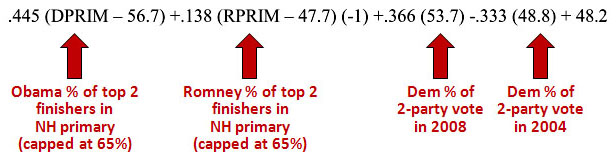
    This is….eccentric, to say the least. Not the incumbent thing: most forecasters recognize that, historically, incumbents usually win if their party has been in the White House for only four years. But the New Hampshire primary? According to the authors, it tells us a lot. An incumbent who gets serious competition (Carter 1980, Bush 1992) is in trouble. Likewise, a challenger who doesn’t clean up against the opposition is also in trouble. And out of all possible primaries, New Hampshire has the most predictive power. This all gets translated into a formula, of course, and here it is. Note that 3rd and 4th terms are Democrat-centric because the current incumbent is a Democrat:

    Here’s how the arithmetic plays out:

    • .445 (65 – 56.7) – .138 (63.2 – 47.7) + .366 (53.7) – .333 (48.8) + 48.2445
    • .445 (8.3) – .138 (15.5) + .366 (53.7) – .333 (48.8) + 48.2 
    • 3.69 – 2.14 + 19.65 – 16.25 + 48.2
    • = 53.15% popular vote margin for Obama

    As it happens, I don’t believe this for a second. Lop off a couple of points because Obama is black and I think you’re closer to the final outcome. My best guess is that Obama will win about 51% of the popular vote.

    But who knows. The authors claim that their model explains 89% of the variance in party shares of presidential votes, and that’s pretty good. On the other hand, it’s wise to be cautious. The simpleminded rule that incumbent parties win after four years in office and lose after eight or more years correctly predicts 13 out of 15 elections since 1952 (the outliers are 1980 and 1988). That’s an 87% success rate.

    Still, I thought this model was pretty fascinating. I have a hard time believing it, but if Obama really ends up winning 53% of the vote in November, my hat’s off to the authors.

  • Paul Ryan Likes to Supersize It

    Last week Paul Ryan told conservative radio host Hugh Hewitt that he had once run a sub-three hour marathon. More specifically, “I had a two hour and fifty-something,” he said. That’s pretty impressive. And, as it happens, untrue:

    This evening, the terrific running journalist Scott Douglas figured out that Ryan had actually run a 4:01 in the Grandma’s Marathon in Duluth, Minnesota, in 1990, when he was a college student. This is not quite so fast.

    ….Ryan, through a spokesman, responded that he’d just mixed things up: “The race was more than 20 years ago, but my brother Tobin—who ran Boston last year—reminds me that he is the owner of the fastest marathon in the family and has never himself ran a sub-three. If I were to do any rounding, it would certainly be to four hours, not three.”
    Does Ryan deserve a bit of mockery for this? Sure. But if there’s anything really telling about Ryan’s character here, it’s the fact that when he misrepresents himself, he doesn’t do it in a small way. Ryan didn’t just shave five or ten minutes off his time, the way some of us might if we were bragging about an old athletic accomplishment that no one could check up on, he shaved off a full hour, giving himself an extremely respectable, elite amateur time. This doesn’t quite rank up there with Kim Jong-Il carding eleven holes-in-one on his first round of golf, or Pat Robertson leg-pressing 2,000 pounds at age 76, but it’s in the same ballpark.

    Keep this in mind when Ryan talks about his tax and budget plan and promises with a straight face that it will slash the deficit, benefit the middle class, protect the social safety net, and supercharge economic growth all at once: lying is easier when you tell a big lie. This is Ryan’s oeuvre. His mistake was letting himself be lulled by Hugh Hewitt’s blandishments and forgetting that even 20-year-old marathon times, unlike his rather spectacular economic claims, are pretty easy to verify.

  • Friday Cat Blogging – 31 August 2012

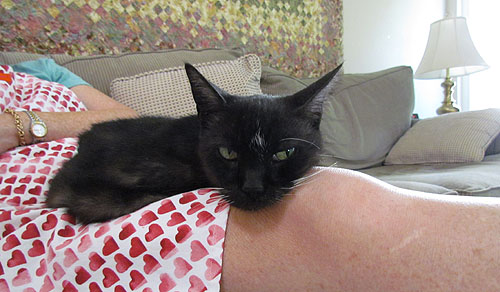
    Here’s Domino sitting on Marian’s lap with her neck twisted at what looks like a really uncomfortable angle. But she seems happy enough, and she cocks her head at even weirder angles than this sometimes. I sure wish I were that flexible. As for what she seems to be peering at outside the frame of the picture, it beats me. After all, there’s no one to peer at suspiciously anymore. Maybe she’s just keeping a vigilant eye on the food bowl.

  • It’s Official: No One Will Ever Be Prosecuted for Bush-Era Torture

    I don’t write about national security and civil liberties issues as much as I should. Partly this is because I find much of it too grim to bear. But it’s also because it seems so hopeless: there’s really no significant difference between the two major parties on most of these issues, and therefore no real chance of any of them being changed. There are differences at the margin — Obama banned torture and Eric Holder at least tried to institute civilian trials for terrorist suspects — and during campaign season even modest differences become magnified. But really, there’s a pretty broad bipartisan consensus on all the big stuff: drones and assassinations and secrecy and military intervention and the ever increasing role of surveillance in our society, just to name a few items.

    But ignoring this stuff is a character flaw, not a rule, and today Glenn Greenwald writes about the Justice Department dropping its last investigation into Bush-era torture charges. All of the hundreds of possible cases had already been quietly scrapped years before, but until yesterday there were still two left:

    The only exceptions were two particularly brutal cases, both of which resulted in the death of the detainee. One involved the 2002 abuse of Gul Rahman, who froze to death in a secret CIA prison in Afghanistan known as the “Salt Pit”, after he was beaten, stripped, and then shackled to a cement wall in freezing temperatures.

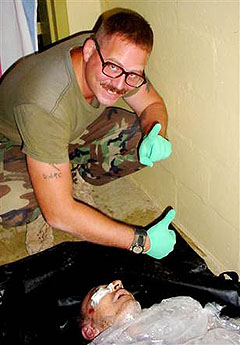
    The other was the 2003 death of Manadel al-Jamadi at Abu Ghraib, who died in CIA custody after he was beaten, stripped, had cold water poured on him, and then shackled to the wall. It was al-Jamadi’s ice-packed body which was infamously photographed with a smiling US Army Sgt Charles Graner standing over it giving the thumbs-up sign.

    ….Because the Obama administration has systematically blocked all other cases besides these two from any possibility of criminal charges, yesterday’s decision means that nobody in the US government will pay any price for the systematic worldwide torture regime which that nation implemented and maintained for close to a decade.

    However, as Glenn points out, the Obama administration is still willing to prosecute whistleblowers who spoke out against the torture regime. This is, to say the least, not our nation’s finest moment. Or our president’s.