• Debt Doesn’t Cause Low Growth. Low Growth Causes Low Growth.


    Our story so far: Carmen Reinhart and Ken Rogoff have been telling us for the past few years that high levels of government debt are bad for future growth. But is that true? There’s certainly a correlation between debt and growth, but is there causation? Or is there some third factor that causes both high debt and low growth?

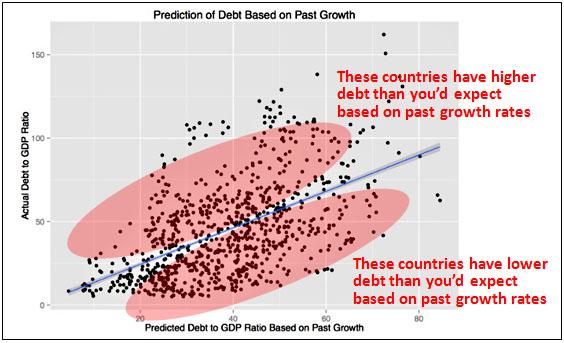
    There’s already some evidence from UMass economist Arindrajit Dube that R&R get the causality backward: It’s not that high debt causes low growth, but that low growth causes high debt. Today, Miles Kimball and Yichuan Wang of the University of Michigan take a closer look at this and try to tease out what’s causing what. To start with, using R&R’s dataset, they plot past growth rates vs. present debt for various time periods. This allows them to produce a formula that predicts debt levels based on past growth. Then they plot actual debt vs. predicted debt. The regression line running through the middle of the data tells us the average level of national debt you’d expect based on past growth rates:

    Obviously some countries have higher debt than you’d expect based on their past growth, and some have lower debt. So the next question is: Do countries with higher than expected debt levels at a particular point in time have lower future growth than countries with lower than expected debt? If debt truly has an independent effect on growth, you’d certainly think so.

    But it turns out this isn’t the case. Not even slightly. Debt simply doesn’t matter. Basically, low growth in the past predicts low growth in the future. That’s all there is to it. However, low growth in the past also predicts high debt, which can fool you into thinking it’s the debt that’s causing low growth in the future. But it’s not.

    Now, Kimball and Wang are still no fans of high debt. If your debt is high compared to other countries, the bond markets will probably punish you. What’s more, “the big problem with debt is that the only ways to avoid paying it back or paying interest on it forever are national bankruptcy or hyper-inflation. And unless the borrowed money is spent in ways that foster economic growth in a big way, paying it back or paying interest on it forever will mean future pain in the form of higher taxes or lower spending.” It’s possible, of course, to spend money in ways that foster economic growth, but they believe that most conventional stimulus spending isn’t spent that way and therefore isn’t very useful.

    Nonetheless, it isn’t harmful either. “Our bottom line from this analysis, and the thinking we have been able to articulate above, is this: Done carefully, debt is not damning. Debt is just debt.”

  • Our Military Intervention Record in the Middle East Is “Dismal”


    John McCain went to Syria recently and, among other things, apparently ended up posing for a photograph with rebels who had kidnapped 11 Lebanese Shiite pilgrims. I think Joe Klein draws the right conclusion:

    I don’t blame McCain for this. It’s hard to advance a trip into rebel territory….The point is: We just don’t know these places well enough to go over and draw grand conclusions about policy. In a way, McCain’s trip is a perfect metaphor for the problem of involving ourselves with the Syrian rebels. We may be siding with the greater evil. We may be throwing fuel on a fire that could consume the region. Our track record when it comes to such things is dismal.

    Obviously McCain didn’t do this deliberately. But he’s been insisting for years that we can tell the good guys from the bad guys in Syria, and this incident suggests that we can’t. Not reliably, anyway. Even McCain can’t. As Klein says, our track record on this stuff is pretty dismal. President Obama is right to be very, very cautious about committing American military aid to this fight.

  • Math Is Hard? No, Reading Is Hard


    If you’ve read the several dozen posts I’ve written about NAEP test scores over the years, you already know about one thing that stands out: scores on math tests have improved a lot more than scores on reading tests. Despite (or because of?) the endless math wars of the past few decades, the evidence suggests that we’re doing a better job of teaching math than we used to. Quite a bit better, in fact.1
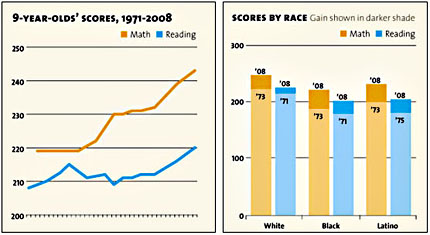
    But why? Motoko Rich asks the experts and gets the following answers:

    Teachers and administrators who work with children from low-income families say one reason teachers struggle to help these students improve reading comprehension is that deficits start at such a young age: in the 1980s, the psychologists Betty Hart and Todd R. Risley found that by the time they are 4 years old, children from poor families have heard 32 million fewer words than children with professional parents.

    …Reading also requires background knowledge of cultural, historical and social references. Math is a more universal language of equations and rules. “Math is really culturally neutral in so many ways,” said Scott Shirey, executive director of KIPP Delta Public Schools in Arkansas.

    ….And while reading has been the subject of fierce pedagogical battles, “the ideological divisions are not as great on the math side as they are on the literacy side,” said Linda Chen, deputy chief academic officer in the Boston Public Schools.

    I’d argue about that third bullet. The “ideological divisions” over math teaching have actually been pretty damn impressive for the past few decades, though it’s possible that they’ve calmed down lately.

    The other two bullets sound more plausible, though. Low SES kids start out with a big reading deficit as early as kindergarten, and it’s hard to make up that deficit later on. The deficit in math is probably small or zero. I’m a little less sure about possible cultural issues, but that might be part of it too. And if I were speculating, I’d suggest that because language is more hardwired into the brain than math, it might just be a tougher nut to crack.

    In any case, I just wanted to pass this along. There are a few topics that mainstream news organizations rarely mention—for example, the fact that test scores are up, not down, over the past few decades—and the math/reading dichotomy is one of them. It’s nice to see it at least get a mention.

    1Up through 8th grade, anyway. Beyond that, test scores have been fairly flat in both reading and math.

  • Tax Expenditures Favor the Rich—But Probably by Less Than CBO Says


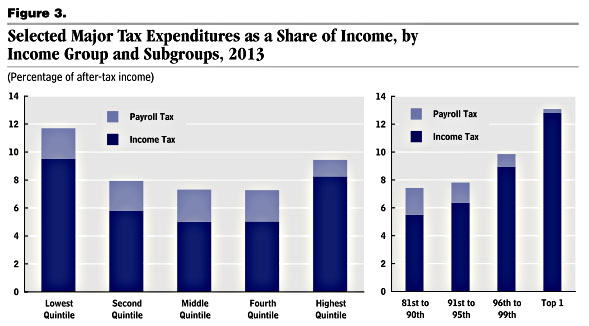
    The Congressional Budget Office has a new report out that tries to figure out who benefits the most from tax expenditures. This includes things like the exclusion of healthcare from income tax, the charitable deduction, the EITC, and so forth: money that’s essentially an expenditure, but is distributed via tax credits and deductions instead of by mailing checks to people. What the CBO finds is that the biggest beneficiaries are the poor and the rich:

    As it turns out, I have a couple of problems with this analysis. First, it includes the preferential tax rate on dividends and capital gains as a tax expenditure, one that obviously benefits the wealthy disproportionately. But I’m not sure that’s fair. Whatever you think of the preferential tax rate on investment income, it doesn’t really strike me as a tax expenditure. I suppose this gets us into angels-on-the-head-of-a-pin territory, since you could argue that low cap gains rates are a subsidy for investment that’s distributed through the tax code, but that seems sort of tendentious to me.

    My other problem is with the three big tax deductions they study: mortgage interest, charitable contributions, and state/local taxes. These also disproportionately favor the wealthy. But for the non-wealthy, the tax code allows a benefit for these things in the form of the standard deduction. So if we’re going to make comparisons, don’t we need to tot up the benefit of the standard deduction for various income groups?

    Even if you account for these things, the wealthy probably benefit more from tax expenditures than the middle class. And there are good reasons to think that capital gains rates should be less preferential than they are, regardless of whether or not they count as tax expenditures. Still, done properly, I suspect the chart above would be a lot flatter than it looks.

  • The Public Wants a Special Prosecutor to Investigate the IRS


    A recent Quinnipiac poll suggests that the public isn’t too concerned about either Benghazi or the subpoena of AP phone records. But they are concerned about the IRS scandal. Ed Kilgore highlights a disturbing piece of this:

    The most startling finding from the Q-poll is that 76% of respondents—including 63% of Democrats and 88% of Republicans—favor the appointment of a special prosecutor to investigate the IRS allegations. This may simply reflect the fact that many people don’t know who to trust as the “scandal” drags on, and/or that partisans assume the “other side” has too much control over the investigations. But these are some formidable numbers for a course of action that most liberal elites—and a growing number of conservative elites—deplore as threatening a nightmarish return to the 1990s at their worst.

    My guess is that most people simply don’t understand the implications. “Special prosecutor” sounds pretty benign, after all. They just aren’t aware that, in practice, they mostly turn into obsessive, Ahab-like trawlers through every nook and cranny of the federal government.

    It sure seems like there ought to be some way to keep them more focused, though. Obviously that didn’t work with Ken Starr, but why can’t a special prosecutor be appointed jointly by House, Senate, and president, with a limited mandate and a clear timeframe? Say, one year or so. And an agreement that the mandate can’t be changed unless all three agree to it. It seems like that ought to be doable. So why isn’t it?

  • Obama to Nominate Comey as Head of FBI


    The Washington Post is reporting that President Obama plans to nominate James Comey, the former Bush deputy attorney general who became famous for declining to certify the legality of the NSA’s warrantless wiretapping program, to become head of the FBI:

    The White House had narrowed the search in recent days to Comey and Lisa Monaco, a former assistant attorney general for national security who became Obama’s chief counterterrorism adviser earlier this year.

    Law enforcement and administration officials said the White House was concerned that Monaco’s confirmation process would run into obstacles in Congress. Comey’s nomination, on the other hand, was described by some officials as a symbol of bipartisanship.

    Of course. Because everyone knows that nominating a Democrat to run the FBI would be an intolerable provocation.

    I sure hope this reporting is wrong. Nominating Comey because he thinks he’s the best person for the job is one thing. But if Obama thinks that nominating Comey will be seen as some kind of bipartisan olive branch, he’s crazy.

  • News Orgs Not Thrilled About Meeting With Eric Holder


    In his big national security speech last week, President Obama promised that Attorney General Eric Holder would meet with members of the press to “review existing Department of Justice guidelines governing investigations that involve reporters.” Michael Calderone says this isn’t unusual:

    When the press and government are battling over issues of access or press freedom, it’s common to bring in top Washington-based editors and executives in hopes of coming to a resolution.

    I didn’t know this, actually, and I’m curious about how often meetings like this take place. Whatever the answer, it turns out that this one won’t include the New York Times, which says it “isn’t appropriate for us to attend an off the record meeting with the attorney general.” AP agrees. This suggests that past meetings like this have been on the record. Is there an old-timer out there who can give us the skinny on this?

    In any case, here’s the interesting thing about whether this meeting is on or off the record: I doubt that it matters much to Holder. He’s basically asking for input into revised policies, not making news or committing himself to anything. But it might matter to the editors who attend. After all, if the meeting is on the record, they’re pretty constrained in what they can say. How likely is it that they can be candid if they know they’re speaking for public consumption? Not very, I’d guess.

  • In the AP and Rosen Leak Cases, Both Sides Have Made Mistakes


    Matt Cooper, who was threatened with jail time during the Valerie Plame case, writes today that laws can only go so far to protect journalists from government intrusion:

    This is one of those areas where custom carries more weight than statute, the custom being the general good sense of prosecutors not to go after reporters for their information….The current shield law being considered by Congress has lots of national-security exceptions and probably wouldn’t have helped me or the current subjects, the AP and James Rosen of Fox News. It’s better than nothing from where I sit, but it also means that no court will ever grant unconditional protection to reporters to hide their sources. Prosecutors and others are always going to have the opportunity to persuade a court that national security overrides First Amendment issues. The best we can count on is that prosecutors will use their powers with discretion, especially since in most national security cases they wind up not prosecuting for any leak itself but for false statements to the FBI.

    For a contrasting opinion, Cooper recommends reading Walter Pincus, one of our best and longest-serving national security reporters:

    When First Amendment advocates say Rosen was “falsely” characterized as a co-conspirator, they do not understand the law. When others claim this investigation is “intimidating a growing number of government sources,” they don’t understand history.

    The person or persons who told the Associated Press about the CIA operation that infiltrated al-Qaeda in the Arabian Peninsula, and Kim — or someone else — who informed Rosen about North Korea, were not whistleblowers exposing government misdeeds. They harmed national security and broke the law.

    The White House Correspondents’ Association board issued a statement May 21 saying, “Reporters should never be threatened with prosecution for the simple act of doing their jobs.” But it admitted, “We do not know all of the facts in these cases.” The board added: “Our country was founded on the principle of freedom of the press and nothing is more sacred to our profession.”

    I worry that many other journalists think that last phrase should be “nothing is more sacred than our profession.”

    Taken together, these pieces strike the right balance. Cooper is right that journalists are customarily left alone, and the government would be wise to take this custom seriously. Pincus is right that journalists customarily take care not to blow legitimate intelligence operations just for the sake of a few sentences in a routine story, and they’d be wise to take this custom seriously.

    Rosen and the AP should have been more careful, and their actions deserve more scrutiny than their fellow reporters have given them. At the same time, the government overreached when it seized their phone records. It overreached in the Rosen case because Rosen’s records weren’t absolutely necessary to find the leaker, and it overreached in the AP case by phrasing its subpoena so broadly. That deserves scrutiny of its own. There’s no tension in believing both of these things at the same time.

  • How Polarized Is Your State?


    “Those of us who report on state-level politics,” writes Abby Rapoport today, “usually brag about how much better it is than following Congress.” Really? I’ve always thought of state capitols as cesspools that make Congress look like a finely crafted Swiss watch. What’s going on here?

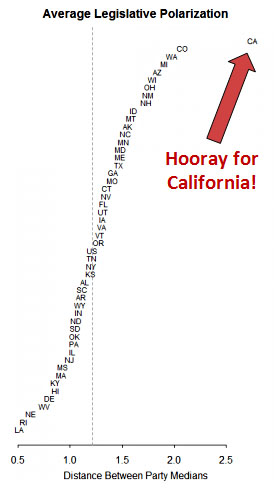
    The answer, it turns out, is location, location, location. The chart on the right shows the average polarization of all 50 state legislatures, which is a pretty good proxy for gridlock and general cesspoolishness. My state isn’t merely the most polarized, it’s literally in a class by itself. No wonder I think of state politics as insufferable. In California, it is.

    So it’s true: California really is two states. Not northern and southern, though. Unless water is involved, LA and San Francisco can get along OK. Basically, what this chart shows is coastal vs. inland. Most of coastal California is as liberal as its stereotype, while inland California is somewhere to the right of rural Georgia. Lately, the coastals have taken firm command of Sacramento, and the inlanders haven’t yet figured out how to respond. I don’t think they will anytime soon.