• Our Amazing Slowdown in Healthcare Spending Growth


    The growth rate of healthcare spending, which once seemed to be putting us on a path to national bankruptcy, seems to be abating pretty seriously lately. Jon Chait comments:

    The general conservative response to date has involved ignoring the trend, or perhaps dismissing it as a temporary, recession-induced dip likely to reverse itself. Yesterday, the Wall Street Journal editorial page offered up what may be the new conservative fallback position: Okay, health-care costs are slowing down, but it has absolutely nothing to do with the huge new health-care reform law. “It increasingly looks as if ObamaCare passed amid a national correction in the health markets,” the Journal now asserts, “that no one in Congress or the White House understood.” It’s another one of those huge, crazy coincidences!

    My take is a little different: I think the Journal is wrong to suggest that we’re merely in the middle of a temporary correction, and Chait is wrong to imply that Obamacare has played a role in the slowdown of healthcare spending. Take a look at the chart below, which is a home-brewed version of one that’s cropped up in a lot of places recently. I took the CMS figures for per-capita national healthcare consumption expenditures and compared its year-over-year growth rate with the inflation rate. A high number means healthcare spending is growing faster than inflation. The chart is noisy, but the pattern is pretty clear: the growth rate of healthcare spending has been on a pretty steady downward trend for three decades. If it keeps following the current trendline, per-capita healthcare spending will be growing at the same rate as general inflation by around 2020 or so:
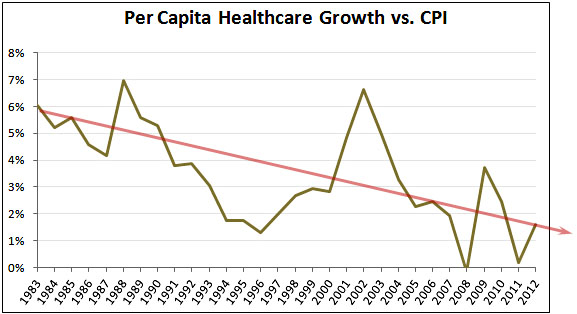
    For a more rigorous look at this over just the past decade, check out “When the Cost Curve Bent,” described here by Sarah Kliff. Standard caveats apply: the trendline might not keep going down; more people will still mean higher healthcare spending; and recent data might be artificially depressed by the recession and the sluggish recovery.

    Bottom line: I think the moderation of healthcare spending growth has been going on for quite a while. And while Obamacare may very well accelerate this trend, it’s too early to say it’s had any effect yet. At the same time, Chait’s more general mockery of the Journal’s about-face on this subject is fully merited:

    Of course, it’s not just that the Journal didn’t predict the health-care cost slowdown. The Journal insisted it couldn’t possibly happen. Indeed, it insisted that Obamacare would destroy — was already destroying — any possible hope for a health-care cost correction, and would instead necessarily lead to a massive increase in health-care inflation.

    That’s been the party line on the right all along. Along with hyperinflation and spiraling interest rates, I think we can put this squarely in the basket of stuff they just don’t get.
  • IG Report Says IRS Has No Idea What Its Own Rules Mean


    The Inspector General’s report on the targeting of tea party groups by the IRS is now out, and I was hoping there might be some interesting tidbits now that we can see the whole thing. Not really, though. Mainly, it paints a drearily predictable picture of bureaucratic FUBARism, with various groups in various places either misunderstanding each other; not responding to each other; or assuming that stuff was getting done that, in fact, wasn’t getting done. Anyone who reads Dilbert regularly gets the picture.

    But the soporific paragraph below actually tells us something pretty important. In fact, it’s the heart of the whole issue:

    In April 2012, the Senior Technical Advisor to the Acting Commissioner, Tax Exempt and Government Entities Division, along with a team of EO function Headquarters office employees, reviewed many of the potential political cases and determined that there appeared to be some confusion by Determinations Unit specialists and applicants on what activities are allowed by I.R.C. § 501(c)(4) organizations. We believe this could be due to the lack of specific guidance on how to determine the “primary activity” of an I.R.C. § 501(c)(4) organization. Treasury Regulations state that I.R.C. § 501(c)(4) organizations should have social welfare as their “primary activity”; however, the regulations do not define how to measure whether social welfare is an organization’s “primary activity.”

    Did you get that? IRS regs say that 501(c)4 groups can’t primarily be engaged in political activity. Instead, their “primary activity” has to be social welfare. To call this vague would be a disservice to mirages and chimeras everywhere. How the hell are actual human beings sitting in cubicles in Cincinnati supposed to decide whether a group is planning to spend more than 50 percent of its time engaged in something other than social welfare? For that matter, how are they supposed to decide what “social welfare” is in the first place?

    The IG report recognizes this, and Recommendation 8 in its audit is that this really needs to get resolved at a policy level, not a line level:

    Recommend to IRS Chief Counsel and the Department of the Treasury that guidance on how to measure the “primary activity” of I.R.C. § 501(c)(4) social welfare organizations be included for consideration in the Department of the Treasury Priority Guidance Plan.

    Good luck with that! Frankly, I think it’s a mug’s game. There’s really no way to define this in any kind of rigorous way, and even if you could, how would you apply it to organizations that are merely applying for 501(c)4 status? In the wake of Citizens United, this whole section of the Internal Revenue Code is a definitional witch’s brew that admits of no sensible resolution. If we had a functioning Congress, I’d suggest that they should address this from the ground up and provide a set of guidelines that makes sense in the modern world. But I don’t suppose that’s very likely, is it?

  • Word of the Month for May: BOLO


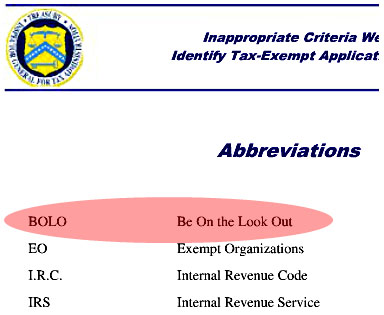
    Here’s my favorite part of the IRS scandal yet. According to the Inspector General’s report, the Cincinnati office of the IRS developed an acronym for “Be On the Look Out.” Yep, they turned it into BOLO. Apparently the spreadsheet which listed words and phrases that might indicate political activity became known as the “BOLO Listing.” I expect this to take Twitter by storm any second now.

    UPDATE: Pardon my ignorance. Turns out this is a standard police term. A “BOLO alert” is issued when police are trying to find someone suspected of a crime. I guess the IRS appropriated the term, they didn’t invent it.

  • What We Now Know About the CIA’s Benghazi Turf War


    The more we find out about the editing of the Benghazi talking points, the more the evidence points in one direction: this was a CIA fiasco from the start. As we all know by now, the Benghazi mission was primarily a CIA operation, and they were the ones responsible for security there. But when it came time to write up talking points for public consumption after the September 11 attacks, they immediately started trying to shift blame. Here is David Brooks writing about the role of State Department spokesman Victoria Nuland:

    On Friday evening of Sept. 14, the updated talking points were e-mailed to the relevant officials in various departments, including Nuland….[She] noted that the talking points left the impression that the C.I.A. had issued all sorts of warnings before the attack.

    Remember, this was at a moment when the State Department was taking heat for what was mostly a C.I.A. operation, while doing verbal gymnastics to hide the C.I.A.’s role. Intentionally or not, the C.I.A. seemed to be repaying the favor by trying to shift blame to the State Department for ignoring intelligence.

    Marcy Wheeler had a more pungent assessment a few days ago:

    In other words, the story CIA — which had fucked up in big ways — wanted to tell was that it had warned State and State had done nothing in response….The truthful story would have been (in part) that CIA had botched the militia scene in Benghazi, and that had gotten the Ambassador killed.

    Today Jake Tapper tells us that previous reports about the role of Deputy National Security Adviser Ben Rhodes have also been mistaken. Rhodes didn’t say anything to suggest that the White House was concerned with protecting the State Department’s reputation. All he said was this: “We need to resolve this in a way that respects all of the relevant equities, particularly the investigation.” The next day, when everyone got together to vet the talking points, they were stripped down to their final mushy state.

    Greg Sargent has more here. This was, pretty clearly, a turf war, and the evidence increasingly suggests it was a war started by the CIA. The State Department has already largely owned up to its own failures in the ARB report released last year. So far, though, the CIA hasn’t.

  • Today’s Austerity Smackdown: US vs. UK


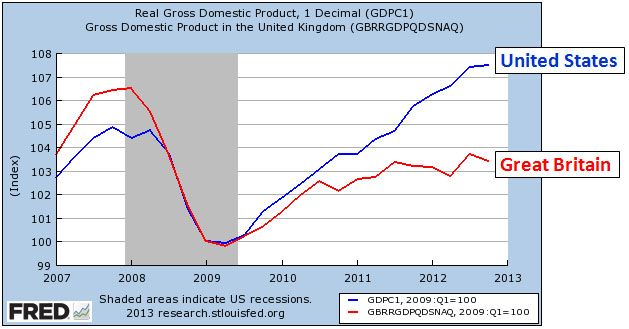
    This chart is making the rounds today, so I might as well join in the fun. It shows how well the U.S. economy has recovered from the recession compared to Great Britain. The Tory approach in Great Britain has famously been based on austerity measures, and it sure doesn’t seem to be working all that well. Karl Smith provides the caveats:

    The UK has an infamous productivity puzzle, that has allowed it to add jobs even as GDP stalls. The UK is more closely tied to the crumbling Eurozone economy. The UK has seen its energy resources dwindle while the US has seen them explode. The United States has seen a good deal more austerity than its President would have liked.

    All true, and these things point in different directions. That said, austerity doesn’t seem to be working in Britain and it’s not working in the rest of Europe either. So why are Republicans so hellbent on emulating them?

  • Final Ultrawonky Stat Geek Analysis of the Oregon Medicaid Study


    If you really want to understand the shortcomings of the Oregon Medicaid study, you should be reading Austin Frakt and Aaron Carroll over at The Incidental Economist. Frakt has one final post today in which he goes ultrawonky and calculates just how underpowered the study was if it wanted to get statistically significant results on the diabetes markers. It’s way over my head, so I’ll just pass along the headline result: the study was underpowered by at least a factor of 23. That is, the researchers would have needed a sample size 23 times larger than they had in order to find the results they were looking for.

    The full writeup is here. Bottom line: this study was just too small. The fact that it didn’t find statistically significant results doesn’t really tell us anything at all, either good or bad, about the effect of Medicaid on health outcomes.

  • A Taxonomy of Scandals


    “White House Under Siege” is too juicy a narrative to pass up, especially during a slow news period, so that’s what we’re getting right now. But there are scandals and then there are “scandals.” The three that are currently erupting are all quite different. Let’s categorize them:

    Benghazi. The truth is that this is no more of a scandal than it’s ever been. Right now Republicans are doing their best to keep this carnival act going, but President Obama was pretty much right yesterday when he said there’s no there there. That remains true even if Jay Carney was a little less than candid last November about the editing process of the infamous talking points. This whole thing is basically a fever dream invention of the right, and the public doesn’t seem any more interested in it today than it ever has been.

    AP phone records. This is a policy scandal, perhaps, but not an abuse of power or example of corruption. As near as I can tell, the Justice Department followed the law scrupulously here, obtaining a warrant for the records and then informing AP of the warrant afterwards. Lots of people, including me, happen to think the law that allows this is a bad one, but that’s an argument about the PATRIOT Act and its followups. From a political point of view, Republicans are going to have a hard time making much hay with this because (a) most of them support the law that allows DOJ to do this, and (b) the American public doesn’t think very highly of the press and probably isn’t very outraged that they can have their phone records collected just like anyone else.

    IRS targeting of tea party groups. This one is a genuine scandal, and it’s one that plays right into Republican hands. It’s also one that will resonate with the public. Politically, the question is whether the president can get out ahead of it. If he’s found to have had no hand in the original targeting, and is perceived as being sufficiently zealous in cracking down on it, it might not hurt him much. We’ll see.

    There’s one wild card in all this: the media. They finally got personally annoyed over Benghazi when the spotlight turned to things that Jay Carney had told them personally, and the AP warrant also directly affects them. If this episode feeds into further media disenchantment with Obama, that could affect his press coverage going forward. In the end, that could end up being the worst fallout of all from this stuff.

  • Robots, Mass Unemployment, and Riots in the Streets


    You can never get too much robot punditry, can you? So here are two more followups from my magazine piece on the coming rise of smart machines. First, an interview with Dylan Matthews over at WonkBlog. Here’s my take on what happens as we disemploy more and more people along the road to our eventual robot paradise:

    It seems like if you have a huge section of people who are unemployed, who don’t really have resources but have a lot of spare time, then there’s a possibility of really huge political mobilizations on the part of those people, like you see in countries nowadays with mass unemployment.

    I think that’s likely to be one of the things that happens along the way. Societies that suffer from mass unemployment, the history of what happens to those societies is not a bright one. At some point you have to respond, and there’s going to be a lot of resistance to responding because of ideology, because of politics, because of pure greed, but eventually we are going to respond to this. It’s going to be obvious what’s happening, that people are unemployed due to no fault of their own, and that we have to respond.

    In the meantime, we’re going to resist responding, and we’re probably going to resist responding very very strongly, because rich people don’t like giving up their money. We’re in for a few decades of a really grim fight between the poor, who are losing jobs, and the rich, who don’t want to give up their riches.

    OK, fine, that wasn’t the most lucid description of the problem ever. In a few years a robot will be able to make a better fist of it. But you get the idea. The big question is: how long will it be before everyone finally caves in and admits that something new is happening, and we’re not just suffering from the same old economic problems as we have in the past?

    And if that’s all a little too heavy for you, check out Ryan Jacobs’ brief history of awesome robots, from RUR to LS3. Here’s hoping that our future is more R2D2 and less Terminator.

  • Fed Monitoring of Terror-Related Phone Calls Finally About to Get Some Attention


    My Twitter feed has become almost totally consumed by reaction to today’s story about the government obtaining records of phone calls made by AP reporters:

    The records obtained by the Justice Department listed outgoing calls for the work and personal phone numbers of individual reporters….In all, the government seized the records for more than 20 separate telephone lines assigned to AP and its journalists in April and May of 2012.

    ….The government would not say why it sought the records. U.S. officials have previously said in public testimony that the U.S. attorney in Washington is conducting a criminal investigation into who may have provided information contained in a May 7, 2012, AP story about a foiled terror plot. The story disclosed details of a CIA operation in Yemen that stopped an al-Qaida plot in the spring of 2012 to detonate a bomb on an airplane bound for the United States.

    The government has been obtaining phone records like this for over a decade now, and it’s been keeping their requests secret that entire time. Until now, the press has showed only sporadic interest in this. But not anymore. I expect media interest in terror-related pen register warrants to show a healthy spike this week.

    That could be a good thing. It’s just too bad that it took monitoring of journalists to get journalists fired up about this.