
• Life Was Riskier a Century Ago Than It Is Today


    Karl Smith argues that the increasing stability of modern life might be making us more bubble prone:

    Let’s imagine a simple model where we have two sources of risk. There is background you cannot avoid. And, there is personal risk that you create by through your own choices.

    Policy makers have since Thomas Hobbes been attempting to drive down background risk. They have largely been successful. As a result our lives are getting more and more stable.

    As that happens, however, folks are going to tend to take on more personal risk. There is a tradeoff between risk and reward tradeoff. As you face less background risk for which you not rewarded it makes sense to go for more personal risk for which you are rewarded.

    ….Said another way, attempts to prevent bubbles from forming will only make folks more complacent about bubbles. Eventually, a bubble will slip through the cracks. However, folks will deny it’s a bubble, because don’t you know, bubbles are a thing of the past. Even as it grows to massive proportions the smartest minds will argue that it only looks like a bubble. If it were a real bubble, surely the Fed would have popped it by know.

    Hmmm. That flew by a little fast. Are we really so sure that as society becomes less risky in general, individuals respond by taking more personal risks? It’s certainly possible, but what’s the evidence?

    Let’s think about this by looking at a different example. Liberals like to argue that strong social welfare policies encourage risk taking. One reason not to quit your job and start up a cupcake chain, for example, is that you’ll lose your big-company health insurance, thus multiplying the financial risk you’re already taking by setting out on your own. Under this theory, universal healthcare makes entrepreneurship more likely since it removes one source of catastrophic risk from your decision.

    Needless to say, I like this theory. Unfortunately, I’ve never been able to find any evidence that it’s true. And conservatives have an entirely different view: they believe that social welfare policies breed weakness and dependence. The more that you come to depend on government to take care of you, the less likely you are to feel motivated to do anything risky.

    My own suspicion is that neither of these is quite true, but what is true is that as societies become richer, people are less motivated to take personal risks. You simply have too much to lose. I’d also argue that as societies become more educated, they tend to take fewer stupid risks.

    But this is a two-edged sword. People in richer societies also have better safety nets when they fail, both personal (family, friends, etc.) and government-based (bankruptcy laws, safety net programs). And while we highly educated types might take fewer obviously stupid risks, perhaps we make up for this by taking more highly sophisticated risks that only seem less stupid on the surface.

    So which is it? I don’t know, and I don’t think we can figure it out by arguing from first principles. Overall, though, my intuition tells me that my personal vulnerability to other people’s risky behavior is less today than it was a hundred years ago.

    In any case, I’d like to see some evidence on this score. Do rich countries tend to breed more risk taking than poor countries? Has risk taking increased over the past few centuries? How do you even measure risk taking, anyway? A Wall Street trader risking a billion dollars is obviously taking a bigger absolute risk than an Indian peasant who takes out a $100 loan to buy a bicycle, but on a personal level they might actually be about the same. So what’s the right way to calculate this?
  • Did Gun Legislation Fail Because of a Filibuster?


    Bob Somerby wants to know why the Manchin-Toomey background check bill failed in the Senate even though it received 54 votes:

    All through the Post, reporters and analysts referred to “the 60-vote threshold required for approval.” But no one ever tried to explain where that threshold came from….The Post’s news report didn’t try to explain where that threshold came from. Neither did its analysis piece. 

    ….After that, we read the New York Times, including its featured news report on the front page. After reading that report, we realized that we were no longer sure….Sixty votes were “needed under an agreement between both parties?”….Do you have any idea what that means? Frankly, we do not, though [Jonathan] Weisman makes it sound like this was not a typical filibuster. He makes it sound like Democrats agreed to a special threshold in part to defeat that amendment they didn’t favor.
    Here’s our question: Did the practice known as a “filibuster” create the need for the sixty votes? That’s what we would have thought last night. By this morning, we no longer knew. And our big press organs were working hard to keep us all in the dark.

    Maybe some of you are wondering the same thing. Was this a filibuster? If so, why not say so?

    Here’s the answer: over the past few years, as the use of the filibuster has become routine, it’s become common to speed things up a bit by adopting unanimous consent agreements under which both sides agree that a piece of legislation will require 60 votes to pass but won’t require all the usual procedural hurdles of an actual filibuster. This is often convenient for both parties.

    That’s what happened in this case. The party leaders negotiated a unanimous consent agreement which specified that 60 votes were required to proceed to debate on Manchin-Toomey. It didn’t get those 60 votes, so it failed. [UPDATE: This agreement also applied to all the other amendments to the gun bill, both Democratic and Republican. That’s why they all failed.]

    This puts reporters in a bind. Here are their options:

    1. Explain the whole thing: a UC was negotiated; it required 60 votes on a motion to proceed; the motion failed because it got only 54 votes. Unfortunately, this will leave readers confused unless you also explain why Harry Reid agreed to such terms in the first place. The answer is that if Reid didn’t, then Republicans would formally filibuster the bill. 60 votes would still be required and a bunch of other procedural hurdles would be put in place. Reid was better off negotiating the UC.
    2. Chalk it up to “Senate procedures” or something like that and move on. This is short and sweet, but it risks leaving a lot of readers scratching their heads and wondering what really happened.
    3. Just call it a filibuster. For all intents and purposes, that’s what it is, and it’s the threat of a filibuster that prompted the UC in the first place. Technically, however, it’s not a filibuster, so reporting it as one isn’t precisely correct.

    You can see the problem: none of these is really satisfactory. #1 is out of the question. It’s simply too long. #2 is unsatisfying. It doesn’t really explain what happened. #3 gets the guts of the explanation right, but it’s technically inaccurate.

    Along with James Fallows, I guess I’d opt for #3. It’s a very minor inaccuracy, I think, since the whole point of the unanimous consent agreement is to incorporate the voting requirements of a filibuster. So far, though, I don’t know of any newspapers that have decided to go this route. That leaves option #2, so that’s what we usually get. It may leave readers completely uninformed, but it’s technically accurate. Apparently most copy desks think that’s a reasonable tradeoff.

  • The Reinhart/Rogoff Episode Shows Us Why Data Openness is So Important


    What’s the most important takeaway from this week’s kerfuffle over the errors in the Reinhart/Rogoff dataset? Obviously there are public policy implications, since R&R concluded that debt levels above 90 percent of GDP lead to a sharp dropoff in economic growth. This provided important intellectual support during the past few years for the belief that it’s more important to focus on deficit reduction than on unemployment and fiscal stimulus.

    In the end, though, although R&R’s results were important, they probably weren’t crucial. As Jared Bernstein notes, deficit hawks were “using research findings the way a drunk uses a lamppost: for support, not for illumination. If the R&R lamppost turns out to be wobbly, the austerions [] will find another one. In this town, I’m sorry to say, you can pretty much go think-tank shopping to buy the result you seek.”

    I agree. R&R’s results were convenient to have, but not crucial. People who are dedicated to cutting spending, either for political or ideological reasons, would simply have trotted out other justifications if R&R’s study hadn’t been available.

    More important, then, may be the light this shines on the fact that an awful lot of research is based on datasets that are kept private. Megan McArdle pinpoints both the reason for this and the dangers involved:

    There are a lot of private data sets out there these days, and a lot of work being produced off of them. Why can’t more of us see it?

    Mostly, I suspect, because of the economics of the thing. Assembling a nice private data set is a huge amount of work. You want to be able to mine that work for publishable insights. Very little professional credit accrues to the guy who built a great dataset which everyone else uses to generate elegant new findings. The credit goes to the authors of the elegant new findings. Which means that once you’ve built a dataset, you want to keep the thing to yourself as long as possible.

    ….Unfortunately, there’s always the possibility that “I want to hold onto it as long as possible so I can publish” can be a cover for “I need to hold onto it as long as possible because if anyone else sees it, it will rapidly become obvious that my results aren’t very robust.” Or, in some cases, for “There are no results because I made the whole thing up.”

    This was an issue that was front and center during Climategate. Climate skeptics were unhappy that the raw data collected by various research groups (mostly using public money) wasn’t made available to them, and they made the reasonable point that if your analysis is correct, you shouldn’t be afraid to share the underlying data. Professional researchers, for their part, were reluctant to make their data available because they knew it would generate an enormous flurry of amateur debunkings that they’d have to waste their time picking apart. In the end, though, releasing the data didn’t make much difference because it turned out the professionals were interpreting it correctly.
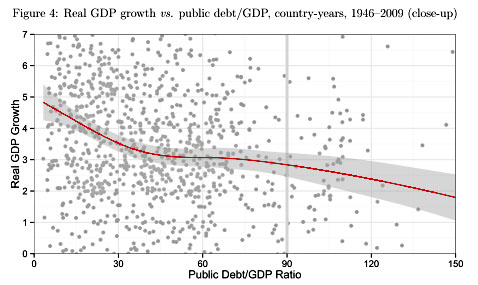
    This is why the R&R incident might be more important for the cause of openness. It’s not just that critics found errors in the dataset once they got hold of it. Even more important might be the fact that once the raw data was available, they were motivated to do certain types of analysis that R&R didn’t do. For example, they discovered that R&R’s results were quite fragile, changing dramatically with the addition or subtraction of just a few observations. They also found that, far from showing a sharp drop in growth when debt passes 90 percent of GDP, the data actually showed a sharp drop between 0-30 percent of GDP and only a rather leisurely decline above 70 percent. Finally, and perhaps most important, UMass economist Arindrajit Dube took a closer look at what the data said about causality, and produced persuasive evidence that R&R’s own data suggested not that high debt leads to low growth, but that low growth leads to high debt. R&R could have performed the same analysis, but for some reason they weren’t interested in it.

    As long as the dataset was private, nobody would ever have known any of these things. We could have guessed them—and a lot of people did—but we wouldn’t have had any evidence. Now we do. Unfortunately, as McArdle says, “the incentives are all wrong for data openness.” This episode suggests why it might be worthwhile to try to change those incentives.

  • Obama Wants Conservatives to Know that Immigration Reform Won’t Be a Rerun of 1986


    What are the odds that immigration reform will pass? Opposition has already started to mobilize from, among others, Alabama Sen. Richard Shelby, who noted the other day, “We’ve seen this movie before — 27 years ago, remember?” Ed Kilgore comments:

    Shelby, of course, is alluding to a “scandal” that most people outside conservative activist circles are at best dimly aware of: the 1986 immigration law that sold “amnesty” under the false flag of reform.

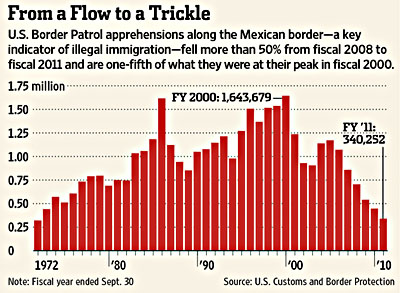
    I guess this is true: most people who are neither conservative activists nor political junkies don’t really remember the 1986 immigration bill. But make no mistake: it’s profoundly driven the approach toward immigration reform from both left and right. Among tea partyish conservatives, the 1986 bill is universally considered one of the great betrayals of all time. They were promised tougher border security in return for a path to citizenship for undocumented immigrants, but in the end they got only a wave of newly legalized immigrants flooding into their towns and schools. The tougher border security was a mirage, discarded almost immediately, which naturally led to yet another new wave of Mexicans crossing the border illegally and yet another call for a path to citizenship for them. As far as conservatives are concerned, they were played for suckers in 1986, and they’re not going to fall for this con again.

    President Obama has done his best to blunt this anger by spending his first term getting tough on undocumented immigrants. E-Verify has been ramped up; deportations have become harsher and more intensive; fences have been built; and funding for the border patrol has been increased. Liberals have been incensed with much of this, but the result—with a big assist from the recession—has been a sharp decline in illegal immigration over the past few years. Generally speaking, Obama’s entire strategy with immigration reform has revolved around proving that he doesn’t plan a rerun of 1986. This time, he’s saying, there really will be tougher border security and tougher employer checks to go along with the path to citizenship.

    Will this work? Conservatives have not been notably willing to credit Obama with much good faith in the past, and even Marco Rubio can only do so much to change that. Nevertheless, this has been the plan all along, and now we get to see if it works. If Obama can convince enough conservatives that he’ll be tougher than Reagan on border security, then immigration reform has a chance. If not, it will probably fail.

  • Obamacare Has Its Problems, But It’s Basically On Track


    Peter Suderman reacts to Sen. Max Baucus’s latest complaint about the implementation of Obamacare:

    If there’s any one legislator who can legitimately claim to be the law’s author, it’s Baucus. So it’s worth paying attention when Baucus says that he thinks the process of setting up the law’s health insurance exchanges is marching towards catastrophe.

    There’s no question that Obamacare faces difficulties. It’s an imperfect law with a lot of moving parts, and it’s also facing tremendous resistance from Republicans around the country, who are doing everything they can to delay, defund, and just generally sabotage it. Put those two things together and smooth sailing was never in the cards.

    But “catastrophe” is stretching things a bit. Baucus is, and has been, concerned about the implementation of Obamacare for some time. Yesterday, at a Senate hearing, he confronted HHS secretary Kathleen Sebelius with his concerns, but this is really nothing new. Oversight is his job, and Baucus is worried that people don’t yet understand the law well and are going to be confused once the exchanges open up:

    Ms. Sebelius replied that the department takes its outreach and education efforts “very, very seriously” and was currently recruiting consumer “navigators” to help with enrollment, but that it is hamstrung in part because it did not get additional resources for those efforts in the 2013 continuing resolution to fund the government.

    “Having said that, we have engaged in efforts with the Small Business Administration, which is doing regular meetings around the country with our regional personnel, and we just released a request for proposals for on-the-ground navigators, individuals who come out of the faith community, the business community, the patient community, the hospital community who will be available to answer questions,” she said. “We also understand that people have a lot of questions and are deploying as many resources as we can to answer those questions and get folks ready to engage in open enrollment on Oct. 1.”

    ….Ms. Sebelius replied several times that officials were “definitely on track to implement the law as it is anticipated and have open enrollment start in every state in the country on Oct. 1st.”

    I don’t expect the implementation of Obamacare to go smoothly. It’s big, it’s complex, it’s underfunded, and Republicans desperately want it to fail. This makes problems inevitable. Nevertheless, pouncing on every reported hitch as a harbinger of doom is taking schadenfreude too far. HHS has consistently claimed that they’ll be ready to go by October 1. Maybe that’s overoptimistic. But although it will probably take several years for Obamacare’s uptake rate to reach its goal, I’ll bet that by this time next year it will be up and running and basically doing its job. It’s a little early to be writing its obituary.

  • A Bit of Sticker Shock Can Reduce Hospital Costs


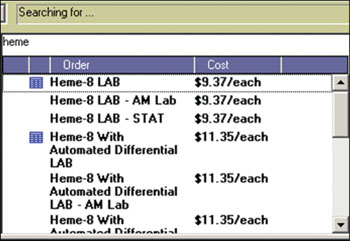
    Sarah Kliff points to an interesting little study today. Conservatives have long suggested that one way to control healthcare costs is to give patients some “skin in the game.” That is, make them pay at least a portion of all bills, which gives them an incentive to shop around for lower prices and to undergo only treatment that genuinely seems worth the cost. But how about giving doctors some skin in the game? To test this, a team of researchers ran a trial at Johns Hopkins Hospital in which the price of certain procedures was displayed on a computer screen when doctors ordered them. Other procedures didn’t display a price.

    The results were encouraging: Compared to a baseline period, doctors ordered nearly 10 percent fewer tests in the group of tests that displayed prices. They ordered 5 percent more tests in the group where prices remained hidden. They figure the hospital saved about $400,000 during the period of the study.

    What I’d really like to see is a time series of this data. Did doctors suffer from a bit of sticker shock and cut down on tests at first, but then slowly ramp back up to their normal rate as the novelty wore off? Or did they cut back and stay at a lower level for the entire six months? I’d also be interested in whether there was any effect on patient outcomes during the course of the study.

    In any case, it’s an intriguing study that deserves replication.

  • War With Syria Just Got a Step Closer


    It’s possible that the biggest news of the week might not be either the Boston bombings or today’s failure of gun legislation to pass the Senate. It might be this:

    The Pentagon is sending about 200 troops to Jordan, the vanguard of a potential U.S. military force of 20,000 or more that could be deployed if the Obama administration decides to intervene in Syria to secure chemical weapons arsenals or to prevent the 2-year-old civil war from spilling into neighboring nations.
    Troops from the 1st Armored Division will establish a small headquarters near Jordan’s border with Syria to help deliver humanitarian supplies for a growing flood of refugees and to plan for possible military operations, including a rapid buildup of American forces if the White House decides intervention is necessary, senior U.S. officials said.

    …The move marks the first deployment that Pentagon officials explicitly described as a possible step toward direct military involvement in Syria….U.S. officials say they have stepped up preparations because the Syrian civil war shows few signs of abating, and a political settlement that includes the departure of President Bashar Assad appears increasingly unlikely.

    Defense Secretary Chuck Hagel insists that military intervention in Syria is still an “option of last resort,” but once operations like this start to ramp up, they often acquire a momentum of their own. This is something to keep a very, very close eye on.

  • Obama is Right: Today is Merely Round One in the Gun Fight


    New York mayor Michael Bloomberg said today that the Manchin-Toomey gun legislation failed because senators are afraid of the NRA:

    Today’s vote is a damning indictment of the stranglehold that special interests have on Washington. More than 40 US senators would rather turn their backs on the 90% of Americans who support comprehensive background checks than buck the increasingly extremist wing of the gun lobby.

    The implication here is that there are a bunch of senators who wanted to vote for M-T, but didn’t because they were afraid of retaliation from the NRA. For the most part, though, that’s not really right. The NRA certainly has the power to make life miserable for politicians who vote against them, but here’s their real power:

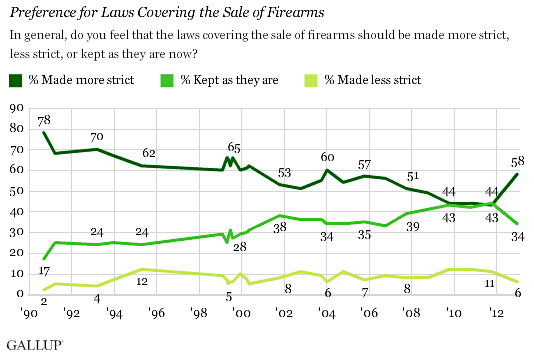
    Generic support for gun control fell from 78 percent to 44 percent over the past two decades. Over that time, the NRA persuaded the public that gun control was a bad idea, and it paid off for them today. The upward blip in support following the Sandy Hook massacre is probably fairly ephemeral, but even if it’s not, 58 percent support just isn’t enough to pass contentious legislation. You generally need two-thirds or more. Even 70 percent support in 1994 was only barely enough to pass a modest assault weapons ban.

    That’s the power of the NRA. They’ve worked hard to get the public on their side, and that brings politicians along automatically. They don’t really need to threaten conservative senators to get their support because conservative senators already agree with them. That agreement is strong enough that even a watered-down background check bill with 90 percent public support can’t overcome a filibuster, and renewal of the assault weapons ban is just flatly out of the question.

    President Obama was right to call this “round one.” This kind of thing is a long-term fight for public opinion, and only after you get the public firmly on your side do you have any real chance of passing serious legislation. So the question today for liberals is simple: Is this issue important enough to keep banging away on it for years on end, the way the NRA does? If not, nothing will ever happen.

  • If You Have a Cash Cow, You Should Milk It


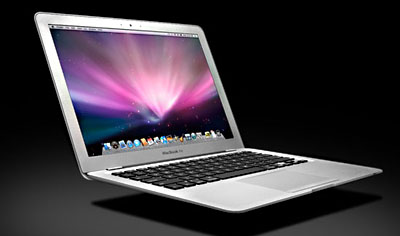
    Matt Yglesias thinks that Apple’s strategy of earning very high margins on Mac desktops and laptops isn’t very smart:

    Apple already has an awful lot of cash. Getting even more cash is not particularly useful for any goal at this point (diminishing marginal utility). So they ought to do something. One smart thing to do would be to make a strategic investment in Mac OS market share since with its current rather small market share Mac profits are not a particularly important part of overall Apple profits, but Mac could and should be an important part of Apple strategy.

    I’ll play devil’s advocate here. As I recall, Matt himself has made the point in the past that plowing money into a declining business usually doesn’t make sense. If you make buggy whips, you should forget about trying to make a better or cheaper buggy whip. Just milk the product for all it’s worth, return the profit to shareholders (or plow it into another product line), and shut the whole thing down when it finally gets too small to be worth running.

    This is actually conventional wisdom, and my guess is that this is how Apple feels about Macs. Could they get more market share if they slashed prices? Maybe. Then again, maybe not. Mac buyers tend to be devotees who are willing to pay more because they love Macs. Anyone who’s truly price sensitive is never going to be a customer anyway—especially these days, when Windows and Mac OS have converged enough that, frankly, there’s not a big difference between them.1

    But the kicker is the fact that the PC market is declining, and no one thinks this is going to reverse in the long term. It’s losing out to tablets and phones and Google glasses. Given that fact, why bother trying to increase your market share a point or two? There’s no long-term benefit since the entire segment is doomed.

    Now, there’s still the question of what to do with the mountains of cash that Macs spin off, and it’s pretty clear that Apple doesn’t yet have any bright ideas on that front. Neither do I. But using it to buy more market share in a declining segment probably isn’t the answer.

    1Yes, I know this is going to start a flame war. Save your breath. I’ve used both Macs and Windows boxes, and modern versions work about equally well and have pretty similar feature sets. There are differences, some that favor Macs and some that favor PCs, and those of us who live and breathe tech will defend them against all comers. But for your average consumer, who just wants to browse the web and send some emails, they’re about the same.

