• China Going Crazy for SUVs


    The SUV craze has hopped the Pacific Ocean and headed to China:

    Gone are the days when buyers in China, the world’s largest car market since 2009, mostly purchased fuel-sipping compacts and subcompacts. Their shift toward larger and ever-more-numerous vehicles is not only driving up China’s oil import bill and contributing to pollution but is also fattening automakers’ profits — and manufacturers made clear over the weekend that they plan to infuse the market with large vehicles.

    General Motors announced that it would introduce nine new or restyled S.U.V. models in China in the next five years, and disclosed that it would build four more factories and add 6,000 jobs to accommodate its ever-rising sales here.

    This is why global consumption of oil doesn’t respond very strongly to higher prices. As incomes go up in developing countries, demand for oil also goes up, and this offsets the reduction in demand due to higher oil prices. You can see this vividly in China, where incomes are increasing steadily and, sure enough, the newly emerging middle class wants SUVs even though world oil prices remain pretty high.

    So what does reduce oil demand? Lower incomes, of course. Recessions reduce oil demand quite nicely. That’s not the answer anyone wants, but it seems to be the correct one.

  • Chart of the Day: Why Global Recovery Has Been So Slow


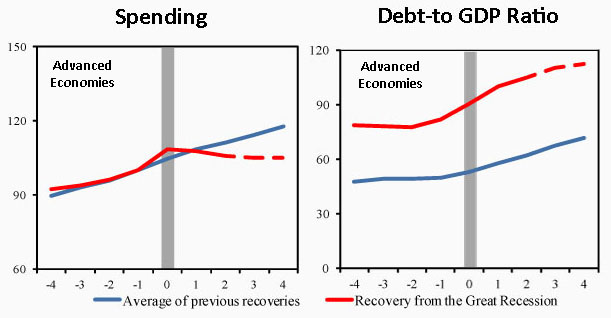
    Over at Vox, a trio of IMF researchers summarize their explanation from the latest World Economic Outlook of why the recovery from the Great Recession has been so much slower than previous recessions. The two charts below tell most of the story:

    • In previous recessions, government expenditures in advanced economies continued to rise during the recovery period, helping to bootstrap a return to growth. This time, spending spiked up during the recession itself, but since then it’s fallen. Austerity, not stimulus, has ruled the day.
    • Why? Probably because advanced countries entered the Great Recession with higher debt ratios than in the past. This is what’s spooked governments into cutting back on spending.

    Rightly or wrongly,1 most central governments have a limited tolerance for debt, and a high debt level therefore restricts their responses to a serious recession. That’s what happened this time around, and it will be even worse next time if debt levels don’t come down over the long term.

    1But which is it, rightly or wrongly? Mostly it’s wrong, especially in the short term during and after a serious recession, but it’s not entirely wrong. There’s certainly some point at which debt service can overwhelm a government, and if investors feel that a country is headed toward that point with nothing to stop it, they’ll start demanding higher interest rates on government bonds. Needless to say, this just makes debt service problems even worse, leading to a death spiral of sorts. So the trajectory of debt probably matters, even if there’s no special debt level at which things fall apart. This, along with the plain fact that governments are spooked by debt, whether we like it or not, is one of the reasons that long-term deficit reduction really is pretty important.

  • A Tax Everyone Can Love (But No One Actually Does)


    Doyle McManus writes today that a carbon tax would promote efficiency, reduce air pollution, slow climate change, and increase energy independence. What’s more, conservative economists like the idea:

    If it were part of a “revenue neutral” deal, in which all the taxes that came in were returned to the taxpayers some other way, it wouldn’t cost a nickel. If it were part of a revenue-raising deal, in which some of the taxes didn’t come back, it could help cut the federal deficit and reduce the national debt.

    So let’s consider this a test of the American political system: How long can Congress resist an idea this good?

    How long indeed? Let’s allow McManus himself to answer the question:

    Until 2011, there was at least one conservative champion of a carbon tax in the House, Rep. Bob Inglis (R-S.C.). But Inglis was defeated in the 2010 GOP primary by a tea party candidate who criticized him for believing in global warming. “I really am the worst commercial for this idea,” said Inglis, who now runs a think tank promoting the carbon tax. “There are lots of Republicans [in Congress] who know better … but they’re not going to come out of their foxholes until they think it’s safe.”

    Okey doke. Last year there were about 240 Republican House members. A grand total of one (1) supported a carbon tax. For this, he was primaried and lost. Today the number of Republican House members who support a carbon tax stands at zero (0).

    So how long can Congress resist an idea this good? Probably a good long time.

  • Who Will Immigration Reform Help More? Republicans or Democrats?


    The other day I was idly wondering whether immigration reform would be better for Republicans or Democrats. Politically, it’s a zero-sum game, so it can’t be both. And if, in the end, supporting immigration reform doesn’t improve GOP electoral prospects, why should they bother supporting it?

    Today, Andrew Gelman points to a piece written a couple of months ago by Alex Engler that takes a look at just this question. Engler assumed a voter turnout of 42 percent and then examined the 20 congressional districts for each party that were most likely to switch sides based on shifts in the Hispanic vote:

    Based on this data, a dramatic shift in Hispanic support toward Democrats would have yielded startlingly small gains in the House. Under the 42 percent Hispanic voting scenario, a 10 percentage point shift toward Democrats would net only one additional seat….Conversely, shifts away from Democrats by Hispanics could be devastating. Under the 42 percent scenario….a 10 percentage point shift to the right would have handed Republicans 12 seats.

    The basic insight here is that Democrats already get such a high percentage of the Hispanic vote that another few points wouldn’t do them much good. But just the opposite is true for Republicans. The chart on the right shows this graphically. The area outlined in yellow represents congressional districts that are (a) heavily Hispanic and (b) in play. There are only a few currently in Republican hands, so even if immigration reform helps Democrats, it won’t do them much good. But there are about 20 currently in Democratic hands. If depriving Democrats of immigration reform as an issue hurts them, Republicans could make significant gains.

    This doesn’t answer the question of which party immigration reform is likely to help. What it does say is that it’s a no-lose proposition for Republicans. Even if it turns out to help Democrats more, Republicans aren’t likely to suffer much because of it.

    Of course, as Engler points out, the fact that immigration reform is likely to help the Republican Party doesn’t mean that it’s likely to help very many individual Republicans:

    Most incumbent Republicans will not have a strong incentive to vote for an immigration bill containing a path to citizenship if a significant Hispanic population appears to be lacking in their districts. In fact, many conservatives may be far more concerned about primary challengers than Hispanic backlash.

    On the other hand, the Republican Party as a whole has a tremendous opportunity to turn districts in their favor. If they can redefine themselves to the Hispanic population, starting with comprehensive immigration reform, they will be doing more than pouring water on the DCCC’s gunpowder—they will be stealing it for themselves.

    This suggests that GOP party leaders probably should push hard to get Republican support for immigration reform. It also means that if they don’t push hard, it’s pretty likely to fail. It’s an interesting analysis.

  • A Style Question on Filibusters for the Times and the Post


    On Thursday I wrote a post about this week’s filibuster of universal background check legislation. My topic was the unwillingness of news outlets to call it a filibuster even though 60 votes were required for passage. Why the reluctance? The reason is that, technically, it wasn’t a filibuster. Harry Reid negotiated a unanimous consent agreement with Mitch McConnell, and among other things they agreed that the background check amendment (along with all the other proposed amendments to the gun bill) would require 60 votes to pass.

    Jonathan Bernstein objected. Here’s his nickel summary of what happened:

    1. There’s a filibuster.
    2. The two sides then decide how to settle the filibuster. The 60-vote threshold UC is an agreement on how to settle the filibuster. Not by waiting it out, not by a cloture vote, but by a 60-threshold vote.
    3. And then the vote itself both resolves the filibuster and resolves the issue. Under 60, the amendment is defeated by filibuster; over 60, it overcomes the filibuster, and also passes the amendment, all in one.

    On Twitter, I joked that Bernstein and I disagreed only on petty details, not the actual question itself, since I think he’s right that this should be called a filibuster. But petty details are what the blogosphere was invented for, and they’re important here as a way of understanding why the press continues to refuse to call this week’s events a filibuster.

    The key question is a semantic one. What’s the definition of a filibuster in the U.S. Senate? There are basically two approaches to this:

    The strict rules-based approach. During the early 70s, in response to the increasing complexity of Senate life, a set of procedures emerged for conducting and resolving filibusters. Senators (usually from the minority party) were no longer required to actually speak to sustain a filibuster. Instead, they signaled their intent to filibuster by notifying their party leader to place a hold on a bill. Once this was done, the majority leadership would either negotiate a compromise or else schedule a cloture vote. If the cloture vote succeeded, the bill would proceed. If it failed, the bill died.

    The broader academic approach. In the academic literature, the definition of a filibuster is broader. Here’s Gregory Koger: “Filibustering is delay, or the threat of delay, in a legislative chamber to prevent a final outcome for strategic gain. The key features are the purpose (delay) and the motive (gain) and NOT specifying the legislature or the method.”

    Under the strict rules-based definition, what happened last week wasn’t a filibuster. There was no hold and there was no cloture vote. Under the broader definition, what happened was clearly a filibuster. The method wasn’t the classic one, but there was certainly a threat of delay in order to prevent a final outcome (passage of the background check amendment). The resolution was a unanimous consent agreement rather than a cloture vote, but that’s immaterial. It’s still a filibuster.

    So here’s the question: why has the press been so reluctant to describe modern filibusters as filibusters? The actual conduct of filibusters has changed over the years, but for some reason style guides haven’t kept up. In fact, even 70s-style filibusters often aren’t described as filibusters. Reporters seem to be stuck in an ancient era when a filibuster meant Jimmy Stewart performing a talkathon on the Senate floor, and they aren’t willing to call anything else a filibuster.
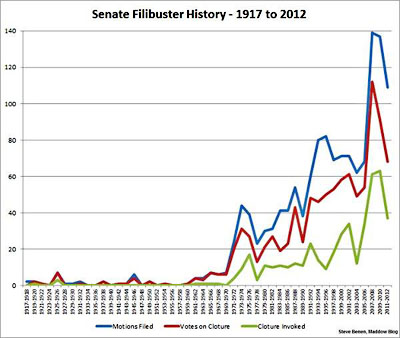
    But Bernstein is right. Times change and procedures change. In the past, senators would talk and the opposition would either try to wear them down or negotiate a compromise. That evolved into a more modern form with holds and cloture votes. Then it evolved yet again into an institutionalized form where filibusters are simply assumed and the two party leaders negotiate a unanimous consent agreement based on that assumption. (This is one reason why cloture votes have decreased recently even as the Senate has filibustered more and more bills. Steve Benen’s chart on the right shows this.) Nonetheless, all of these things are filibusters. Only the methods differ.

    So here’s a question for the public editors of the Washington Post and the New York Times: why do your style guides continue to insist that only a very specific set of old-style obstruction tactics can be called a “filibuster”? Why not keep up with the reality of legislating? In the modern Senate, unanimous consent agreements are now a common method of declaring and resolving filibusters. So why not call them that?

  • Friday Cat Blogging – 19 April 2013


    Some weeks you need Friday catblogging more than other weeks. This is one of those weeks. Yesterday it was 80 degrees in the backyard, so that’s where Domino spent the afternoon, soaking up the warmth while the rest of us worried about terrorist bombings, exploding fertilizer plants, and failed gun bills. If events get to be too much for you, I recommend staring at this picture and zoning out for a bit.

  • Tea Party Smells Blood In Immigration Fight


    Glenn Thrush and Reid Epstein report on one of the reasons that gun legislation failed in the Senate yesterday:

    In the end, [] moderates and conservatives in the upper chamber said they simply couldn’t deal with a flurry of progressive issues at once — from gay marriage to immigration to guns….One senator told a White House official that it was “Guns, gays and immigration — it’s too much. I can be with you on one or two of them, but not all three.”

    Some are taking this to suggest that voting against the gun bill gives conservatives a little more room to maneuver on immigration. So the silver lining here is that all the no votes on guns might mean a few more yes votes on immigration. Ed Kilgore is skeptical:

    I wouldn’t put much reliance on the idea that the demise of Manchin-Toomey is a blessing in disguise for progressives or for those still pining for a “bipartisan breeze” in Washington. For one thing, to continue the propitiation metaphor, the “base” is a jealous god, which views every act of ideological “betrayal” as sufficient to justify primary excommunication or primary challenges. For another, this fresh demonstration that “the base” has the power to compel party discipline on guns (only three Republicans joined former Club for Growth president Pat Toomey in the end) will make the desire to impose it on other subjects seem much more practicable. And third, to focus on the next issue coming up in the Senate, it’s never been clear to me that the obsessive desire to find a way to detoxify the GOP among Latino voters–which is the elite factor driving the interest of Beltway Republicans in immigration reform–is shared that widely among hard-core conservative activists, who are more likely to think that insufficient ideological rigor continues to be the party’s biggest problem.

    I agree. Think about it from a liberal perspective. When the repeal of DADT passed in 2010, did we all breathe a sigh of relief and decide to give Democrats a pass on other legislation? Not a chance. On gay issues in particular, it simply convinced us that we were on the right side of history and that now was the time to push even harder than ever. On other issues, it didn’t make much difference at all.

    The same is true of the tea partiers. Winning produces energy, not apathy. Having smelled victory in the gun fight, they’re now even more determined that they can win the immigration fight too. This was always going to be a very tight battle, and so far nothing has changed that. 

  • Boy Scouts Poised to Admit Gay Members


    Today’s news from the Boy Scouts:

    The Boy Scouts of America called to end a long-standing ban on openly gay members, a spokesman said on Friday, but the organization’s board must still vote in May on whether to ratify the resolution. If the vote is approved, “no youth may be denied membership in the Boy Scouts of America on the basis of sexual orientation or preference alone,” Deron Smith, the organization’s spokesman, told Reuters.

    ….”This is a historic change for the Boy Scouts,” said Patrick Boyle, whose 1994 book “Scout’s Honor” examined sexual abuse in the Boy Scouts of America. “You have a more than hundred-year-old organization changing what it considered a fundamental belief just a decade ago. That says a lot about the Scouts and a lot about how far the gay rights movement has come in the United States.”

    One of the key drivers of the continuing anti-gay policy from the Boy Scouts has been the fact that so many scout troops are sponsored by the Mormon Church. But the longtime Mormon fight against gay marriage, and specifically its support for California’s Proposition 8 in 2008, has been a “PR fiasco” for them. As Stephanie Mencimer reported for us a few days ago, this has led to some changes:

    In the five years since the LDS church sent busloads of the faithful to California to canvass neighborhoods, and contributed more than $20 million via its members to support the initiative, it has all but dropped the rope in the public policy tug of war over marriage equality. The change stems from an even more remarkable if somewhat invisible transformation happening within the church, prompted by the ugly fight over Prop. 8 and the ensuing backlash from the flock.

    ….In response to the anger within Mormon ranks over Prop. 8, the president of the Oakland, California, stake (a stake is akin to a Catholic diocese) began organizing gatherings of gay and straight members to try to bridge the differences. In September 2010, the disgruntled church members received a private audience with one of the church’s top officials, Marlin Jensen, who serves as the LDS’s historian….After listening to them talk, Jensen did something almost unheard of in a church whose strict authoritarian hierarchy is unaccustomed to being challenged from below: He apologized “for the pain that Prop. 8 caused [us],” Mayne recalls, choking up at the memory. It was, he says, a “very meaningful event.”

    The apology from a high church official turned out to be just the beginning of a cultural shift toward greater acceptance of gays and lesbians within LDS ranks. In 2011, Mayne was called to serve as an official of his local San Francisco ward, as an openly gay man. It was a historic appointment in an institution with a long history of excommunicating openly gay members, which it referred to as people who were “afflicted” with same-sex attraction.

    Officially, the LDS church hasn’t changed its policies, but I imagine that behind the scenes its opposition to gay scouts has been considerably tempered in the past few years. This probably played a significant role in today’s decision.

  • Immigration Reform Took a Hit Today


    The anti-immigration right has jumped on this morning’s news to argue that this is not the time to loosen our immigration laws. After all, the two guys who set off bombs at the Boston Marathon have turned out to be a pair of immigrants. As radio host Bryan Fischer says, “Time to tighten, not loosen, immigration policy.” Greg Sargent comments:

    It’s unclear thus far how widespread the effort among conservatives will be to connect the Boston bombing suspects to the immigration reform debate. But it’s certainly something that bears watching. If this argument picks up steam, it will be another indication of how ferocious the resistance on the right to immigration reform is going to get.

    I think it’s safe to say that this argument will pick up steam. Why wouldn’t it, after all? It’s a gut punch to the idea that immigrants are no more dangerous than natives, and it doesn’t matter which side logic is on. It’s a strong appeal to emotions, and it’s probably an effective one.

    A few days ago, someone asked: Who are you secretly hoping the bombers turn out to be? My answer was, whatever kind of person is least likely to have any effect whatsoever on public policy. Chechnyans with a grudge of some kind actually fit this bill fairly well, and since the immigration debate is focused mostly on Mexico it might not even have too much impact there. Still, it will have some effect. I don’t know if today’s news will kill immigration reform, but a bill that was on a knife edge already doesn’t need any further setbacks. This is going to hurt its chances.

  • The Next Step in Social Media Pranking


    Dave Weigel reports that a fellow with the Twitter handle @FootyTube_ quickly changed his handle last night to @Dzhokhar_ and swapped out his avatar for a thumbnail of the suspect in the Boston bombings. That’s hilarious!

    Or not. But I predict a growth industry in this kind of thing. FootyTube’s idiocy was easy enough to see through, but someone out there now has the bright idea of creating a Twitter/Facebook/Tumblr/etc. account and populating it over time with grievances of some kind. Islamic, gun nut, anti-tax, libertarian, PETA, whatever. Just create a nice long chain of posts and then wait for the next terrorist attack. As soon as pics and names are available, switch the account name, make it public, and wait to be discovered.

    Actually, I’m a little surprised this hasn’t happened yet. It takes some planning ahead and could be a little tedious, but surely there are plenty of bright high school juniors who are bored enough to think this would be a pretty cool prank?