• Con Men Love Tax Havens


    The Washington Post wins April’s Least Surprising Headline of the Month award with this entry today:

    On a serious note, it’s actually an interesting piece. The Post worked with the International Consortium of Investigative Journalists, which somehow obtained 2.5 million records created by a couple of offshore companies. “Among the 4,000 U.S. individuals listed in the records, at least 30 are American citizens accused in lawsuits or criminal cases of fraud, money laundering or other serious financial misconduct.” It’s worth a read to get an idea of what kinds of scams and frauds get hidden by these tax havens.

  • Crime Is Down in Los Angeles (And Everywhere Else Too)


    Hey, guess what?

    With the first quarter of 2013 in the books, crime in Los Angeles has so far continued its decade-long decline, according to statistics released Friday.

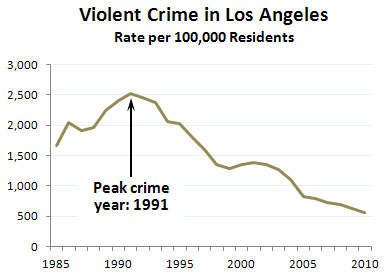
    OK, first off: can we please stop talking about LA’s “decade-long” crime drop? I know I’ve mentioned this often enough that I sound like a crank on the subject, but it’s important. If crime started declining in 2003, it might well be due to improved policing techniques introduced by Bill Bratton in 2002. But if it started declining in 1991—which it did—then the cause has to be something else, unless Bratton invented not just CompStat, but time travel as well. Moving on:

    Mayor Antonio Villaraigosa and Police Chief Charlie Beck announced the early but notable improvement at a press conference that served as a swan song for the mayor, who will leave office this summer after being termed out….Beck highlighted the significant declines in gang-related killings and other crimes — a result, he said, of close cooperation between his department and the city’s aggressive anti-gang programs that.

    ….”There is no other big city in America that can make these claims. I invite any of you to go to Chicago, go to New York, go to Houston … and see if you can find a replication of this effort. You cannot,” Beck said.

    Look: the crime decline in Los Angeles has been impressive. More cops on the street have probably been effective. Beck’s gang initiatives have probably been effective—maybe even more effective than in other places. But no other city can make these claims? It’s exactly the opposite: nearly every big city can make these claims. The violent crime rate in Phoenix is down 52 percent from its peak. Washington DC is down 58 percent. Chicago is down 66 percent. Dallas is down 70 percent. New York is down 75 percent.

    In California, San Jose is down 58 percent. San Francisco is down 61 percent. San Diego is down 67 percent.

    We should all applaud anti-crime initiatives that seem to be effective. But we should also rigorously question whether they’re effective. And we shouldn’t mindlessly repeat claims that just flatly aren’t true, no matter who or where they come from. The public deserves to hear the full story about crime in America, not just the part that’s convenient for politicians singing their swan songs or police chiefs who want funding for more cops.

  • Yes, Disability Payments Are Up, But It’s Nothing to Act Surprised About

    Last week I blogged about a Planet Money story on the steady increase in Social Security disability payments over the past couple of decades. The story was more nuanced than I think its critics gave it credit for, but there’s no question that the big takeaway for most people was the notion that lots of workers with only minor disabilities are being allowed into the program simply because the economy is bad and they probably can’t find work after they’ve been laid off.

    Friday night this was a topic of discussion on the Chris Hayes show. One of the guests was Michael Astrue, a former commissioner of the Social Security Administration, and it’s fair to say that Astrue was pretty exasperated about the whole affair. One of the points he made was this: Nothing has skyrocketed. Nothing has suddenly spiraled out of control. The program today is spending exactly as much as it was forecast to spend back in 1994, the last time Congress revised the disability law.

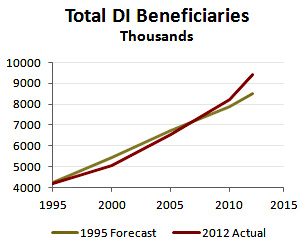
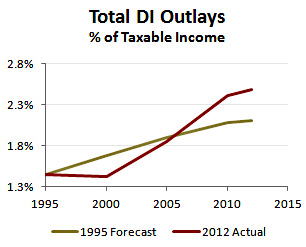
    That struck me as a pretty strong argument. If we really are exactly in line today with the predictions made 20 years ago, then obviously nothing is out of control. So I checked. I pulled up the 1995 trustees report and the 2012 trustees report and compared the 1995 forecast with the 2012 reality. Here’s what it looks like:

    Astrue is pretty much correct—though not entirely. In 2012, there were about 10 percent more people receiving disability than was forecast in 1995. Total outlays were about 18 percent higher than forecast.

    That’s not nothing, but it’s not a lot, either. There are two things going on. First, ever since 2000 the number of beneficiaries has been growing slightly faster than the original 1995 forecast. Second, there was a small extra spike starting in 2009, probably due to the Great Recession. This partly vindicates the Planet Money story, which suggested that (a) standards had loosened a bit over time, and (b) people who otherwise might have gutted it out and returned to work in better times decided to go on disability instead when jobs became scarce.

    However, it doesn’t vindicate it very much. These factors have been responsible for only a small extra blip in the number of people approved for disability payments. The blip in outlays is a bit bigger, but that’s mostly a mirage: the recession reduced taxable income below forecast, which artificially inflates the outlay figure because it’s calculated as a percentage of income. By far the majority of the growth in the disability program has been due to simple demographics (as the boomer generation ages, more of them go on disability), and it was baked into the forecast two decades ago. We shouldn’t act shocked now that the forecast is coming true.

  • Friday Cat Blogging – 5 April 2013


    Today we have an aerial view of Domino. She’s lounging on the very first quilt Marian made, a 1985 crib quilt based on a pattern called Snowball, by Marsha McCloskey.

    It also demonstrates one of the great things about quiltblogging: it’s really easy. Basically, you just put a quilt somewhere, twiddle your fingers for a minute or two, and suddenly a cat appears. It’s like magic. I put this one on the floor just below our second-story hallway, so all I had to do was go upstairs, point the camera downward, and then make stupid noises to get Domino to look up at the camera. Eventually it worked.

  • CDC Reports That Lots of Kids Still Suffer From Lead Poisoning


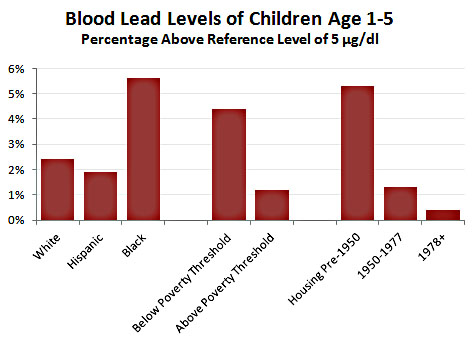
    Via Susie Cagle of Grist, here’s the latest from the CDC on blood lead levels in young children. We’ve known for a long time that lead is dangerous in much smaller concentrations than previously thought, and last year the CDC finally adopted a “reference level” of 5 ug/dl for the study of lead in kids. In its latest study, CDC reports that a total of 2.6 percent of children age 1-5 have blood lead levels above 5 ug/dl. That’s bad (though better than it used to be), but it’s also not evenly distributed. If you’re black, or poor, or live in old housing, the odds that your kids have elevated lead levels is much higher. The chart below tells the story.

    As the CDC says, “Childhood exposure to lead can have lifelong consequences.” This includes cognitive damage that reduces IQ and contributes to poor performance in school. It also produces cognitive damage that increases the propensity to commit violent crime. But you knew that already, right?

  • Is the U.S. Economy Powered by Dark Matter?


    Karl Smith is bullish on America:

    “The Great Takedown” […] is the not yet realized bombshell that the US in general and the US Federal Government in particular made out like gangbusters in the Great Recession. I am still trying to tie this all together but a full accounting of US Treasury “profits” from the Global Financial Crisis look to number in the trillions.

    This is based on a theory that if you value assets correctly, based on their financial return, the apparent multi-trillion dollar increase in the U.S. current account deficit over the past few decades hasn’t actually happened. It’s been offset by exports of “Dark Matter” that aren’t included in official accounts:

    The US is a net provider of knowledge, liquidity and insurance. As the world became more global financially, the increasing asset value of these services underlies the spectacular increase in dark matter over the last two decades.

    As a result, foreign-owned U.S. assets are worth less than official accounts suggest and U.S.-owned foreign assets are worth more. Karl is excited because Paul Krugman kinda sorta endorsed this theory today, but it’s worth noting that Krugman leaves open the question of whether there’s really been a mis-valuation of assets, or whether this is basically a dangerous leverage play that relies on using cheap U.S. debt to buy risky foreign assets, assuming that those risky assets will pay high returns forever.

    Beats me. This is way above my pay grade. But interesting!

  • Chained CPI and the 2014 Midterms


    Now that President Obama is poised to officially endorse the adoption of chained CPI in his next budget—a change that would cut the future growth of Social Security benefits—Ed Kilgore ponders the political implications:

    Could Republican congressional candidates in 2014 actually run against “Obama’s Social Security Cuts,” after decades of lusting for “entitlement reform” and several consecutive years of demanding that Obama give Social Security benefits a haircut or worse?

    Ha ha ha! That’s a knee slapper. To his credit, Ed comes up with the obvious answer: Of course they could.

  • I Doubt That Obama Really Expects a Grand Bargain With Republicans


    Greg Sargent tries to explain White House thinking on their decision to embrace entitlement cuts in next week’s budget proposal:

    They believe a Grand Bargain is good for Democrats in general, because it essentially would lock in a medium-term agreement over core disputes — about the safety net and about the size of government, and who should pay for it — that have produced a debilitating stalemate in Washington.

    Yes, Republicans would continue railing about government spending, the thinking goes, but no one would listen, since they would have already endorsed a deal stabilizing the deficit. This would deprive Republicans of the ability to focus attention on one of their core targets — Big Government — as a way to avoid grappling with other issues, such as jobs and long-term middle class economic security, immigration, guns, and perhaps even climate change. Reaching a deal on the deficit will force Republicans to confront those problems more directly and to choose between real cooperation on them or continue to calcify as a hidebound, reactionary party incapable of addressing major challenges facing the country.

    Yeah, maybe. Of course, that’s also a pretty good reason for Republicans to refuse to cut a deal. Why bother if all it does is pave the way for Obama to spend lots of time on wedge issues that are good for Democrats and bad for them?

    The truth is that, for the most part, the deficit isn’t a real issue for Republicans. They don’t want to raise taxes; they don’t want to cut defense spending; they don’t want to cut entitlement spending on seniors (the core of their base); and cutting future entitlements doesn’t affect the deficit any time soon. The only thing left is cutting spending on the poor, and although Republicans think that’s a fine idea, even they can’t cut social welfare spending enough to have a serious impact on the deficit.

    So it’s mostly a charade. And it’s a good one! One of the very best, in fact. Cutting the deficit polls well, it lends itself nicely to demagoguery, and it’s an all-purpose excuse to oppose any spending proposals they don’t like. So why on earth would you cut a deal to take it off the table? That would be crazy. And if they’re forced to swallow a tax increase as well, that makes it even crazier. There’s literally no benefit at all in this for Republicans.

    So they won’t do it. Obama’s real hope—since I assume he’s not an idiot and knows all this perfectly well—is that Republicans will indeed refuse to make a deal, and, as Sargent suggests, this could turn the public against them in the 2014 midterms. I suppose that’s possible, depending on how well he plays his hand. It’s certainly more possible than assuming that Republicans will voluntarily commit electoral suicide by agreeing to a deal.

  • Obama Plans to Offer Very Public Entitlement Cuts in Budget Next Week


    President Obama’s long-delayed budget will finally make it to Congress next week. Jackie Calmes reports:

    In a significant shift in fiscal strategy, Mr. Obama on Wednesday will send a budget plan to Capitol Hill that departs from the usual presidential wish list that Republicans typically declare dead on arrival. Instead it will embody the final compromise offer that he made to Speaker John A. Boehner late last year, before Mr. Boehner abandoned negotiations in opposition to the president’s demand for higher taxes from wealthy individuals and some corporations.

    Congressional Republicans have dug in against any new tax revenues after higher taxes for the affluent were approved at the start of the year. The administration’s hope is to create cracks in Republicans’ antitax resistance, especially in the Senate, as constituents complain about the across-the-board cuts in military and domestic programs that took effect March 1.
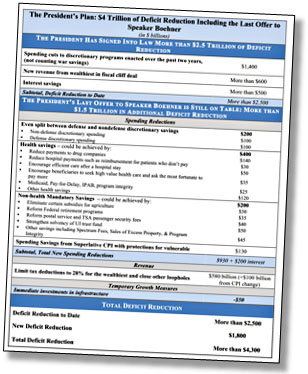
    It’s not clear precisely what this means, but it sounds as if it mostly embodies the president’s sequester-replacement plan that’s been on offer for the past two months, which includes about $1.1 trillion in spending cuts over ten years and $700 billion in new revenue. Among other things, this plan offers to cut Medicare by reducing reimbursement levels and cut Social Security by adopting chained CPI. Presumably, however, it will present those cuts in considerably more detail than Obama has done before.

    This will be an interesting test of the theory that one of the things preventing a deal has been simple Republican ignorance of what Obama has offered. Once these things are in the official budget, there’s simply no way to ignore them. They’ll get a ton of coverage—including massive outrage from the liberal base—and there will be enough detail that even Bill O’Reilly should be satisfied that Obama is offering a “real plan.” The fact that Obama is proposing serious cuts in entitlements will finally be impossible to ignore.

    Will this pave the way for a deal? I have my doubts, because I never thought that ignorance was truly a roadblock. Any Republican paying even minimal attention knew what Obama was offering earlier this year, and the ones not paying minimal attention simply didn’t want to know. Their ignorance was mostly a deliberate strategic choice: it allowed them to continue railing against Obama without having to engage with the facts of what he was offering, and that was pretty convenient for most of them. This option will be taken away next week, but since it was never the true roadblock, they’ll simply switch to other objections.

    At least, that’s my guess. As a strategy to change the media narrative, this might work, but as a strategy to change Republican priorities, it won’t. It will simply be the latest in a long line of preemptive concessions, none of which have worked before. Republicans will treat the spending cuts as a new baseline to negotiate down from, while treating the revenue increases as dead on arrival.

    But I might be wrong! Certainly it will change the tone of the conversation, and the more outraged liberals get about this the better it will be for Obama. Next week we’ll start to find out.

    UPDATE: It turns out we don’t have to wait until next week after all. All we have to do is read Politico right now:

    House Speaker John Boehner immediately dismissed President Barack Obama’s package of significant new entitlement cuts tied to new tax revenues, calling them “no way to lead and move the country forward…..Boehner said he will not consider new revenues as part of the deal, arguing that “modest” entitlement savings should not “be held hostage for more tax hikes.”

    Quite a shocker, no?

  • Chart of the Day: Net New Jobs in March


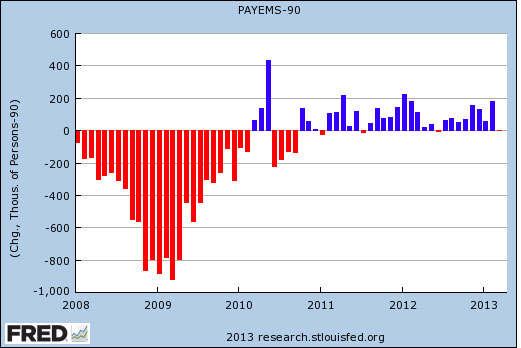
    The American economy added 88,000 new jobs last month, but about 90,000 of those jobs were needed just to keep up with population growth, so net job growth was actually slightly negative at -2,000 jobs. That’s terrible. It’s yet another spring swoon, but even earlier than usual. Ever since the end of the Great Recession we’ve been stuck in an odd pattern where employment growth looks promising in winter and then falls off a cliff in spring, but usually the dropoff doesn’t happen until April or May. We’re early this year.

    Workers continued to drop out of the workforce in large numbers, so the labor force participation rate declined by 0.2 percentage points to 63.3 percent. As a result, despite the terrible jobs numbers the headline unemployment number actually went down to 7.6 percent. The private/public breakdown of the employment numbers followed the same trend as it has for the past few years, with the private sector gaining 95,000 jobs and the public sector losing 7,000 jobs. The size of government continues to decline.

    Some of this bad news may have been due to the fiscal cliff deal in January, and the end of the payroll tax holiday, but it’s probably too early for any of it to be due to the sequester. However, we can expect that to start biting in April and May. Nice work, Congress.

    All in all: yuck.