
• Arkansas Accepts Medicaid Expansion, But Not Via Medicaid


    Ed Kilgore, once again directing his gimlet eye at goings-on in his native South, points us today to a report that Arkansas plans to accept the full expansion of Medicaid that’s part of Obamacare. The gotcha is that Arkansas’ Republican legislature is insisting that instead of receiving traditional Medicaid, all the new beneficiaries will get benefits via private insurance purchased on Obamacare’s exchanges. This will almost certainly be more expensive, but apparently Republicans are so enamored of a private solution that they’re willing to accept this.

    Ed is pretty gobsmacked by that, but I’m a little more willing to wait and see how it works out. In particular, I happen to think this may solve a legitimate problem. Here’s the tail end of an article in the Arkansas Times:

    Department of Human Services Director John Selig speculated that things would actually run more smoothly. “The most difficult part of the exchange was going to be people going from Medicaid to private insurance, back and forth as they went up and down [the] income line,” he said. “Now, you just keep [the private insurance company] as you go up or down. In a lot of ways this simplifies what happens on the exchange.”

    This really is an issue with the Medicaid expansion, and it’s a well known one. If you’re at 130 percent of the poverty level this year, you qualify for Medicaid. If you get a raise and go up to 140 percent next year, you no longer qualify and instead have to navigate the exchanges. If your hours are cut back and you fall to 130 percent again the year after that, it’s back to Medicaid.

    How big a deal is this? That’s hard to say. But it’s not a made-up issue, and it’s possible that the Arkansas approach could legitimately be better. What’s more, I’m OK with allowing states to experiment within limits. It’s the only way to find out whether or not the exchanges really are more expensive, and whether or not the Medicaid ping-pong really is a serious problem. The ideology behind this decision might be misguided, but there’s a good chance we’ll get some useful data out of it regardless.

  • Shale Gas Fracking Will Be Around For a Long, Long Time


    The Wall Street Journal reports that the shale gas boom is going to last for decades:

    The most exhaustive study to date of a key natural-gas field in Texas, combined with related research under way elsewhere, shows that U.S. shale-rock formations will provide a growing source of moderately priced natural gas through 2040, and decline only slowly after that. A report on the Texas field, to be released Thursday, was reviewed by The Wall Street Journal.

    ….Looking at data from actual wells rather than relying on estimates and extrapolations, the study broadly confirms conclusions by the energy industry and the U.S. government, which in December forecast rising gas production. “We are looking at multi, multi decades of growth,” said Scott Tinker, director of the Bureau of Economic Geology at the university and a leader of the study.
    I don’t have access to the study of the Texas field, let alone the “related research” on other shale gas fields, but the press release from the University of Texas does include the chart on the right, which suggests that the Barnett field peaked last year and is now in decline. In 15 years it will be producing at half its peak rate.

    But that’s still a lot of shale gas between now and 2050, when the field will be exhausted. And it’s going to require drilling a lot more wells along the way, since individual wells tend to produce for only a short time. Given this, it sure would be nice to work out the possible environmental damage of shale fracking on air and groundwater now, instead of waiting until 2030 or so, when it will be too late.

  • The Chinese Bond Meme That Refuses to Die


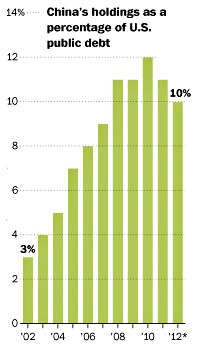
    Robert Solow had an op-ed in the New York Times yesterday “emphasizing six facts about the debt that many Americans may not be aware of.” For example, half our debt is owned by foreigners; it’s owed in dollars, which is our own currency; and while this debt could spark inflation and soak up private savings that would otherwise go into useful investment, that’s not going to happen in a weak economy like the one we have now. CFR president Richard Haass tweets that Solow isn’t pessimistic enough about rising interest rates and the “ability of a hostile foreign govt to pressure US,” but Dan Drezner thinks that, if anything, Solow is painting too grim a picture:

    As for Haass, I’m not exactly sure what “rising rates” he’s talking about, as just about any chart you can throw up shows historically low borrowing rates for the United States government. Indeed, the U.S. Treasury is exploiting this fact by locking in U.S. long-term debt at these rates. As for foreign governments pressuring the United States, the fear of foreign financial statecraft has been overly hyped by the foreign policy community. And by “overly hyped,” I mean “wildly, massively overblown.”
    The bias in foreign policy circles and DC punditry is to bemoan staggering levels of U.S. debt. This bias does percolate down into the perceptions of ordinary Americans, which leads to wild misperceptions about the actual state of the U.S. economy and U.S. economic power. I’d like to see a lot more op-eds by Solow et al that puncture these myths more effectively.

    This claim that China will be able to blackmail or extort America because of all the U.S. debt it owns is a zombie idea that just won’t die. The truth is that China’s holdings of U.S. treasuries give it no leverage to speak of; pose no danger to America; and China’s recent actions demonstrate pretty conclusively that they know this perfectly well. Hell, China’s share of U.S. debt has gone down for the past two years. This whole meme really needs to die.

  • Seriously, WTF Is Up With Bob Woodward?


    I was busy with something else and somehow missed the big Bob Woodward spat last night. Toward the end of the evening I reconnected with Twitter and caught up with a few exhausted tweets from people who were tired of the Woodward thing, or disgusted with the Woodward thing, or whatever, but I didn’t quite realize that something genuinely new had happened.

    But yes. It’s splashed all over Drudge: “White House Threatens Woodward”! WTF? Well, one of the nice things about missing this in real time is that the whole story has now played out and I can catch up with it in a few minutes. Basically, Woodward told CNN that a “very senior person” at the White House had threatened that he would “regret doing this” if he published a story saying that the sequester originated with Obama. After fast forwarding through an entire day of confused stories, it turns out the official is Gene Sperling, and here’s the email he sent Woodward last Friday:

    I apologize for raising my voice in our conversation today. My bad. I do understand your problems with a couple of our statements in the fall — but feel on the other hand that you focus on a few specific trees that gives a very wrong perception of the forest. But perhaps we will just not see eye to eye here.

    But I do truly believe you should rethink your comment about saying saying that Potus asking for revenues is moving the goal post. I know you may not believe this, but as a friend, I think you will regret staking out that claim. The idea that the sequester was to force both sides to go back to try at a big or grand barain with a mix of entitlements and revenues (even if there were serious disagreements on composition) was part of the DNA of the thing from the start. It was an accepted part of the understanding — from the start. Really. It was assumed by the Rs on the Supercommittee that came right after.

    Woodward responded the next day that Sperling had no need to apologize. “I for one welcome a little heat; there should more given the importance.”

    Some threat, huh? As a friend put it via email, “It’s odd that a reporter who you would have to assume has had many run-ins, shouting matches, accusations, etc. would go public with his perceived slights. I can’t imagine a junior reporter taking this tack now and not being chastised for mishandling it.”

    Something very odd is going on with Woodward. The point of Sperling’s email is clear: he’s not taking issue with the idea that the White House proposed the sequester, but he does think Woodward is wrong when he says both sides agreed that the sequester substitute would be purely spending cuts with no tax increases. Virtually everyone in Washington agrees that Woodward is wrong about that, yet he’s been repeating that line for the past week in the face of mountains of evidence to the contrary.

    What’s more, Sperling quite clearly didn’t threaten Woodward, and Woodward didn’t take it as a threat at the time. Again: WTF?

  • Why Aren’t Conservatives Interested in Healthcare?


    Here’s something new. CPAC, the right wing’s big annual gabfest, has come in for a lot of criticism recently for being too hidebound and insular to give Chris Christie a speaking slot at their conference in March. Today, though, Philip Klein takes them on for the opposite sin: giving up on conservatism by not holding an Obamacare panel this year. However, he admits this is less a CPAC problem than simply a problem with conservatism itself:

    Conservative activists often disregard health care as a liberal issue […] and only become engaged when liberals attempt to advance big government solutions.

    In 1993 and 1994, for instance, when the Clintons were pushing their national health care plan, the conservative movement rose up to successfully defeat it. But then, instead of taking advantage of the intervening 15 years to advance market-based solutions to health care, conservative activists largely ignored the issue.

    ….A few scholars such as Sally Pipes, John Goodman, Grace-Marie Turner, David Hogberg and Greg Scandlen were consistently writing about how to foster the creation of a consumer-based medical system. But health care just didn’t generate any passion at the grassroots level until Obama began his health care push….In hindsight, the interest in health care policy on the Right is looking more like a fad built around opposition to Obamacare.

    There’s a pretty obvious conclusion to be drawn here: conservatives actually don’t care much about healthcare. Just like they don’t care much about income inequality or particulate poisoning. These just aren’t hot button issues on the right, and the truth is that the grass roots isn’t much interested in egghead ideas about consumer-directed healthcare.

    In other words, the recent blooming of interest in healthcare policy really was just a fad built around opposition to Obamacare. Nobody in the conservative movement ever had the slightest intention of following through on the “replace” part of “repeal and replace.”

    So Klein is right about that. But he doesn’t take the next step: asking why conservatives have no real interest in healthcare policy. If there really are some conservative scholars working in this area, why haven’t their proposals sparked any interest among the rank-and-file? From my liberal perspective, the answer seems obvious, but I’d be curious to hear what Klein thinks. He’s got the symptom right, but what about a diagnosis?

  • It Looks Like Pre-Clearance Is Doomed


    The 1965 Voting Rights Act requires certain states with histories of racial discrimination to pre-clear any election changes with the Department of Justice. Conservatives have been arguing for years that this provision of the VRA is antiquated and should be struck down. The Supreme Court heard yet another argument on this subject today, and this time it looks like opponents are finally going to win. Here’s election law expert Rick Hasen:

    A few years ago, I would have had a smidgen of sympathy for the opponents of pre-clearance. Maybe half a century is long enough. But given the rash of racially charged voter suppression efforts of the past three years—photo ID laws, early voting shenanigans, voter purges, etc.—this sure seems like a wildly inopportune time to pretend that we’ve overcome the demons of our past. Personally, I think I’d vote to expand pre-clearance at this point. Republicans like to claim that the VRA is unfair because it’s not just the South that does this stuff, and their point is well taken. The solution just happens to be the opposite of the one they’ve proposed.

    More here from Adam Serwer on Chief Justice John Roberts and his long war against the VRA.

    UPDATE: Hasen’s site is back up, and his full post is here.

  • Skip the Rules, Let’s Just Allow Smart People to Stay in the United States


    Felix Salmon is enthusiastic about the latest version of the Startup Act, sponsored by a bipartisan group of senators. In particular, he likes the idea of creating an “immigrant-entrepreneur visa”:

    The immigrant-entrepreneur visa is pretty simple. You create a pool of 75,000 such things, available to anybody who’s here already on an H1-B or F-1 visa. When those people switch from their old visa to their new one, they have to start a new company; employ at least two full-time, non-family member employees “at a rate comparable to the median income of employees in the region”, and invest or raise at least $100,000. After that, they have to continue adding employees at a rate of one per year, so that after three years, there must be at least five employees. At the end of three years, you graduate to a green card, and with it the standard path to citizenship.

    The new visa would create an employer exit strategy for H1-Bs, allowing workers to leave companies which pay too little or offer too few opportunities, and instead strike out on their own. And of course — by definition — it would create jobs.

    Hold on a second. This is based on a Kauffman Foundation report, and as near as I can tell, the authors didn’t even make a nod to dynamic effects. Would this create new jobs on net? Or would job creation simply shift from one group to another? They don’t say.

    In a way, of course, I don’t care. This whole thing sounds like almost a parody of bureaucracy to me, practically designed to encourage cheating and game playing among these budding new entrepreneurs. It would be much better to simply let them do whatever they want without any special rules. If they want to employ their nephews and nieces, let them. If they only have four employees after three years, but still believe in their businesses and want to keep trying to make a go of it, that’s fine with me. If they can only raise $50,000, who cares? If their company fails, let ’em start up a new one or take a different job.

    Now, my guess is that Felix agrees. To the best of my knowledge, we don’t really have a shortage of STEM workers, so that’s a lousy excuse for a visa program. The reason we should let people like this into the country is because they’re smart and educated, and we should let them switch jobs freely. Or start up a company. Or whatever they want to do. On average, I don’t doubt for a second that this would be enormously beneficial without a bunch of dumb rules that try to shoehorn all these visa holders into specific careers.

    Unfortunately, there are too many interest groups opposed to this. So instead we end up with rule-laden proposals like this. It’s a shame.

  • Maybe It’s Time to Cut Back on the C-List Outrages


    Yesterday, Sen. Jeff Sessions waved around a new GAO report that proved Obamacare was all based on a big fat lie. “The report reveals the dramatic falsehoods that were used to push it to passage,” Sessions said. “The big-government crowd in Washington manipulated the numbers to get the financial score they wanted.”

    I shrugged my shoulders when I heard it. It was pretty obviously some kind of fever swamp nonsense, and I didn’t really look forward to diving into a GAO report to figure out what Sessions was up to. Luckily for me, Aaron Carroll took a look and described the actual conclusions of the report:

    Let’s be clear about what this report says. It’s a worst-case-scenario. They looked at what would happen to the deficit if (1) we left in all the spending, (2) all of the cost control measures utterly failed, and (3) we removed all of the revenue streams/taxes. If you do that, then the bill raises the deficit $6.2 trillion over 75 years.
    This is what Sessions asked the GAO to do. He wanted a report describing what would happen if all the costs of Obamacare stayed intact but all the revenues and savings measures didn’t. To the surprise of no one, under those conditions the deficit would go up. You could pretty much plug any government program into a scenario like that and get the same result.

    I don’t get it. This is so obviously moronic that no one with a room-temperature IQ will pay attention to it. So what’s in it for Sessions? He gets to wave around a report and hustle the rubes at CPAC, maybe, but what’s the point of that? They already hate Obamacare anyway.

    Are conservatives starting to notice that this kind of half-baked outrage-mongering is a waste of time? Matt Yglesias points today to a post from RedState’s uberconservative leader Erick Erickson, who seems to have figured this out:

    Conservatives are trying so hard to highlight controversies, no matter how trivial, we have forgotten the basics of reporting….The “Obamaphone” is a great example of this. Conservatives laughed out loud at the video of the lady saying Barack Obama had given her a phone. Conservatives used it as an example of all that was wrong with the expansion of the welfare state under Barack Obama. What many conservatives missed was that the program was a pre-existing program. In fact, the “Obamaphone” idea goes back to the Reagan Administration, but the present program was implemented in 2008 when George W. Bush was President. Government funds are not even used directly.

    Focus on the Obamaphone by conservatives missed a number of key points and, in not covering the basic facts, sent conservative activists down rabbit holes. It would have been helpful if conservative reporters spent more time laying out the basic who, what, where, when, why, and how of the issue before exploring the necessity of the program and the fact that there are Americans who credit Barack Obama with giving them that phone.

    ….There are scandals to uncover and there are outrageous stories to be outraged over, but I would submit conservatives are spending a lot more time trying to find things to be outraged over than reporting the news and basic facts online from a conservative perspective….Conservatives must start telling stories, not just producing white papers and peddling daily outrage.

    On a bigger scale, this also applies to Solyndra, Fast & Furious, and Benghazi!, but these kinds of things will always be part of the political world because they really do have the potential to produce genuine scandals if determined digging eventually uncovers something. Conservatives may have overplayed their hands on all of them, but in a way that’s just an occupational hazard.

    But even if the big-ticket items are here to stay, conservatives could still do themselves some good by spending less time on manufactured C-list outrages that are (a) transparently dumb and (b) do little except produce grist for scammers and hucksters. The GAO report that Sessions commissioned is a good example. After all, there are plenty of reasons already to dislike Obamacare if you’re so inclined. It’s self-destructive to waste time on things that just make you look dumb and don’t really help your cause anyway. Smarter conservatives, please.

  • Recession? What Recession?


    Regular readers of this blog will find this no surprise, but it’s nice to see it on the front page of a daily newspaper:

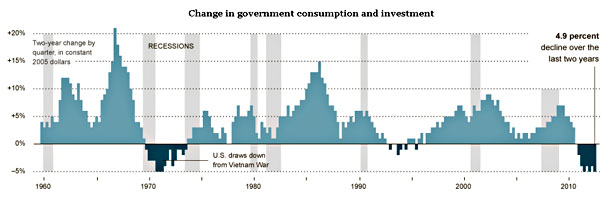
    The federal government, the nation’s largest consumer and investor, is cutting back at a pace exceeded in the last half-century only by the military demobilizations after the Vietnam War and the cold war….Federal, state and local governments now employ 500,000 fewer workers than they did on the eve of the recession in 2007, the longest and deepest decline in total government employment since the aftermath of World War II.

    ….The spending cutbacks and actions to raise taxes could reduce growth by roughly 1.5 percentage points this year, according to the Congressional Budget Office, leaving the sluggish economy operating well below capacity.

    The basic chart is below. If the recession of 2007-08 had been a normal one, the cutbacks we’re seeing now might have been justified after the initial round of stimulus. But it wasn’t a normal one. It was the deepest economic slowdown since the Great Depression. It’s suicidal that we pulled back so soon.

  • 9 Surprising Facts About Junk Food

    Abandon all hope, all ye who enter here. <a href="http://www.flickr.com/photos/trustypics/5623287052/">Trustypics</a>/Flickr


    Riffing on his new book Salt Sugar Fat: How the Food Giants Hooked Us, ace New York Times investigative reporter Michael Moss is suddenly everywhere—he’s out with a blockbuster article in the Times Magazine and just appeared on Fresh Air.

    I haven’t had a chance to read the book yet, but I’ve skimmed it, and it looks excellent. Here are nine quick takeaways:

    1. The Cheeto is a modern miracle. Made of corn, fat, and something called “cheese seasoning” (which itself is made of 11 ingredients, including canola oil and artificial color “yellow 6”), this ever-popular snack, which now comes in no fewer than 17 different flavors, may be the food industry’s creation par excellence. Here’s Moss:

    “This,” Witherly [a food scientist] said, “is one of the most marvelously constructed foods on the planet, in terms of pure pleasure.” He ticked off a dozen attributes of the Cheetos that make the brain say more. But the one he focused on most was the puff’s uncanny ability to melt in the mouth. “It’s called vanishing caloric density,” Witherly said. “If something melts down quickly, your brain thinks that there’s no calories in it…you can just keep eating it forever.”   

    2. Subverting “sensory-specific satiety” is the key to junk-food success. Moss identifies this key food industry concept as “the tendency for big, distinct flavors to overwhelm the brain, which responds by depressing your desire to have more.” The key is to create recipes that get around it. Moss explains:

    Sensory-specific satiety also became a guiding principle for the processed-food industry. The biggest hits—be they Coca-Cola or Doritos —owe their success to complex formulas that pique the taste buds enough to be alluring but don’t have a distinct, overriding single flavor that tells the brain to stop eating.       

    3. At least since 1999, the industry has known its products are contributing to a massive public-health crisis. Moss’ piece opens with a secret meeting that year of the industry’s top executives wherein evidence of severe harm from the industry’s aggressive marketing of junk food—and a comparison to the tobacco industry—was laid out by concerned midlevel execs. The CEOs explicitly decided to ignore the evidence and reject a plea for reform, Moss reports. Instead, they focused their companies on more of the same.

    4. Like the agrichemical industry, the food industry has become adept at selling questionable solutions to the problems it has generated. Take the industry’s habit of blasting everything with loads of salt. Apparently, baby boomers—a major target of the industry’s snack marketing efforts—are expressing interest in cutting back on salt. Problem? No, opportunity! Here’s Moss, reporting on a recent presentation by Frito Lay (a subsidiary of Pepsi) execs to investors:

    The Frito-Lay executives also spoke of the company’s ongoing pursuit of a “designer sodium,” which they hoped, in the near future, would take their sodium loads down by 40 percent. No need to worry about lost sales there, the company’s C.E.O., Al Carey, assured their investors. The boomers would see less salt as the green light to snack like never before.

    5. First you find a product that sells, then you find the right cheap ingredients to make it profitable. The rise of Lunchables, the massively profitable school lunch product Philip Morris launched in the 1980s, illustrates a key insight into how the food system works. Here it is, emphasis added:

    The trays flew off the grocery-store shelves. Sales hit a phenomenal $218 million in the first 12 months, more than anyone was prepared for. This only brought Drane [the Philip Morris exec who invented Lunchables in the 1980s] his next crisis. The production costs were so high that they were losing money with each tray they produced. So Drane flew to New York, where he met with Philip Morris officials who promised to give him the money he needed to keep it going. “The hard thing is to figure out something that will sell,” he was told. “You’ll figure out how to get the cost right.” Projected to lose $6 million in 1991, the trays instead broke even; the next year, they earned $8 million.

    Those cheap ingredients are, of course, mainly iterations of corn and soy—the two crops that cover more than half, and growing, of US farmland, propped up by US farm policy. That’s where the interests of Big Food and Big Ag intersect. And a topic for another post.

    6. Your brain reacts to sugar and cocaine in very similar ways. You know how people will sometimes call food they like a lot “crack”? E.g,. “Hey, this roasted broccoli is really good—it’s veggie crack!” Turns out, in the case of sugary foods, it’s more than just a metaphor. Moss:

    Some of the largest companies are now using brain scans to study how we react neurologically to certain foods, especially to sugar. They’ve discovered the brain lights up for sugar the same way it does for cocaine, and this knowledge is useful, not only for formulating foods. The world’s largest ice cream maker, Unilever, for instance, parlayed its brain research into a brilliant marketing campaign that sells the eating of ice cream as “scientifically proven” way to make ourselves happy.

    7. “Food manufacturers now spend nearly twice as much money on advertising their [breakfast] cereals as they do on the ingredients that go into them.” This fact may be well known to others, but it dropped my jaw.

    8. Tang wasn’t developed for astronauts. I grew up thinking the treacly orange stuff somehow grew out of the US space program (which added to its appeal). Moss set me straight. Turns out, it grew out of the efforts of a giant company called General Foods to think outside the cereal box in marketing breakfast foods to kids through their mothers in the 1950s. The idea was to create a “synthetic juice” to eliminate the drudgery of making orange juice from concentrate or—gasp—squeezing it from fresh oranges. Early efforts were promising but unsuccessful—they had a “good mouthfeel,” but tasted “horribly bitter and metallic.” A company engineer got to the root of the problem—the technicians had been adding a range of vitamins and minerals in an attempt to replicate the nutritional composition of orange juice. By eliminating all of the nutrient additives besides vitamin C—which imparts a tart flavor that jibes with orange juice—the company came up with a winner, launched in 1958.

    And there actually is an after-the-fact space angle—and it’s scatological:

    NASA, the space program, needed a drink that would add little bulk to the digestion, given the toilet constraints of space. Real orange juice has too much bulky fiber in its pulp. Tang, however, was perfect—what technologists call a “low-residue” food.

    NASA embraced Tang for its orbit around Earth in 1962, giving the instant drink a lingering marketing boost—removing untold nutrients and fiber from the US diet.

    9. Many of the cereals of my childhood were composed of 50 percent sugar or more. I also loved sugary cereals as a kid. Damn, was I eating a lot of sugar back then. Moss, reporting on a cereal test conducted in 1975:

    A third of the brands had sugar levels between 10 and 25 percent. Another third ranged to an alarming 50 percent, and 11 climbed higher still—with one cereal, Super Orange Crisps, packing a sugar load of 70.8 percent.