• James Fallows on Threat Inflation


    James Fallows has some things to say about the Iraq War as we near the tenth anniversay of the invasion. Go read. This was the most resonant bit for me:

    As I think about it this war and others the U.S. has contemplated or entered during my conscious life, I realize how strong is the recurrent pattern of threat inflation. Exactly once in the post-WW II era has the real threat been more ominous than officially portrayed. That was during the Cuban Missile Crisis in 1962, when the world really came within moments of nuclear destruction.

    Otherwise: the “missile gap.” The Gulf of Tonkin. The overall scale of the Soviet menace. Iraq. In each case, the public soberly received official warnings about the imminent threat. In cold retrospect, those warnings were wrong — or contrived, or overblown, or misperceived. Official claims about the evils of these systems were many times justified. Claims about imminent threats were most of the times hyped.

    We’re all going to use the anniversary as a reason to cast blame and demand accountability from everyone who was wrong ten years ago. That’s fine. But it’s more important, I think, to try to learn some actual lessons, and this is the key one. The lesson isn’t that threats are never real. The lesson is that, nine times out of ten, the official account of the threat is overblown by at least half.

    So keep that in mind for the next war. If you listen to the war supporters, and their case still sounds reasonable even after you discount everything they say by 50 percent or more, then maybe you should support military action. But that ought to be your standard. Your default assumption should be that they’re overstating the threat by at least that much.

  • The Dumb Sequester Cuts Are Only For 7 Months


    I’ve actually made this point twice today already, but both times it’s been buried in a longer post. So here’s a post that just says one thing:

    Yes, it’s a dumb idea for the sequester to make equal, across-the-board cuts to every single agency in the U.S. government. But those dumb cuts are only for this fiscal year, which ends in September. For the following years, the cuts will be made mostly through the normal appropriations process. Congress and the president will have lots of freedom to make the cuts exactly where they want to, and to spare whatever programs they can agree on.

    Just keep this in mind. It’s dumb to cut R&D spending, for example, but it’s only being cut for seven months. After that, normal funding will be restored if Congress can figure out someplace else to make the cuts instead. They can even do this in a limited way via the continuing resolution scheduled for a vote later this month. The sequester is dumb, but it’s slightly less dumb than people are making it out to be.

    NOTE: Of course, the main reason the sequester is dumb is because we shouldn’t be cutting spending at all right now. We should be spending more. But that’s a whole different issue.

  • Chart of the Day: Everyone Loves Foreign Trade!


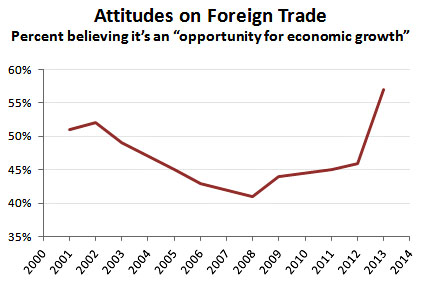
    Dan Drezner and I have had a friendly argument going on for several years about public attitudes toward trade. He’s a worrywart who trembles in fear whenever some pol badmouths China during a primary in Ohio. I’m a Pollyanna who thinks it’s a testament to the fundamental popularity of global trade that the Great Recession produced only a few tiny glimmerings of protectionist sympathy. Today I’m declaring victory. Dan himself links to the latest Gallup polling on trade, summarized in the chart on the right, but then tries to wiggle out with this comment:

    Astute readers might argue that this disproves my oft-repeated claim that the American people are stone cold mercantilists. [Yes indeed. –ed.] To which I say, look at the question that’s being asked — exports good, imports bad. The mercantilism is baked into the polling question!! Essentially, what this poll reveals is enthusiasm for exports, not trade more generally.

    That said, a closer look at the poll also suggests something even more promising. It would appear that public enthusiasm about trade exports is a leading indicator for rational expectations of U.S. economic growth….We’re now in the realm of pure speculation, but another source of American optimism on trade comes from some of the underlying positive trends I talked about a year ago. U.S. consumers are almost done with their necessary deleveraging; the U.S. manufacturing sector continues its small boomlet; and projections about U.S. energy production have become even more optimistic.

    These are all intrinsically good trends, but the spillover effect on American attitudes towards trade is particularly promising. The spike in public enthusiasm from last year is politically significant. At a minimum, it suggests that president Obama won’t face gale-force headwinds in trying to negotiate trade deals.

    Humbug. Of course people are more enthusiastic about exports than imports. But by a margin of 57-35, they see the upside of exports as a bigger deal than the downside of losing their jobs to cheap imports. That’s as close to enthusiasm for trade in general as you’re going to find outside of a Brookings seminar on comparative advantage. The economics profession should be proud of the public brainwashing it’s conducted over the past few decades on trade. It’s been remarkably successful even in the face of some pretty substantial headwinds. 

    And, as Dan himself has suggested before, this bodes well for the future prospects of trade deals with Europe and Asia during Obama’s second term. The public is OK with them; they’d be nice capstones to Obama’s legacy; and they’re among the few things that Republicans will probably be happy to support. I wouldn’t bet against them.

  • Conservatives Need to Leave Their Comfort Zone on Poverty, Charity, and Welfare


    Philip Klein wrote on Wednesday that he was unhappy about the lack of healthcare panels at CPAC this year. “Interest in health care policy on the Right is looking more like a fad built around opposition to Obamacare,” he concluded. Today he directs my attention to Ben Grivno:

    Healthcare isn’t the only panel discussion CPAC is missing. I, too, examined the CPAC 2013 schedule and there are exactly zero panel discussions on poverty, charity, welfare, or community involvement — all of which are important issues to a majority of Americans….Considering the level of disinterest in these crucial topics, Conservatives should not be surprised we are perceived as uncaring by most of America….If the right is to have any hope of becoming a permanent majority, we must learn to enthusiastically embrace issues outside of our comfort zone. These issues we’re ignoring are just waiting to have conservative principles applied to them.

    Obviously I have my doubts that these issues desperately need to have conservative principles applied to them, but then, I’m a liberal. I wouldn’t think that, would I?

    Still, Grivno is right that conservatives need to demonstrate some genuine interest in these problems. If the only things that get the crowds roaring at CPAC are attacks on gays and calls to slash spending on food stamps, it’s not much of a surprise that conservatives are perceived as uncaring. It’s because their revealed preferences demonstrate pretty conclusively that they are uncaring. 

    Times change. In the same way that Democrats had to painfully come to grips with growing public anxiety over crime in the 70s and 80s, conservatives need to respond to today’s growing public anxiety over middle-class wage stagnation and growing income inequality. And within a conservative framework, they need to genuinely respond, not just produce tired old nostrums that are plainly intended more for looks than as real solutions. The public didn’t buy it when Democrats initially tried to brush off crime with shibboleths, and they won’t be any more indulgent with conservatives over modern-day pocketbook issues.

    But yeah, this will require conservatives to work outside their comfort zones. That’s going to take a while.

  • A Whole New Use For Parks: Driving Out Sex Offenders


    The insanity of laws that basically prohibit sex offenders from living anywhere is reaching new heights in Los Angeles. Several itsy-bitsy new parks are being built in the city, but not to give kids a place to play:

    State law prohibits sex offenders from living within 2,000 feet of a park or school. By building the park, officials said, they would effectively force the sex offenders to leave the neighborhood. This section of Harbor Gateway has one of the city’s highest concentrations of registered sex offenders: 86 live in a 13-block area.

    Los Angeles plans to build a total of three pocket parks with the intent of driving out registered sex offenders; two will be in [nearby] Wilmington.

    This is the end result of policies that have made it impossible for sex offenders to live anywhere. As the rules have multiplied—you can’t live near a park, you can’t live near a school, you can’t live near a daycare center, etc.—there are fewer and fewer places where paroled sex offenders can live. The unintended result of this is that they end up crowding into the very few places left to them. Wilmington still has a few areas outside the welter of overlapping circles where sex offenders are banned, so hundreds congregate there in group homes and hotels that cater to them.

    It’s pretty easy to see how even residents who are relatively tolerant of one or two sex offenders living nearby would be pretty unhappy over having hundreds dumped into their community. And they’d be especially unhappy that they’re getting dumped there precisely because their community lacks the amenities of richer neighborhoods. So now they’ve figured out a clever dodge to get rid of them.

    This is craziness. I don’t really blame the residents of Wilmington or Harbor Gateway. Their frustration is pretty easy to understand. But it’s craziness nonetheless. The end result will be even further concentrations of sex offenders, and even more frustration. When does it stop?

  • How Republicans Learned to Love the Sequester


    John Boehner will be meeting with President Obama this afternoon, but he’s already announced that he refuses to seriously discuss the sequester anymore. It turns out this was just what he needed to bolster his flagging reputation within the Republican Party:

    As the president and Congressional Democrats have tried to force Mr. Boehner back to the table for talks to head off the automatic budget cuts set to take effect on Friday, Mr. Boehner has instead dug in deeper, refusing to even discuss an increase in revenue and insisting in his typical colorful language that it was time for the Senate to produce a measure aimed at the cuts.

    ….While the frustrations of Congressional Democrats and Mr. Obama with Mr. Boehner are reaching a fever pitch, House Republicans could not be more pleased with their leader. “We asked him to commit to us that when the cuts actually came on March 1, that he would stand firm and not give in, and he’s holding to that,” said Representative Steve Scalise, Republican of Louisiana.

    ….Representative Mick Mulvaney, a South Carolina Republican who was elected on the 2010 Tea Party wave and has had his differences with the speaker, was similarly complimentary toward Mr. Boehner. “He’s doing exactly what he said he was going to do, and I think it’s working to our favor and to his,” Mr. Mulvaney said. “I get the feeling that our party is probably more unified right now than it has been at any time in the last several months.”

    I’m not surprised about this. After all, Republicans are fine with the domestic cuts, and probably figure the inevitable horror stories won’t be bad enough to do them any lasting damage. They can tough it out. And while cutting every single agency by the same amount is dumb, it’s only for seven months. They’re allowed to rejuggle the cuts during the upcoming budget cycle.

    As for the defense cuts, they’re probably counting on putting that money back into the budget somehow. There are enough Democrats who will go along with this to make that possible.

    So here’s what they get: A bunch of cuts to domestic programs. A short-term hit to the Pentagon. No tax hikes. And lots of chaos over the next few months, which will make voters even more disgusted with Washington than usual. What’s not to like? This is Republican heaven, assuming their political read of the situation turns out to be correct. And it might.

  • The Sequester, Explained

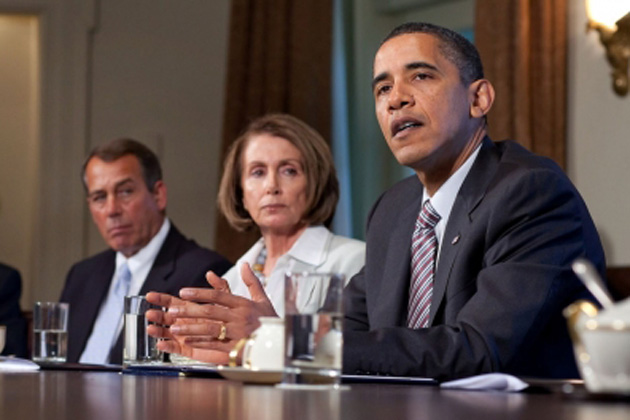
    <a href="http://www.whitehouse.gov/blog/2010/06/10/president-obama-meets-with-congressional-leaders-bp-spill-and-months-ahead">Pete Souza</a>/White house


    Today is Sequestration Day! To celebrate, all of your most burning sequestration questions are answered right here. Enjoy.

    Where did the whole idea of sequestration originate? It goes back to 1985. The tax cuts of Ronald Reagan’s early years, combined with his aggressive defense buildup, produced a growing budget deficit that eventually prompted passage of the Gramm-Rudman-Hollings Act. GRH set out a series of ambitious deficit reduction targets, and to put teeth into them it specified that if the targets weren’t met, money would automatically be “sequestered,” or held back, by the Treasury Department from the agencies to which it was originally appropriated. The act was declared unconstitutional in 1986, and a new version was passed in 1987.

    Sequestration never really worked, though, and it was repealed in 1990 and replaced by a new budget deal. After that, it disappeared down the Washington, DC, memory hole for the next 20 years.

    What about the 2013 version? Where did that come from? In the summer of 2011, Republicans decided to hold the country hostage, insisting that they’d refuse to raise the debt ceiling unless President Obama agreed to substantial deficit reduction. After months of negotiations over a “grand bargain” finally broke down in July, Republicans proposed a plan that would (a) make some cuts immediately and (b) create a bipartisan committee to propose further cuts down the road. But they wanted some kind of automatic trigger in case the committee couldn’t agree on those further cuts, so the White House hauled out sequestration from the dustbin of history as an enforcement mechanism. It would go into effect automatically if no deal was reached.

    In the end, no immediate cuts were made, but a “supercommittee” was set up to propose $1.5 trillion in deficit reduction later in the year. To make sure everyone was motivated to make a deal, the sequester was designed to be brutal: a set of immediate, across-the-board cuts to both defense spending and domestic spending, starting on January 1, 2013. The idea was that everyone would hate this so much they’d be sure to agree on a substitute.

    Needless to say, no such agreement was reached. So now we’re stuck with the automatic sequestration cuts.

    How big is the sequester? You’d think this would be an easy question to answer. In fact, it’s surprisingly complicated! Are you ready?

    The basic amount of the sequester is $1.2 trillion in deficit reduction over 10 years. But when you reduce spending, you also reduce interest on the national debt. This means that we only need $984 billion in actual program cuts. And since it’s for 10 years, naturally that means we divide by nine to get annual spending cuts of $109 billion. For FY2013, this comes to $12 billion per month, because there are only nine months from January (when the sequester begins) through the end of the fiscal year in September.

    But wait! The fiscal cliff deal in January delayed the sequester until March 1, so it also lopped off two months of cuts. This means that the total amount of spending cuts for this year clocks in at $85 billion.

    So what gets cut? The sequester is split evenly between defense spending and domestic spending. The domestic half has two parts: Medicare and everything else. For Medicare, the sequester specifies a flat 2 percent cut in reimbursements. Doctors will continue to bill at their usual rate, but they’ll only receive 98 cents on the dollar. According to the Congressional Budget Office, here’s how the whole thing nets out (see Table 1-2):
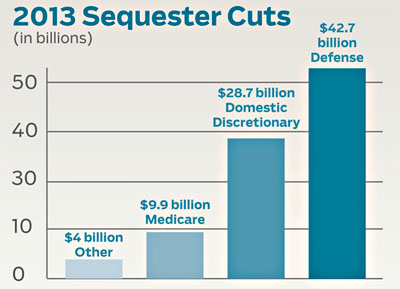
    • Defense: $42.7 billion
    • Medicare: $9.9 billion
    • Other domestic: $32.7 billion

    Aside from Medicare, how are the other cuts divvied up? The sequester legislation requires the cuts to come evenly from every budget account. This means everything (with a few exceptions) gets cut the same amount. It’s an especially stupid way to cut spending, since everyone agrees that some programs are more important than others, but that’s the way it is. If you really want to torture yourself, you can read this Office of Management and Budget report, which contains 224 pages listing the sequester amounts from every single agency in the United States government. It’s followed by another 158 mind-numbing pages of agency accounts that are exempt from the sequester.

    But as stupid as this is, don’t get too excited about it. It’s only for FY2013, which lasts seven more months. After that, although the total amount stays in place ($109 billion, split evenly between defense and domestic spending), congressional appropriations committees have much more flexibility about how to juggle the cuts.

    Aren’t we still in a recession? What are these cuts going to do to the economy? Technically, we’re no longer in a recession, but there’s no question the economy remains weak. A big bunch of dumb spending cuts is about the last thing we need.

    That said, the actual impact of the cuts is hazy. Among private forecasting firms, Macroeconomic Advisers figures the sequester will cut GDP by 0.7 percentage points, while IHS Global Insight puts it at 0.3 percent. Back before the sequester was delayed, CBO estimated 0.8 percentage points. Given a consensus growth forecast of about 2 percent for this year, this is a fairly substantial headwind. In terms of jobs, it will probably increase the unemployment rate by about half a percentage point. This is why Fed chairman Ben Bernanke basically told Congress on Tuesday that they were nuts to let the sequester proceed.

    That’s all sort of bloodless. How about some horror stories? You know, three-hour waits at airports because of TSA cutbacks, food poisoning epidemics thanks to USDA cutbacks, that sort of thing? The White House has been making a lot of hay over its 50-state breakdown of cutbacks. California, for example, will lose 1,200 teachers, 8,200 Head Start slots, 49,000 HIV tests, $5 million in meals for seniors, etc. You can see the forecasts for your state here. Aside from that, Wonkblog seems to be the go-to site for alarmist coverage of the sequester. Brad Plumer has the impact on R&D spending here. In an interview with Ezra Klein, former NIH director Elias Zerhouni says it will be a “disaster for research.” Suzy Khimm interviews a former Homeland Security official here who says smuggling will increase. And MoJo‘s own Zaineb Mohammed lists six ways the sequester will hurt the environment here, including higher risk of damage from wildfires.

    That’s terrible! Does anyone have a plan to avoid the sequester? Sure. Sort of. President Obama has proposed a substitute that includes about $1.1 trillion in spending cuts and $700 billion in new revenue. It was dead on arrival because Republicans are flatly unwilling to consider any plan that includes higher taxes. Back in December, Republicans in the House passed a bill that would have kept all the domestic cuts and replaced the defense cuts with yet more domestic cuts, mostly to anti-poverty programs. It was DOA too, for obvious reasons. House and Senate Democrats have plans as well.

    But the truth is that there’s probably no deal to be made. Republicans won’t accept tax hikes, Democrats won’t accept any bill that’s exclusively spending cuts, and neither party is willing to just kill the sequester outright, which is the most sensible option. For now, all that’s really happening is that both sides are barnstorming the country blaming the other guys. Obama seems to be winning that battle at the moment.


  • Justice Scalia and the Voting Rights Act


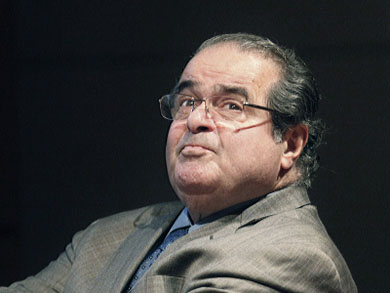
    I’ve been mulling over Antonin Scalia’s extraordinary outburst against the Voting Rights Act yesterday, but the more I think about it the more peculiar it seems.

    Background first. The provision of the VRA at issue is preclearance, which requires certain states and counties with prior records of racial discrimination to get clearance from the Justice Department before they make changes to their election laws. My understanding is that there are two opposing constitutional interests here. First, under the principle of federalism, states have an interest in making and administering their own laws without getting prior permission from the federal government. Second, under the Fifteenth Amendment, the federal government has an interest in making sure that states don’t abridge the right to vote based on race or skin color. When the Supreme Court upheld the VRA in South Carolina v. Katzenbach, it explicitly noted that preclearance tested the boundaries of federal authority:

    This may have been an uncommon exercise of congressional power, as South Carolina contends, but the Court has recognized that exceptional conditions can justify legislative measures not otherwise appropriate….Congress knew that some of the States covered by [] the Act had resorted to the extraordinary stratagem of contriving new rules of various kinds for the sole purpose of perpetuating voting discrimination in the face of adverse federal court decrees. Congress had reason to suppose that these States might try similar maneuvers in the future in order to evade the remedies for voting discrimination contained in the Act itself. Under the compulsion of these unique circumstances, Congress responded in a permissibly decisive manner.

    In other words, Congress doesn’t have the inherent power to approve or veto state election laws. In fact, normally it wouldn’t have this power at all. But in this particular case, the court ruled, it had this authority because there were “unique circumstances” that caused the Fifteenth Amendment to trump the rights of the states. The misbehavior of the states in question had been so egregious, so longstanding, and so impervious to previous attempts to stop it, that Congress’s extraordinary remedy in the VRA was justified.

    In other words, there really is a legitimate constitutional question here. Congress has the power to abrogate state authority only if suitably exceptional conditions apply, and it’s a proper question for the Court to decide whether those exceptional conditions still exist. Given this, why would Scalia let loose with this Limbaugh-esque analysis of why Congress reauthorized the VRA in 2006?

    I think it is attributable, very likely attributable, to a phenomenon that is called perpetuation of racial entitlement. It’s been written about. Whenever a society adopts racial entitlements, it is very difficult to get out of them through the normal political processes….And I am fairly confident it will be reenacted in perpetuity unless—unless a court can say it does not comport with the Constitution… [T]his is not the kind of a question you can leave to Congress.

    Scalia here is making it sound as if Congress just flatly can’t be trusted with this kind of decision. But why say something so outlandish when he has a perfectly conventional argument to make instead? Why not simply stick to the question of whether present-day circumstances remain exceptional enough to warrant such a significant intrusion into the customary right of states to make and enforce their own laws?

    So I’m sort of stumped. Was there an actual reason Scalia went so far beyond what was necessary? Or was it just a cranky outburst that he made because, after all, who’s going to stop him? Even for Scalia, it seems pretty damn peculiar.

  • VAWA Passes, the Hastert Rule Takes a Tumble


    The House finally reauthorized the Violence Against Women Act today despite the opposition of more than half the Republican caucus. Steve Benen thinks this means the wind is shifting on the venerable Hastert Rule:

    We’re learning something important about House Speaker John Boehner (R-Ohio) and the so-called “Hastert Rule.” For those who need a refresher, under modern Republican norms, the Speaker only considers legislation that enjoys “majority of the majority” support — if most GOP House members oppose a measure, it won’t even be considered, whether it can pass the chamber or not.

    The non-binding rule is great for party discipline, but lousy for democracy and governing.

    For Boehner’s part, the Speaker has long believed in enforcing the “Hastert Rule,” but he’s finding far more flexibility on the issue than we’re accustomed to seeing. When it was time to approve the “fiscal cliff” deal, Boehner ignored the rule to pass a bipartisan Senate plan. When he needed to pass relief aid to Hurricane Sandy victims, he bypassed the rule again.

    At the time, the Speaker said these were isolated incidents that wouldn’t be repeated, but he we are again — most of Boehner’s caucus opposed the Violence Against Women Act, but he brought it to the floor and passed it anyway.

    I guess my takeaway is a little different: This is mostly a sign that Boehner understands what his party is up against. In the last election, Republican problems with the Hispanic vote got most of the attention, but that’s not the only demographic group the GOP is losing badly. There’s also women. And young voters. And especially young women voters: in the last two elections, they’ve voted for Obama by whopping margins of 69 and 66 percent.

    So in the same way that pragmatic Republicans are in favor of passing some kind of comprehensive immigration bill to stop the bleeding among Hispanics, Boehner wanted to pass VAWA in order to stop the bleeding among young women, for whom this is very much a hot button issue. This same dynamic might play out on a few other issues too, but I’m not sure if it heralds the demise of the Hastert Rule more generally. We’ll have to wait and see.