• China Calls for “De-Americanized” World


    Here is today’s shutdown news:

    Upset that the fiscal stalemate in Washington is threatening the global economy, China called for the U.S. dollar to be replaced as the international reserve currency as well as for broader steps to create a “de-Americanized world.”

    China also called for an end to the “pernicious impasse” in the U.S. over the raising the debt limit and ending the partial government shutdown, saying the world needed another reserve currency so nations could protect themselves “from the spillover of the intensifying domestic political turmoil in the United States.”

    China has been saying stuff like this for a long time, so in a sense this isn’t a big deal. But as the mess in Washington drags on, more and more countries are going to be taking this idea more seriously. I’m generally bullish on America’s future relative to other areas of the world, but that could change if dysfunctional governance forces the rest of the world to essentially gang up against us for their own safety. Thanks, Republicans!

  • Friday Cat Blogging 11 October 2013


    This is one of the first quilts Marian ever made. The pattern is called Nine-Patch, and it’s machine pieced and hand quilted.

    It occurs to me that all the non-quilters out there, which is most of you, might appreciate a terminology primer. There are three basic steps to making a quilt. First you cut out the pieces as specified by the design you’re making. This step, oddly enough, doesn’t really have a name. Second, you sew the pieces together, either by hand or machine. This is called piecing. Third, once you have the quilt top sewn together, you place it against the backing with batting in between. Then you sew the top and the backing to each other using fancy stitching patterns. This can be done either by hand or machine, and it’s called quilting. So there you have it.

  • Yet Another Front in the War to Make the Web (Almost) Unusable


    Sign me up for this Felix Salmon rant:

    It might have been the Slate redesign which pushed me over the edge, I’m not sure. Maybe it’s just PTSD from Reuters Next. But at this point I will seriously donate a substantial amount of money to anybody who can build a browser plugin which automatically kills all persistent navbars, or “sticky navs”, as they’re also known.

    It’s impossible to identify who started this trend, but it has become the single most annoying thing on the news web, recently overtaking even the much-loathed pagination for that title. If you’re reading a story on Pando Daily, then no matter what page you’re on, no matter where you are in the story, the top of your browser window always looks like this:

    Click the link for examples if you’re not sure what this is all about. But Felix is right: It’s annoying. It’s evil. It needs to stop. Felix explains why in his post, but what makes navbars even worse is that they’re sometimes paired up with bizarro code that makes it difficult or impossible to cut and paste text using the normal tools that we’ve all used forever. Instead you have to go through the navbar in some weird way. There have been a few cases where I was so flummoxed by what they expected me to do that I finally just went into the page source and copied from there. So far, no one has figured out how to take over a text editor, so that still works.

    (And while we’re at it, why do so many sites make it so damn hard to embed their videos? They usually have an embed option, so obviously they want you to embed their videos. But the code they provide is all but impossible to vary in even the slightest way, like aligning it on the right instead of the center, or something like that. I just went through an experience this morning trying to embed a PolitiFact video that almost makes me believe in ghosts. Just stop it, folks.)

    This is all part of an ongoing evolution of the web that seems to be based on a desire to make the browsing experience as annoying as possible without quite going over the edge where people just give up on your site. A site that’s a micron short of that is ideal. You want your readers tearing their hair out, but not going ballistic enough to quit entirely. As more and more sites go down this road, it makes the web more a blood pressure raising machine than an information source. But it was nice while it lasted.

  • Can Methanol Save Us All?


    In the Wall Street Journal today, George Olah and Chris Cox suggest that instead of venting carbon dioxide into the atmosphere, where it causes global warming, we should use it to create methanol:

    Thanks to recent developments in chemistry, a new way to convert carbon dioxide into methanol—a simple alcohol now used primarily by industry but increasingly attracting attention as transportation fuel—can now make it profitable for America and the world to reduce carbon-dioxide emissions.

    At laboratories such as the University of Southern California’s Loker Hydrocarbon Research Institute (founded by George Olah, one of the authors here), researchers have discovered how to produce methanol at significantly lower cost than gasoline directly from carbon dioxide. So instead of capturing and “sequestering” carbon dioxide—the Obama administration’s current plan is to bury it—this environmental pariah can be recycled into fuel for autos, trucks and ships.

    ….In Iceland, the George Olah Renewable Methanol Plant, opened last year by Carbon Recycling International, is converting carbon dioxide from geothermal sources into methanol, using cheap geothermal electrical energy. The plant has demonstrated that recycling carbon dioxide is not only possible but commercially feasible.

    Olah has been writing about a “methanol economy” for a long time, and he skips over a few issues in this op-ed. One in particular is cost: it takes electricity to catalyze CO2 and hydrogen into methanol, and it’s not clear how cheap it is to manufacture methanol in places that don’t have abundant, cheap geothermal energy—in other words, most places that aren’t Iceland. There are also some practical issues related to energy density and corrosiveness in existing engines and pipelines. Still, it’s long been an intriguing idea, since in theory it would allow you to use renewable energy like wind or solar to power a facility that creates a liquid fuel that can be used for transportation. You still produce CO2 when you eventually burn that methanol in your car, of course, but the lifecycle production of CO2 would probably be less than it is with conventional fuels.

    I haven’t kept up with the details of this lately, so I don’t know what Olah means when he talks about “recent developments” in chemistry. Does he mean stuff that’s been in the pipeline over the past decade, or something that’s genuinely new over the past year or two? I’m not sure. I’d be interested in reading a response from a neutral expert, though.

    And why did this appear on the Wall Street Journal op-ed page, not a place that’s famous for its concern over climate change? Because Olah and Cox are arguing that for methanol to compete in the marketplace, we need to stop subsidizing ethanol unfairly. I’m all for that, and I guess the Journal is too. I’m also on the lookout for anything non-shutdown related to write about. Any port in a storm.


  • Pundits Soon to Face the Wrath of PolitiFact


    A regular reader warns me to watch my back:

    PolitiFact, the Pulitzer Prize-winning fact-checking website of the Tampa Bay Times, will soon launch PunditFact, a site dedicated to checking claims by pundits, columnists, bloggers and the hosts and guests of talk shows.
    Luckily, I’m not important enough to catch the attention of these guys, so I can probably continue to lie with impunity. For example, did you know that a recent study concluded that PolitiFact made a substantial contribution to increased political polarization? It was very clever. The researchers used Mechanical Turk to recruit a dozen college students who read an article about Obamacare. Half the students then read a PolitiFact column that fact-checked an Obama speech and the other half read a column that —

    Just kidding! There was no such study. Seriously, how could PolitiFact contribute to polarization when we all know that conservatives don’t care about facts in the first place? As the chart on the right shows —

    Kidding again! There’s no chart. But I wish there were. It would be interesting to know whether fact-checking operations actually have any impact whatsoever on public opinion. Based on my own zero percent track record of ever changing anyone’s mind, I’d guess not. But a study would be great. Especially if it had a colorful chart to go along with it.

    Anyway. Here’s what I’m really curious about: How will PunditFact go about deciding which pundits to check? Given that they’re including radio and TV talkers and guests in their net, I’d guess that they’ll have something like a thousand outright lies to check every day. I’m talking about things that aren’t even close calls and that are heard or read by audiences numbering in the millions. So which ones actually get their attention? That’s easily the most important decision they’ll make, since the actual process of demonstrating the lies is sort of like shooting fish in a barrel. You might as well just hire a few dozen interns for that part of the job.

    But I’ll bet they won’t tell us. Nobody ever does.

  • Republicans Intent on Keeping Hostage Power Forever


    I assume that David Drucker of the Washington Examiner has a good sense of what Republicans are really thinking about the debt ceiling, and it’s not a cheery analysis:

    At issue isn’t whether House Republicans should accept a bad deal to raise the federal borrowing limit and ensure the U.S. does not default on its $16.7 trillion debt. Republicans are concerned that the refusal of President Obama and Senate Democrats to negotiate those issues with Republicans would establish a precedent making it impossible to haggle over future debt limit increases or to use them as leverage in other policy negotiations….Republicans see the debt ceiling vote as part of an institutional fight over constitutional authority, which is harder for them to walk away from than a policy priority that can always be brought up again later.

    In other words, just as I suspected last night, the offer of a 6-week debt ceiling extension doesn’t mean much. It’s just another deadline. Not only will it be used as a hostage yet again, but Republicans are intent on using the debt ceiling as a hostage forever into the future.

    This is what makes the whole affair so intractable. President Obama is intent on preventing the debt ceiling from ever being used as a hostage again. Republicans are intent on keeping it alive as a hostage to be used annually forever. Once you cut through all the sound and fury, that’s where we are. There’s simply no compromise possible.

    Or is there? I keep wondering if it’s possible to come up with something outside the framework of the debt ceiling. That is, get rid of the debt ceiling, but put something else in place that gives the House more budget leverage than it has now. I’m not sure what that is since, despite what the tea partiers apparently think, the House already has considerable leverage just through the normal order of things. But maybe there’s something that could give them a little bit more without doing serious damage to the constitutional order.

    Probably not. It’s just a thought.

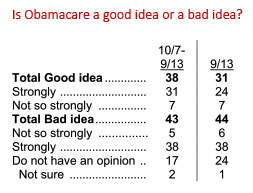
  • Surprise! Support for Obamacare Is Up Sharply Over the Past Month


    The latest NBC/Wall Street Journal poll is just an endless horror show for Republicans. Obama’s approval is up; Republican Party approval is down; confidence in the economic recovery has plummeted thanks to the budget standoff; and voters blame Republicans for the government shutdown by a margin of 53-31. Virtually everyone who’s not a hardcore dittohead blames the GOP. What’s more, 73 percent of the public thinks the shutdown is a serious problem and 31 percent have been personally affected.

    But none of that is a big surprise. Here’s something that is: After a week of 24/7 media coverage about the problems with the rollout of Obamacare, its popularity has gone up. It’s still not doing gangbusters or anything, but it’s pretty interesting that an awful lot of people who previously had no opinion are now feeling pretty positive about it. Is this because they or someone they know has actually gone on line and discovered that there are pretty good deals available? I don’t know. But something has changed their minds.

  • How Many Republicans Will Vote to Confirm Janet Yellen?


    It’s time for a pool. There are currently 46 Republicans in the Senate. How many of them do you think will vote to confirm Janet Yellen as chairman of the Fed? Keep in mind that there isn’t even a ghost of a reason to vote against her.

    I’ll go with 13. Not for any particular reason. Just because. Leave your guess in comments.

  • Boehner Offers to Delay Hostage Taking Until Thanksgiving


    Like everyone, I guess, I’m having trouble keeping track of what’s really going on today. My best reading of the tea leaves is that John Boehner plans to offer President Obama a clean 6-week debt ceiling extension in exchange for a willingness to negotiate over the budget. Or something. Maybe there will actually be some strings attached. It’s hard to tell.

    But it’s hard to fathom the point of a 6-week extension even if it comes without formal strings attached. The fact that Republicans are insisting that Obama negotiate with a debt ceiling breach looming over him is a tacit admission that the debt ceiling is still being used as a threat. Right? Or am I missing something here?

    I suppose Obama would have to sign a clean extension regardless. And he probably should. And who knows? Anything can happen in six weeks. But it’s a little hard to see that this accomplishes anything except to guarantee a Thanksgiving hostage crisis instead of a Halloween hostage crisis.