• New House Shutdown Proposal Is a Deliberate Attempt to “Sabotage” the Senate Deal


    Ramesh Ponnuru provides us with a brief summary of today’s Republican budget proposal in the House that “changes the Senate plan in several ways that are designed to make it more palatable to Republicans.” I’ll provide an even briefer summary: it removes the one thing Democrats wanted and replaces it with four new items that Republicans want.

    Ezra Klein writes that “on a policy level, there’s really very little difference between this and the Senate deal.” That’s true. But there’s a huge difference in principle: the Senate plan is a genuine deal, giving Democrats something they want and Republicans something they want. The House plan, as usual, is a laundry list of Republican demands that offers nothing in return except a short-term extension of the debt limit and a short-term CR. The wish list might be smaller than it used to be, but the House deal very plainly still uses the debt ceiling as a hostage for the passage of a set of Republican demands. Greg Sargent confirms that Democrats understand this perfectly well:

    Dem Rep. Chris Van Hollen, a key ally of the Dem leadership and White House, told House Democrats at a private meeting today that a vote for the new House GOP plan is a vote for a deliberate Tea Party effort to sabotage the emerging Senate deal.

    In an interview with me, Van Hollen strongly suggested it will get no Democratic votes, which could call into question the ability of Republicans to pass this plan through the House, as some conservatives are already balking at it because it raises the debt limit.

    “This has no Democratic support,” Van Hollen told me. “It is a recipe for default. The Democratic leadership told the caucus that a vote for this is a vote for default and for keeping the government shut down. Democrats understood that this is exactly what this was.”

    This is going nowhere. President Obama has set out one thing very clearly: he won’t make concessions to Republicans as a direct quid pro quo for raising the debt ceiling. That’s what the House deal does. If Democrats supported it, they know perfectly well that the result would be yet another list of demands next year when the short-term extensions run out. It’s dead on arrival.

    UPDATE: As it turns out, the Republican plan couldn’t even get enough Republican votes in the House. So everything is back on the Senate’s doorstep now.

  • Obamacare’s State Sites Are Doing Better Than the Federal Site


    With all the (increasingly) bad news we’ve been hearing about the Obamacare website, someone asked me yesterday if it was only the federal site that was a disaster or if the state sites were also in bad shape. As far as I know, the answer is that most of the state sites have some problems here and there, but are basically working OK and getting better. Today, in an interview at WonkBlog, Robert Laszewski, the president of Health Policy and Strategy Associates, confirms this:
    How are the state exchanges functioning?

    They’re not seeing anything like the federal problems. I should say that if you’ve seen one state you’ve seen one state. But to generalize, the vast majority of states really did a good job testing. Some of them didn’t open up with everything. Now, enrollment is not great, but that’s because every one of them had real glitches. And in the states, those actually were glitches — not a train wreck. So we still don’t have an accurate picture of how many people will sign up. I think if you look at some of the states that opened fairly smoothly, like Maryland or Connecticut or Kentucky, they all had problems but in two weeks we’ll have a better sense of how they’re running. Enrollments are smaller than they need to be right now but the federal publicity is hurting them. The guy in Maryland doesn’t know he’s not on a federal exchange.

    I’m not trying to downplay the problems with the federal website, which are certainly starting to look even worse than we thought at first, but this is worth knowing. The exchange software isn’t an impossible problem to solve, since apparently 14 states have managed to meet the deadline with nothing more than a rocky start.

    In the meantime, I assume that telephones are still working and it’s possible to sign up for Obamacare over the phone if you live in a state that’s on the federal exchange and therefore has an unusable website.

  • Austerity Policies Have Probably Cut Economic Growth in Half This Year


    In the past, I’ve extrapolated from a variety of CBO reports to estimate the effect of austerity on the U.S. economy. Today, via Paul Krugman, I see that Macroecomic Advisors has produced a comprehensive estimate of the total effect of bad fiscal policies. Their conclusion: austerity policies since the start of 2011 have cut GDP growth by about 1 percentage point per year—and the bad news got even worse in the first two quarters of this year as the sequester kicked in. Add in additional economic contraction caused by the budget/debt ceiling crisis, and the total hit to growth in 2013 might clock in at about 1.5 percentage points.

    In other words, the combined effect of past budget deals + sequester + fiscal cliff + debt ceiling crisis is probably a reduction of about half in our economic growth rate this year.

    Let me repeat that: Republican austerity policies have probably cut economic growth in half this year and raised the unemployment rate by 1.4 percentage points. Heckuva job, guys.

  • We’ll Probably Hit the Debt Ceiling Next Week, Not This Week


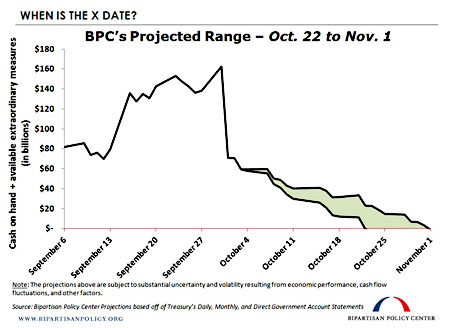
    Just a quick note about the debt ceiling battle that I think is getting a bit lost: although the Treasury Department hasn’t officially modified its October 17 estimate of doomsday, it seems almost certain that it’s no longer the most likely date that we run out of money to pay our bills. The government shutdown hasn’t stopped a ton of spending, but it has stopped some spending, and the Bipartisan Policy Center’s most recent analysis of cash flow suggests that money will run dry sometime between October 22 and November 1.

    So if October 17 comes and goes and Armageddon hasn’t arrived, don’t be too surprised and don’t listen to conservatives who claim that this means the whole thing has just been a big scam all along. We’re still on track for doomsday, but most likely it will arrive next week, not this week.

  • The Debt Ceiling Explained in 10 Short Sentences

    Zhang Jun/ZUMA


    For most of the past year, the Republican Party has been threatening to refuse to raise the federal debt limit unless Democrats give in to a broad and varying set of demands. To understand just how reckless this brinkmanship is, you have to understand just what the debt limit is and what it means to breach it. So here’s an explanation in 10 short sentences:

    1. On May 19, total US debt reached $16.7 trillion, the maximum currently allowed by law.

    2. The Treasury Department has been playing various games since then to continue paying all our bills while still technically remaining under the debt limit, but within a few days they’ll run out of tricks and the government will no longer be allowed to spend more money than it takes in.

    3. These Treasury tricks are very much not business as usual, and the fact that we’ve been reduced to these kinds of shell games means that normal governance is already dangerously crippled.

    4. The Congressional Budget Office estimates that in FY 2014 (which runs from October 2013 through September 2014), total federal income will be $3,042 billion and total spending will be $3,602 billion, a difference of $560 billion.

    5. This is the amount of debt we need to issue to pay for everything in the budget, which means that if the debt limit isn’t raised, we need to immediately cut spending by $560 billion, or $46 billion per month.

    6. That’s roughly the equivalent of wiping out the entire Defense Department; or wiping out two-thirds of Social Security; or wiping out all of Medicaid + all unemployment insurance + all food assistance + all veterans’ benefits.

    7. What’s worse, because the government’s computers are programmed to simply pay bills in the order they’re received, it’s not clear if the Treasury can specify which bills get paid and which don’t.

    8. This raises the additional risk that interest on treasury bonds might not get paid—something that would put US debt in default and could be disastrous in a global economy that depends on US bonds being rock solid.

    9. So those are our choices if Congress fails to raise the debt limit: Either we suddenly stop paying for critical programs that people depend on, or we default on US treasury bonds—or both.

    10. The former would immiserate millions of people and probably produce a second Great Recession, while the latter would likely devastate the global economy.

    Not much of a choice, is it? That’s why it’s time for Republicans to stop playing games with the financial equivalent of nuclear weapons and agree to raise the debt limit.

  • NSA Collects Millions of Address Books, Buddy Lists


    Yes, the NSA is collecting your address books and buddy lists too:

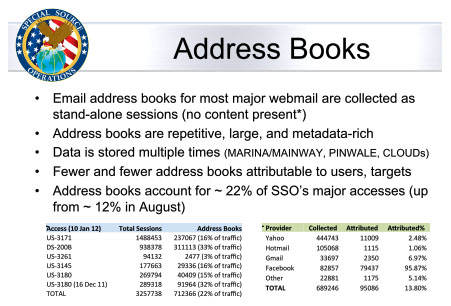
    During a single day last year, the NSA’s Special Source Operations branch collected 444,743 e-mail address books from Yahoo, 105,068 from Hotmail, 82,857 from Facebook, 33,697 from Gmail and 22,881 from unspecified other providers, according to an internal NSA PowerPoint presentation. Those figures, described as a typical daily intake in the document, correspond to a rate of more than 250 million a year.

    Each day, the presentation said, the NSA collects contacts from an estimated 500,000 buddy lists on live-chat services as well as from the inbox displays of Web-based e-mail accounts….Although the collection takes place overseas, two senior U.S. intelligence officials acknowledged that it sweeps in the contacts of many Americans. They declined to offer an estimate but did not dispute that the number is likely to be in the millions or tens of millions.

    ….Because of the method employed, the agency is not legally required or technically able to restrict its intake to contact lists belonging to specified foreign intelligence targets, he said. When information passes through “the overseas collection apparatus,” the official added, “the assumption is you’re not a U.S. person.”

    ….A senior U.S. intelligence official said the privacy of Americans is protected, despite mass collection, because “we have checks and balances built into our tools.”

    The NSA’s collection of bulk phone records and bulk online records is overseen by the FISA court. That may not be much, but in theory anyway, at least it’s something. But the NSA’s collection of address books is done solely under presidential order and has no oversight at all. They can collect anything they want and use it any way they want.

    Luckily for us, the NSA has “checks and balances” built into their tools, so you have nothing to worry about.

  • A Budget Deal Finally Starts to Take Shape


    I’ve deliberately avoided posting about all the dueling proposals and counterproposals in the Great Budget Showdown of 2013 because (a) it’s too damn depressing, and (b) you all know where to find Politico if you want to. However, it now appears that we’re getting close to a deal that might actually make it through the Senate:

    The latest proposal would reopen the government at current spending levels until Jan. 15 and extend the federal borrowing limit until early February, according to aides familiar with the talks. Lawmakers also would begin longer-term negotiations on the budget, with the task of reaching an agreement by Dec. 13.

    ….The proposed agreement’s framework included no major alterations to the 2010 health-care law that Mr. Obama championed and congressional Republicans have tried to curtail.

    However, lawmakers appeared to be weighing some minor changes, including new procedures to verify the incomes of some people receiving government subsidies for health-insurance costs. Lawmakers also appeared to be considering delaying for a year a fee of $63 per insured person levied on those who offer policies, including employers, unions and insurance carriers.

    The way this fig leaf seems to work is that Republicans get the income verification provision and Democrats get a delay of the “belly button tax.” Since this is a genuine deal, not a demand for Democratic concessions in return for nothing, we can all pretend that it’s a completely independent barnacle that just happens to be attached to the rest of the deal. This means that President Obama can sign it while sticking to his promise not to negotiate anything in return for a debt ceiling increase. Everyone wins!

    There are, of course, several reasons to remain cautious:

    • Ted Cruz might decide to filibuster the deal. The odds are probably against it, but you never know.
    • The House might refuse to vote on it.
    • Even if it passes, all it does it set everyone up for (appropriately) a Groundhog Day rerun of the whole mess next year. But then again, maybe not. The evidence this time around has been pretty resounding that the public isn’t on the GOP’s side in this fight, and that might convince a lot of Republican fence-sitters to nip things in the bud if the tea partiers try to start another hopeless war in February. Right now, public irritation with the budget fight probably hasn’t had any real effect on next year’s midterm elections, but if Republicans do it again and again, it might.

    So….that’s where we are. Stay tuned.

  • Yet Another Grim Poll for Republicans


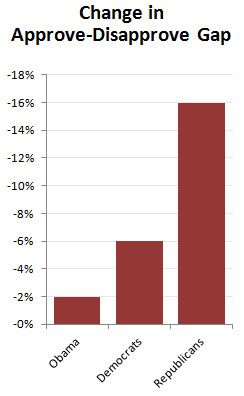
    Another poll, another disaster for the GOP. According to the latest ABC/Washington Post poll, the approval rating of the Republican Party has cratered ever since the budget showdown started. The gap between approval and disapproval has dropped by 16 points for the Republican Party in just two weeks. The change for Democrats has been only 6 points, and for President Obama there’s barely been any change at all:
    For the first time this week numerically fewer than half of Republicans — 49 percent — approve of the way their party’s representatives in Congress are handling the budget talks.

    Obama, by contrast, gets 71 percent approval in his own party. Further, while 58 percent of political independents disapprove of Obama’s work on the issue, that soars to 76 percent disapproval for the GOP’s approach. In terms of ideology, 59 percent of conservatives disapprove of how the Republicans in Congress are handling the issue, despite their generally closer alignment with GOP policies. Obama’s disapproval among liberals is far lower — 32 percent. And moderates roughly divide on Obama’s approach (49 percent disapprove), while broadly criticizing the Republicans, with 80 percent disapproval.

    It’s just dismal news for Republicans across the board. The full poll is here.

  • Can America Survive Parliamentary Norms in a Presidential System?


    I’ve written before that America is in danger of adopting de facto parliamentary rule, but within a presidential system that never developed the parliamentary norms to make this work. A regular reader emailed this weekend to ask a very basic question: what does this mean? How does a parliamentary system work, anyway?

    I’m reluctant to take this on, because there are lots of different kinds of parliamentary systems and lots of subtleties about how they work. Still, at the risk of being inundated with comments about all the stuff I’m leaving out, maybe it’s worth providing a really simple primer about this.

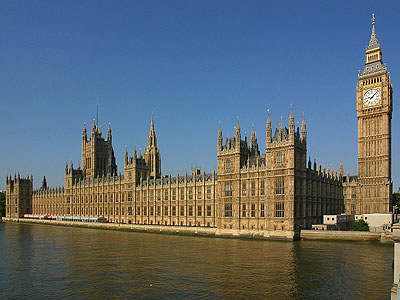
    Roughly speaking, in a parliamentary system there’s only a single house of the legislature. (If there are two, the upper house usually has very limited powers these days.) As a voter, the only thing you do in an election is vote for a member of parliament for your district. Whichever party wins the most seats is the winner of the election.
    There’s no president in this system.1 The leader of the winning party becomes prime minister and forms a government. Party discipline, in most cases, is absolute. The party leadership submits legislation to implement its campaign platform, and every member of the party is expected to vote for it. Thus, the kind of gridlock we suffer from is very rare: the prime minister and his or her cabinet always have a majority of the votes in parliament, so they can be assured that their platform will be implemented exactly as they want it to be. Only in rare cases will members of the majority party decline to support the leadership on an important vote. When this happens, it’s taken as a vote of “no confidence” in the government and a new election is held.

    The advantage of a parliamentary system is accountability: the parties run on their platforms, and the winning party always has the authority to implement its platform. If the voters don’t like it, they can throw the bums out at the next election. The biggest drawback, probably, is the difficulty of forming a government if no single party wins a majority. In this case, the party that won the most seats typically tries to form a coalition with other likeminded parties. As you can imagine, coalitions can be fairly fragile, and if they fall apart too often you can end up with frequent elections and pretty chaotic governance.

    That’s the nickel explanation. So what’s this business about “de facto parliamentary rule” in the United States? The key issue here is party discipline. In the past, the Republican and Democratic parties had fairly weak discipline. It was common for Republicans and Democrats to defect to the other side on particular votes, and this kind of horse-trading allowed us to muddle along fairly well even when Congress and the president were of different parties.

    Today, that’s changed. Like a parliamentary system, we have pretty tight party discipline with virtually no defections. That works fine if you actually have a parliamentary system, where the majority party always has the power to pass laws and implement its platform. And the existence of no-confidence votes provides an escape valve that allows early elections if the government fails in some spectacular way or public opinion changes dramatically.

    But strict party discipline doesn’t work so well in a presidential system like ours. There’s no formal mechanism to force agreement between a Congress and a president of opposite parties, so when traditional horse-trading disappears you have a recipe for gridlock. Nor is there an equivalent of a no-confidence vote. If the government is gridlocked, you’re out of luck until the next scheduled election.

    Parliamentary systems with strict party discipline work fine because the rules are set up to accommodate that. Presidential systems with weak party discipline can also work fine because informal horse-trading between the parties usually allows everyone to cobble together a working compromise of some kind. But a presidential system with parliamentary-style strict party discipline? Not so good. This is why it’s rare for presidential systems to endure.

    Ours is the exception, having endured for over two centuries. But the development of strict party discipline over the past couple of decades has put us in a dangerous position. One way or another, governments have to work. Right now, ours doesn’t, and something has to give. But what?

    1Actually, there is, sometimes. But it’s usually a fairly minor post with mostly ceremonial powers.

  • A “Clarifying Moment” on the Debt Ceiling?


    Back in 2011, during our first debt ceiling crisis, Mitch McConnell proposed a solution: the president would be given authority to increase the debt ceiling on his own, and Congress could only block the increase via a veto-proof super majority. The idea was to defuse the immediate crisis, but force Obama to take sole responsibility for raising the debt ceiling over the next two years until his authority ran out.

    Greg Sargent thinks Democrats should propose making this arrangement permanent in exchange for accepting sequester levels of spending into early next year. But not because Republicans are likely to accept the deal:

    If Republicans refuse this request, it will be a clarifying moment: It will confirm Republicans are fully intent to use the threat of default as leverage to get what they want in later showdowns. And the refusal to renounce this tactic will become what kills any hopes of a compromise. “If a deal fails on that basis, it becomes clear that Republicans are intent on using this as a weapon of extortion over and over again,” [Norm] Ornstein tells me. “It changes the agenda in terms of why a deal failed.” Make Republicans defend this position.

    Unfortunately, I don’t think Republicans would have any trouble defending this position. They’ve said repeatedly that they think the debt ceiling is a useful—and traditional—deadline that forces Washington to confront its overspending ways. Whether they truly believe that or not is hard to say, since they’ve raised the ceiling plenty of times without fuss during Republican presidencies, but that’s their story. They may not like the word “hostage,” but they’ve never made any bones about using the debt ceiling as a hostage in order to force spending cuts out of Democrats.

    So I don’t think this really changes the agenda much. It just confirms what we already know and what Republicans have repeatedly acknowledged in the past. The big question is how the American public reacts to it as the deadline draws closer and the hostage scenario starts to become more than academic. We’re going to find out about that over the next few days.