• Obamacare Isn’t the First Program to Have Opening Day Headaches


    It’s easy to get alarmed about the widely-reported problems with the Obamacare website. People can’t log in; can’t create accounts; and have to endure crashes and software failures once they do finally get on. It’s a mess. And it’s an embarrassing mess.

    At the same time, it’s easy to overreact. Today, Stephanie Mencimer reminds us of what it was like during the early days of the Massachusetts program that served as a template for Obamacare:

    After the law went into effect in Massachusetts, state offices were totally overwhelmed by the number of people clamoring to sign up for insurance, or what the state’s Medicaid director dubbed the “stress of success.” Lost paperwork, computer glitches, confusion over who was eligible for what, and not enough staff to handle the workload meant that in those early days, consumers could wait several months after submitting an application to finally get coverage….In the first two months, only 18,000 of more than 200,000 potentially eligible people had successfully signed up through the connector, according to Jonathan Gruber, an MIT professor who helped design the Massachusetts system and served on the Connector board.

    ….But guess what? Eventually the kinks got worked out and people got covered. Enrollment opened in October 2006, and by the deadline for getting mandatory coverage, July 1, 2007, the Boston Globe reported, 20,000 more people had signed up for insurance on the exchange than the state had expected—12,000 of them in just the two weeks before the deadline. Total enrollment went from 18,000 in December 2006 to 158,000 a year later, says Gruber.

    Read the whole thing for more. None of this means that we should be dismissive about the technical problems with the exchanges. At the same time, most of the state programs are already working pretty well, and the federal program is slowly but surely getting better. There’s still plenty of time to sign up; phone banks are accessible in addition to the website; and the navigator program is just starting to get underway. Within a few weeks, things will be working tolerably well and people will begin signing up in large numbers. By January 1, we’ll likely have millions of satisfied customers signed up via the exchanges, and the early hiccups will be forgotten.

    And look at the bright side: for all of Obamacare’s problems, it’s already working better than Congress. And unlike Congress, it’s almost certain to get better.

  • Why Are We Talking About the Debt Ceiling Crisis As If It’s Normal Politics?


    I was noodling over Obama’s debt ceiling press conference during lunch, and the thing that struck me—again—was how hard it is to truly communicate his postion. And I sympathize. I’ve written about the basics of the debt ceiling hostage crisis at least a dozen times, and I still don’t feel like I’ve ever been able to get across just how radical the whole thing is.

    Except for Newt Gingrich in 1995, no one has ever shut down the government as a threat to get something they want. And except for John Boehner in 2011, nobody has ever threatened to breach the debt ceiling as leverage to get something they want. That’s because it’s basically nuclear chicken, threatening to destroy the economy unless you get your way. It’s unthinkable.
    And yet, it’s now become so institutionalized that Republicans can repeat over and over their mantra that “President Obama refuses to negotiate,” and eventually it starts to get some traction. Reporters who should know better write columns suggesting that Obama should try to bargain his way out of this. Conservative pundits complain not about the hostage taking itself, but about the fact that Republicans should be sure to choose the superior—i.e., most damaging— hostage-taking opportunity available. And Obama is forced to take the stage and try out an extended series of metaphors to explain exactly what’s going on. And then we all sit around and analyze his speech and nitpick his metaphors and game out how this might end.

    It’s crazy. How do you get across how insurrectionary this is? Raising the debt ceiling isn’t a concession from Republicans that deserves a corresponding concession from Democrats. It’s the financial equivalent of a nuclear bomb: both sides will go up in smoke if it’s triggered. Ditto for the government shutdown. And ditto again for the piecemeal spending bills, which are basically a way for Republicans to fund only the parts of government they like but not anything else.

    You can’t govern a country this way. You can’t allow a minority party to make relentless demands not through the political system, but by threatening Armageddon if they don’t get what they want. It’s not what the Constitution intended; it’s not something any president could countenance; and it’s reckless almost beyond imagining.

    And most important of all, it’s not something that should get written about as if it’s just a modest escalation of normal political disagreements. It’s not normal. At all. But how do you get this across? How do you get across just how non-normal it is that we’re even talking about it?

  • Obama Talks About the Debt Ceiling


    President Obama has been holding forth on the debt ceiling and the government shutdown for over an hour now, and you can’t fault him for his ability to stay on message. He’s been clearer than usual, and less stuttery than usual, and he’s repeated his basic position over and over and over: I’ll negotiate about anything, but not as ransom to prevent economic chaos. Democrats have asked Republicans for budget meetings 19 times over the past six months, and they’ve refused because they wanted to wait until they could use threats to get what they wanted. That’s unacceptable. Unilateral threats to burn down the country are unacceptable. But take the threats off the table, and then we can talk.

    Will it work? I don’t know. I’ll leave the detailed commentary to others. But I did like it when Obama told one reporter (I forget which one) “You know they’ve been planning to use threats to get their way for months. You’ve been reporting on it.” It’s true. Reporters know perfectly well how this all happened. It’s not as if Republicans have made any secret of their plans, after all.

  • Investors Are Getting Ever More Nervous About a Treasury Default


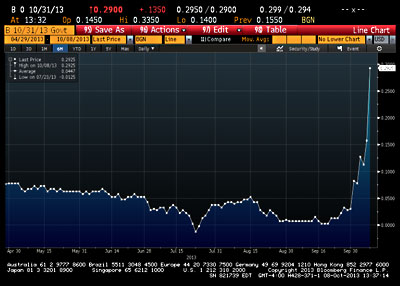
    Last week I linked to a report showing a sharp increase in rates for treasury bonds that mature in late October. This is a signal that markets are starting to get genuinely nervous about the possibility of delayed payment on these notes. Today, Neil Irwin passes along the latest on this. As the chart on the right shows, the rates on short-term bills have hovered right around zero percent for all of September. Then, starting October 1, rates started to rise. In the past 48 hours, they’ve spiked enormously:
    There are reports, including this one from Reuters, indicating that some of the biggest money managers in the world are starting to avoid U.S. government debt that matures in the near future out of fear they will not be repaid promptly. Bond investors seem to be confident that the U.S. government will make good on its obligations in the longer term –securities that mature a year or more from now are actually seeing their rates fall. But they are becoming less confident that these short-term securities will pay on time.

    Ironically, this can create self-fulfilling problems for the Treasury. Treasury bills roll over every week, on Thursdays. Here’s how it works: The government issues the bills for a “discount,” then refunds the par value when they come due. So, for example, an investor might pay $995 for a bill that returns $1,000 in three months, for an equivalent of about a 2 percent annual interest rate.

    As Irwin says, there’s an easy answer to this. Just raise the debt ceiling.

  • The Shutdown Might Be Hurting the GOP’s Chances in Next Year’s Election


    Poll analyst extraordinaire Sam Wang thinks that things are looking fairly bleak for Republicans right now:

    PPP surveyed 24 Congressional districts currently held by Republicans. They asked voters to choose between their current representative and a generic Democrat….The swing was toward Democrats for 23 races [] and toward the Republican for 1 race.

    ….Since the election is over a year away, it is hard to predict how this will translate to future seat gain/loss. If the election were held today, Democrats would pick up around 30 seats, giving them control of the chamber. I do not expect this to happen.

    ….In a followup series of questions, PPP then told respondents that their representative voted for the shutdown. At that point, the average swing moved a further 3.1% toward Democrats….That would be more like a 50-seat gain for Democrats — equivalent to a wave election. An analyst would have to be crazy to predict that!

    I would echo Wang’s caution. It’s quite normal for Democrats to perform well in generic congressional polls 6-9 months before a midterm election, so this probably doesn’t mean much. As for the shutdown, I think it’s an open question whether that’s still going to be a live issue by next November. It might be! Or it might have been completely forgotten. I just wouldn’t put much stock in this either way.

  • Americans Are Poorly Educated, Part XXVI


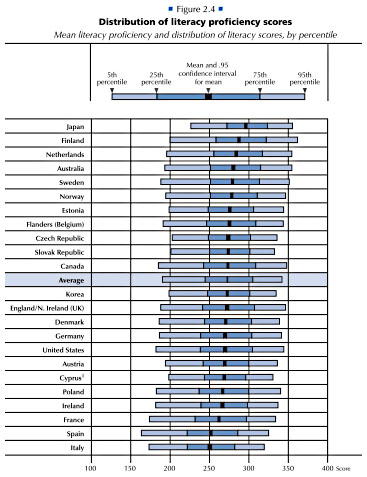
    The OECD has a big new study out about literacy and numeracy in developed countries, and the United States didn’t do very well:

    The study, perhaps the most detailed of its kind, shows that the well-documented pattern of several other countries surging past the United States in students’ test scores and young people’s college graduation rates corresponds to a skills gap, extending far beyond school. In the United States, young adults in particular fare poorly compared with their international competitors of the same ages — not just in math and technology, but also in literacy.

    More surprisingly, even middle-aged Americans — who, on paper, are among the best-educated people of their generation anywhere in the world — are barely better than middle of the pack in skills.

    Every year someone conducts a geography test among America’s high school students, and every year the results are the same: lots of kids can’t find France on a map. Quelle horreur! And every year I have the same reaction: how about if we give this test to adults? I’ll bet most of them can’t find France on a map either.

    This is why the second paragraph of the excerpt above doesn’t surprise me. It also wouldn’t surprise me if the same thing were true 50 years ago. There’s a widespread myth that America used to be the best educated country in the world and has since slipped into mediocrity, but as near as I can tell it’s just a myth. America’s kids have always been fairly middle-of-the-pack. Ditto for America’s adults. My guess is that this is largely due to averages being pulled down by enduring levels of inequality and the legacy of racism, but that’s just a guess.

    So I’m honestly not sure what to think about this. Low literacy levels are obviously a serious issue. This isn’t something that should be casually dismissed. And yet….as you can see in the chart, the difference in literacy levels between countries is fairly small except at the very top and bottom, and the United States is sandwiched right in between Denmark, Germany, and France. Does anyone think that Denmark and Germany are educational hellholes doomed to decline and poverty?

    As an aside, one odd result in this study is that America does worse in numeracy than in literacy. This is odd because if you look at NAEP test scores over time, it’s the math scores that have gotten substantially better. If there’s an area where you’d think the United States would be in relatively better shape, it’s math.

    For now, I’ll wait for some more expert commentary. I’ve seen too much of this stuff to panic about it without digging a little deeper, and especially without knowing if it’s truly an alarming new development, or just the same results as always.

  • The Problem With Jon Stewart’s Obamacare Interview

    From First Read:

    If you’re a Democrat and you’ve lost Jon Stewart, you have a problem. And that’s exactly what happened when HHS Secretary Kathleen Sebelius went on the “Daily Show” last night to talk about the glitches with the Obamacare website. “As the secretary sat down to begin the segment, Stewart opened a laptop on his desk. ‘I’m going to attempt to download every movie ever made, and you’re going to try to sign up for Obamacare, and we’ll see which happens first’”….We said it yesterday and we’ll say it again: The last thing you ever thought would happen is that Team Obama would have a website issue. These were the folks who pioneered how campaigns interact with voters over the internet.

    Obamacare’s website issues are obviously serious, but at the same time: give me a break, folks. I’m pretty sure the First Read team is well aware that Obama wasn’t allowed to just call up his favorite web guru and tell him to get the old campaign team together and set up the Obamacare site. It had to go through the usual government procurement and bidding process, and was designed and created by whichever outside consultants won the job.

    The NBC news team knows this, right? So why do they act like they don’t?

    As for Stewart, I’m not sure what to say. I watched his interview last night, and I thought Stewart was easily as big a problem as Sebelius. He decided to ask about the conservative talking point that it’s unfair to delay the employer mandate while leaving the individual mandate in place, and Sebelius clearly tap danced a bit. But the big problem, as near as I can tell, is that Stewart was his usual unprepared self for this interview. Frankly, I couldn’t tell throughout the interview if he even understood what the employer mandate was. This happens all the time, usually with conservatives knocking Stewart around because they know what they’re talking about and he doesn’t. This time it happened to be a liberal, but the result was the same: an incoherent interview in which he couldn’t drive home his point because he wasn’t really sure what his point was.

    Following the interview, he made a gag about still not understanding what was going on, and then suggested that maybe Sebelius had been lying. That was really beneath him. Sebelius didn’t do a great job of answering the question, but I sure didn’t catch her in any lies. She basically told him that the employer mandate applied only to businesses with more than 50 employees (true); that most of these businesses already offer their employees health coverage (true); and that the number of people affected by the delay of the employer mandate was pretty small (true). RAND estimates that the delay will affect 1,000 firms and 300,000 people, about 0.2 percent of the population.

    Now, is delaying the employer mandate “fair?” That’s hardly a question with a factual answer, so I’m not sure what kind of reply Stewart expected to get in the first place. In the end, this was just another example of Stewart on his high horse again, and it’s always been his least attractive persona, regardless of whether it’s prompted by liberal or conservative outrage. Sebelius obviously tried to put the best possible face on the Obamacare rollout, just as all politicians do, but she didn’t lie.

    POSTSCRIPT: And why was the employer mandate delayed? The truth is that we’ve never gotten a definitive explanation. The basic answer is that the regulatory requirements turned out to be more complex than anticipated. The deeper answer is roughly the one that Sebelius gave: it was possible to grant the delay because the effect was tiny and didn’t affect anything fundamental about Obamacare. Conversely, the individual mandate isn’t especially complex and does fundamentally affect Obamacare. It can’t be delayed without doing serious damage to the entire law. This answer might or might not be satisfying, but it’s roughly the truth.

    ANOTHER POSTSCRIPT: If you want a slightly more detailed description of what was wrong with this interview, and what kind of answer Sebelius should have given, Josh Barro has a pretty good rundown here.

  • Is October 17 Still the Drop Dead Date for the Debt Ceiling?


    I’d still like to know if Treasury thinks October 17 is the drop-dead day for hitting the debt ceiling. I’ve looked through the various numbers about federal income and outgo, and I accept that the government shutdown probably doesn’t affect spending all that much. But it does affect it some, and I’d like to know how much.

    Here’s why. If October 17 rolls around and Jack Lew suddenly announces that, thanks to the shutdown, we have some extra time before the sky falls, it’s going to feed the shockingly common Republican belief that all the debt ceiling chatter is little more than liberal scaremongering. For the same reason, I’d like Treasury to tell us definitively if they can prioritize payments or not. Because if it turns out they can, and the worst effects of the debt ceiling can therefore be deferred, Republicans will take it as even further evidence of scaremongering.

    I know Treasury is in a tough position. But it could be disastrous if they’ve been less than 100 percent forthright and pundits everywhere start claiming that the whole thing has been a cynical game and there was never any serious danger after all. It wouldn’t be true, but it would nonetheless make resolution of the debt ceiling crisis even harder than it seems now.

  • New Study Says Conservatives React More Strongly to Insults Than Liberals


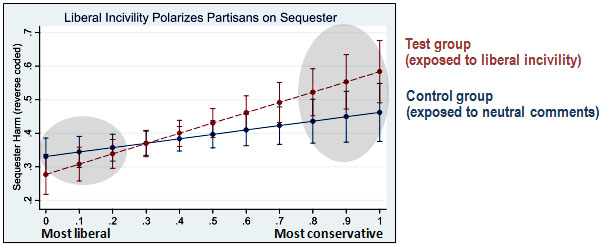
    Via Henry Farrell, here’s something that won’t surprise you at all. Lafayette College professor Elizabeth Suhay ran an experiment recently that tested the effect of incendiary blog comments. As you can see in the chart below, when the test included obnoxious liberal comments, it didn’t have much effect on liberals compared to a control group. But conservatives reacted pretty strongly. The comments pissed them off and their views became even more conservative than before:

    Like I said, this is no surprise. You’d expect conservatives to react more strongly than liberals to liberal insults.

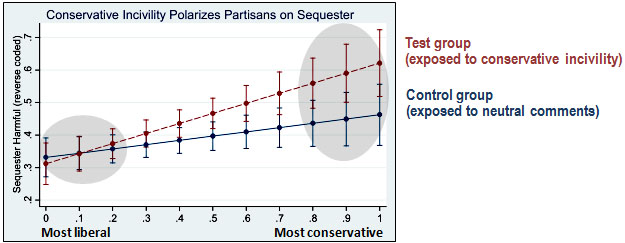
    But here’s the surprise: Another version of the test included obnoxious conservative comments. And the results were the same. Liberals pretty much shrugged off the insults, but conservatives reacted strongly compared to a control group. When they read nasty comments from their fellow conservatives, it fired them up to be even more conservative than before:

    Now, there are a few reasons to take this with a grain of salt. First, it’s only one study. There may be problems with methodology or question wording or a dozen other things. Second, this is pretty much what we liberals would like to believe, isn’t it? That should give us pause before we get too self-righteous over this. Third, the study was done using volunteers recruited via Mechanical Turk, and I’ve had some pretty uncomplimentary things to say about MT before.

    Still, it’s intriguing and certainly deserves some follow-up. I presume this result is related in some way to the fact that conservatives tend to have higher in-group loyalty than liberals, but that’s just an armchair guess. Maybe further research could dig into that.

    From a political point of view, I guess the big question this study raises is: What fires up liberals? We have a pretty good idea of what fires up conservatives, but what gets us lefties going?