• Why Washington Is Stuck in an Endless Loop of Dysfunction and Squabbling


    Today Ezra Klein lists “The 13 reasons Washington is failing,” and to be honest, I was all ready not to like this post. I mean, seriously? Thirteen reasons? Spare me.

    But it’s pretty good! Sure, numbers 5, 10, and 11 are kinda the same, but that’s OK. It’s an idea that deserves some repetition. And many of the others don’t always get the attention they deserve even though they’re surprisingly important. The most important one of all, I think, is way at the bottom of the list at #13. Generally speaking, I’m not part of the crowd that thinks we’re doomed to eternal gridlock and dysfunction, but there’s not much question that the transformation of American parties into ideological European-style parties is very, very, underappreciated. Regardless of how our current crisis works itself out, we’re on a massive collision course between de facto parliamentary rule, with party discipline as its fundamental feature, and a presidential system that never developed the parliamentary norms that make this work.

    Maybe we’ll work things out. But governing norms are critical when the actual governing rules are incoherent, as ours have become, and the Republican Party has been gleefully tearing down governing norms ever since Newt Gingrich took over. I’m not sure how this is supposed to end.

  • Maybe Obama’s Team Needs to Be a Little More Alarming on the Debt Ceiling


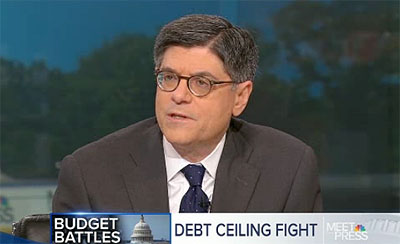
    Bob Somerby writes today about Sen. Rand Paul’s appearance on Meet the Press this weekend, but throws in an aside about Treasury Secretary Jack Lew’s appearance:

    [Paul] followed Jack Lew, who pretty much convinced the nation that we have little to fear from a failure to raise the debt limit. We know, we know! Lew was trying to say the opposite. But what a horrible, narcotized spokesman!

    It’s true that Lew took a pretty low-key approach, despite host Savannah Guthrie’s best efforts. “Are you talking catastrophe?” she asked. Lew wouldn’t bite, so then she gave him another chance. “It would be calamitous for the economy?” Still no bite! “It would be very bad,” was the worst Lew could summon up.

    That’s pretty soporific, all right. The problem, I assume, is that Lew is in an impossible situation. Breaching the debt ceiling would be pretty calamitous, but Treasury secretaries have an obligation not to panic markets with loose talk. Backbench congressmen, by contrast, can say anything they think might get them a few minutes on the evening news.

    It’s an asymmetrical war, and it’s not clear what the answer is. Administration officials have a fine line to walk, trying to make sure they have well and truly warned everyone about how disastrous a debt ceiling breach would be, but at the same time not sending markets into a tailspin unnecessarily. I’m not sure what the answer is, but I think Bob is right: Lew pushed the balance a little too far into yawn inducing territory yesterday. He needs to be clearer about what exactly would happen once we finally get to the day when we can’t pay our bills.

  • Ted Yoho: We Must Destroy the World In Order to Save It


    Government policy may or may not have been a prime cause of the 2008 financial crisis, but Dan Drezner says it sure is a prime cause of the lousy recovery since then:

    A standard lament about the 2008 financial crisis is that it happened because of “market fundamentalism.”….But between the Eurozone crisis and U.S. policy deadlocks, it’s striking how much the gyrations of the past few years are because of governance failures. And it’s depressing to consider how much better the global economy would be doing if politicians in the advanced industrialized economies were a bit better at their jobs.

    Yep. And speaking of governance failures, here is Rep. Ted Yoho over the weekend:

    “I think we need to have that moment where we realize [we’re] going broke. If the debt ceiling isn’t raised, that will sure as heck be a moment. I think, personally, it would bring stability to the world markets,” since they would be assured the United States had moved decisively to curb its debt.

    Yes indeedy. Breaching the debt ceiling will bring stability to world markets. I wonder what other ideas Yoho has for bringing stability to world markets? I’d love to hear them.

    I think Yoho deserves to be immortalized for this. As we all know, the increasingly annoying acronym YOLO means You Only Live Once. So what does YOHO stand for? You Only Hijack Once?

  • How Population Genetics May Help Explain Economic Growth


    Alex Tabarrok links to a short post today by a couple of researchers who study the transmission of ideas throughout history. Their conclusion is that the speed of diffusion depends on a country’s “genetic distance” from the source of the idea, and when I first read this I thought they were using genetic distance as a metaphor of some kind. That is, they were measuring the distance between various cultures, and the math happened to be similar to the math for measuring the genetic distance between human population groups, so that’s what they called it.

    But no. The two researchers, Enrico Spolaore and Romain Wacziarg, are literally talking about population genetics:

    Measures of average differences between vectors of allele frequencies (different genes) across any two populations provide a measure of genetic distance….The goal of this approach is not to study any genetic characteristics that may confer any advantage in development….On the contrary, they are neutral: their spread results from random factors and not from natural selection. For instance, neutral genes include those coding for different blood types….Instead, genetic distance is like a molecular clock — it measures average separation times between populations. Therefore, genetic distance can be used as a summary statistic for divergence in all the traits that are transmitted with variation from one generation to the next over the long run, including divergence in cultural traits.

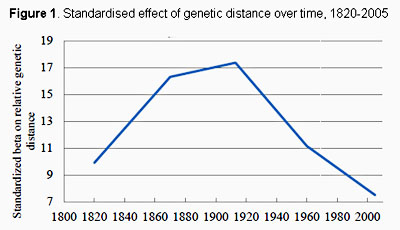
    Their hypothesis is that populations that are genetically more distant are also culturally more distant and are therefore more resistant to trading and adopting each others’ cultural traits. In the case of the Industrial Revolution, the epicenter was in Great Britain, so the adoption of new technology was strongly influenced by the genetic distance of different populations from Britain. Sure enough, they claim that was the case. The chart on the right shows the effect of genetic distance from Britain on the adoption of machine technology. It starts out fairly modestly, rises to a high level by 1913, and then declines as technology finally diffuses everywhere.

    In a sense, this comes as no surprise. Genetic distance is pretty obviously correlated with both physical distance and cultural distance, so you’d expect that it might also correlate with the spread of ideas as well. Path dependence and deliberate policy (for example, colonial rules that deliberately inhibited the spread of technology) can then account for most of the rest. Spolaore and Wacziarg’s conclusion:

    In sum, we find considerable evidence that barriers introduced by historical separation between populations are central to account for the world distribution of income….These results have substantial policy implications. A common concern when studying the persistent effect of long-term history is that not much can be done today. But if a major effect of long-term historical divergence is due to barriers, there is much room and scope for policy action. Populations that are historically farther from the frontier can benefit from policies that specifically aim at reducing barriers to exchange and communication.

    Needless to say, “reducing barriers” is a two-edged sword. But it’s an interesting proposition nonetheless.

  • John Boehner Has Been Cruzified on a Cross of Tea


    Byron York has an interview today with a Republican congressman who is unnamed except for this description: “It’s fair to say his was a perspective well worth listening to.” The gist is that this guy was surprised by the passion of the Ted Cruz crusade to defund Obamacare, but nonetheless figured that Democrats would eventually agree to pass a CR with a single modest concession: repealing the medical device tax. Here’s the relevant passage:

    “I never thought defund, and honestly, I never thought delay, would work,” the lawmaker said. “I think the Democrats very much need the exchanges to come on and work to finally create a constituency for [Obamacare]…so I never thought they would agree on that.”
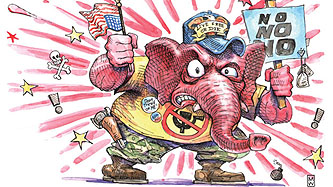
    Still, the lawmaker thought Senate Democrats, and Majority Leader Harry Reid, would make some sort of concession on a lesser aspect of Obamacare. “I do think, though, when Boehner sent over delay and [repeal of the] medical device tax, I think he thought he’d probably get back medical device, and that would have probably been enough right there,” the congressman said. But Reid and the Democrats steadfastly refused to consider any change to Obamacare, surprising Republicans again….When Boehner lowered his demands to include a delay for just the individual mandate — not for all of Obamacare — Republicans thought Democrats would be open to that more modest proposal.

    “Instead, it’s no, we’re not going to negotiate, we’re not going to negotiate, we’re not going to negotiate,” the lawmaker said. “Which means effectively you’re going to try to humiliate the Speaker in front of his conference. And how effective a negotiating partner do you think he’ll be then? You’re putting the guy in a position where he’s got nothing to lose, because you’re not giving him anything to win.”

    I understand that I’m writing from a partisan perspective and might be as blinkered as the next guy. But this strikes me as jaw-droppingly naive.

    Here’s the thing: I agree with our unnamed congressman about the device tax. It’s a fairly small thing ($2-3 billion per year) and completely nonessential to Obamacare. It could be eliminated without harm, and it would give Boehner a small bit of face-saving that might allow him to pass a budget. If this had been the GOP’s initial ask, Democrats probably would have given in.

    But after weeks and weeks of tea party rage and intransigence, that became impossible. By the end of September, the Republican strategy had become crystal clear: demand unceasing concessions from Democrats at every opportunity without offering anything in return and without any negotiation. A month ago, Democrats might have shrugged over the device tax. Today, they know perfectly well what it would mean to let it go. It means that when the debt ceiling deadline comes up, there will be yet another demand. When the 6-week CR is up, there will be yet another. If and when appropriations bills are passed, there will be yet another. We’ve already seen the list. There simply won’t be any end to the hostage taking. As their price for not blowing up the country, there will be an unending succession of short-term CRs and short-term debt limit extensions used as leverage for picking apart Obamacare—and everything else Democrats care about—piece by piece.

    There’s no way that any political party anywhere in the world would willingly put itself in this position. Does this mean that Democrats are “jamming” Boehner, leaving him no way to save some face? Yes it does, and human nature being what it is, that’s truly unfortunate. But what other choice do they have? The newly Cruz-ified Republican Party has left them with no alternative.

  • Denny Hastert’s Republicans Are Gone, Gone, Gone


    Eleanor Clift interviewed former House Speaker Denny Hastert for the Daily Beast this week, and the part that’s getting the most attention is Hastert’s claim that there’s never really been a Hastert Rule. But that’s not the most interesting part of the interview. It’s this part, where Clift asks him why there’s so much gridlock right now:

    Pressed on the differences between then and now, Hastert said: “I didn’t have to deal with Barack Obama. I dealt with Bill Clinton, and he came to the table and negotiated.” In August 2000, with Clinton nearing the end of his term, Hastert needed to resolve some outstanding issues….Clinton asked, “What can I do for you?” “A haircut across the board,” Hastert replied. “I would suggest a 1 percent cut.” Can’t take that, Clinton said, offering all the reasons why that wouldn’t work. “What do you suggest?” Hastert asked him. A quarter of 1 percent, Clinton replied. “We dickered back and forth and settled on .86 percent, not because it was a magic number,” said Hastert. “But the moral of the story is Clinton would come to the table. I’m not going to go into the science of negotiating, but you can put one thing on the table and end up with something entirely different, but you’ve got to talk.”

    I get that Hastert is being a good trouper here, and I don’t really blame him for that. But the real moral of the story is exactly the opposite of what he suggests. In 2000, he asked Clinton for a particular level of funding; he dickered for a bit; and then eventually settled for a little less than he originally wanted. By contrast, in 2013 John Boehner asked for a budget at sequester levels of funding; Obama eventually agreed to give him 100 percent of what he asked for; and then Boehner turned down the deal anyway.

    The difference isn’t that Obama won’t dicker. The difference is that House Republicans aren’t willing to accept the funding levels they asked for in the first place. They won’t let the government reopen unless they get more, more, more. The issue isn’t Clinton vs. Obama, it’s Republicans in 2000 vs. Republicans in 2013.

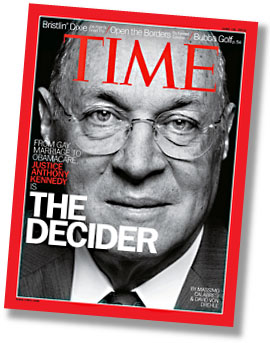
  • Anthony Kennedy Denounces Anthony Kennedy’s Supreme Court Jurisprudence


    Justice Anthony Kennedy thinks our political system should solve more problems on its own, instead of turning to the courts to solve them. Jonathan Adler is unimpressed:
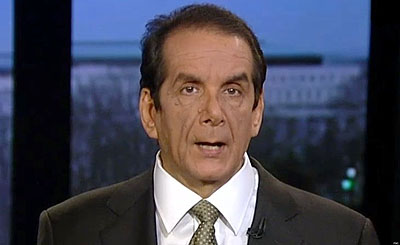
    In most cases, the Supreme Court intervenes not to help the democratic process to function, but rather to alter the way in which these questions have been resolved. Moreover, Justice Kennedy is more prone to support such intervention than most of his colleagues, having voted to invalidate DOMA, Section 4 of the Voting Rights Act, McCain-Feingold, the PPACA, the Stolen Valor Act, and so on. The only sense in which these questions were not “solved” before they came to the Court is in that the resolution was not that which Justice Kennedy would have preferred (or which Justice Kennedy believed is constitutionally compelled).

    The Supreme Court, if it chose, could informally agree to overturn only those laws that are definitively unconstitutional. It has, needless to say, chosen nothing of the sort, with justices at both ends of the political spectrum routinely voting to overturn statutes based on wholly novel and often tortuous lines of reasoning. In recent years, this has been far more common among Kennedy and his fellow conservatives than among the liberal justices.

    However, if Kennedy is serious, perhaps he should propose a constitutional amendment that would require a two-thirds majority to overturn an act of Congress. More prosaically, since Kennedy is so often a swing vote, he could personally decide never to overturn a law unless there were at least five other votes already in favor. But he pretty obviously hasn’t the slightest intention of doing so.

  • We Are Witnessing a Destruction Test of P.T. Barnum’s Philosophy of Life


    So Republicans have settled on their messaging, and it’s this: Democrats are refusing to negotiate. We keep offering compromise after compromise, but Democrats won’t listen to any of them.

    Will this work? The truth of a proposition has little or nothing to do with its pyschodynamics,1 so I suppose it has a chance. But it certainly shows a considerable contempt for the intelligence of the voting public. After six months of (a) refusing to meet with Senate Democrats to discuss the budget and (b) gleefully telling anyone who would listen that the shutdown and/or debt ceiling would be their ultimate leverage to force President Obama to agree to their laundry list of demands, you’d think it would be a hopeless task to pretend it was Democrats who wanted this fight all along. Add to that the fact that Democrats have already given in completely to Republican demands on spending levels, and you’d think it would be flatly impossible to pretend that Democrats were the ones refusing to negotiate.

    But you never know. The fact that this is a cynical ploy doesn’t mean it won’t work. Ironically, given that Karl Rove is opposed to this strategy, it reminds me of his well-known—and frequently successful—tactic of turning an opponent’s strong points against him. Republicans are pretty universally known as the party of instransigent zealots, so let’s claim that it’s really Democrats who are the intransigent zealots! And we’ll do it by continually offering the same concession—i.e., nothing—in return for an ever-changing set of demands and pretending that this represents a sincere search for compromise. It’s so crazy it could work!

    1Bonus points if you can name the fictional character who said this. No googling!

  • Hostage Taking Then and Now


    Here is Charles Krauthammer today:

    President Obama indignantly insists that GOP attempts to abolish or amend Obama­care are unseemly because it is “settled” law, having passed both houses of Congress, obtained his signature and passed muster with the Supreme Court….Yet when the House of Representatives undertakes a constitutionally correct, i.e., legislative, procedure for suspending the other mandate — the individual mandate — this is portrayed as some extra-constitutional sabotage of the rule of law. Why is tying that amendment to a generalized spending bill an outrage?

    Now let’s imagine it is 2003, Democrats control the House of Representatives, and they have refused to allow the government to continue running unless President Bush’s tax cut is repealed. Under pressure, they have since “compromised,” and are now demanding only that the top rate cuts be repealed as their price for reopening the government. Here is Krauthammer:

    President Bush indignantly insists that Democratic attempts to abolish or amend his tax cut are unseemly because it is “settled” law, having passed both houses of Congress, obtained his signature and passed muster with the Supreme Court….Yet when the House of Representatives undertakes a constitutionally correct, i.e., legislative, procedure for suspending the top end cuts, this is portrayed as some extra-constitutional sabotage of the rule of law. Why is tying that amendment to a generalized spending bill an outrage?

    Please raise your hand if you can imagine Krauthammer writing that. Anyone? Now please raise your hand if you’re pretty sure he’d have written the exact opposite.

    On a related note, Krauthammer is part of the crowd that thinks it was foolish for Republicans to tie Obamacare defunding to a government shutdown. If they were going to do this at all, he figures they should have tied it to the debt ceiling increase instead. This is a hundred times more damaging, of course, the financial equivalent of threatening nuclear obliteration, but it polls better so he prefers it. It’s a pretty good example of the dissolute state of the highbrow end of the conservative commentariat these days.

  • Friday Cat Blogging – 4 October 2013


    Domino’s favorite activity, by far, is to demand a belly rub. Here’s how it works: she comes barreling down the stairs (because I’m usually downstairs) and starts squawking loudly. Then she tries to lure me into the living room, squawking the whole time, and waits for me to get down on the floor because she prefers that I be at her level. Then she walks back and forth in front of me while I pet her, with her squawks slowly turning into a sort of low rumble that’s halfway between a meow and a purr. Then, after circling back and forth five or six times (never less), she plops down on the floor and turns over for a belly rub.

    It’s an extremely choreographed maneuver, with very specific sounds and dance moves. This morning I brought my camera with me for the 9 am showing and took a few selfies. This one is toward the end of the performance, with Domino already plonked on the floor and, as you can see, my hand rubbing her belly. In the picture she looks suspicious, but that’s just a trick of the light. In real life, she was rolling around and completely blissed out.

    This happens about a dozen times a day. It’s lucky for her that I work at home.