• Wall Street Tycoons Are Very, Very Hurt by All the Criticism They’ve Gotten


    AIG CEO Robert Benmosche is in trouble for telling the Wall Street Journal that the fight to cut AIG bonuses after the company was bailed out by the federal government was basically the work of a lynch mob, “sort of like what we did in the Deep South [decades ago].” Ezra Klein reviews other similar statements by Wall Street honchos and then explains where it comes from:

    I was in an off-the-record meeting with top Wall Street folks where similar comparisons to Nazi Germany were tossed around. It really was a meme on Wall Street that the singling out of the wealthy for criticism — and, more to the point, taxation — had a direct historical precedent in Nazi Germany, where the Jews were first demonized, then taxed, and then, well, you know. The sense was that the rich in general, and Wall Street in particular, weren’t just being criticized, but that they were being turned into a dangerously despised minority.

    That’s the context of Benmosche’s comment. I would bet he’s made the same point a number of times in private rooms to appreciative nods. When you say and hear that kind of thing often enough, however, you forget how insane and offensive it is — and then you say it to the Wall Street Journal.

    Even Mitt Romney was smart enough to keep this kind of talk private. He was just unlucky that a worker at one of his fundraisers was offended by what he said and decided to release a video of it. Nonetheless, it was pretty obvious that this really was the kind of thing Romney said in private, and the kind of thing that Romney voters ate up.

    Likewise here. Wall Street tycoons really do feel put upon. They simply don’t feel any collective responsibility for either the housing bubble or the Wall Street fraud and financial manipulation that made it worse. Nor do they feel any responsibility to support government action that helps ordinary workers who were hurt by the massive recession that followed. Nor do they believe that any further regulation of their activities is warranted in any way. They are the engines of the economy, not rent-seeking mooches, and they’re just damn tired of all the pipsqueaks who think otherwise.

    It is truly mind-boggling.
  • Why Do Humans Get Motion Sickness?


    The New York Times reports on a researcher who thinks the traditional explanation for motion sickness is all wet:
    For decades now, [Thomas] Stoffregen, 56, director of the university’s Affordance Perception-Action Laboratory, has been amassing evidence in support of a surprising theory about the causes of motion sickness. The problem does not arise in the inner ear, he believes, but rather in a disturbance in the body’s system for maintaining posture. The idea, once largely ignored, is beginning to gain grudging recognition.

    “Most theories say when you get motion sick, you lose your equilibrium,” said Robert Kennedy, a psychology professor at the University of Central Florida. “Stoffregen says because you lose your equilibrium, you get motion sick.”

    That’s kind of intriguing. But I can get severe motion sickness while sitting still in a seat on a perfectly calm airplane flight. It happens when I have a cold, or I’m recovering from a cold, and one ear clears but the other one doesn’t as the cabin pressure is changing. It happens all the time to me, and the result is that the world starts spinning violently and I get dizzy and nauseous. This happens with no change in posture and no loss of equilibrium.

    Maybe this is different from motion sickness, though. Seasickness does prompt some dizziness, but not quite the spinning world effect of one ear staying at a different pressure from the other.

    On the other hand, sitting in an IMAX theater and watching a movie that simulates a roller coaster ride can induce motion sickness, even though you’re sitting perfectly still. So what’s up with that? Maybe you’re not sitting quite as still as you think? Questions, questions.

  • “Ted? Oh yeah, immense a*#hole.”


    Josh Marshall was at Princeton at the same time as Ted Cruz, but doesn’t remember anything about him. After Cruz won his Senate election last year, he decided to try to refresh his memory:
    So I started getting in touch with a lot of old friends and asking whether they remembered Ted. It was an experience really unlike I’ve ever had. Everybody I talked to — men and women, cool kids and nerds, conservative and liberal — started the conversation pretty much the same.

    “Ted? Oh yeah, immense a*#hole.” Sometimes “total raging a#%hole.” Sometimes other variations on the theme. But you get the idea. Very common reaction.

    In other words, the fact that practically everyone in the Senate already hates his guts is no surprise. “The reaction to Cruz in the senate is simply the reaction Ted’s gotten at least at every stage of his life since he arrived at college in 1988.”

    At least.

  • Americans Claim to be Equally Divided on Who to Blame for Government Shutdown


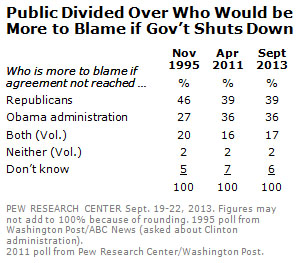
    According to Pew, the public will blame Republicans and President Obama about equally if there’s a government shutdown. I suppose this is good news for Republicans, though I’d be really interested in seeing the party breakdown on this question, since I’ll bet it’s basically a proxy for party affiliation and not much else. This seems especially likely since only 25 percent of those polled even say they’re following the shutdown fight “very closely.” Of the remaining 75 percent, only 7 percent answered “don’t know” on the blame question. So what are they basing their answers on?

    UPDATE: Michael Dimock passes along the partisan breakdown. No surprise on the D/R front, but it turns out that independents say they’d blame Obama more than Republicans by a margin of 39-33 percent. I’ll confess that this startles me. I’m not sure what to make of it.

  • The Economy Is Pretty Hard to Understand These Days


    Tyler Cowen is perplexed by the size of the market reaction to the Fed’s announcement that QE3 will continue along its present path for the foreseeable future instead of being tapered down. After all, the difference between taper and non-taper is only a few tens of billions of dollars of bond purchases. That’s peanuts, Cowen says, and it doesn’t make sense:

    I’ll say it again: none of you understand what is going on here, and neither do I. I am not seeing enough admission of this basic fact.

    I’ll cop to that. I do think we have a pretty good idea in a general sense of what caused the Great Recession and what kind of government response would have been best: extremely loose monetary policy combined with massive fiscal stimulus. There’s a lot of evidence that this would have improved the economy fairly quickly, and we might very well be back to trend growth today if we’d done it. Unfortunately, the initial stimulus was too constrained and the austerity zealots made sure that not only did we have no further stimulus, but we slashed spending massively at the very time we should have been spending more.

    But what’s done is done. The question now is what kind of impact nonconventional monetary policy has on a slowly recovering economy that still has lots of slack. And there, I’m with Cowen: it’s really hard to make sense out of the evidence. Scott Sumner, for example, says the market reacted strongly to the Fed’s announcement because it was unexpected and signaled not just a change, but a change to a completely different policy regime. I have to say that I find that strained. It’s become almost faddish to believe that all a central bank has to do is set expectations properly and everything else will magically fall into place, but it’s not clear that the evidence backs this up. The expectations channel, after all, depends on the market believing that the Fed has an actual operational channel that can produce whatever results it wants. If that’s true, there’s no point in fighting, and the market will bring about the results the Fed wants with no actual Fed action necessary. That would be pretty cool if it were true. But what if the market becomes skeptical of the Fed’s power? It doesn’t matter why. It might be skeptical for fundamental economic reasons; or because it thinks the Fed is politically constrained; or because it thinks overseas leakage is important; or because it simply disagrees with the Fed’s likely strategy. If that happens, then the expectations channel isn’t that powerful after all—and I don’t think any of us know to a certainty just how the market judges either the Fed’s commitment in the face of pressure or the effectiveness of its nonconventional open market operations if it’s forced to show its hand. The financial channels the Fed manipulates are just too murky.

    This stuff is all way over my pay grade. I’ve seen bits and pieces of evidence that make me think the expectations channel is significant, but far from omnipotent. I’ve also seen bits and pieces of evidence that just seem damn strange. Maybe someone will come along soon and present us with a comprehensive new theory of monetary policy in the context of 21st century financial markets, but I don’t think we’ve seen it yet.

  • The Public Is Massively Opposed to Shutting Down the Government Over Obamacare


    The public is generally opposed to defunding Obamacare, but it’s a close call. However, when the question is whether it’s worth shutting down the government in order to defund Obamacare, it’s not a close call at all according to a new CNBC poll:

    Opposition to defunding increases sharply when the issue of shutting down the government and defaulting is included. In that case, Americans oppose defunding 59 percent to 19 percent, with 18 percent of respondents unsure.

    ….When including the issue of a government shutdown and default, [] 48 percent of Republicans oppose defunding Obamacare, while 36 percent support it. However, a 54 percent majority of Republicans who also identify themselves as Tea Party supporters want the new health care law defunded even if it means a government shutdown — the only demographic measured in the poll with such a majority.

    ….Independents are more troubled by the prospect of defunding Obamacare and shutting down the government than the broader population. In general, they oppose defunding by a slight plurality of 44 percent to 40 percent. However, when the issue of shutting down the government is included, opposition to the measure swells to 65 percent, while support drops to just 14 percent.

    Nobody wants to shut down the government over Obamacare except for hard-core tea partiers. Among independents, opposition to hostage taking is an amazing 65-14 percent. Now tell me again about how Republicans are somehow going to convince the public to blame a shutdown on Democrats?

  • Quote of the Day: Control Over the Internet Is the “Struggle of Our Generation”


    From Glenn Greenwald, in an interview with Noam Sheizaf of Haaretz:

    The promise of the Internet was that it would liberate people and bolster democracy, but it has become a tool for suppression and control. In fact, it is one of the most powerful instruments of control ever invented. The most essential challenge we face today is related to the real effect of the Internet. Will it impart power to people and liberate them, or will it impart more strength to the centers of power and help them oversee, control and suppress the population? That is the struggle of our generation, and it has yet to be decided.

    In the past, outside of police states, there were practical limits to surveillance simply because people communicated in so many different ways. Today, we’re moving toward a world in which virtually all communication is done via a single global digital network. This has obviously empowered individuals in a broad and complex set of ways, but as our lives become more and more dependent on the internet, it has also provided governments with a single point of contact for nearly ubiquitous surveillance. As Glenn says, it’s not clear yet which of these forces is more powerful. In China, I’d say the latter. In the United States, probably the former. So far.

  • Finally, a Problem With Obamacare That’s Actually Real


    Conservatives have no end to the horror stories they tell about the launch of Obamacare and the impact it will have on the health care market. Most of them, I think, are fairly modest, and many are downright trivial. But for the record, there’s one that I think is going to turn into a sore spot, and today the New York Times picked up on it:
    From California to Illinois to New Hampshire, and in many states in between, insurers are driving down premiums by restricting the number of providers who will treat patients in their new health plans.

    When insurance marketplaces open on Oct. 1, most of those shopping for coverage will be low- and moderate-income people for whom price is paramount. To hold down costs, insurers say, they have created smaller networks of doctors and hospitals than are typically found in commercial insurance. And those health care providers will, in many cases, be paid less than what they have been receiving from commercial insurers.

    It’s no surprise that here in California, Kaiser came in as one of the highest bidders on the new state exchange. That’s because they’re an HMO and they can’t easily restrict their network for certain customers. With that eliminated as a way of saving money, their overall cost ended up higher than most of the other bidders.

    This is not likely to be a disaster, and it won’t prevent the rollout of Obamacare. But unlike so many of the other Chicken Little predictions (21-page form! No more full-time jobs!) I suspect that this one really will be a bit of a festering sore.

  • How Austerity Wrecked the American Economy


    With Washington DC’s attention focused on the antics of Ted Cruz and the tea partiers, who are threatening to shut down the government unless Obamacare is defunded, it’s easy to lose sight of the bigger picture: Aside from Obamacare, the budget battles of the past three years have been exclusively about the Republican obsession with cutting spending while we’re trying to recover from the worst recession since World War II.

    This is lunacy, and it’s the subject of “Death by a Thousand Cuts,” my cover story in the current issue of Mother Jones. The piece is framed around the famous Excel error in the paper by Carmen Reinhart and Ken Rogoff, but my point isn’t really to blame them for what happened. Their paper, predicting doom if U.S. debt levels went above 90 percent of GDP, provided important intellectual cover to the austerity zealots who wanted to use the recession as an excuse to hack away at spending on social welfare programs, but the truth is that the zealots would have done it anyway. R&R just made their job easier.

    And they’re still at it. As I write in the story, conservatives remain obsessed with slashing spending despite the fact that (a) this is unprecedented in recent history and (b) the deficit has already been slashed repeatedly over the past three years:

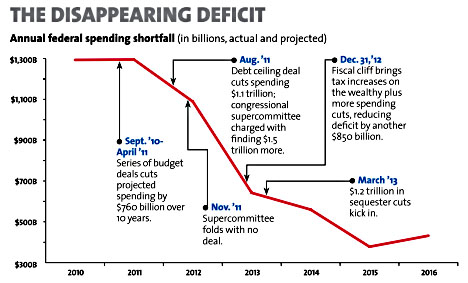
    First came budget deals in 2010 and 2011 that reduced the deficit by $760 billion. Then, in August 2011, Obama struck an agreement with Republicans to resolve the debt ceiling crisis, which produced about $1.1 trillion in spending cuts along with the promise of more from a congressional supercommittee. At the end of 2012, the fiscal-cliff showdown resulted in $850 billion in tax increases and spending cuts. Finally, in March, sequestration cuts (cued up when the supercommittee failed to produce a deal) kicked in, to the tune of another $1.2 trillion. Taken as a whole, these measures have cut the deficit by $3.9 trillion over the next 10 years. And that doesn’t even count the expiration of desperately needed stimulus measures like the payroll tax holiday and extended unemployment benefits.
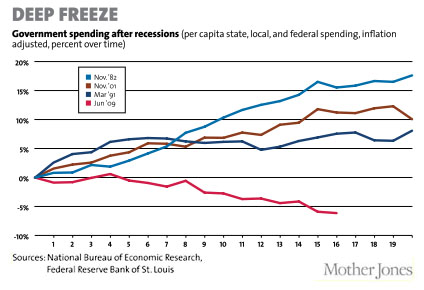
    This was unprecedented, as the chart on the right shows. After every other recent recession, government spending has continued rising steadily throughout the recovery, providing a backstop that prevented the economy from sliding backward. It happened under Ronald Reagan after the recession of 1981, under George H.W. Bush after the recession of 1990, and under George W. Bush after the recession of 2001. But this time, even though the 2008 recession was deeper than any of those previous ones, it didn’t.

    Because most state budgets are required by law to be balanced, it’s normally the job of the federal government to keep spending on an upward path during a recovery. But with federal outlays squeezed by all the budget deals, total government spending peaked in the second quarter of 2010 and then started falling, falling, and falling some more. Today, government spending at all levels—state, local, and federal combined—has declined 7 percent since the publication of Reinhart and Rogoff’s paper.

    Government spending at all levels is far below the level of any other recent recovery. Sixteen quarters after the end of the recession, spending during past recoveries has been 7-15 percent higher than it was at the start. This time it’s 7 percent lower, despite the fact that the 2008-09 recession was the deepest of the bunch. Reagan, Clinton, and Bush all benefited from rising spending during the economic recoveries on their watches. Only Obama has been forced to manage a recovery while government spending has plummeted.

    And there’s no end in sight. Ted Cruz will lose his battle to defund Obamacare. But the tea partiers have already won their battle to cripple the American economy and Obama’s presidency with it.

  • Ted Cruz Announces That He Will Filibuster House Bill That Defunds Obamacare


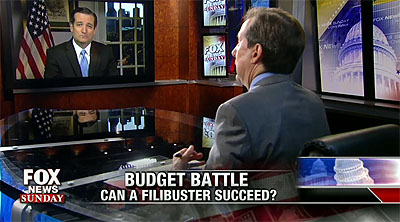
    On Friday I mentioned that Sen. Ted Cruz has a problem. He wants to block funding of Obamacare, but he can’t just filibuster the budget bill that the House has sent over. After all, that bill does what he wants: it defunds Obamacare. So he has to let the Senate consider the bill. But once he does that, Harry Reid can pass an amendment that strips out the defunding language with a simple majority vote and Cruz loses. It’s a knotty little problem, and today Chris Wallace asked him about it. Here’s what he said:

    WALLACE: Well, I’m confused. Are you going to block consideration of the bill? ….

    CRUZ: Well, the first order of business is going to be to ask Harry Reid if he will agree to allow amendments to be subject to a 60-vote threshold….Now, in all likelihood, he’s going to say no….If he does that, then Senate Republicans have the tool that we always used when the majority leader is abusing his power, which is we can deny cloture. We can filibuster and say we will not allow you to add the funding back for Obamacare with just 51 votes and it takes —

    WALLACE: Sir, if I may, you say this is brute political power. Other times, you said it’s a procedural gimmick. It’s Senate Rule 22, which has been around for years. It’s part of the Senate rules and it says after you allow debate, after you take cloture, that you can pass an amendment by a simple majority. That’s the rule.

    CRUZ: Chris, what’s good for the goose is good for the gander. You’re right, that is one rule. But there is another rule that says it takes 60 votes to get cloture. And that’s the reason the Senate, generally, on controversial votes, we work out an agreement for it to be subject to a 60 vote threshold….And so, if Harry Reid says, you know what, I’m going to run the Republicans over. I’m going to ignore the bill passed by the House of Representatives, I’m going to ignore the will of the people and I’m going to do this on a 51-vote threshold — then, from my mind, it should be easy decision for Senate Republicans to stand united and to support House Republicans.

    Cruz is a good talker, you have to give him that. But this appears to be his answer: Unless Reid agrees beforehand to Cruz’s demands, he’s going to filibuster the House bill even though it includes language defunding Obamacare.

    Can he get most of the Republican caucus in the Senate to go along with this? I doubt it—not in the long run, anyway. Cruz isn’t willing to admit that a Republican filibuster against the House Republicans’ own bill would strike the American public as ridiculous, but it would. And if he starts droning on about procedural minutiae, everyone outside the Fox News faithful will tune out after a few seconds.

    As for trying to blame an ensuing government shutdown on President Obama, he demonstrated once again today why that won’t work: He made it crystal clear that he was the one actively working to shut down the government unless his demand to defund Obamacare was met. Again, outside the Fox News faithful, he’s just not going to convince anyone that up is down and black is white on this. Everyone knows whose idea this has been all along.

    It’s possible that Senate Republicans might stand with Cruz for a few days, just to prove their conservative bona fides. Maybe. I guess it depends on how many of them break ranks due to their sheer personal loathing of Cruz.1 But either way, they’ll let the bill go through before long. There are just too many of them who understand how this will play out in the real world. They aren’t willing to risk a rerun of 1995 for a cause they know is lost.

    1Robert Costa tweets: “Emails from House and Sen GOP aides pouring in; furious w/ how Cruz is pressuring McConnell, Boehner to folo his lead….The real fear within GOP right now: Suddenly, if you don’t folo Cruz-Palin on defund strategy, you risk RINO tag and g’roots wrath….Sen aide tells me a dozen+ GOP sens are fuming this am over Cruz making a vote to proceed (CR cloture) seem like support for law they hate.”