 From an unnamed but enthusiastic supporter at a Kentucky political rally:
I’m here to support Senator McConnell because he’s for guns, freedom and coal!
Um, OK. Are T-shirts available yet?

From an unnamed but enthusiastic supporter at a Kentucky political rally:
I’m here to support Senator McConnell because he’s for guns, freedom and coal!
Um, OK. Are T-shirts available yet?
Domino was supervising my blogging-related program activities earlier this week, which mostly consisted of making it hard to use the mouse so that I had no choice but to pay more attention to her. As usual, it worked. The gimlet-eyed among you will notice on the far left a notepad that’s fallen over, a sure sign that Domino has been around. That little yellow pad is her absolute favorite place on my desk to scratch her chin.
This is Shark Week on the Discovery Channel, and my sister informs me that it’s also Shark Cat Week on YouTube. As near as I can tell, this is traditionally celebrated by dressing your cat in a shark costume and then letting it ride around the kitchen on a Roomba. Go figure. As it happens, I need to buy a new vacuum cleaner, and until now I hadn’t been considering a Roomba. But maybe I should.

Lori Montgomery reports that the folks who actually get down in the trenches and negotiate budget deals for Republicans are fleeing the capital:
With another showdown looming over the national debt, Washington insiders last month received some unsettling news: Rohit Kumar, a Republican aide who has played a key role in warding off disaster, is leaving Capitol Hill.
Kumar is the guy who came up with a way to sell a $700 billion bank bailout to anxious lawmakers in 2008 when the financial system was collapsing. And he’s the guy who figured out how to let conservatives raise the debt limit while voting against it in 2011 when the nation was days away from default.
….In addition to losing Kumar, McConnell has lost his longtime floor general, Dave Schiappa, who left after nearly three decades to take a job as vice president at the Duberstein Group, a downtown lobbying firm. And House Speaker John A. Boehner (R-Ohio) has lost his chief negotiator, Brett Loper, a policy expert who came close to hammering out a grand bargain with the White House in 2011. Loper left in June to become a lobbyist for American Express.
Democrats are disturbed by Kumar’s departure in particular: “If you have to do business with the dark side, it’s better to negotiate with an evil genius than with someone who only knows how to say no and doesn’t understand the details,” said one Obama aide who, for obvious reasons, declined to say this on the record.
So how are things going to go in September? Will budget and debt ceiling deals get made? Here are the reasons for optimism:
And here are the reasons for pessimism:
OK, I’ll stop now. Let’s just say that things look grim. The tea party lunatics are madder than ever, the guys in the trenches have given up, and the Republican leadership is MIA. Against that we have a few columnists bringing up the specter of 1995. But that was 18 years ago. For the modern conservative crowd, that might as well have been the Middle Ages. They’re eager for a showdown, and I have a feeling they’re going to get one.
 I need some help with Drudge-ology. He’s currently blaring the headline on the right, based on this story in The Hill:
Forty to 50 House Republicans will support immigration reform, Rep. Luis Gutiérrez (D-Ill.) predicted Thursday. Gutiérrez said many of the Republicans supportive of immigration reform don’t want to be identified, but he insisted they would support comprehensive immigration reform.
Um, who cares? Everyone either already knows or already suspects this is true. The key line in this story is the very last one:
Speaker John Boehner (R-Ohio) has said he will only bring an immigration bill to the House floor if it is supported by a majority of his conference.
Last I checked, 40 or 50 is not a majority of 240. So why is Drudge so excited about this? Is there something going on in conservo-land that I haven’t kept up with? What’s the deal?
Can the DEA get secret tips based on NSA surveillance evidence and then invent new stories about where their evidence came from when the case comes to trial? Yes they can. But now that defense lawyers know about this, they’re going to try and do something about it:
Defense lawyers said that by hiding the existence of the information, the government is violating a defendant’s constitutional right to view potentially exculpatory evidence that suggests witness bias, entrapment or innocence.
“It certainly can’t be that the agents can make up a ‘parallel construction,’ a made-up tale, in court documents, testimony before the grand jury or a judge, without disclosure to a court,” said Jim Wyda, the federal public defender in Maryland, in an email. “This is going to result in a lot of litigation, for a long time.”
….[David Patton, executive director of the Federal Defenders of New York] said information about how an investigation began may be highly relevant in certain cases because it bears on the credibility of government witnesses.
“Informants lie. They lie a lot,” he said. “You can’t competently or fully challenge the basis for a stop or search if the government’s hiding information about the real reason for the stop and search.”
Presumably, Patton is suggesting that once investigators get an NSA tip, they can then go dig up an “informant” willing to recycle the tip, thus giving them probable cause for a warrant. But if the court knew the real source of the tip, jurors might be a little more skeptical of the informant.
Will this get anywhere? Hard to say, since the usual Catch-22 is at work here: How do you know whether to demand NSA evidence if you have no idea whether it was used in your case in the first place? Unfortunately, that’s never bothered the Supreme Court before, which happily tosses out cases when plaintiffs can’t prove they were the subjects of secret surveillance. But maybe this kind of case, which doesn’t involve terrorism or national security, will finally change their minds. Maybe.
Mother Jones has joined the ranks of publications that refuse to utter the name of Washington DC’s pro football team. In fact, that’s now what our style guide calls them: “Washington’s pro football team.” Personally, I’d prefer the Victorian era affectation of using initials. I never quite understood why old novels were littered with things like Mr. K—- or Bishop M—–, but why not make use of it anyway? We could refer to Washington’s pro football team as the R—–s. This has the added advantage of automatically giving it the veneer  of vulgarity. Dan Snyder’s team would be the R-word, to go along with the N-word and the C-word and all the others.
But here’s a question: Is there a similar movement afoot to change the name of Cleveland’s pro baseball team and Atlanta’s pro baseball team? It’s true that the I-word and the B-word are less offensive than the R-word, but on the other hand, the team logo in Cleveland sure beats Washington for offensiveness. And that hatchet thing in Atlanta is just plain annoying. I know that both those teams have taken some heat for their names, but not as much as Washington. Anyone know if that’s changing?
Under Obamacare, large employers are required to provide health insurance for every employee who works more than 30 hours a week. This provides an unfortunate incentive to cut worker hours so that they’re just under the 30-hour limit, but Brad DeLong doesn’t think this is likely to be a big problem:
I am confident that as ObamaCare is implemented we will see some firms reconfigure themselves to rely more on part-time and less on full-time workers—and that this distortion will be one of the costs of ObamaCare. But I don’t expect this to be a large effect. And I do not believe that we are seeing it yet. The rise in the relative number of part-time workers looks to be, so far, due 100% to the depression plus statistical noise due to the small sample of the Current Population Survey.
I think this is right. There are several anecdotes making the rounds of Fox News about companies who are cutting worker hours in response to the Obamacare mandate, and some of them may even be true. But so far, the evidence suggests that the effect is very, very small. A CEPR study last month looked at the number of people working 26-29 hours per week, figuring that if hours were cut back, they’d probably be cut back to just under 30. If Obamacare were having an effect, we’d expect to see a rise in the number of workers in the 26-29 hour bucket, but that’s not what CEPR found. The percentages turned out to be essentially identical between 2012 and 2013. 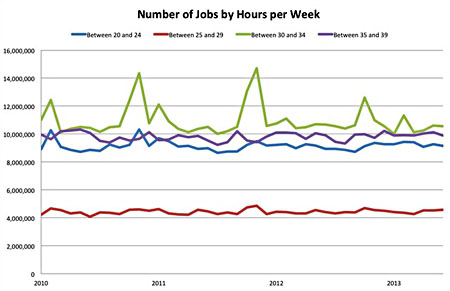 What’s more, the total number of people working that many hours is so small that even if the change were fairly large, it would be barely noticeable.
Brad himself looks at the raw number of people employed part time and sees nothing beyond the effect of the Great Recession. He also points us to Evan Soltas, who crunched the numbers and produced the chart on the right, which simply doesn’t show any noticeable shift toward part-time work. Soltas thinks we’ll probably see an effect on full-time work eventually, and I agree, but it’s likely to be very small.
There’s a moral to this story. Two morals, really. First, conservatives are going to trumpet every employer who announces some kind of cutback, regardless of whether they ever follow through on it. But as with most Obamacare doomsaying, it should be taken with a whole shaker of salt. Second, a lot of liberals agree that the 30-hour rule is bad policy, and should either be repealed or reformed. If conservatives were interested in making good policy, it would be pretty easy to team up with a bunch of Democrats and pass something that would improve the way the law works. But they aren’t. They want horror stories, not good policy.
I’ll confess that I don’t really understand why anyone wants to go on TV with a cable blowhard like Bill O’Reilly, Lawrence O’Donnell, or Chris Matthews. What’s the point of putting up with their ranting? Is appearing on television really that important?
But that’s just me. I get that plenty of people enjoy being on TV more than I do. (Actually, pretty much everyone probably enjoys it more than I do.) Different strokes and all that. That said, I sure did enjoy finally, finally seeing a mistreated guest tee off on a blowhard host. Julia Ioffe’s post today is one I’ve been waiting a long time to read.
Dave Weigel alerts me today to a “smarter” version of the conservative obsession with repealing Obamacare. It comes from Grover Norquist and a supporting cast of about a dozen right-wing luminaries. Here it is:
 higher taxes for a system that isn’t ready.
Um, what? How is this smarter? Instead of simply repealing Obamacare, this plan proposes repeal of the individual mandate, the subsidies, and the taxes that pay for it. But that’s practically the whole bill. Aside from the Medicaid expansion, the only thing left is the guarantee of private coverage for people with preexisting conditions.
(And why is that one provision left alone? Hard to say. The charitable explanation is that it’s very popular, so Norquist doesn’t want to oppose it. The less charitable explanation is that keeping it around without the subsidies or the mandate would be a disaster for insurance companies, which would turn them into enemies of Obamacare. Take your pick.)
The problem is that politically, this is as much a nonstarter as full repeal. So it’s only smart if it makes a dent with the public. But I don’t see how. It’s too complicated for most people to understand or care about.
Actually, I think Norquist came close to a winner with this proposal, but then whiffed. What he should have proposed is a flat one-year delay for the whole bill. That’s easy to understand and easy to defend, and it’s the perfect complement for all the horror stories conservatives are ginning up about problems with implementation. It’s still a nonstarter politically, but at least it would force Democrats to defend the law more vigorously than they are right now, and maybe even to overreach and make promises they can’t keep. Unfortunately for Norquist, I suppose the true believers never would have gotten behind it. It would have seemed like too much of a sellout. Live by the sword, die by the sword.
Alex Tabarrok has a pretty interesting post today about the peculiar obesity epidemic among animals. It turns out that both pets and feral animals (like sewer rats) have been steadily gaining weight over the past few decades. But before you jump in and take a guess at why, it also turns out that lab mice used as controls in experiments are getting heavier too. This is hard to explain, since researchers have done their best not to change the way they treat control mice:
Control mice are typically allowed to feed at will from a controlled diet that has not varied much over the decades, making obvious explanations less plausible. Could mice have gained weight due to better care? Possibly although that is speculative.
More generally, there are specific explanations for the weight gain in each of the animal populations, just as there are for humans. Each explanation looks plausible taken on its own but is it plausible that each population is gaining weight for independent reasons? Could there instead be a unifying explanation for the weight gain in all populations? No one knows what that explanation is: toxins? viruses? epigenetic factors? I am not ready to jump on any of these bandwagons and in some cases the author’s samples are small so I am not yet fully convinced of the underlying facts, nevertheless this is intriguing and important research.
So what’s going on? So far, it’s a mystery, though I agree with Tabarrok’s skepticism that lots of different populations (humans, pets, wild animals, control mice) are all getting fatter and all for different reasons. It just seems a little too pat. But you never know.
As an aside, I wonder if this kind of weight gain has been observed in any non-mammal populations?

Award-winning photojournalism.
Stunning video. Fearless conversations.


