
• Electric Cars Are Great in Vermont, Not So Great in Kentucky


    Climate Central has some bad news for all of us eco-sensitive folks: figuring out the best car to drive is harder than you think. For starters, you need to take into account which state you live in. If you live in, say, Washington or Vermont, where most of your electricity comes from hydropower or nuclear, an electric car is pretty carbon friendly. If you live in Kentucky, where your power mostly comes from coal, an electric car isn’t such a good choice.

    But there’s more. You also need to account for the carbon emissions it takes to build the car in the first place. And since battery manufacturing is pretty carbon intensive, a car with a big battery starts out with a big carbon deficit to make up. Their conclusion:
    In 26 states, a plug-in hybrid is the most climate-friendly option (narrowly outperforming all-electrics in 11 states, assuming 50:50 split between between driving on gas and electric for the plug-in hybrids), and in the other 24 states, a gas-powered car the best. All-electrics and plug-in hybrids are best in states with green electrical grids with substantial amounts of hydro, nuclear and wind power that produce essentially no carbon emissions. Conventional hybrids are best in states where electricity comes primarily from coal and natural gas.

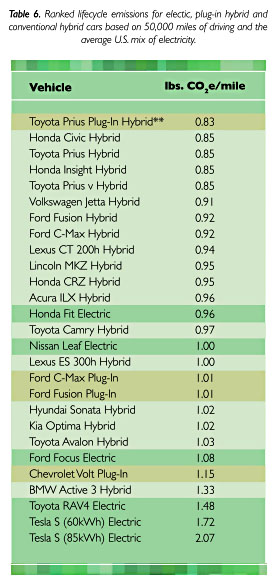
    The table on the right shows Climate Central’s total lifecycle ranking of various cars based on 50,000 miles of driving and U.S. average electrical emissions. All-electric cars do better if you live in a state with lots of hydropower, and they also do better if you drive more, since that provides more time to make up the carbon deficit from manufacturing the battery.

    You can read the whole report for more details, including rankings for each state. In Vermont, the all-electric Honda Fit comes in first. In California, a plug-in Prius is the top choice. In Kentucky, a regular gasoline-powered hybrid Prius is number one. The lovely Tesla S, sadly, does poorly pretty much everywhere.

  • The NSA Is Reading Every Email Sent To and From the United States


    Charlie Savage reports today that the NSA doesn’t just monitor communications between Americans and terrorist suspects overseas. It monitors every communication sent overseas, searching for keywords linked to foreigners already under surveillance:

    The N.S.A. is not just intercepting the communications of Americans who are in direct contact with foreigners targeted overseas, a practice that government officials have openly acknowledged. It is also casting a far wider net for people who cite information linked to those foreigners, like a little used e-mail address, according to a senior intelligence official.

    ….To conduct the surveillance, the N.S.A. is temporarily copying and then sifting through the contents of what is apparently most e-mails and other text-based communications that cross the border. The senior intelligence official, who, like other former and current government officials, spoke on condition of anonymity because of the sensitivity of the topic, said the N.S.A. makes a “clone of selected communication links” to gather the communications, but declined to specify details, like the volume of the data that passes through them.

    ….The official said that a computer searches the data for the identifying keywords or other “selectors” and stores those that match so that human analysts could later examine them. The remaining communications, the official said, are deleted; the entire process takes “a small number of seconds,” and the system has no ability to perform “retrospective searching.”

    The official said the keyword and other terms were “very precise” to minimize the number of innocent American communications that were flagged by the program.

    The justification for this revolves around a close parsing of the word “target”: As long as no Americans are specifically targeted, NSA can trawl through our email as much as it wants. After all, the keywords it’s looking for may come from emails we send, but they’re targeted at foreigners:

    The rule they ended up writing, which was secretly approved by the Foreign Intelligence Surveillance Court, says that the N.S.A. must ensure that one of the participants in any conversation that is acquired when it is searching for conversations about a targeted foreigner must be outside the United States, so that the surveillance is technically directed at the foreign end.

    Maybe so. But if you send an email to a pal in Berlin, be careful. Mention the wrong name or talk about the wrong subject, and you could end up in the NSA’s dragnet.

  • How the Paint Industry Escapes Responsibility for Lead Poisoning


    The main focus of my story in January about the link between lead and crime was on leaded gasoline. That was mainly because the rise and fall of leaded gasoline following World War II tracks the rise and fall of crime between the 60s and 90s. However, lead is lead, and the lead in leaded paint has all the same ill effects when small children are exposed to it: it reduces IQ, increases learning disabilities, and affects parts of the brain linked to impulse control. Despite that, activist groups haven’t had much luck holding the paint industry accountable. Lilly Fowler reports for us today on what happened:
    Apart from one settlement, the industry has successfully fended off roughly 50 lawsuits by states, cities, counties, and school districts over the past quarter century. Now, in a trial under way in San Jose, California, industry lawyers are seeking a final victory in a case brought by 10 agencies, including the cities of San Francisco, Oakland and San Diego, and the counties of Los Angeles and Santa Clara. The agencies want the industry to cover the cost of eliminating lead paint from all the homes in their jurisdictions; the price tag could exceed $1 billion.

    ….Defense lawyers have argued in a brief that the companies weren’t aware when they promoted lead paint that it would someday cause harm. “Scientific knowledge concerning lead exposure evolved over the decades,” it reads. What’s more, they claim there is no longer any widespread danger from lead. Today’s blood lead levels, according to their court filings, do not present “a current public health crisis” but rather “a public health success story.”

    What’s more, they argue, California already has a well-funded lead poisoning prevention program that collects annual fees primarily from the gasoline industry, but also from makers of paint and other lead-containing products.

    Unfortunately, the research linking lead to crime has probably come too late to have an impact in this case. Read the whole thing to learn how the paint industry has managed for decades to avoid responsibility for the catastrophic effects of their products.

  • Seniors Aren’t Very Happy With the Republican Party These Days


    Erica Seifert writes that polling evidence suggests that seniors are turning against the Republican Party in big numbers. Here are three of her bits of evidence:

    • In 2010, seniors voted for Republicans by a 21 point margin (38 percent to 59 percent). Among seniors likely to vote in 2014, the Republican candidate leads by just 5 points (41 percent to 46 percent.)
    • Seniors are now much less likely to identify with the Republican Party. On Election Day in 2010, the Republican Party enjoyed a net 10 point party identification advantage among seniors (29 percent identified as Democrats, 39 percent as Republicans). As of last month, Democrats now had a net 6 point advantage in party identification among seniors (39 percent to 33 percent).
    • On almost every issue we tested — including gay rights, aid to the poor, immigration, and gun control — more than half of seniors believe that the Republican Party is too extreme.

    I’m not sure how seriously to take this. Comparing attitudes on Election Day in 2010 to attitudes today, 15 months before an election, strikes me as a stretch. And the fact that you think the GOP is too extreme on an issue or three doesn’t mean you’re going to vote against them. On the other hand, there’s also this:

    • When Republicans took control of the House of Representatives at the beginning of 2011, 43 percent of seniors gave the Republican Party a favorable rating. Last month, just 28 percent of seniors rated the GOP favorably. This is not an equal-opportunity rejection of parties or government — over the same period, the Democratic Party’s favorable rating among seniors has increased 3 points, from 37 percent favorable to 40 percent favorable.

    I dunno. I’d want to know why the party’s approval ratings have dropped. If it’s because tea-partyish seniors think the GOP leadership isn’t conservative enough, that certainly doesn’t suggest much of a pickup opportunity for Democrats. So color me unconvinced for now. At the same time, this does suggest that there’s at least an opportunity here for Democrats. If they can goad Eric Cantor and his pals into spending the next year jabbering about cuts to entitlements—i.e., Medicare and Social Security, which 89 percent of seniors want protected—then who knows? Maybe seniors really will bolt.

  • Apple Losing Its Mojo in the Smartphone Market


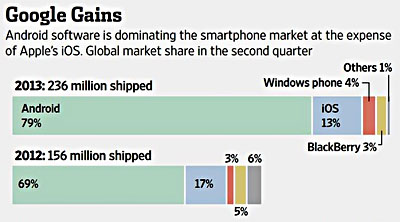
    The Wall Street Journal ran the chart on the right today, showing that Apple’s iPhone is losing ground to Android. But Matt Yglesias says this isn’t bad news for Apple: after all, 13 percent of 236 million is a lot more than 17 percent of 156 million. Apple is selling more phones than ever, and making lots of money on them.
    This is true. But I’d say it’s still bad news for Apple. Until now, one of Apple’s big advantages in the market has been the depth and quality of its app ecosystem. But as its market share keeps decreasing, that will go away. Developers will write apps for Android first, and then port their code over to iOS later. All the newest and coolest stuff will be available on Android phones first, and as that happens the all-important teen demo will slip away. Apple’s obsessively tight control over what you’re allowed to do with your phone will start to seem creepy, not smart, and their single-minded dedication to a single form factor will become an albatross.

    Not right away, of course. It will take a while. But there’s a tipping point where declining market share turns into a death spiral. If that happens, the iPhone will become cousin to the Mac: a niche product that spins off some money but not much else. And that might be OK. Maybe Apple has never counted on the iPhone being an industry-leading product forever, and figures that the next big thing will power its next growth phase, all funded by stagnant but steady profits from the iPhone. Maybe.

  • The Sale of the Washington Post Really Isn’t That Big a Deal


    Ed Kilgore:

    Gotta say, the quantity of writing about the WaPo sale–particularly at WaPo–is pretty astounding. Don’t know if it’s the slow news day or some editorial effort to show the paper’s independence, or some sort of collective mid-life crisis. But nobody’s going to say this story is under-reported.

    No kidding. My blogging has been light lately because I’ve been fighting off a cold for the past few days, and on Monday in particular I just gave up. By mid-afternoon, not only was I bleary-eyed from the invasion of rhinoviruses, but everywhere I looked nobody was talking about anything but the sale of the Post. So I called it a day and took a nap.

    But seriously: who cares? Rich people have been buying newspapers for a long time, and that’s only accelerated over the past few years. Rupert Murdoch bought the Journal. Sam Zell bought the LA Times. John Henry just bought the Boston Globe. Now Jeff Bezos has purchased the Post. It’s really not that big a deal. The decline of big city dailies has been ongoing for decades; the reasons for the decline are well known; and this has produced an ownership game of musical chairs that shows no signs of slowing down. The Post sale took everyone by surprise, but aside from that it’s just more of the same.

    So can we shut up about it already? Pretty please?

  • Everyone Wants to Live Longer, But Lots of People Don’t Want to Admit It


    As proof that timing is everything (except in real estate, of course, where it’s location), Pew Research is getting lots of attention today for a new survey about American attitudes toward radical life extension. What’s so great about the timing? Well, it’s August, and every blogger in the country is having a hard time finding anything to write about. So the Pew survey is getting lots of attention.
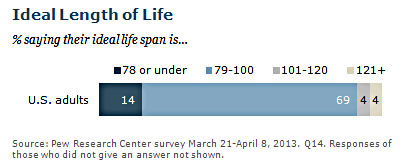
    As near as I can tell, the main takeaway from the whole thing is that most people lack even the tiniest spark of imagination. Take a look at the response on the right. Nearly everyone thinks the ideal lifespan is between 79 and 100. What an amazing coincidence! No one wants a shorter life than they live now, and no one wants a life that’s much longer either. If Pew had surveyed fruit flies, they all would have said the perfect lifespan was around 38 days or so.

    The headline result of the survey is that more than half of the respondents said they wouldn’t want treatments to “slow the aging process and live to be 120 or more.” I guarantee you that nearly all of them are mistaken. Or lying. If such a treatment actually existed, every baby boomer in the country would be lining up at their local hospitals to get it, and would be demanding that Medicare pay for it. There would be a few exceptions for the chronically depressed and those suffering from debilitating illnesses, but that’s about it. The rest of us, given an opportunity to live healthy lives for an extra 40 or 50 years, would jump at it.

  • How Will the Other Networks React If GOP Bans NBC From Debate Coverage?


    As we all know, RNC chairman Reince Priebus has threatened to exclude NBC from hosting Republican primary debates if they continue with their plans for a Hillary Clinton miniseries. The whole thing is basically a no-lose proposition for Priebus, since it rallies the base today and does him no harm tomorrow. If NBC caves, all well and good. If it doesn’t, who cares? Priebus wants fewer debates in 2016 anyway.
    But here’s a thought. I figure there’s one way in which this could come back to bite him: if all the other networks refuse to host Republican debates as long as NBC remains blackballed. I don’t mean Fox News, of course. They’ll host debates regardless. But what if CBS and ABC and CNN all decline to participate on the grounds that the RNC is abusing its power to influence press and entertainment coverage on the networks? That has the potential to hurt. Priebus may want fewer debates, but he does want them televised and I’ll bet he doesn’t want 100 percent of them on Fox.

    Anyway, just a thought. Remember back in 2009, when all the other networks came to Fox’s defense when the White House tried to exclude them from a pool interview with executive-pay czar Kenneth Feinberg? I wonder if the same thing could happen this time?

  • As Expected, Student Test Scores Have Plummeted in New York City


    Just to follow up on a post from a couple of days ago, the scores on New York’s new, more difficult school tests are in. Here’s how New York City did:

    Across the city, 26 percent of students in third through eighth grade passed the state exams in English, and 30 percent passed in math, according to the New York State Education Department….Under the old exams last year, the city fared better: 47 percent of students passed in English, and 60 percent passed in math.

    ….The results galvanized critics of Mayor Michael R. Bloomberg, who has often pointed to improvements in test scores as evidence that his stewardship of city schools has been a success.

    ….Anticipating the outcry, the city and state arranged for the United States secretary of education, Arne Duncan, to participate in a conference call with reporters on Tuesday. In his remarks, Mr. Duncan said the shift to Common Core was a necessary recalibration that would better prepare students for college and the work force.

    “Too many school systems lied to children, families and communities,” Mr. Duncan said. “Finally, we are holding ourselves accountable as educators.”

    This is all pretty silly. The only thing it proves is that you can pass or fail as many kids as you want by fiddling with a test. Make it hard enough, and even a national merit scholar will fail. Make it easy enough, and even a moron will pass. You can set the bar anywhere you like.

    Is the new test a “better” measure of how much students know? Maybe. Maybe not. But it’s different, which means it tells you exactly nothing about how good Bloomberg’s stewardship of New York City schools has been over time. If you think test scores are a good way of measuring student performance, we already know the answer to that question: he’s done OK, but not great.

  • Twitter Slowly Becoming More Cool Than Facebook


    Over at Balloon Juice, mistermix highlights this paragraph from a story about bullying at an Ohio high school:

    At Hudson High School, Facebook is yesterday’s news — “Most of Facebook is just people saying, ‘Is anyone still on Facebook?'” one student says — and increasingly, students are interacting on Twitter. In the five months since it was created, an account named Hudson Confessions (@HudConfessions) has amassed more than a thousand followers, or about two-thirds of the size of Hudson’s current student body.

    Hmmm. Just a year or two ago, I remember reading that despite its aura of coolness, kids didn’t really use Twitter much. It was mostly us oldsters who used it, while Facebook reigned supreme among teens. But mistermix says that although the lamestream media doesn’t report much about Facebook’s decline, “it’s been true for a while.”

    But I want numbers. I want Science™. What is America’s youth really up to? A Pew report from last May has this to say:

    Teen Twitter use has grown significantly: 24% of online teens use Twitter, up from 16% in 2011….Focus group discussions with teens show that they have waning enthusiasm for Facebook, disliking the increasing adult presence, people sharing excessively, and stressful “drama,” but they keep using it because participation is an important part of overall teenage socializing.

    So there you have it. Oddly enough, the social networking site beloved of political junkies and journalists is now spreading its tentacles into the Justin Bieber set. I’ll bet that’s not something that happens very often. For now, though, we old folks can pride ourselves on being social media trendsetters.

