• You Are Less Industrious Than You Think


    Catherine Rampell reports today that we work less than we think we do and sleep more than we think we do.  She has a few guesses about why this might be, along with the possibility that it’s merely a statistical aberration. But my guess is that she’s right when she suggests that “people just systematically exaggerate their industriousness.” For some reason, we all like the idea that we are uniquely besieged with too much work and too little sleep and yet somehow manage to perform our jobs awesomely anyway. It’s just one of the little fairy tales we tell to keep ourselves plugging along.

  • The 2014 Spending Bill is Infested With Right-Wing Pet Rocks


    I see via Steve Benen that one of the dumbest bits of tea party hysteria in a long time has ended up as a rider to the new spending bill:

    The bill bans the construction of a new embassy in London and bars the State Department from closing the chancery at the U.S. Embassy in the Holy See and merging it with the one at the U.S. Embassy in Rome for security reasons, a project first pushed by George W. Bush’s administration.

    This one was so dumb I never even bothered writing a post about it back when it first became yet another right-wing pet rock. Long story short, the Vatican requires countries to have separate embassies in Rome for Italy and the Vatican. They don’t want to be just an office in a country’s Italian embassy. But the United States has an entire compound in Rome, and after 9/11 security obviously became a big issue for American embassies. So the Bush administration came up with a plan to move the Vatican embassy inside the compound, where it would have its own building and its own street entrance and save money in the bargain. The Vatican went along with the plan, and for years no one cared until the plan was officially signed off last year. Of course, Barack Obama was president by that time, but I’m sure that had nothing to do with all the outrage about downgrading Vatican relations or being a slap in the face to every Roman Catholic in America. Nothing at all.

    Anyway, apparently it’s back. The 2014 spending bill is chock full of conservative pet rocks, presumably designed to mollify all the tea partiers who are unhappy at the passage of a spending bill in the first place. It probably won’t work, and in the meantime it bollixes up US governance for no serious reason. As Benen says, “Good ideas fail because of right-wing paranoia that congressional Republicans take seriously, and bad ideas advance because of right-wing paranoia that congressional Republicans take seriously. We can no longer focus on what is true; we must also consider what far-right media perceives as possibly true.

  • Phones Are Smarter Than Ever, But Are We?


    Tyler Cowen points me to a Washington Post story today about the fact that lots of people are confused by computers. Today, though, the computers are really small and we call them smartphones:

    For [old fogies], there is nothing intuitive at all about manipulating data with their fingers, whether it be swiping screens back and forth, pinching to shrink an image, or entering information into glass. They typically worry that doing something wrong on the phone will cause it to self-combust.

    This has always been the big problem with computers for non-power users: the fear of doing something that will screw everything up. Generally speaking, it’s overblown, and most people would be better off experimenting a bit more. Still, it’s hardly a trivial concern. I’ve been using computers for more than three decades, and even now I’m occasionally nonplussed by hitting some key combination or other that puts my computer into an unknown mode that I don’t know how to get out of. Thank God for Google, which almost always answers my questions.

    Other issues aren’t nearly as mysterious as the Post thinks. A Harris Poll, for example shows that “just 5 percent of Americans used their smartphones to show codes for movie admission or to show an airline boarding pass.” That’s not surprising. A fairly small percentage of Americans fly or go to the movies regularly, and there’s really not much point in trying to figure out how to do something with your smartphone unless you do it a lot. Besides, getting a boarding pass or buying a movie ticket isn’t that hard in the first place. And what if your battery goes dead?

    Anyway, I’m just the opposite. I’m thinking of getting a new phone, and although there are some good reasons for this (bigger screen, free tethering, etc.), it’s mostly just because I’m bored with my iPhone and I want to try something new. How about a Nokia Windows phone? My Windows tablet has turned out to be better than I expected, so maybe I should get on the bleeding edge and try it on my phone. T-Mobile will sign me up for $50 per month with a bunch of nifty features, and that would put me on the bleeding edge again since I have no idea if T-Mobile coverage is any good. But life is always better with a soupçon of risk and danger. Besides, screaming at your computer is very cathartic, isn’t it?

  • Chart of the Day: The Job Market For College Grads is Tougher Than Ever


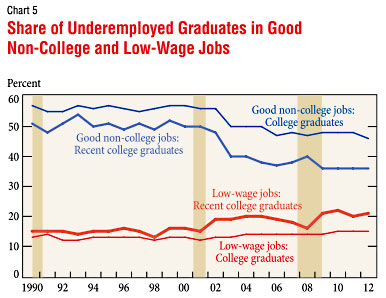
    A new report from the New York Fed offers a grim take on the job prospects of recent college grads. It finds that underemployment (i.e., working at a job that doesn’t require a college degree) has averaged around 40 percent for the past two decades, going down a bit during economic expansions and up a bit during recessions.

    But if the rate of underemployment itself hasn’t changed very much, the nature of underemployment sure has. It’s gotten worse. Take a look at the thick lines in the chart on the right. They show what happens to recent college grads who can’t get college-level jobs. The number who get good non-college jobs has plummeted from 50 percent to 35 percent. The number in low-wage jobs has risen from 15 percent to 20 percent. And needless to say, these grads also have quite a bit more student loan debt than grads from the early 90s.

    Getting a college degree is still worth it. But there’s not much question that today’s college grads have it tougher than previous generations did. And the 40 percent who don’t find good jobs have it the toughest of all.

  • Opposing View: Yes, We Should Keep Adding “Gate” to Every Flap


    USA Today’s media columnist, Rem Rieder, is tired of the rest of us tacking gate onto the end of every conceivable scandal. Here’s his argument:

    It’s not cute. It’s not cool. It’s not clever.

    I will give it knee-jerk. And lazy. And oh, so predictable.

    But it’s not supposed to be cute, cool, or clever. It’s supposed to be knee-jerk, lazy, and predictable—or, as the rest of us refer to this quality, instantly recognizable. Tomato, tomahto, my friend.

    Perhaps recognizing the tenuousness of his case, Rieder adds this:

    But there is a more serious reason to show gate to the gate. By awarding the suffix to everything from serious government misconduct to the exposure of Janet Jackson’s breast during the halftime show of Super Bowl XXXVIII (surely you remember Nipplegate), you create a false equivalency that ends up trivializing everything.

    That certainly was the take of Sam Dash, who served as chief counsel to the Senate Watergate Committee all those years ago. “When people hear this proliferation of ‘gates,’ they feel the press is telling them this is the same as Watergate, and whatever Watergate has stood for has lost its meaning,” Dash told Suzan Revah of American Journalism Review.

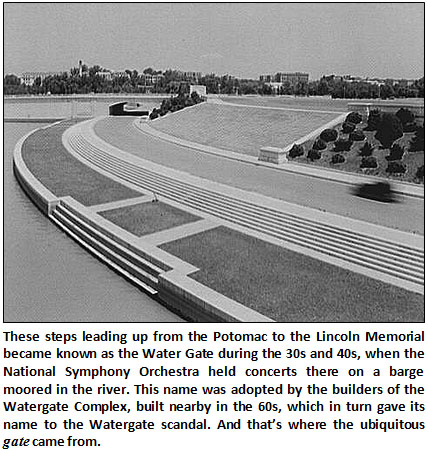
    I dunno. We’ve been slapping gate on the end of things for 40 years now, and Richard Nixon’s notoriety remains safe. So I don’t really think this argument holds water. Besides, gate actually has a very specific meaning. Watergate was the first big example of scandal as public spectacle during the media age, and because of this gate is generally reserved for spectacles large and small. But it’s not used for things that go beyond the realm of political spectacle. There’s no such thing as Benghazi-gate because that was a tragedy in which people died. Likewise, there’s no Surveillance-gate or Waco-gate. Its use is actually surprisingly specialized.

    Still, what if we did all get tired of gate? What would we replace it with? It would be even more boring to just call all these things scandals, and that wouldn’t clearly identify them anyway. But maybe we could poach some other scandal-related suffix? What options do we have? Teapot Dome. Crédit Mobilier. The Plame Affair. Iran-Contra. The XYZ Affair. The Keating Five. Chappaquiddick. The vicuna coat. Let’s try these out to see how they sound as a replacement for Bridgegate:

    • Bridgedome
    • Bridgemobilier
    • Bridgeplame
    • Bridgecontra
    • Bridgexyz
    • Bridgekeating
    • Bridgechappaquiddick
    • Bridgevicuna.

    It’s hopeless. Teapot Dome is the only one that works—though I’ll confess that Bridgexyz has certain possibilities depending on how you pronounce it. So that’s that. We either keep using gate or else switch to dome. I think we’re better off sticking with gate.

  • It’s Time to Fix the Housing Finance Market


    Yesterday I mentioned Brad DeLong’s belief that the biggest problem with the economy right now is the weak housing market:

    I find it very hard to escape the conclusion that the big bad thing going on in the third millennium is not the excess construction of the mid-2000s housing bubble–a sum of 7.5% points of annual GDP….but rather the additional 20% points of annual GDP of residences not built since 2007 because of the financial crisis, resulting depression, and breaking of housing finance.

    The chart above shows what DeLong is talking about. Housing was overbuilt in the aughts, but we’ve more than made up for that. The shortfall in new housing starts since 2008 is far larger than the excess between 2002 and 2007.

    So what’s the problem? Felix Salmon, keying off a New York Times piece today, writes that a big reason for the continuing weakness of the housing market is the inability of even people with good credit to get mortgages.

    Anecdotally, it’s much harder to get a mortgage now than it used to be. In the NYT article, the Center for American Progress’s Julia Gordon says that “a typical American family” with a credit score in the low 700s is “being left out”: that’s a very long way from subprime, which is what you’re considered to be when your credit score is below 620.

    Meanwhile, here in Manhattan, no one in my condo building has been able to sell or refinance for the past couple of years, thanks to an ever-shifting series of rules at various different banks, all of which are clearly designed to just give them a reason to say no.

    The chart below shows this dramatically:
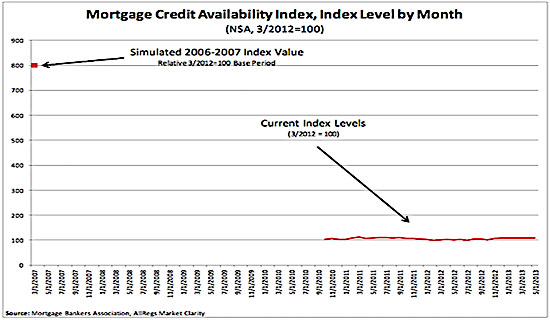
    Needless to say, mortgages were too easy to get in 2006, and we don’t want to go back to that level. But neither do we want to be where we are now. Salmon believes the problem is fairly simple: it’s not because of new rules about qualified mortgages or anything else regulatory, it’s simply because 30-year fixed mortgage rates are currently running at about 4.5 percent. “Would you lend money fixed for the next 30 years at a rate of less than 5%?” he asks.

    The 30-year fixed mortgage is mostly a creature of Fannie Mae and Freddie Mac, who have historically bought up and securitized 30-year fixed mortgages so that banks didn’t have to keep them on their books. They aren’t doing that as energetically as they used to, and this has depressed the entire mortgage market. So what to do? DeLong suggests the answer lies with the government: “Have Mel Watt’s FHFA end policy uncertainty about housing finance and rebalance the construction sector to fill in our current 20%-point of annual GDP housing capital deficit.” Salmon suggests the answer might be the opposite: “Phase out the 30-year fixed-rate mortgage entirely, since it’s a product no private-sector financial institution would ever offer.” But both agree that the mortgage market is a crucial part of getting the economy back on its feet. Here’s Salmon:

    One thing is clear: for all that the Fed has been pumping billions of dollars into mortgage securities as part of its quantitative easing campaign, all that liquidity has failed to find its way to new homebuyers. I’m in general a believer in renting rather than buying, but the US is a nation of homeowners, and in such a country, a liquid housing market is a necessary precondition for economic vitality. Right now, we don’t have one — and we don’t have much hope of getting one in the foreseeable future, either.

    With household deleveraging having now run its course, this is a good time to start thinking more seriously about the housing market. It’s not a silver bullet, but there are plenty of families out there willing to fund more residential construction if only they could get a mortgage. Not a go-go-no-doc-no-down bubble mortgage, just a normal mortgage for normal people. This is something that President Obama should probably be thinking pretty hard about.


  • We’re Passing a Budget, But Not a Debt Ceiling Increase? Why?


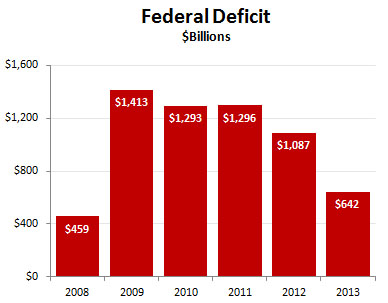
    Ed Kilgore comments on the imminent passage of the recently agreed trillion-dollar spending bill:

    It seems leaders of both parties in Congress have decided to low-key the whole thing. Republicans are supposed to like the bill because it reduces domestic spending below the levels that prevailed when George W. Bush left office, and contains a lot of conservative policy riders. Democrats are relieved it restores funding from sequestered accounts, and that the riders mostly aimed at the capillaries of major progressive priorities. And everyone can shrug and say the bill just implements December’s budget “deal,” which Congress already approved.

    Still, the deadly duo of Heritage Action and Club For Growth are opposing the omnibus bill as a “scored” vote, which means the ratings of Members for voting “wrong” will be affected. And you’d better believe conservative primary challengers around the country will be uniformly opposing the bill and trying to make it an issue. So even if omnibus appropriations slide through Congress without a lot of noise, markers are being laid down that could matter down the road.

    Maybe I’m naive, but why aren’t both parties also in favor of adding a debt ceiling increase to this bill? Democrats should favor it because it avoids another dumb fight down the road. Republicans should favor it because they’re already taking a scoring hit over this vote anyway, so why not toss in the debt increase and avoid a second scoring hit later in the year?

    I know, I know, Republicans are still vainly hoping to use the debt ceiling to screw some concessions out of Obama. And perhaps they don’t want to set (or revive, actually) the precedent that spending bills which create deficits should approve the payment of those deficits at the same time. Still. It sure seems like everyone would be better off getting this whole thing off the table at once. Don’t Republicans want to spend the rest of the year complaining about Obamacare, not losing yet another debt ceiling fight?

  • Obama Plans No Significant Changes to NSA Surveillance


    Well, it looks as if our surveillance practices are going to be “reformed” in such a way that basically nothing changes at all:

    Mr. Obama plans to increase limits on access to bulk telephone data, call for privacy safeguards for foreigners and propose the creation of a public advocate to represent privacy concerns at a secret intelligence court. But he will not endorse leaving bulk data in the custody of telecommunications firms, nor will he require court permission for all so-called national security letters seeking business records.

    The emerging approach…suggested a president trying to straddle a difficult line in hopes of placating foreign leaders and advocates of civil liberties without a backlash from national security agencies….The decision to provide additional privacy protections for non-American citizens or residents, for instance, largely codifies existing practices but will be followed by a 180-day study by the director of national intelligence about whether to go further. Likewise, instead of taking the storage of bulk data out of government hands, as recommended by a review panel he appointed, Mr. Obama will leave it in place for now and ask lawmakers to weigh in.

    I think it’s safe to say that the director of national intelligence will not be recommending any serious changes after he undertakes his study. My read of this piece is that Obama will recommend a few cosmetic changes; mandate better security to prevent any future Snowdens; and punt the rest to Congress, knowing perfectly well they’ll do nothing.

    This is no surprise. But it’s disappointing anyway. The military-surveillance complex has pretty obviously won this round.