
• Quote of the Day: The War Party Is Working Hard to Make Iran Look Like a Victim


    Jeffrey Goldberg:

    It would be quite an achievement to allow Iran, the world’s foremost state sponsor of terrorism, to play the role of injured party in this drama. But the Senate is poised to do just that.

    Goldberg is talking about the possibility that the Senate will pass a sanctions bill against Iran just as the Iranians have finally agreed to come to the table and negotiate an agreement to dismantle their nuclear program. As Goldberg says, this makes sense only if you’re hellbent on a military strike against Iran and flatly eager to sabotage anything that might lead to a peaceful settlement. It’s hard to believe that this is the position of the entire Republican Party as well as a pretty good chunk of the Democratic Party, but apparently it is. It’s especially hard to believe given the realities of what it would accomplish:

    While it could set back (though not destroy) Iran’s nuclear program, it could also lead to the complete collapse of whatever sanctions remained in place. In addition, it could unify the Iranian people behind their country’s unelected leader, Ayatollah Ali Khamenei — a particularly perverse outcome. And in some ways, an attack would justify Iran’s paranoia and pursuit of nuclear weapons: After all, the regime could somewhat plausibly argue, post-attack, that it needs to defend itself against further aggression. A military campaign should be considered only when everything else has failed, and Iran is at the very cusp of gaining a deliverable nuclear weapon.

    ….So why support negotiations? First: They just might work. I haven’t met many experts who put the chance of success at zero. Second: If the U.S. decides one day that it must destroy Iran’s nuclear facilities, it must do so with broad international support. The only way to build that support is to absolutely exhaust all other options. Which means pursuing, in a time-limited, sober-minded, but earnest and assiduous way, a peaceful settlement.

    This is exactly right. As it happens, I doubt that we’ll be able to reach a final deal with the Iranians. In the end, I think Iran’s hawks have too much influence and just won’t be willing to give up their nuclear ambitions. What we’ll do then is anyone’s guess. But as Goldberg says, even if you’re a hawk who favors a military strike, surely you’re also in favor of demonstrating to the world that we did everything humanly possible to avoid it. What possible reason could you have for feeling differently?


  • When It Comes to Process, We Are All Hypocrites


    Just before lunch I wrote a post suggesting that if conservatives win their fight against Obama’s recess appointments, they’re probably just shooting themselves in the feet since the most likely victims will be fellow conservatives. Over at The Corner, Charles C. W. Cooke takes exception:

    As a matter of practical politics, this may be true. Nevertheless, the “nice work, conservatives” line only makes sense if one presumes that all that matters in a system of government is raw political power, and that the role of the citizenry is to try to bend the rules for the short-term favor of their chosen party. I can only speak for myself and for the many conservatives who, like me, have kicked up a fuss over this, but I can assure you that the checks and balances contained within the Constitution really do matter to us.

    ….Republicans and Democrats alike ignore the Constitution when it suits them. Indeed, that politicians are self-interested and that they will subjugate principle to personal political profit is precisely why we have a codified charter of power. This notwithstanding, there is no reason for unaffiliated writers to look at these questions with such a cynical, will-to-power eye — especially when they write for an outlet that sees itself as continuing the traditions of a woman whose raison d’être was, she said, to “abide where there is a fight against wrong.”

    Let’s stipulate that I’m pretty cynical when it comes to this kind of stuff. But am I wrong? My take is that liberals and conservatives tend to be tolerably consistent and principled on matters of policy. Working politicians obviously tailor their messages depending on when, where, and to whom they’re speaking, but generally speaking, liberals aren’t going to suddenly oppose national healthcare just because Obamacare is having some growing pains and conservatives aren’t going to suddenly favor high capital gains rates just because bankers have become a wee bit unpopular.

    However, when it comes to matters of process, neither liberals nor conservatives tend to be very principled. Both sides have switched their view on filibuster reform based on who happens to be in power, for example. Likewise, they’ve traded places on their tolerance for broad claims of executive power between the Bush and Obama administrations.

    Both sides will claim that there are subtle differences that justify these switches. Spare me. It happens too often to be anything other than picking whichever rule happens to favor your side. So here’s my question:

    • How many examples can we come up with in which either liberals or conservatives have consistently supported a matter of process that works against their own interests?

    I’m not interested in individuals here. I’m not interested in policy issues. I’m not interested in positions that are being taken right this moment. I’m looking for things in which a significant majority of one side or the other has consistently supported a procedural matter that works against their own policy interests. Help me out here.

  • Conservatives Shoot Own Feet In Recess Appointment Case


    Can a president make a recess appointment if the Senate leaves town but declares itself in session anyway? The Supreme Court heard arguments on this question yesterday, and judging from the questioning, it looks like the answer is going to be no. Even the liberal justices seem inclined to tell President Obama that it’s up to the Senate to decide when it’s in recess, even if the recess is a bit of a sham. Jonathan Bernstein provides some of the background here.

    Fair enough, I suppose. But it sure is bad timing for the conservatives who are pressing this case. After all, it doesn’t really matter anymore, now that Harry Reid has done away with the filibuster for presidential confirmations. Obama no longer needs to make any recess appointments because Democrats can just confirm his nominees in the usual way. That could change after the midterm elections if Republicans take back the Senate, but it probably won’t. And either way, the electoral landscape almost guarantees that Democrats will retain (or regain) control of the Senate in 2016.

    In other words, effectively doing away with recess appointments probably won’t hurt Democrats at all over the next few years, but might very well hurt Republicans if they win the White House in 2016. Nice work, conservatives.

  • Ignore the Republicans: Obamacare Is Doing Fine


    I’ve been writing a bit less lately about Obamacare, and there’s a reason for that: It’s a done deal. It’s not going to be repealed; the website woes have mostly been fixed; and we’re now at a point where we’re simply not going to know how it works out until it’s been up and running for a while. Obsessing over every interim report and every Republican screamfest doesn’t make much sense. We just have to wait and see.

    For example: the latest bit of manufactured Republican hysteria concerns an interim report showing that 2.1 million people signed up on the exchanges through January 1 (not bad, really), but only 24 percent of them are young people. That’s potentially a problem, since insurers rely on a certain mix of old and young when they set their premium levels. Older people tend to be sicker, so if there are more older people than they expect then they’ll have to raise premiums.

    As it happens, this is almost certainly not a real problem. Younger people tend to wait longer to sign up for insurance, and that 24 percent number will most likely rise through the end of the year. But what if it doesn’t? As it turns out, nothing much will happen. Ezra Klein explains:
    The risk of a “death spiral” is over. The Kaiser Family Foundation estimates that if the market’s age distribution freezes at its current level — an extremely unlikely scenario — “overall costs in individual market plans would be about 2.4% higher than premium revenues.” So, in theory, premiums costs might rise by a few percentage points. That’s a problem, but it’s nothing even in the neighborhood of a death spiral.

    There are additional details that make this even less of a problem than that, but who cares? That’s enough. The 24 percent number is extremely likely to go up; the impact will be very small if it doesn’t; and there are transitional policies that smooth out any problems in the first few years anyway. Bottom line: Republicans are trying to make hay with this, but that’s just Republicans being Republicans. You can safely ignore them. There’s really nothing much to worry about here.

  • The Light Bulb Revolution Is Here to Stay


    Congressional negotiators have agreed on a budget for FY2014, and for the most part it’s anticlimactic: the spending outlines were agreed to last year, so all this does is fill in some of the details. However, there’s always room for a few partisan hobbyhorses to make their way into the fine print. For example:

    The agreement is riddled with dozens of controversial policy riders. One would bar funding to enforce a law that requires incandescent light bulbs to meet new efficiency standards.

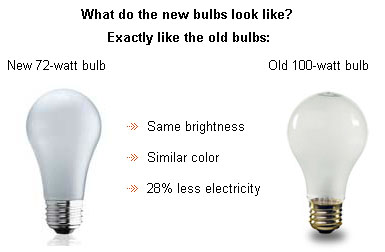
    How much difference would this actually make? Hard to say. On the one hand, the lighting industry has completed the transition to newer, more efficient bulbs and has no interest in going back. What’s more, these newer bulbs provide just about all the options anyone could ask for. Newer CFLs turn on quickly and don’t flicker. LED bulbs last forever. (Supposedly.) And ordinary incandescent bulbs continue to be available in more efficient halogen formulations for those who just don’t want to make the switch. Yes, you read that right: despite all the screaming about the heavy jackboot of the government, incandescent bulbs are still available right alongside the newer bulbs. All told, the transition is pretty much complete, so at this point there isn’t much to enforce anyway.
    On the other hand, it’s also true that old-style incandescents provide a yellower light and are cheaper to buy than the newer halogens.1 So if the new standards aren’t enforced, there will certainly be a market for old-school bulbs. I suspect that big outlets like Lowes or Home Depot will stay away from them regardless, but smaller stores and internet suppliers will probably stock them for as long as anyone manufactures them.

    Bottom line: At this point, suspending enforcement is mostly a symbolic gesture to please the tea party base of the GOP. It will have a modest effect, but for the most part the market has moved on. The 2007 law that phased out old-style incandescents ushered in a technological race to build a better bulb, and it worked. Those bulbs are here to stay.

    1When you factor in the fact that halogens last twice as long and have lower power consumption than old-style incandescents, they’re actually cheaper over the lifespan of the bulb. However, there will always be a market for a product that costs less at the point of sale.

  • Net Neutrality Takes a Big Hit in Court


    The long, grinding fight over net neutrality—the principle that everyone should have equal access to the internet—hit another speed bump today. But first, some background. Net neutrality was the de facto status quo until several years ago, when the Bush-era FCC decided to classify internet provision as an information service (IS) rather than a telecom service (TS). This mattered because telecom services had always been regulated as common carriers, which effectively required internet providers to treat everyone equally. Under the IS regime, the old common carrier requirements were replaced by four net neutrality “principles” that were considerably less stringent.

    The Obama FCC went on to impose tighter net neutrality rules, but left alone the classification of internet services as IS. Today, a federal judge decided that the FCC’s rules exceeded its authority because it had failed to classify broadband Internet as a common-carrier service:

    The ruling opens the door for Verizon and other Internet service providers to offer managed services or other arrangements where content providers could pay to increase the speed to their content. Verizon has indicated it would pursue such an arrangement if it was permitted to do so.

    Former FCC Chairman Julius Genachowski elected not to reclassify broadband as a common carrier service, the designation that applies to traditional phone lines. But he left the docket open on the subject before departing the commission last year. New Chairman Tom Wheeler has stated his support for net neutrality, but he has also voiced his opposition to regulating the Internet.

    The court’s decision means reclassification is likely the only option for the commission to impose net neutrality rules, though Mr. Wheeler recently argued he has the power to police Internet service providers on an individual basis if their behavior is anticompetitive or prevents consumers from accessing the Web.

    The next step might be an appeal to the Supreme Court or it might be an FCC decision to reclassify the internet as a common carrier. But that’s what it’s come down to. If the Supreme Court upholds this decision (or refuses to hear an appeal), net neutrality is dead unless the FCC or Congress decide to reclassify broadband internet as a telecom service regulated as a common carrier. If they don’t, it will up-end the internet as we know it, with carriers free to provide, say, Amazon or Google with preferred service in return for higher access fees. That could be a big problem for startups—or anyone the telecom providers consider a competitor—who would have to contend with slower service as they tried to build their businesses. The big telecom companies say that’s not what they have in mind, and maybe they don’t right now. But they will. It’s only a matter of time.


  • Chris Christie Will Not Be the 45th President of the United States


    Earlier today I argued that the messaging wars over Bridgegate don’t matter very much. What matters are the facts. If it turns out that Chris Christie really played no role in the lane closures, he’ll probably survive. But if evidence surfaces that he knew more than he’s letting on, he’s doomed.

    Via Twitter, Jonathan Bernstein disagreed: “Facts matter, but so do interpretations.” I sort of lamely responded by saying that I never really thought Christie had a serious chance at the presidency anyway. So really, neither facts nor interpretation will make much difference. He’s not going to be the 45th president of the United States.

    But why? Jonathan Chait provides part of the argument:

    There are now two ongoing investigations into alleged abuses of power, each of which is potentially fatal. Even if neither produces further damaging allegations, they both have already yielded enough public information to be used against him. Beyond that, there is a long list of potential scandals dating back to before his governorship. The odds that any one of them develops into something indictable are high.

    And they’re not just high in the mathematical sense that a person who gets shot at a bunch of times is more likely to be hit by a bullet. They’re high because the high number of scandals surrounding Christie, and the pattern of gleefully using his power to punish his foes, suggests that at least some of the allegations against him are true. The odds of any scandal striking pay dirt are not mathematically independent. The deeper problem is simply that Christie appears to be genuinely corrupt on a scale that is rare for a modern top-tier presidential candidate.

    The scandals don’t kill Christie’s chance in the sense that Republican voters will read the news stories and decide irrevocably they can never vote for the man. The way it works is to create a series of liabilities that his opponents can easily exploit: regional (an untrustworthy Northeastern political boss), personal (the traitor who hugged President Obama and thereby handed him the election), and ideological (gun-controlling, Obamacare-surrendering moderate).

    Yep. Here’s my nickel list of why I’ve never thought Christie can win either the Republican nomination or—in the unlikely event he does—the presidency:

    • He’s very, very attackable. The ads practically write themselves. Neither his fellow Republicans nor his eventual Democratic opponent will be shy about exploiting this.
    • He’s fat. I know that’s not fair, but it’s not fair that Obama is black or Hillary is a woman, either. It’s a liability regardless of whether it’s fair.
    • His bullying of random citizens can seem vaguely like a breath of fresh air when you see it occasionally and from a distance. But if you see it up close, all the time—as you will during a presidential campaign—it won’t wear well.
    • He has too many nonconservative positions. Mitt Romney did too, and even though he spent years disowning his earlier self and prostrating himself to the tea party, conservatives still never really trusted him. Christie isn’t the kind of guy who’s even willing to do that much, and that means the Republican base will be even less inclined to trust him.

    I could see Christie winning if the country were undergoing some kind of horrific disaster, like the Great Depression. In a case like that, it’s possible that Americans would just want someone who’d kick all the right asses and wouldn’t much care about the other stuff. But 2016 seems likely to be a fairly ordinary year, with a decent economy and no huge foreign crises. If that’s how it turns out, I have a hard time seeing how Christie manages to win.

  • Why Have Investors Given Up on the Real World?


    How should we respond to sustained economic weakness? Brad DeLong has a lengthy post today comparing two approaches. To oversimplify, we have Larry Summers on one side, who believes the answer is higher government spending on infrastructure. On the other side is Olivier Blanchard, the IMF’s chief economist, who thinks the answer is higher inflation.

    In a nutshell, the argument for higher inflation is simple. Right now, with interest rates at slightly above zero and inflation running a little less than 2 percent, real interest rates are about -1 percent. But that’s too high. Given the weakness of the economy, the market-clearing real interest rate is probably around -3 percent. If inflation were running at 4-5 percent, that’s what we’d have, and the economy would recover more quickly.

    There are two arguments opposed to this. The first is that central banks have demonstrated that 2 percent inflation is sustainable. But what about 5 percent? Maybe not. If central banks are willing to let inflation get that high, markets might conclude that they’ll respond with even higher inflation if political considerations demand it. Inflationary expectations will go up, the central bank will respond, and soon we’ll be in an inflationary spiral, just like the 1970s.

    The second argument is the one Summers makes: sustained low interest rates are almost certain to lead to asset bubbles. So even if higher inflation works in the short run, it’s a recipe for disaster in the long run.

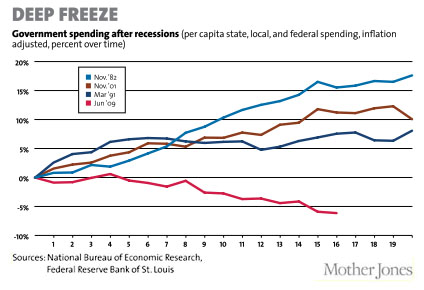
    DeLong draws several conclusions from this. He agrees that higher government spending is a good idea—and so do I. The drop in government spending since 2010 has been unprecedented in recent history (see chart below). He’s ambivalent about a higher inflation target, since he agrees that at some level it risks turning into a spiral. (But he’s not sure what that level is.) And finally, he thinks the real demand-side problem is in residential construction, which has plummeted since the housing bubble burst. This could be addressed with policy changes at the FHFA, which might be a better alternative than higher inflation anyway. I have two observations about all this:
    • Central bankers seem to think that over the past 30 years they’ve demonstrated credibility in restraining inflation, something they’re loath to give up. That’s why they hate the idea of raising their inflation targets above 2 percent. But it strikes me that they may be wrong: what they’ve really done is demonstrate credibility in following the Taylor Rule, which provides a formula-based target for short-term interest rates. But right now, the Taylor Rule suggests that interest rates should be below zero.1 A higher inflation target that’s in service of rigorously following the Taylor Rule might increase the monetary credibility of central banks, not decrease it. (Or, possibly, have no effect at all on their credibility.)
    • The Summers view that sustained low interest rates lead to bubbles may be correct. But this is only true if there just flatly aren’t enough good real-world investment opportunities available, which would leave investors with no place to put their money except in risky asset plays. DeLong seems to agree with this. When Ryan Avent asks, “Are we really arguing that there aren’t enough good private investment opportunities in America?” DeLong answers, “Yes. We are.”

    DeLong has much more to say about all this, and I’m dangerously oversimplifying here. But I’m doing it to make a point. First, I think central banks have a lot of leeway to pursue higher inflation as long as they’re clear about what they’re doing and can credibly say that they’re merely following the same monetary rules they’ve been following for the past three decades. Second, it’s surprising that we haven’t paid more attention to the suggestion that asset bubbles are the result of a (permanent?) condition in which there simply aren’t enough good private investment opportunities. This deserves way more discussion, not just a footnote in a broader essay. If it’s true, surely this is the economic challenge of our day. No matter what else we do, we’re in big trouble if markets simply don’t believe there are enough factories to expand or new companies to invest in. If investors have essentially given up on the real economy, no amount of fiscal or monetary policy will save us.

    So why isn’t this getting more discussion?

    1Actually, this depends on which version of the Taylor Rule you use. But let’s leave that for another day. For now, it’s enough to say that there’s a conventional version of the Taylor Rule which says real interest rates should be well below zero.

  • Europe Going Wobbly on Carbon Emission Goals?


    Speaking of carbon emissions, the Financial Times reports that high energy prices are “undermining support” in Europe for rules that mandate increased use of renewable energy sources:

    European commissioners are considering scrapping the targets for 2030 in a move that would please big utility companies but infuriate environmental groups….A proposed compromise, at the heart of discussions over the 2030 package, envisages that a renewables target, of up to 27 per cent, would be non-binding.

    ….This compromise for 2030, if accepted in the face of German opposition, would represent a significant change from the EU’s 2020 targets, which included binding goals that EU states should cut overall greenhouse gas emissions by 20 per cent from 1990 levels and derive 20 per cent of their power from renewables.

    A long, grinding economic downturn cuts energy usage in the short run, but reduces tolerance for higher energy prices in the long run. That’s what we’re seeing happen here.

  • The Great Recession Is Still Going Strong for Young Men


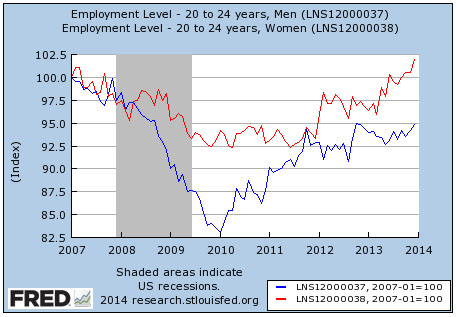
    Matt Yglesias takes a look today at the trajectory of employment since the Great Recession started. He finds that among older workers, men have done slightly better than women. Among the middle aged, men and women have done about the same. But among the young, men have done far worse than women. Male employment is still about 5 percent under its 2007 peak, while female employment is about 2 percent higher:

    All told, it’s very much an End of Men scenario—with the particularly striking fact being that you see the end of men more strongly in the younger cohorts. The population of people over the age of 55 is both large and growing, so the experience of older people carries a lot of weight in national aggregates. But the younger you look the more you see men’s disemployment as a theme. For younger workers we really are slouching toward gender equity—we’re just doing it more by men becoming worse off than by women becoming better off.

    This is yet another lesson in disaggregation. If you take a look at broad numbers, you can often miss the most important trends. The fact that young men have been so hard hit by the Great Recession is something you might miss if you just looked at broad aggregates. But it’s important, because we know that a person’s lifetime employment prospects are heavily influenced by the first few years in the job market. What’s happening to young men today is something that’s likely to ripple forward for decades.1

    1Until the robots put us all out of work on a gender-equal basis, that is.

