• After Years of Decline, Carbon Emissions Rose Again in 2013


    Brad Plumer passes along the news that after modest declines over the past few years, US carbon emissions rose in 2013:

    The big story here, as usual, involves coal and natural gas….The shale fracking boom had pushed natural gas prices to unsustainably low levels — down to a dirt-cheap $2 per million BTUs in 2012. As a result, electric utilities have been switching to natural gas as fast as they could since 2006….But prices crept up again this year past $4 per million BTUs, thanks to colder winters, higher demand for heating fuel, scaled-back drilling, and also new storage facilities that are preventing a glut of gas on the market. As a result, some electric utilities found it economical to shift back to coal. That increased emissions.

    It’s worth pointing out that the Great Recession played a role too. Both automobile use and general energy consumption declined during the weak economy of 2008-11, but as the economy has started to recover these trends were always bound to reverse. The chart on the right, for example, shows total vehicle miles driven over the past decade or so. This number is very seasonally dependent (more driving in the summer, less in winter), so just take a look at the summer peaks. They increased steadily until 2008, and then dropped, hovering about 3-4 percent below the previous record for the next four years. Then they started to pick up again. At the current rate, we should expect the 2014 peak to be roughly the same as it was in 2007.

    Now, it’s still good news that it hasn’t increased more. After all, US population has increased about 4 percent since 2007, so per capita miles driven is still well below 2007 levels. Still, it’s always been the case that our reduction in carbon emissions has been only partly the result of greater efficiencies and the switch to natural gas. It’s also been the result of a weak economy. Now, with the economy starting to recover, we’re going to have work harder to lock in real gains.
  • It Doesn’t Matter What Republicans Say About Bridgegate


    I gather that the main Republican response to Bridgegate has now been settled. There are two parts to it:

    • Hey, at least Christie came clean with his manly press conference and his decisive firing of Bridget Anne Kelly. That’s more than Obama has ever done.
    • It’s nowhere near as bad as Benghazi or the IRS scandal.

    Will this two-pronged counterattack work? It’s obviously pretty puerile, only slightly more sophisticated than your average kindergarten playground comeback, but my guess is that it doesn’t matter. Pretty much any reaction will work if the scandal doesn’t get any worse and no evidence pops up that implicates Christie himself. Conversely, no amount of agit-prop will work if it turns out that Christie knew more about this than he’s letting on. This is a scandal in which the messaging campaign just doesn’t matter. All that matters is what crawls out when more rocks start getting turned over.

  • Iran Says Interim Nuclear Talks Have Been Completed


    One day after Iran’s Ayatollah Ali Khamenei declared that the current round of nuclear negotiations “showed the enmity of America against Iran, Iranians, Islam and Muslims,” relations seem to have improved dramatically:

    Iran said Friday that talks in Geneva with the group of six world powers had resolved all outstanding issues on how to carry out an agreement reached in November that would temporarily halt some of Iran’s nuclear activities in exchange for billions of dollars in sanctions relief.

    A report on Iranian state television quoted Abbas Araghchi, the deputy foreign minister….saying that “we found solutions for all the points of disagreements, but the implementation of the Geneva agreement depends on the final ratification of the capitals.” He did not specify a target date, although officials have said privately it is Jan. 20.

    OK then. It sounds like progress, fitfully and slowly, is being made.

  • The Rise of the Self-Loathing Partisan


    Why do so many people call themselves independents even though they mostly vote for one party pretty consistently? Yanna Krupnikov and Samara Klar describe a study they just completed that asked people to rate photographs of two affluent neighborhoods:

    Some respondents saw pictures of the neighborhoods without any political signs, and some saw these very same neighborhoods with just one small addition: a political campaign sign on one of the well-manicured lawns.

    When people were reminded of partisan disagreement, they consistently rated the neighborhood with the political sign as being a less desirable place to live. In addition, more than 60 percent also reported that they would not even want to attend an event with people who lived in that neighborhood.

    Yeah, but I’ll bet all those intolerant jerks were narrow-minded tea-party Republicans. No wait. I mean they were probably arrogant, sanctimonious Democrats. No no. Hold on again. I’ll bet they were really smug, pox-on-both-your-houses “moderates.” See? I can do that all day long. Anyway, let’s forge ahead with the Science™:

    In a similar study, we showed people photographs of strangers. We told some of our participants that the strangers were Independents, and we told others that the strangers were partisans. We found that when people were reminded of partisan disagreement, they rated photographs of Independents as being more attractive than photographs of partisans — even when, by objective standards, the partisans were actually more attractive.

    Bottom line: Krupnikov and Klar find that (a) most people don’t like engaging with partisans, but (b) are themselves mostly partisan, no matter what they actually call themselves. This makes sense to me. Engaging with conservatives is obviously annoying for me, since I’m a liberal and I think they’re wrong about everything. But engaging with liberals can be kind of annoying too. After all, liberals are annoying, always trying to tell you that the power structure is oppressive and factory-farmed beef is an outrage and you should be more concerned about lead in the environment, blah blah blah. Better to just find a nice independent and chew the fat about whether Andrew Luck has what it takes to put Tom Brady out to pasture tomorrow.


  • Was Bridgegate Really About the Mayor of Fort Lee?

    Why did Chris Christie’s staff shut down several lanes of the George Washington Bridge in August? The working theory is that it was retaliation against the mayor of Fort Lee, who had declined to endorse Christie for reelection. This has never really made sense, though. The guy was a Democrat and Christie was cruising to victory. As both the mayor and Christie himself have pointed out, no one would care if he decided not to endorse Christie.

    So Rachel Maddow and Steve Benen offer up another theory today. Last year Christie was in a long-running battle with Democrats over his appointees to the state Supreme Court, and in August Christie decided to remove a justice from the court rather than submit her to renomination to Senate Democrats:

    The governor, enraged, held a press conference to tell reporters, “I was not going to let her loose to the animals.”

    The “animals,” in this case, were the Democrats in the state Senate.

    Christie said that on the afternoon of Aug. 12, 2013.

    On the morning of Aug. 13, 2013, Christie’s deputy chief of staff told the governor’s guy at the Port Authority, “Time for some traffic problems in Fort Lee.”

    The leader of the Senate Democrats at the time was a senator from … Fort Lee.

    This is just speculation, of course, so take it for what it’s worth. Dave Weigel, for example, points out that the Democratic leader of the state Senate was “utterly safe at re-election,” so retaliating against her seems kind of pointless too. Maybe so. But for now, speculation is all we have. The whole story about retaliation against the mayor of Fort Lee has always been pretty wacky, so now that we know for sure that retaliation of some sort really did take place, it’s only natural to scratch our heads and start trying to figure out if maybe something else was going on. This is as good a guess as any.

    Here’s the video:

  • Chart of the Day: Net New Jobs for December


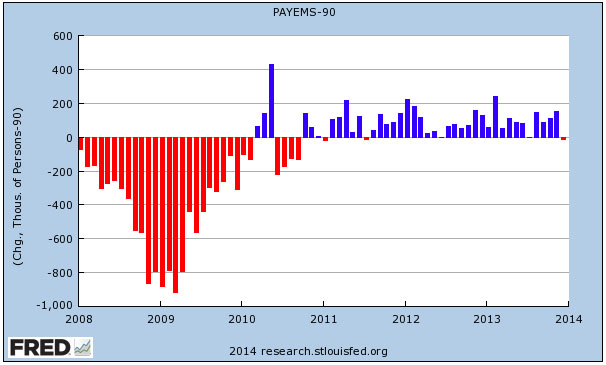
    The American economy added 74,000 new jobs in December, but about 90,000 of those jobs were needed just to keep up with population growth, so net job growth clocked in at minus 16,000. There’s no way to sugarcoat this: it’s pretty dismal news. Last night was obviously a bad time to predict that the economy might be getting back on track.

    The headline unemployment rate dropped to 6.7 percent, but that’s mainly because a huge number of people dropped out of the labor force, causing the labor force participation rate to decline from 63.0 percent to 62.8 percent. At the same time, the number of discouraged workers dropped. This suggests that in addition to the usual exodus of workers due to retirement, a fair number of people simply gave up and quit looking for work, dropping out of the official numbers entirely.

    It’s only one month, and it might not mean much. Maybe it was just bad weather. Maybe. But it’s a lousy start to the year.

  • 2014 Might Turn Out to be a Fairly Good Year for the Economy


    Analysts are starting to get optimistic about the economy:

    Record exports and the smallest trade deficit in four years. Healthier consumer spending, including the strongest annual increase in automobile sales since 2007, spurred by a booming stock market and an improving housing sector. And a slow but steady pickup in job creation that has pushed unemployment to its lowest level since 2008.

    ….Just a few weeks ago, there were fears that 2013 would end on a sour note in terms of economic growth….But better-than-expected trade data on Tuesday, as well as an increase in consumer activity in October and November, prompted many economists to revise their estimates of growth in the fourth quarter sharply higher this week.

    Dean Maki, chief United States economist at Barclays, now says he believes the economy expanded at an annualized pace of 3 percent in October, November and December, double his previous estimate….Mr. Maki attributes more than half of the gain in consumer spending to the surging stock market in 2013 and the steady recovery in real estate prices, the so-called wealth effect that has left shoppers feeling more confident.

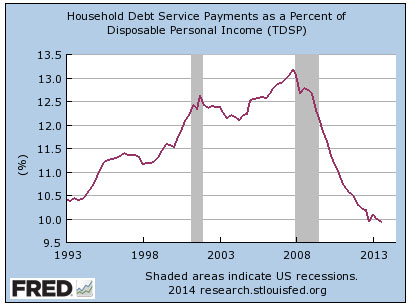
    Without getting too rosy-minded about things, I’m modestly optimistic too. Why? Because the proximate cause of our long, grinding downturn was too much debt, and in the second half of 2013 it started to look as if household deleveraging had finally run its course. With consumer debt now below the level of the mid-90s, there’s a decent chance that spending will pick up and the economy will come along with it. No one should expect sudden boom times, and long-term unemployment remains a national catastrophe, but 2014 could turn out to be a fairly decent year. We’ll get our first sign on Friday morning, when the Labor Department reports December jobs growth. If it’s over 200,000 again, that will be a good sign. If it’s closer to 250,000, that will be a great sign.

  • Democrats Offer Republicans a Lifeline on Unemployment Benefits


    Greg Sargent reports on the latest maneuvering over the extension of unemployment insurance benefits:

    Senate Democrats are closing in on an agreement to pay for an 11-month extension of unemployment benefits with spending cuts that would not go into effect for at least a decade, sources tell me. This would probably be acceptable to liberals, because it would sustain a lifeline for the jobless right now, while pushing off any damage the “pay for” would do deep into the future.

    There are two ways to look at this. The first and most obvious is that it’s ridiculous. Democrats are saying they want to spend $17 billion this year in return for $17 billion in cuts in 2023. I don’t really need to point out that nobody over the age of five believes those cuts will materialize a decade from now, do I?

    But there’s a second, more congenial way of looking at this: as a lifeline for Republicans. They say they want UI benefits paid for. They also say they truly empathize with folks who have been out of work for a long time. Furthermore, they’re uneasy about their reputation for meanspiritedness and are looking for something that will soften their image. Et voilà! Here’s their solution. Sure, it’s basically sophistry, but no more so than most of what they do every day of their lives. And anyway, everyone knows that it makes no sense to pay for the UI extension in the first place.

    So this is it: a way for Republicans to have their cake and nibble on it too. But I’ll bet they don’t bite.

  • Chris Christie Needs to Talk to Bridget Anne Kelly Pronto


    Recent political scandals have given us a whole new set of colorful euphemisms for dodgy behavior. Wide stance. Walking the Appalachian trail. Drunken stupor. And now, We’re doing a traffic study.

    And speaking of Bridgegate, New Jersey Gov. Chris Christie held an epic press conference today about it. Actually, “held” is the wrong tense. As I write this, it’s still going on. He’s apologized repeatedly, denied that he’s a bully, claimed that he’s embarrassed and humiliated, and fired a couple of his close aides. He’s doing pretty well, and if he’s telling the truth that he knew nothing about any of this before it happened, then he might be able to put it all behind him eventually. Still, I was struck by this:

    Q: I’m wondering what your staff said to you about why they lied to you. Why would they do that? What was their explanation? And what about Mr. Samson? What role did he play in this?

    GOV. CHRISTIE: I have — I have not had any conversation with Bridget Kelly since the email came out. And so she was not given the opportunity to explain to me why she lied because it was so obvious that she had. And I’m, quite frankly, not interested in the explanation at the moment.

    Bridget Anne Kelly was one of Christie’s top aides, and very clearly someone who was rather gleefully involved in planning the pre-election lane closures on the George Washington Bridge as retribution against the mayor of Ft. Lee. But Christie wasn’t interested in talking to her directly to find out what was going on? Really? That sounds like a guy who either (a) already knows what she’d tell him, or (b) is afraid of what she might tell him.

    A friend of mine also emails with this:

    Here’s something I haven’t heard yet, and it seems kinda obvious to me:

        Bridget Anne Kelly: “Time for some traffic problems in Fort Lee.”

        David Wildstein: “Got it.”

    Does this exchange sound like it’s between two people who are suggesting a new and novel way to screw their political opponents, or between two people who have clearly done this before?

    If I’m working in the governor’s office1 and someone sends me an email saying “Time for some traffic problems in Fort Lee!” I’d probably email back something like, “What are you talking about?” or “What happened in Fort Lee that’s causing all the traffic?” Instead, Wildstein knows what she’s getting at right away, and what he’s supposed to do. Then he does it.

    It would surprise me less if this turns out to be the only time they’ve done this than if we discover two or three more incidents of politically inspired “traffic problems.”

    Maybe that’s what Christie is afraid to find out?

    1Actually, Wildstein worked at the Port Authority. But you get the idea anyway. “Wildstein was known as the Governor’s eyes and ears inside this massive agency,” says one reporter, and he’s a longtime friend and confidante of Christie’s.