• Here’s How to Tell If Marco Rubio Is Serious About Fighting Poverty


    Yesterday I wrote briefly about Marco Rubio’s poverty reform proposal, and I was….unenthusiastic. I don’t believe that Rubio is really serious; I don’t believe Republicans will follow his lead even if he is; and I imagine that once Rubio provides us with details, his proposal will turn out to be little more than a plan to cut spending on the poor.

    Jared Bernstein followed up last night with a bit more on those pesky details. For example, Rubio proposes that we should get rid of most federal anti-poverty programs and simply give the money to the states, where they can experiment with different approaches. But there’s a problem with block grants like this:

    “Revenue neutrality” may sound technical and inoffensive, if not fiscally sound, but what it really means is the safety net will be unable to expand in recessions. Let’s see the details, but typically under these arrangements, states will be unable to tap the Feds for unemployment benefits, nutritional assistance, and all the other functions that must expand to meet need when the market fails. This would be a huge step backwards, essentially enshrining poverty-inducing austerity in place of literally decades of policy advancements to meet demand contractions with temporary spending expansions.

    The chart on the right shows what Bernstein is talking about. The blue line shows TANF, the basic welfare program that was block-granted as part of the mid-90s welfare reform. During the Great Recession, spending on TANF didn’t budge. Conversely, both SNAP (food stamps) and unemployment insurance rose during the recession, as they should have. Will Rubio’s plan include automatic stabilizers based on eligibility requirements? Or will it strangle safety net programs by not allowing them to grow when the economy is bad? We’ll have to wait and see.

    Rubio also wants to replace the EITC with wage subsidies. I’ve pointed out before that the experience of other countries that have tried this is decidedly inconclusive, so it’s something to be cautious about. Still, if it’s done right it has the potential to be an effective program. However, Bernstein is worried about Rubio’s apparent proposal to change the program to be more generous to married couples:

    What Sen. Rubio appears to be up to here is targeting the so-called marriage penalty—the idea that since EITC eligibility is based on family income, combining incomes through marriage can lead formerly eligible workers to lose eligibility.

    But it sounds to me like he’s losing the income targeting of the program and will end up shifting current EITC spending away from single parents with kids to married couples with kids (along with childless adults, who get little—too little—from the EITC). Given that kids in single parent families are already more likely to be poor than those in married families, the only way this idea could not increase child poverty would be if he spent considerably more on it than is being expended on the EITC. And that’s not likely what he’s got in mind.

    This would fit with Rubio’s belief that government programs should encourage marriage, a popular notion in conservative circles. Now, it so happens that I think we should encourage marriage. In fact, I wish this were a more popular notion among the educated liberal class, which pretty clearly thinks marriage is a great thing but is often skittish about “imposing” its values on others. I say: be less skittish! Nobody wants to lock others into bad or abusive marriages, but generally speaking, marriage has a ton of benefits: for the couple itself, for their children, and for society. I’m all for it.

    That said, I’m pretty skeptical that the government should be in the business of encouraging or discouraging marriage, and I’m even more skeptical that offering a few more or a few less dollars in welfare programs is likely to have any effect anyway. So I share Bernstein’s concerns. However, there’s no special reason to think the status quo is ideal in this regard, so if Rubio’s proposal ends up shifting spending a bit, I’m happy to evaluate it on the merits.

    Still, the devil is really in the details here. EITC is a program with a lot of history behind it, and we know that it works pretty well. Wage subsidies show some promise, but they’re untested and extremely sensitive to program design. We’ll know how serious Rubio is about this stuff based on how much thought he ends up putting into his final proposal. I’ll be waiting.
  • How to Ensure a Republican Landslide in November


    RNC chair Reince Priebus thinks Democrats are playing politics with the poor:

    All of this kind of stuff is ridiculous because we’re spending all of our time actually talking and perpetrating what the Democrats actually want. They don’t want this to pass, what they want to do is they want to talk about these things, they want to talk about minimum wage and what they want to do ultimately is create a campaign issue, this sort of rich vs. poor, the same old thing they can do and avoid Obamacare. That’s what they want.

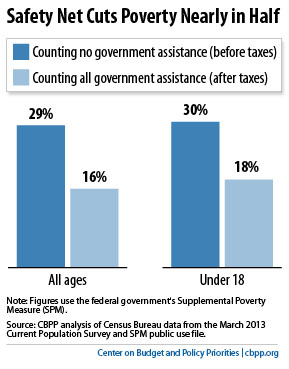
    You know what Republicans should do? They should totally call the Democrats’ bluff. They should just go out there and pass an extension of unemployment insurance; pass an increase in the minimum wage; and pass a farm bill that doesn’t cut food stamps. It would hardly cost anything—maybe 0.3 percent of the federal budget—and it would blow away Democratic campaign plans for November. Plus it would be good for the economy!

    It’s a win-win-win: good for the poor, good for the Republican Party, and good for America. It would sure teach Democrats a lesson if Republicans sneakily agreed to all this stuff. I say they should go for it.

  • Moderates Are Fleeing the Republican Party, But That Doesn’t Mean Anything Has Really Changed


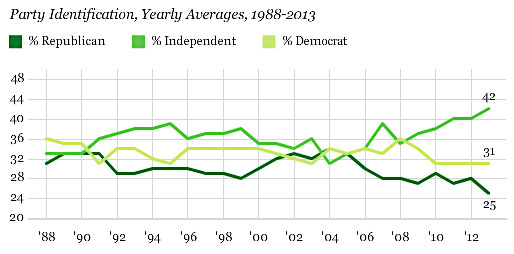
    Gallup reports that the number of people self-identifying as independents has increased dramatically since 2008:

    There are two things to say about this. First, this trend most likely represents moderate Republicans who no longer want to identify with the modern tea-party-ized GOP, and are now calling themselves independents. But as John Sides points out, this doesn’t mean much in terms of voting behavior. These folks might call themselves independents, but they mostly vote the same way they always have.

    Second, it goes a long way toward explaining that Pew survey last week, which found that belief in evolution had plummeted from 54 percent to 43 percent among Republicans over the past four years. If you dig into the details of that poll, the decline is actually a little more moderate than it seems, and it’s probably explained mostly by the fact that so many moderate Republicans have left the party. When you remove a big chunk of people who believe in evolution, the group that’s left will have a higher percentage of deniers even though no one’s beliefs have actually changed.

    Bottom line: moderates are abandoning the Republican Party. The remaining rump is more conservative, and this certainly affects the behavior of Republican politicians in Washington. However, it doesn’t mean that anyone’s views have changed or that anyone’s voting patterns have changed.

  • Marco Rubio Talks about Poverty, But Is the GOP Serious About Listening?


    Republicans have been getting antsier than usual lately over the prospect that voters are starting to think they’re little more than the Party of Mean. The problem is that Republicans remain adamantly opposed to just about every possible program that helps the poor, and after a while that starts to look fairly obnoxious when everyone knows the economy is still weak and there simply aren’t enough jobs available for everybody who wants one. This week, in the latest memo from the GOP high command suggesting that everyone watch their tone in public, Republicans were instructed to at least show a little empathy for the unemployed rather than sneering at them as moochers and looters who just need to get off their butts and go to work.

    That’s good advice, but it only goes so far. There’s still the niggling problem that although Republicans like to talk about they do so care about poverty, their actual proposals are pretty thin on the ground. Today, Marco Rubio tried to fix that in a talk held in the LBJ room in the Capitol. After a few shoutouts to marriage, education, tax reform, and liberal failure (“Raising the minimum wage may poll well, but having a job that pays $10 an hour is not the American Dream”), he got to the point:
    Our anti-poverty programs should be replaced with a revenue neutral Flex Fund. We would streamline most of our existing federal anti-poverty funding into one single agency. Then each year, these Flex Funds would be transferred to the states so they can design and fund creative initiatives that address the factors behind inequality of opportunity.

    ….It’s wrong for Washington to tell Tallahassee what programs are right for the people of Florida — but it’s particularly wrong for it to say that what’s right for Tallahassee is the same thing that’s right for Topeka and Sacramento and Detroit and Manhattan and every other town, city and state in the country.

    ….We should pursue reforms that encourage and reward work. That’s why I am developing legislation to replace the earned income tax credit with a federal wage enhancement for qualifying low-wage jobs. This would allow an unemployed individual to take a job that pays, say, $18,000 a year — which on its own is not enough to make ends meet — but then receive a federal enhancement to make the job a more enticing alternative to collecting unemployment insurance.

    Unlike the earned income tax credit, my proposal would apply the same to singles as it would to married couples and families with children. It would also be a preferable means of distributing benefits since it would arrive in sync with a monthly paycheck rather than a year-end lump-sum credit. And it’s a better way of supporting low-income workers than simply raising the minimum wage.

    It’s a shame that Rubio is almost certainly not serious about genuinely fighting poverty. Because these aren’t impossible ideas. The first one is basically the usual conservative dream of block granting everything and then dumping the whole load onto the states, something that liberals are quite reasonably skeptical about. After all, virtually every state controlled by Republicans is currently refusing to expand Medicaid coverage even though it’s nearly 100 percent paid for by the federal government. This gives everyone a pretty good idea of just how eager red states are to help the poor.

    And that’s a shame, because Rubio is right when he says that state experimentation, a la welfare reform in the early 90s, could be pretty valuable. If states were truly serious about finding answers, and if each of the various state policies were rigorously studied, it could provide some genuine insights into how best to fight poverty. But what are the odds of that?

    The wage subsidy is also a potentially good idea, and I guess we’ll have to wait for the details that Rubio promises to reveal later. Again, though, I’ll be pretty surprised if it doesn’t end up turning into nothing more than an excuse to cut spending on poverty. A wage subsidy that, in aggregate, is as large or larger than the current EITC, might be worth considering. More likely, though it will just be a nothingburger designed to justify opposition to a minimum wage increase.

    But we’ll see. I don’t believe for a second that Rubio is serious about this stuff, nor do I believe that his fellow Republicans will show any interest in anything that doesn’t slash spending on the poor. But he can prove me wrong if he wants.

  • Robert Gates Thinks Obama Was Right. So Why Is He So Down On Him?


    In his newly published memoir, former Defense Secretary Robert Gates describes a 2011 meeting about Afghanistan: “As I sat there, I thought: The president doesn’t trust his commander, can’t stand Karzai, doesn’t believe in his own strategy and doesn’t consider the war to be his. For him, it’s all about getting out.” Andrew Sullivan points me to Rod Dreher, whose pithy reaction seems like the right one:

    Is it just me, or is this nuts? Obama’s judgment of the sleazy Karzai was correct, Obama knew the war was unwinnable, Gates thinks Obama made the right calls — but he faults the president for not being a True Believer? As if George W. Bush’s unwillingness to reassess American strategy in light of cold, hard experience is a sign of wisdom and character! I suppose Gates has a point if he’s faulting Obama for pursuing a military strategy that he (the president) didn’t believe in, but does Gates believe that an immediate withdrawal from Afghanistan would have been the better strategy, even if it had been politically feasible (which it may not have been)?

    Based on the excerpts we’ve seen, this seems like the right response. Over and over, Gates seems to suggest that Obama made the right decisions and made them in the right way. And yet, he remained uneasy because Obama’s attitude toward the military wasn’t as deferential as he thought it should be. It’s easy to understand why a guy with Gates’ background might feel that way, but honestly, after over a decade of mostly fruitless war does Gates truly think that deference was in order? The truth is that Obama and his staffers should have been extremely skeptical of the military’s judgment by 2011. Nobody in the Pentagon wants to hear this, but by that time they had failed enough times that skepticism was really the only reasonable response from a new president.

    It’s interesting to see how this book is being handled by different people. Obviously Gates has some criticisms of Obama, and every review notes that. However, he also had some very positive things to say about Obama, and most of the reviews are fairly evenhanded about pointing that out. Not so for Bob Woodward, though, whose front-page review in the Washington Post is so unremittingly negative that you’d think Gates’ book was little more than a 600-page hatchet job against Obama. Once again, I find myself wondering what’s up with Woodward. He obviously has a fairly intense loathing for Obama, but I can’t really figure out why.

    Also interesting is Andrew Sprung’s comparison of Gates’ mid-90s memoir to this one. Gates has obviously changed a lot:

    Gates 1996 and Gates 2014 are rather like America 1996 and America 2014. The first, ebullient, a tad triumphal, serenely confident that U.S. policymaking will be driven by countervailing democratic pressures both to express the will of the people and to secure order in the world as well as national security. The second, embittered, exhausted, fearful that the country has lost its capacity for problem-solving.

    The whole post is worth a read. It’s obvious that Gates doesn’t much like what’s happened to America over the past decade, both politically and militarily. It’s hard to blame him for that.

  • Chart of the Day: Being Poor Is Bad for Your Health


    Hypoglycemia is an ever-present threat among diabetics who are being treated with insulin injections. Generally speaking, it’s caused by inadequate nutrition leading to dangerously low blood sugar, and it can usually be fixed by simply eating enough. But what if you’re poor, and at the end of the month you don’t have enough money left to buy adequate food? Adrianna McIntyre passes along this devastatingly simple chart that shows exactly what happens:

    Take a look at the top three lines. Among those with high incomes, the risk of hypoglycemia is about the same all month long. But the red line shows the incidence of hypoglycemia among the poor. It goes down at the beginning of the month, when money is available for food, rises a bit in the middle of the month, and then jumps dramatically in the final week when money is tight. As a check to make sure that tight budgets really are at fault, the authors ran the same test on the incidence of appendicitis, which should be unrelated to income. It was.

    McIntyre uses this as an object lesson: although policy wonks tend to focus a lot of attention on insurance and health care financing, there are plenty of other things that affect health. What’s more, solutions aren’t simple:

    These findings also illustrate the difficulty in finding policy solutions to address health disparities. The authors note that food pantries and soup kitchens already ramp up staffing and resources toward the end of the month. We could explore different ways to distribute existing benefits, but that may have other negative impacts (ie: making it harder to pay rent or bills at the beginning of the month).

    Nothing is ever easy.

  • Next Time Can Be Different—But It Probably Won’t Be


    In This Time is Different, their exhaustive history of banking crises, Carmen Reinhart and Kenneth Rogoff concluded that recessions caused by financial collapses are typically (a) really deep and (b) last a really long time. So it’s no surprise that the Great Recession has produced such a long stretch of sluggish growth. Historically speaking, though, Neil Irwin reports that Reinhart and Rogoff think the United States has recovered surprisingly strongly:

    The short version of their conclusion: We’re doing pretty well! Or at least, pretty well by the standards of countries emerging from banking crises.

    Of 100 systemic banking crises in the United States and around the world, Reinhart and Rogoff found that it takes an average of eight years for per-capita GDP to fully recover. Of the 12 countries directly hit by the global financial crisis that began in 2007, the United States and Germany have both returned to their pre-crisis levels of per-capita GDP.

    ….That all raises the question of “why”. Why is it that it takes so long for nations to recover from financial crisis-induced recessions? In an intriguing but not well-developed set of concluding observations, Reinhart and Rogoff argue that it is because advanced nations do not consider the kinds of radical actions that might deal with the heart of their financial problems: Restructuring debts so as to reduce the overhang that holds back growth in highly indebted countries, allowing higher inflation to achieve the same result, introducing capital controls.

    This is the key to everything. Sure, a housing bubble that sets off a financial crisis is bound to produce a deep recession. There’s no way around that. But it’s possible to recover fairly quickly. It simply takes the will to understand what’s going on and the courage to implement policies that, in other circumstances, might seem reckless and foolhardy. We could have done that this time around, but we didn’t have the political courage to try it. Even worse, the Republican Party rather clearly lacked even the desire to rescue the economy once Barack Obama became president.

    Can it be different next time? From a narrow economic standpoint, Reinhart and Rogoff think it can be. From a broader policy standpoint, it’s less clear. Political courage is in short supply these days.

  • Bridgegate Edges Closer and Closer to Chris Christie Himself


    New Jersey Gov. Chris Christie still says that he had nothing to do with closing traffic lanes on the George Washington bridge in order to punish the mayor of Fort Lee, who had declined to endorse him for reelection. Maybe so. But newly released emails show pretty clearly that the lane closures were indeed designed as political punishment and that senior Christie staffers were in on it:

    “Time for some traffic problems in Fort Lee,” Bridget Anne Kelly, one of three deputies on Christie’s senior staff, wrote to David Wildstein, a top Christie executive at the Port Authority, on Aug. 13, about three weeks before the closures. Wildstein, the official who ordered the closures and who resigned last month amid the escalating scandal, wrote back: “Got it.”

    Other top Christie associates mentioned in or copied on the email chain, all after the top New York appointee at the authority ordered the lanes reopened, include David Samson, the chairman of the agency; Bill Stepien, Christie’s re-election campaign manager and the newly appointed state GOP chairman; and Michael Drewniak, Christie’s spokesman.

    ….The private messages, mostly sent through personal e-mails accounts, indicate that Kelly, a senior staff member in the governor’s office, was involved in the planning and received updates during the week of the traffic jams.

    ….In one exchange of text messages on the second day of the lane closures, Wildstein alludes to messages the Fort Lee mayor had left complaining that school buses were having trouble getting through the traffic.

    “Is it wrong that I’m smiling,” the recipient of the text message responded to Wildstein. The person’s identity is not clear because the documents are partially redacted for unknown reasons.

    “No,” Wildstein wrote in response.

    “I feel badly about the kids,” the person replied to Wildstein. “I guess.”

    “They are the children of Buono voters,” Wildstein wrote, making a reference to Barbara Buono, the Democratic candidate for governor, who lost to Christie in a landslide in November.

    Maybe it’s still plausible that Christie had no idea this was happening. But it’s looking less plausible with every day. I sure figured Christie was smarter than this, but I guess maybe not.

    A complete Bridgegate explainer, along with all the emails, is here.


  • Gates Says Obama Gave Up On Afghanistan Three Years Ago


    Former Defense Secretary Robert Gates has published a memoir of his time in government. He served in Obama’s cabinet for two years:

    Mr. Gates says that by 2011, Mr. Obama began expressing his own criticism of the way his strategy in Afghanistan was playing out.

    At a pivotal meeting in the situation room in March 2011, Mr. Gates said, Mr. Obama opened with a blast of frustration over his Afghan policy — expressing doubts about Gen. David H. Petraeus, the commander he had chosen, and questioning whether he could do business with the Afghan president, Hamid Karzai.

    “As I sat there, I thought: The president doesn’t trust his commander, can’t stand Karzai, doesn’t believe in his own strategy and doesn’t consider the war to be his,” Mr. Gates writes. “For him, it’s all about getting out.”

    Gates was frustrated about this, and I don’t blame him. And needless to say, conservatives are going to have a field day with it.

    But it’s pretty frustrating for those of us on the other side of the fence as well. Apparently, we’ve spent the past three years fighting a war that the White House no longer believes in. There’s been essentially no hope of victory, or even of doing much good, and yet we gutted it out anyway. What a waste.

  • Is Graduate School a Racket?


    Megan McArdle writes about the grim prospects for graduate students:

    Last week, I wrote that collectively, faculty need to deal with the terrible market for professorships by producing fewer potential professors: admitting a lot fewer students to graduate school….There are two criticisms I’ve received that seem worth responding to. The first is that I myself work in a profession that looks a lot like a tournament….[The second is:] Why not unions? Why not unionize the adjuncts and get them paid on par with the tenure-track professors? Better yet, why not convert all those positions to tenure-track lines?

    By chance, I was talking to a professor buddy of mine about this just last week. His take was quite different: he thinks that unions love adjuncts and part-timers and have largely abandoned the interests of full-timers. This is because three part-timers produce three times more union dues than one full-time tenured professor. State legislatures love part-timers too, because three part-timers cost less than one full-time tenured professor. As a result, the number of tenure-track positions in his department has gone down from 22 to 8 in the past couple of decades. This is not because they have fewer students. They have more. It’s because the vast majority of classes are now taught by part-timers.

    Now, obviously this might differ between teaching universities and research universities and between private and public universities. It also might differ from department to department and from state to state. But I know that a lot of professor types read this blog, which is why I’m throwing it out. Has the ratio of full-timers to part-timers plummeted everywhere? Is there a reason for this beyond pure cost savings? What role do unions play? Educate us in comments.