• Chart of the Day: America’s Health Care System Is Killing You


    Is life expectancy a good measure of the quality of a country’s health care system? I’ve always been pretty hesitant to use it as a primary metric because….well, I’ll just let Aaron Carroll describe people like me:

    One of my issues with the arguments people muster against life expectancy is that they are all so small. They attack some individual behavior or factor that might affect life expectancy in some minimal way, but nowhere near enough to cause the big differences we see. It’s smoking. It’s drinking. It’s accidents. It’s immigrants. It’s chemicals in the water. It’s stupidity. It’s suicide. It’s freedom.

    It doesn’t matter that tons of these arguments are just plain wrong. It doesn’t matter that even after you eliminate them from the equation, our life expectancy still sucks. People hold on to them like crazy because they don’t want to believe that it could be the health care system.

    OK, OK, maybe I should take life expectancy more seriously as a metric of health care quality. It’s certainly true that American life expectancy, which largely tracked other rich countries in the years after World War II, diverged rather dramatically starting around 1990. Why? It’s true that there could be a thousand different reasons related to culture and food and violence and so forth, but most of those things existed all along. So what happened around 1990?

    One plausible answer is that it’s related to divergences in health care starting around then. That’s a tricky thing to prove, however, unless you dig deeply into the details. Recently a team of authors did just that in JAMA and produced the chart below. It shows Years of Potential Life Lost (YPLL) as multiples of the median for other rich countries. A number greater than one means we’re losing more years than the rest of our peers. Here’s the chart:
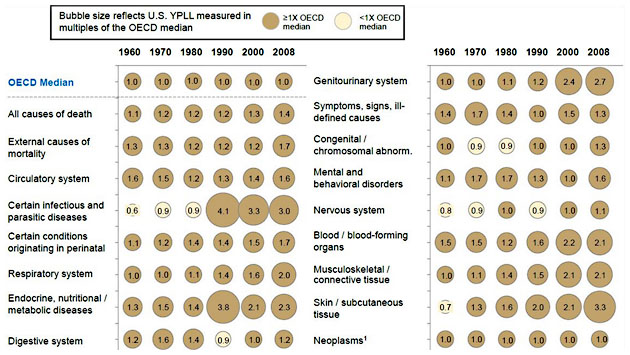
    The dramatic thing about this chart is that the United States does worse than other rich countries in every single area. Sure, it’s possible that there are 16 different reasons that we’re doing worse in 16 different categories, but it doesn’t seem likely, does it? When something is this widespread, the cause is a lot more likely to be something broadly based, like health care delivery. This isn’t smoking gun proof that our Rube Goldberg health care system is responsible for our lousy life expectancy, but it sure ought to make you sit up and take notice. There’s a pretty good chance that you, your friends, and your family are going to live three or four years less than you should, solely because you live in America.

  • A Wee Question for the Climate Change Skeptics


    Mark Kleiman poses an interesting question:

    I’d like to hear the climate-change deniers explain why Monsanto wanted to pay almost $1 billion for a company whose business model is protecting farmers against increasing volatility in the weather, and whose models predict that Kansas will become inhospitable to corn and Alaska a good place to grow wheat.

    The context here is the $1 billion acquisition of the Climate Corporation by Monsanto—which these days is purely a seed company, having spun off its old chemical business years ago. Apparently Monsanto is willing to invest a lot of money in the proposition that climate change is real and they need to be prepared for it. Just like insurance companies. And the US military. There sure are an awful lot of hard-headed types out there who have fallen for the climate change hoax.

  • Unemployment Bill Moves Closer to Inevitable Defeat in House


    A couple of hours ago, the Senate voted 60-37 to move forward on a bill extending unemployment insurance benefits. If those same 60 senators continue to vote the same way, the bill will pass sometime in the next day or two.

    But that will require making some concessions to Republicans, and this is getting a ton of ink. But why? Am I missing something here? Does this bill have even the faintest chance of getting a vote in the House, let alone passing? I haven’t read anything that suggests John Boehner plans to bring it up no matter what concessions Democrats make in the Senate.

    Help me out here. I could use some good news. Does this bill have a prayer of passing the House, or is this just another round of Capitol Hill game playing, with poor people as the pawns?

  • Obamacare’s Saving Grace: The Middle Class Uses It Too


    Generally speaking, one of the guiding principles of politics is that programs for the poor can be managed badly and nobody cares. But if a program for the middle class is badly managed, there’s hell to pay. More broadly, there’s ample evidence that politicians—even liberal ones—care about the middle class, but not about the poor. Not at all.

    Today Ezra Klein talks to Peter Super, a professor of law at Georgetown University, who notes that the rollout of Obamacare’s federal exchange was actually fairly typical for a new program that serves low-income people. “But the recovery has been startlingly fast.”

    EK: There’s an old line that goes, “programs for the poor are poor programs.” When you compare programs that are used by the poor, like food stamps, to programs used by Americans of all income brackets, like the IRS or the DMV, do you think the old adage holds true?

    PS: It’s night and day. I hear people complain about the IRS and I’m just astounded. Its level of customer service is radically better than what we see in even fairly well-run poverty programs. There’s all sorts of things the IRS would never dream of doing that are absolutely routine in these other programs. They actually give people a chance to explain things.

    ….EK: So how do these programs get improved? With Obamacare, a lot of middle class, and even upper middle class, people were using the system, and because it was all online, it was easy for journalists to try it out, and so there was a lot of public pressure. But what do you do when services don’t get as much attention and don’t have beneficiaries with political power?

    PS: Having people with political clout involved certainly makes a big difference. In 1995 or 1996, when the means-tested programs were being overhauled in Congress, the cuts to the school lunch program were far from the most severe being imposed. But because they hit middle-income kids, the outcry was enormous and they were dropped even as more severe cuts to things like food stamps went through.

    But to the extent we can’t get to that, we need to see federal agencies adopting and enforcing best practices, in particular standards for proper testing before rollout, proper success in pilot programs before things go statewide, and proper human fallback to make sure that people aren’t cut off from the program if the automated systems fail.

    This is similar to the outcry over the sequester cuts to the FAA. Unlike a lot of the cuts, that one caused delays at airports, which affected the middle class, the rich, and journalists. And guess what? It got rolled back pronto. But the cuts to food assistance and Head Start? Not so much.

    The Obamacare website rollout might have been a fiasco, but its saving grace was that it was very public and had a big clientele among the middle class. So it got fixed. Pronto.

  • How Much Does State Obstruction Affect Obamacare Enrollment?


    See important updates below.

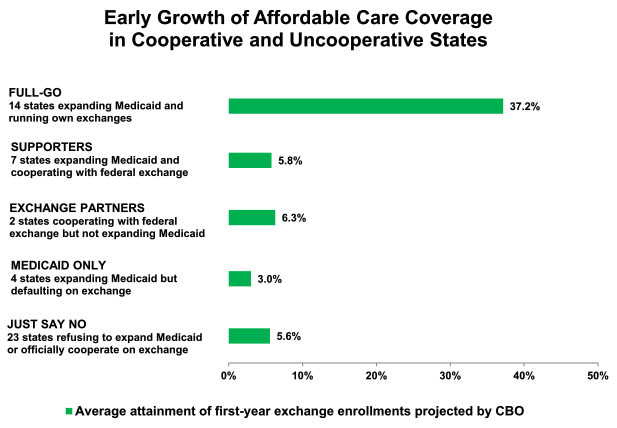
    Dylan Scott points to an interesting chart from Theda Skocpol that shows the signup rate for Obamacare in various states, ranked by how cooperative the various states have been in implementing the law. However, I draw a different conclusion than Scott does. It’s obvious that Medicaid signups are going to be way lower in states that have declined to join the Medicaid expansion, so it’s no surprise that this is exactly what Skocpol finds. What’s more interesting is how state cooperation affects signups on the exchanges. I’ve modified her chart to show only that:

    If you take a look at just the exchange signups, it’s obvious that one, and only one, thing matters: whether a state has its own exchange or relies on the federal exchange. States running their own exchanges are well on the way to meeting their first-year goal for signups. States that rely on the federal exchange, no matter how cooperative they are, are barely signing up anyone at all. The disastrous rollout of the federal exchange website has obviously had a far greater impact on Obamacare signups than lack of cooperation in red states.

    POSTSCRIPT: That’s assuming these numbers are right, of course. And after looking at them a little more carefully, I don’t think they are. According to year-end tallies, 1.1 million people had signed up for coverage via the federal exchange. However, eyeballing the chart and averaging across all states using the federal exchange, the federal exchange is at 5-6 percent of its first-year goal, which means its first-year goal must have been about 20 million. Likewise, 850,000 people had signed up via state exchanges. If that represents 37 percent of the first-year goal, it means the first-year goal for the state exchanges must have been around 2.3 million.

    That number for state exchanges might be about right, but the number for the federal exchange sure isn’t. So I’m not sure what’s going on here.

    POSTSCRIPT 2: There’s nothing in Skocpol’s report that says this, but apparently the state data is through January 4 while the federal data is through November 30. This makes comparisons between the two impossible, and it makes the chart above worthless. Please ignore this entire post.

  • Yellen Confirmed as Fed Chair Despite Knee-Jerk Republican Opposition


    Janet Yellen has been confirmed as Fed chair with 56 votes. Bad weather kept a lot of senators out of town, but even if everyone had been present she would have gotten no more than about 66 votes:

    It is the thinnest margin of Senate approval for a Fed chairman in the central bank’s history. Mr. Bernanke was confirmed for a second term as chairman with 70 yes votes and 30 no votes in 2010.

    Only 11 Republicans voted for Yellen’s confirmation, despite the fact that she’s perhaps the best qualified nominee in history; has demonstrated considerable foresight during her term as vice-chair; and almost literally has provided no reason to vote against her. But it doesn’t matter. She’s Obama’s nominee, so she has to be opposed. If Republicans want to know why Democrats finally got fed up enough to change the filibuster rules, this vote speaks louder than any words possibly could.

  • We Could Do a Lot More to Fight Poverty If We Wanted To


    Today is the 50th anniversary of LBJ’s war on poverty, so we’ll be getting a lot of retrospectives. CBPP has a whole series of charts here, and they’re worth a look. Child poverty is way down since 1963, which is a big win, and elderly poverty is down too, which is a big win for Social Security.

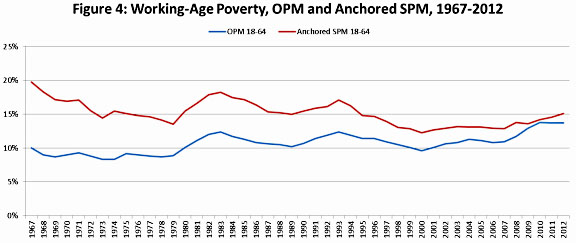
    But at the risk of being a buzzkill, I want to reprint a chart I put up last month. It answers a simple question: if you count income from all the welfare programs we’ve put in place over the past half century, how have working-age folks done? The answer is in the red line in the chart below. The Great Society programs of the 60s got the working-age poverty rate down from 20 percent to 15 percent, but then we gave up. Since the mid-70s, the poverty rate has stayed stubbornly stuck at about 15 percent:

    This is a chart to really keep in mind as you read the inevitable retrospectives. The overall poverty rate has gone down substantially in the past half century, but that’s largely because of the huge effect of Social Security on elderly poverty. But as much as this is a great achievement, it’s not what most people think of when you talk about “poverty.” Rather, they’re mostly thinking of working-age people who are either unemployed or earning tiny wages. And among those people, we simply haven’t done much for the past 40 years.

    It’s probably not possible to eliminate poverty, or even to get it down to 5 percent or so. But we could do more if we wanted. We could make Medicaid more generous. We could raise the minimum wage and the EITC. We could, at an absolute minimum, decide not to cut food stamps. We could do all these things. All we need is a bit of empathy for the worst off among us and the will to do something about it.

  • Anatomy of a Smear Gone Very, Very Wrong


    This note from the Daily Caller is perhaps the most awesome “correction” of the year the month the week:

    An earlier version of this article reported claims made in a Princeton student newspaper article that appears to have been fabricated. Kirkpatrick denies the reporting from the Daily Princetonian and The Daily Caller has not been able to confirm it independently.

    Reading this, you might think that a Princeton reporter turned out to have made up some facts, and after extensive investigation the Caller has ferreted this out and is letting its readers know. These disputed facts still might be true, mind you, but they can’t confirm them and the Kirkpatrick guy denies them.
    Except for a few things:

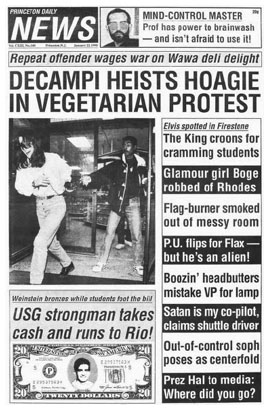
    • The source is a spoof issue of the Princeton Daily News from 1990, which contains stories about Elvis, aliens, and the student government embezzling all the student fees and flying off to Rio.
    • The Caller has “not been able to confirm” its main charge because it didn’t happen.
    • And the best part: The Kirkpatrick in question is New York Times reporter David Kirkpatrick, who wrote a piece about Benghazi a few days ago that conservatives didn’t like. The Caller’s mistake was made in an attempt to smear Kirkpatrick by claiming that he posed nude for Playgirl 23 years ago.

    This is the kind of thing that I’d normally ignore, but it’s just too breathtakingly half-witted to pass by. Does the Caller seriously think that even the part of the story that’s true—that Kirkpatrick streaked through campus as an undergrad—could possibly call his Benghazi reporting into question? This has to be the lamest smear ever, and you, my loyal readers, deserve to know about it. Dave Weigel has all the details if you want to bask in the entire glorious idiocy of the thing.

  • Congress Set to Decide Whether It Cares About Poor People or Corporations


    Brad Plumer lists seven things that Congress needs to do this month. Two of them amount to “don’t be stupid and shut down the government.” One is just miscellaneous stuff. And another is confirmation of Janet Yellen as Fed chairman, which is uncontroversial and should take only a day or two. So really, we’re left with three things:

    1. Decide whether to extend emergency unemployment insurance.
    2. Pass a farm bill.
    3. Decide whether to extend 55 different tax breaks.

    Unemployment insurance is a social safety net program. The farm bill is stalled over whether to enact cuts to food stamps. The 55 tax breaks mostly benefit corporations and campaign donors.

    Any guesses about which of these urgent priorities will produce adamantine opposition from Republicans and which will get broad support and pass without too much trouble? Did you guess that #3 would be the easy one, despite the fact that it costs about five times more than the other two combined? Congratulations! You too can be a political pundit.

  • Medicaid Expansion Is a Stealth Success, and That’s Just Fine


    Obamacare ended the year with about 2 million people who signed up through the insurance marketplaces and maybe three times that many who signed up for Medicaid. That makes the Medicaid expansion a big success, but neither party really wants to admit it:

    To Drew Altman, president of the Kaiser Family Foundation, this exposes a core reality of U.S. health-care politics. “Republicans don’t like entitlement programs, and Democrats want to portray the ACA as mostly a marketplace solution based on private insurance and not another expansion of a government program,” he said, “so neither side wants to emphasize the ACA’s success enrolling people in Medicaid even though it may be the law’s biggest achievement so far in terms of expanding coverage.”

    This has left both the Obama administration and Republicans in a tight spot. The White House can’t really tout the Medicaid expansion because it’ll revive fears on the right that Obamacare is really a stealthy effort to create a single-payer health-care system, and it’ll arouse criticism on the left that the administration should have expanded Medicaid to all.

    As for Republicans, they can’t admit the Medicaid expansion is going well because doing so is dangerously close to advocating a single-payer health-care system. The exchanges, marred by their troubled introduction, are also a problem as they are a Republican idea, enshrined in Rep. Paul Ryan’s health-care bill.

    I think I’d analyze this a bit differently. I don’t really have a sense that much of anyone associates Medicaid expansion with a push for single-payer. Rather, Democrats don’t want to talk about it because Medicaid is a program for the poor, and they don’t want middle-class voters thinking that Obamacare is just another way to funnel their tax dollars into welfare programs for other people. Likewise, Republicans oppose Medicaid expansion simply because they don’t like entitlement programs; they don’t like higher taxes; and they’ve always wanted to block-grant Medicaid and starve it to death. I don’t think it’s really any more complicated than that.

    In any case, I’m fine with this. I think Medicaid expansion is great, but unlike a lot of lefties, I also think it’s a dead end. It’s not going to lead to single-payer, and it’s never going to be a template for future health care reforms. The marketplaces, despite all their problems, have far more potential to eventually lead to health care coverage for all. I think they also have more potential to produce delivery reforms down the road and to rein in cost growth. For that reason, I’m OK with the Medicaid expansion staying under the radar. That’s a fine place for it.