
• Chart of the Day: The Superrich Spend a Ton of Money on Politics These Days


    What do you do when you have so much money you don’t know what to do with it anymore? Well, you can buy a bigger yacht, or gold-plated bathroom fixtures, or throw lots of fabulous parties. Or you can take up an expensive hobby. Collecting old masters, say, or sponsoring NASCAR drivers.
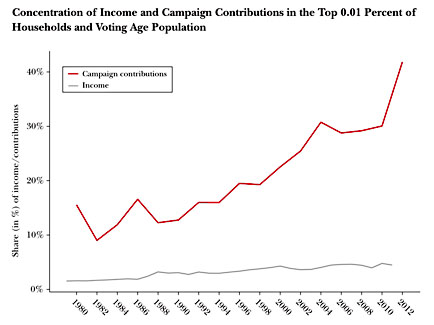
    Or politics. Seth Masket points today to a fascinating study from a team of researchers who have been investigating political polarization and political contributions. As you can see in the chart on the right, the superrich used to account for about 10 percent of all political contributions. Then, starting around 1990, that started to rise steadily, reaching 30 percent by 2010. Then came Citizens United, and the sluice gates really opened. Within two years, the share of contributions from the superrich had skyrocketed to 40 percent.

    But there’s an interesting wrinkle. Based on other data in the study, Masket concludes that the superrich are less polarized than the electorate as a whole:

    The 30 wealthiest donors in the country are actually pretty moderate, at least judging from this measure. Apart from some extremists like George Soros and the Koch brothers, most exist between the party medians.

    This presents an interesting conundrum. We know Congress has grown more polarized over the past three decades. And we know that the very wealthy are donating more and more each year. But the very wealthy aren’t necessarily that polarized. If they were buying the government they wanted, they’d be getting a more moderate one than we currently have.

    This deserves more study. I’m not so sure that wealthy donors are quite as moderate as Masket thinks, since they often have strong views on one or two hobbyhorses that might get drowned out in broad measures of ideological extremism. The Waltons hate unions and Sheldon Adelson is passionate about Israel, but they might be fairly liberal about, say, gay marriage or Social Security reform. But does that make them moderate? If they spend all their money on the stuff they care about and none on the other issues, then no. They’re single-issue extremists.

    This is pretty common among the anti-tax business crowd, for example. They might not care much about the hot buttons that animate the tea partiers, but they’re perfectly willing to support them as long as they oppose higher taxes on businesses and the rich. In practice, this makes them pretty extreme even if their overall political views are fairly centrist. If you’re willing to get in bed with extremists, then you’re effectively an extremist regardless of whether you publicly share their views on everything.

    In any case, this is hard to get a handle on and requires more detailed research than we have at hand. Still, Masket’s observation is an interesting one and deserves a closer look. Are America’s rich really getting their money’s worth? Or has politics simply become an expensive hobby that they’re not very good at?
  • Vladimir Putin Has Been Outplayed by Barack Obama


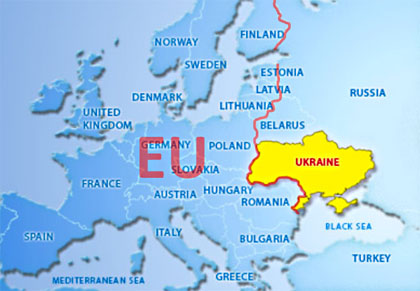
    Max Fisher notes this morning that although President Obama got a lot of flak for his restrained response to Russia’s aggression in Ukraine, his approach of giving Vladimir Putin enough rope to hang himself has turned out to be a lot cannier than his critics expected:
    This has been so effective, and has apparently taken Putin by such surprise, that after weeks of looking like he could roll into eastern Ukraine unchallenged, he’s backing down all on his own. Official Russian rhetoric, after weeks of not-so-subtle threats of invading eastern Ukraine, is backing down. Putin suddenly looks like he will support Ukraine’s upcoming presidential election, rather than oppose it, although it will likely install a pro-European president. European and American negotiators say the tone in meetings has eased from slinging accusations to working toward a peaceful resolution.

    Most of this is economic. Russia’s self-imposed economic problems started pretty quickly after its annexation of Crimea in March and have kept up. Whether or not American or European governments sanction Russia’s broader economy, the global investment community has a mind of its own, and they seem to have decided that Russia’s behavior has made it a risky place to put money. So risky that they’re pulling more money out.

    A lot of that may have come the targeted sanctions that Obama pushed for against individual Russian leaders and oligarchs. Those targeted sanctions did not themselves do much damage to the Russian economy. But, along with Russia’s erratic behavior in Ukraine and the lack of clarity as to whether Europe and the US could impose broader sanctions, it appears to have been enough to scare off global investors — the big, faceless, placeless mass of people and banks who have done tremendous damage to Putin’s Russia, nudged along by the US and by Putin himself.

    I’m a little less surprised by this than Fisher, though Obama’s policy was always a bit of a crapshoot since there was no telling (a) just how important Putin thought annexation of eastern Ukraine was, and (b) how much economic pain Putin was willing to put up with. This wasn’t necessarily a rational calculation on Putin’s part, which meant it was never entirely amenable to rational analysis on our part.

    Still, there have always been good reasons to think that a military annexation of eastern Ukraine represented a huge risk for Russia—potentially turning into a long and wearying guerrilla war—and that even the existing economic sanctions were biting hard enough to be worrisome. After all, Putin’s nationalistic fervor may have initially played well domestically, but in the long term domestic opinion depends heavily on economic performance. If the Russian economy started to tank, those adoring crowds would have turned surly in pretty short order.

    In my mind, the biggest wild card has always been this: what, really, is the value of eastern Ukraine to Russia? Yes, there’s some industry, and potentially a land border with Crimea. But those are frankly small things, especially if annexing Ukraine was likely to lead to prolonged low-level war and even stiffer sanctions from the West. As for Putin’s claim to be responsible for oppressed Russian-speaking minorities, I don’t think anyone should take that too seriously. He may sincerely feel aggrieved about this, but even the threat of action has already gotten him what he wants on this score: a strong likelihood that Kiev will negotiate a certain level of autonomy for regions in eastern Ukraine, and perhaps a more accommodating approach in other countries toward Russian speakers.

    With the caveat—again—that this has never been an entirely rational situation, I continue to think that eastern Ukraine simply isn’t valuable enough to Russia to justify a lot of risk. Putin made a play for taking control without any real opposition, and it failed. It’s obvious now that the cost would be pretty high, both in military opposition and in economic pain. Too high. And Putin knows it.

    Would a more assertive military posture from Obama have made a difference? Maybe. But there’s as much chance it would have made things worse as there was that it would have made things better. This is something that the John McCains of the world have never understood, which is odd since they know perfectly well how they themselves respond to threats of violence. Why do they think Putin would respond any differently?

    In the end, Putin will probably come out of this OK. He has Crimea, and he’s regained at least a bit of the influence over Ukraine that he lost via his bungled foreign policy early in the year. If he backs off now, the economic pain will ease; Ukraine will be a more pliant neighbor; and he’ll retain his popularity at home. If he’s smart, he’ll decide this is close enough to victory, and call it a day.

    But the United States will come out OK too. The punditocracy will have a hard time acknowledging this, since they’re pretty dedicated to the idea that there are only two kinds of foreign policy success: military intervention and flashy, high-stakes diplomatic missions. But there are more subtle kinds of success too. This may well turn out to be one of them.

  • There’s a Reason Voters Don’t Blame Republicans for Congressional Gridlock


    Earlier this week, Republicans killed a carefully crafted, bipartisan energy bill that was three years in the making. Ostensibly, this was done in protest against Harry Reid’s refusal to allow votes on additional amendments, an issue that’s been a longtime grievance for the GOP. But that wasn’t the real problem. After all, everyone knows that delicately constructed bills like this one need to be passed on an all-or-nothing basis once a majority coalition has been painstakingly assembled. What’s more, the Republican amendments were all on tangential hobbyhorses (Keystone XL, EPA power plant regs, etc.) that were designed solely as election-year rube bait anyway.

    No, it turns out that the bill was killed because Scott Brown, who’s running for a Senate seat in New Hampshire against Jeanne Shaheen, asked Mitch McConnell to kill it. Jon Chait tells the story:

    Brown is running against Shaheen this November, and Republicans — especially would-be Majority leader Mitch McConnell — want Brown to beat Shaheen because they want to win a majority.

    Brown needs to deprive Shaheen of the afterglow that would come from shepherding a (now rare) bipartisan bill through Congress….For a voter paying close attention to the Senate’s machinations, this makes little sense: Republicans are arguing that their torpedoing of Shaheen’s bill proves Shaheen is a legislative failure. But few voters follow politics so closely, and even those reading detailed coverage of the bill’s failure would quickly get lost in an arcane procedural dispute that putatively caused its demise.
    ….You can call this cynical, but McConnell is actually doing what we expect our politicians to do.…McConnell has not merely outmaneuvered other politicians in his strategic acumen, he has likewise surpassed the whole Washington Establishment. The near-total absence of bipartisanship has not escaped anybody’s notice — it is the subject of frequent and even obsessive commentary. The failure of the parties to find agreement is routinely attributed to a series of tactical or communications missteps or the decline of the Georgetown dinner party scene or other variations of magical thinking. It is unable to grasp the underlying strategic incentives of two parties.

    It’s all fairly remarkable. McConnell has correctly grasped that if you sabotage the government, most voters won’t really know how or why it happened. They’ll just know that things are a mess and they’ll get peevish about it. And when they look around for someone to blame, it will be the party in power.

    In a sense, you can’t blame McConnell for this. It’s a keen insight, and he’s just using it to play political hardball. And you can’t really blame the voters. Most people are simply never going to have a deep interest in Beltway political minutiae.

    So who can we blame? How about the press? Its fanatical devotion to the proposition that both parties are always equally to blame for everything is one of the reasons voters never figure out what’s really going on. If, instead, the press were more devoted to explaining objective reality, maybe the electorate would have a fighting chance of understanding things. And Mitch McConnell would no longer be able to count on the public staying ignorant of why things are always such a mess.

  • Fox News Really Needs to Up Its Push-Polling Game


    Steve Benen alerts us to the latest ridiculously-worded question in a Fox News poll:

    In the aftermath of the Benghazi terrorist attacks, the Obama administration incorrectly claimed it was a spontaneous assault in response to an online video, even though the administration had intelligence reports that the attacks were connected to terrorist groups tied to al Qaeda. Do you think the Obama administration knowingly lied about the attacks to help the president during the ongoing re-election campaign, or not?

    I’m not even going to bother pointing out all the ways in which this is wrong. If you’ve been reading my blog for a while and you still don’t know, then I’ve failed utterly.1

    But here’s the funniest part: as Benen points out, the question Fox asked is roughly like saying “The administration totally lied. Do you think the administration knowingly lied?” And even so, Fox could only muster 51 percent agreement. Try harder, guys.

    1Oh, all right. Here are the facts yet again: (a) Benghazi was an opportunistic assault, carried out with no more than a few hours of planning. (b) Reporting on the ground confirms that the video did, in fact, play a role in provoking some of the attackers. (c) Neither Susan Rice nor anyone else denied that Al Qaeda-affiliated groups were responsible. In the first few days after the attack they said only that we didn’t know yet. (d) In any case, Ansar al-Shariah is primarily a local group with local grievances, and is only tenuously affiliated with Al Qaeda. Abu Khattala, who also led some of the attackers, had no ties to Al Qaeda at all.

  • Will Only the Rich Benefit From the EU’s New Right to Purge Google?


    Danny O’Brien of the Electronic Frontier Foundation isn’t happy about the new EU court decision that requires Google to delete links to information that people find troublesome:

    When a newspaper publishes a news item, it appears online….Attempting to limit the propagation of that information by applying scattergun censorship will simply temporarily distort one part of the collective record in favor of those who can take the time and money to selectively edit away their own online blemishes….Meanwhile, a new market is created for mining and organizing accurate public data out of the reach of the European authorities. The record of the major search engines will be distorted, just as it was by Scientology and the Chinese government. Outside of Europe’s reach, rogue sites will collect the real information, and be more accurate than the compliant search services.

    There are two interesting points here. First, that the EU ruling will mostly benefit the rich, who can afford to hire people to police their image and make legal demands to have links deleted. Second, that this will prompt the rise of “rogue” search engines that can bill themselves as uncensored.

    The first point depends almost entirely on just how broad the court ruling turns out to be, and right now that’s deeply unclear. In the case at hand, the court ruled that Google had to delete a link because it was now “irrelevant,” a standard that’s fuzzy to say the least. Could I demand that links to dumb articles I wrote for my campus newspaper a few decades ago be deleted? How about a failed business from the 90s? Or bad student evaluations on an anonymous website? The court provided very little guidance on this, so only time will tell how broadly this gets interpreted. Either way, though, it’s almost certainly true that, in practice, only the fairly affluent will be able to take advantage of it.

    The second point is also something to keep track of. The court ruling specifically targeted search engines as a way of exerting EU control even when the source information itself is held on a site outside of EU jurisdiction. But will this work? Creating a search engine isn’t all that difficult. It’s hard to create one as good as Google, but it’s not hard to create one that’s pretty good. And if that search engine is located solely in the United States and does no business in Europe, then the court’s ruling doesn’t affect it. However, residents of Europe would still have access to it unless the EU gets outrageously heavy-handed and tries to firewall unapproved sites, much as China does. That seems unlikely.

    Now, it’s true that your average searcher would still get the censored Google results. At the same time, if a few uncensored sites pop up in response to this court ruling, it wouldn’t be all that hard for anyone who cares to use them. What’s more, the very act of filing a demand to delete a link would itself be a public record, and might produce more bad PR than the original search results ever did.

    I remain opposed to this ruling, which seems vague, overbroad, and just plain bad public policy. But just how bad it is depends a lot on how things unfold over the next few years. Stay tuned.

  • Raw Data: America Is Still Producing Lots of Inventive Young Companies


    Here’s a quick follow-up to my post last week about the decline in new business startups over the past few decades. Does this suggest that America is getting less entrepreneurial? In one way, yes: some of it is probably due to big national chains making it harder to start small family businesses, and some of it is probably due to an aging population. Economically, however, the triumph of gigantic chain stores isn’t necessarily a bad thing, and the aging of the baby boomers should be thought of as a separate demographic issue, not a business startup issue.
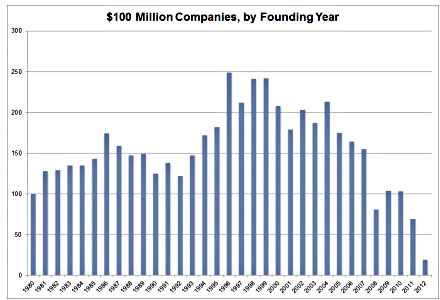
    Still, economists all agree that the key to a healthy economy is young, growing companies (not small businesses pe se). So how are we doing on that score? Over at Slate, Jordan Weissman points to a study by Paul Kedrosky that tries to quantify the number of startups that grow to $100 million or more in a fairly short period. The chart on the right shows his results. There’s a spike during the dotcom boom of the late 90s, and a dropoff during the Great Recession—a period too recent to have yet produced very many $100 million companies anyway—but there’s basically no secular decline at all. Roughly speaking, America has been producing about 150 small, fast-growing companies per year for the past three decades.

    This is just a single data point, and Kedrosky warns that his data is necessarily pretty rough. But it does suggest that although America might be producing fewer new coffee shops and boutique clothing stores, it’s not necessarily losing its inventive edge.

  • Maybe Cable Bundling Is Okay, But We Should Unbundle Sports


    Josh Barro makes the case today that unbundling cable channels and offering them a la carte wouldn’t really benefit consumers. This point has now been made so many times that I don’t think it counts as counterintuitive anymore, but Barro makes one additional point that represents my real gripe with channel bundling:

    Not everyone would lose out. For example, if you never watch sports, you might be better off not having to pay for ESPN, which charges the highest carriage fee of any basic cable channel. But Mr. Byzalov estimates that sports channel carriage fees would more than triple under unbundling, as most subscribers opt out and only die-hard sports fans buy in. Consumers who don’t care about sports at all would be better off, but casual sports fans would be worse off: They wouldn’t find it worth paying $37 for an unbundled cluster of sports channels, even if they would have paid the roughly $9 that it costs to get those channels as part of a bundled package.
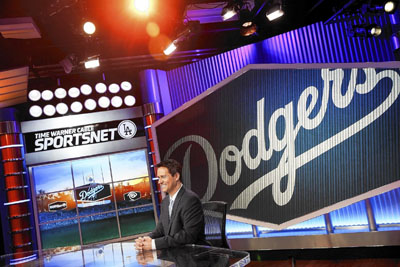
    Most people don’t know just how much sports channels cost them, but they can account for nearly half of your average cable bill in some areas. Not everywhere, mind you, but the explosion of sports channels (Fox Sports 1, the NFL channel, the Golf channel, the NBC Sports Channel, etc.) and rise of dedicated team channels (the Lakers channel, the Dodgers channel, the Pac-12 channel, etc.) have steadily pushed the price of sports skyward in big media markets like Southern California. You don’t pay $9 for that collection. Carriage fees are a closely guarded secret, so it’s hard to say how much you do pay, but it’s probably something like $25 or more.

    This doesn’t hurt me, since I watch enough sports to (mostly) make this worthwhile. And the fact that all you non-sports watchers have to pay for this stuff basically subsidizes my habit. So thanks! But honestly, I don’t think you should have to. When Time Warner demands that the Dodgers channel be part of basic cable—my latest hobbyhorse—it basically amounts to a Dodgers tax on every family in the LA area. But I’m afraid I don’t really see why Time Warner should be allowed to levy a tax on every family in the LA area.

    So go ahead and keep bundling. Maybe it’s more efficient in the end, and doesn’t really cost most of us very much money. But unbundle sports. It’s a big expense, and those of us who are sports junkies ought to be the ones paying it. Plus there’s this: if we all paid the true cost, instead of forcing everyone to subsidize the rest of us, it might finally provoke some serious pushback—and maybe the astronomical and absurd upward spiral of sports rights would finally abate. If this means the Dodgers are worth only $1.7 billion instead of $2 billion, that’s okay with me.

  • Surprise! Marco Rubio’s Social Security Arithmetic Doesn’t Add Up.


    Because I’m a glutton for punishment, I decided to read Marco Rubio’s plan for rescuing Social Security. According to Rubio, “The startling truth is that with an aging population, a sluggish economy, and chronic fiscal irresponsibility in Washington, the Social Security trust fund is drying up. It will be insolvent by 2033….Taken together, these factors have created a real and looming crisis….Anyone who is in favor of doing nothing about Social Security and Medicare is in favor of bankrupting Social Security and Medicare.”

    I don’t want to bankrupt Social Security, so let’s read Rubio’s plan. It contains a grand total of four policy proposals:

    1. Allow workers to invest money in the federal Thrift Savings Plan.
    2. Eliminate the payroll tax for anyone over age 65 who continues to work.
    3. Raise the Social Security retirement age for those under the age of 55.
    4. Increase benefits for low-income seniors and reduce scheduled benefit increases for rich seniors.

    Item #1 may or may not be a good idea, but it has no impact on Social Security. Item #2 reduces payroll tax income and therefore makes Social Security less solvent. The first half of item #4 increases benefits and also makes Social Security less solvent. Item #3 and the second half of item #4 would improve the solvency of Social Security.

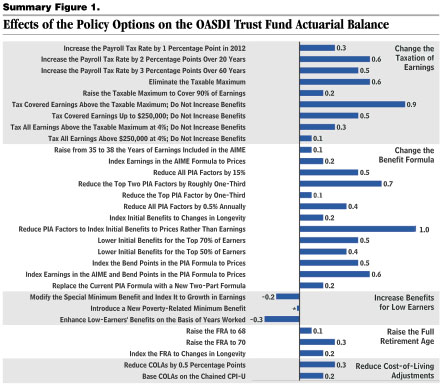
    So would this rescue Social Security? Do Rubio’s numbers add up? That’s hard to say since his proposal is pretty vague, but let’s take a shot at figuring it out. A few years ago the CBO scored a bunch of proposed changes to Social Security, and with a bit of judicious guessing and extrapolating we can match them up with Rubio’s proposals. Here’s my best estimate:

    • Item #2: According to my back-of-the-envelope calculation, about 5 percent of all workers are over the age of 65. Eliminating the payroll tax they pay would therefore reduce payments into the system by roughly 5 percent. This is about the equivalent of reducing the payroll tax rate by 0.6 percentage points, and would therefore worsen Social Security’s actuarial balance by about 0.2 percent of GDP.
    • Item #3: This one is easy. CBO says that raising the retirement age to 70 would improve Social Security’s actuarial balance by 0.3 percent of GDP.
    • Item #4.1: It’s hard to figure this out without any details about what Rubio has in mind, but the CBO proposal that fits the closest would worsen Social Security’s actuarial balance by about 0.2 percent of GDP.
    • Item #4.2: Again, it’s hard to say without details, but if you reduce the growth rate of benefits for everyone (by indexing them to prices instead of earnings), it improves Social Security’s actuarial balance by 1.0 percent of GDP. If you did this for the richest quarter of retirees, it would improve Social Security’s actuarial balance by, oh, let’s say 0.4 percent of GDP.

    So let’s add this all up: -0.2 + 0.3 – 0.2 + 0.4 = 0.3 percent of GDP. Unfortunately, CBO currently estimates that Social Security needs to improve its actuarial balance by about 1.17 percent of GDP. Rubio’s plan comes nowhere near that.

    Needless to say, this is all a little fuzzy. CBO may be unduly pessimistic. Rubio may be planning to raise the retirement age to 75. Maybe his promises to raise payments to the poor are just hot air. Maybe my seat-of-the-pants estimates are off.

    But none of this really matters. Different calculations might change things on the margin, but they wouldn’t even come close to making Social Security solvent by conventional measurements—and those are the measurements Rubio is using. As usual with these kinds of proposals from conservative presidential aspirants, the math just doesn’t add up. I am shocked.

  • Quote of the Day: The Rich Even Get Better Air Than the Rest of Us


    From Harold Meyerson, writing about the Piketty-ization of air travel:

    Even the air within the plane is apportioned by class. In its first-class cabins, Lufthansa has installed humidifiers that increase the humidity to 25 percent, while in coach, it ranges from 5 to 10 percent.

    Read the rest. The combination of TSA and lost luggage and missed schedules and—above all—the relentless downsizing of both service and seating is why I increasingly have little interest in traveling. For anyone over six feet tall, flying has become such a dismal and cramped experience that it’s just not worth it.

    But I’m in the minority. Only 10 percent of the population is over six feet, and anyway, people have long since demonstrated that they’re willing to put up with almost anything if it saves a few dollars in airfare. I guess I should just suck it up too.
