
• Thomas Piketty Says That r > g. But Is It, Really?


    I’ve mentioned before that I have a few misgivings about Thomas Piketty’s thesis in Capital in the 21st Century. One of my misgivings is pretty basic: Piketty argues that r (the return on capital) is historically greater than g (the economic growth rate). Since the rich own most of the capital, this means that the rich accumulate wealth faster than everyone else, which in turn means that rising income inequality is inevitable. But as capital accumulates, surely the return on capital should decline? After all, that’s what happens in every other market when there’s a glut of supply.
    Piketty briefly addresses this objection, and concludes that although r will indeed decrease as capital accumulates, it won’t decrease much. But is that true? Larry Summers doesn’t think so:

    [Piketty’s] rather fatalistic and certainly dismal view of capitalism can be challenged on two levels. It presumes, first, that the return to capital diminishes slowly, if at all, as wealth is accumulated and, second, that the returns to wealth are all reinvested. Whatever may have been the case historically, neither of these premises is likely correct as a guide to thinking about the American economy today.

    Economists universally believe in the law of diminishing returns. As capital accumulates, the incremental return on an additional unit of capital declines. The crucial question goes to what is technically referred to as the elasticity of substitution….Piketty argues that the economic literature supports his assumption that returns diminish slowly (in technical parlance, that the elasticity of substitution is greater than 1), and so capital’s share rises with capital accumulation. But I think he misreads the literature by conflating gross and net returns to capital. It is plausible that as the capital stock grows, the increment of output produced declines slowly, but there can be no question that depreciation increases proportionally. And it is the return net of depreciation that is relevant for capital accumulation. I know of no study suggesting that measuring output in net terms, the elasticity of substitution is greater than 1, and I know of quite a few suggesting the contrary.

    There are other objections to Piketty’s thesis, but it seems to me that this is one of the key criticisms—perhaps the key criticism. If r > g isn’t inevitably true, or even if it’s only slightly true (that is, r is only slightly greater than g), then everything falls apart. I suspect that this is going to be one of the main technical battlegrounds in the macro literature as Piketty’s theory gets hashed out over the next few years.

  • When Republicans Start Their Race to the Bottom, It Can Only Mean Primary Season Is Approaching


    Marco Rubio has announced that he thinks climate change is nonsense. Rand Paul has hastily backed off his heresy over voter ID laws. Bobby Jindal gave the commencement address at Liberty University this weekend. Rick Santorum is flogging a new book, Blue Collar Conservatives. Chris Christie is agonizing over whether to piss off gun owners by signing a bill that would ban magazines holding more than ten rounds. Mike Huckabee has ditched his amiable persona and is demanding impeachment of a judge who struck down a gay marriage ban in Arkansas.

    I guess primary season must be approaching. The fight for the fever swamp vote is now in full swing.

  • World Bank Reports That Microcredit Works After All


    Via Tyler Cowen, the World Bank has released a report that examines microfinance in Bangladesh over the longest period yet studied. The results were quite positive:

    The results of the basic model unequivocally show that group-based credit programs have significant positive effects in raising household welfare including per capita consumption, household non-land assets and net worth. Microfinance increases income and expenditure, the labor supply of males and females, non-land asset and net worth as well as boys’ and girls’ schooling. Microfinance, especially female credit, also reduces poverty. The results using long-panel data thus confirm most of the earlier findings that microfinance matters a lot, and more for female than for male borrowers.

    ….Membership in multiple programs has grown steadily from none to 33 percent in 2010/11….Trading is perhaps now saturated with microcredit loans and households have already started to experience diminishing returns. In such circumstances, households must be assisted through skill training and the development of improved marketing networks to expand activities in more rewarding sectors and beyond the local economy; otherwise, microfinance expansion cannot be sustained. In short, the current microfinance policy of credit expansion alone may not be enough to boost income and productivity, and, hence, sustained poverty reduction.

    I don’t have anything to add to this, but I wanted to at least make a note of it. A few years ago, there was a huge vogue in microcredit, which was broadly portrayed as a panacea for poor countries. Then there was a backlash, with several studies suggesting that it had been overhyped and didn’t really improve the lives of the poor much. Now this study, which looks at data over the course of 20 years, strongly concludes that—up to a point—microcredit really does produce results. I’ve been vaguely down on microcredit since reading some of those initial reports a few years ago, and I figure that might be a common response. This study pretty clearly suggests that we shouldn’t have been so pessimistic, and for that reason I wanted to pass it along.

  • There’s No Good Reason for Keeping OLC Opinions Confidential


    President Obama’s nomination of David Barron to the First Circuit Court of Appeals has reopened a fight over whether the White House should release Barron’s memo (written when he worked at the Office of Legal Counsel) justifying drone strikes against Anwar al-Awlaki. Time reports:

    Under pressure from liberals and libertarians that threatens to sink a judicial nomination, the Obama Administration is moving closer to releasing a classified legal justification for the use of drone strikes against Americans fighting for al-Qaeda, Administration officials tell TIME.

    ….The U.S. intelligence community and the Office of the Director of National Intelligence want the Administration not to release the memo. Also against release is the Office of Legal Counsel, which serves as the in-house legal expert on executive branch powers and which vigorously guards its opinions.

    Greg Sargent comments:

    The case for more transparency was spelled out recently by the New York Times, which argued: “the government has the right to secrets about its operations, but not secrets about its legal reasoning.”

    If there is a convincing rebuttal to that argument, I haven’t heard it. Indeed, one person who may agree with it is President Obama, given that in his big national security speech last May, he said he’d tasked his administration to “extend oversight of lethal actions outside of war zones that go beyond our reporting to Congress.” What is the rationale for keeping the legal justification secret?

    I’d go further. I’ve never really understood the rationale for any OLC opinions to stay confidential. In some sense, yes, there’s a case to be made for executive privilege: this is advice from one of the president’s aides to the president himself, and courts have ruled that presidents have a legitimate interest in keeping internal advice confidential in order to ensure that they get candid judgments. But that’s a helluva stretch in this case because OLC opinions go beyond mere advice. For all practical purposes, they have the force of law, since presidents use OLC opinions as the basis for determining what they can and can’t do.

    Should the United States have secret laws? As it happens, the United States does have secret laws. That is, actual congressional statutes that you and I aren’t allowed to read. So this isn’t quite as unprecedented as it seems. Still, that’s a rare occurrence, while OLC opinions are routinely kept secret. Why? If specific bits and pieces need to be redacted, fine. But in a democracy, the legal reasoning justifying the enforcement of our laws should be a matter of public record. We should all know what the laws of the land are and how the executive branch is allowed to act on them. There’s really no compelling argument on the other side.

  • If ISPs Are Going to Charge for Bandwidth, Why Not Charge End Users?


    I want to toss out an idea about the latest battle over net neutrality. It’s not an original idea by a long way, but for some reason it doesn’t seem to be part of the current discussion, and I’m curious if anyone knows why this is.

    Here’s the problem: ISPs like Comcast and Time Warner want to charge additional fees to companies like Netflix and Google that use a lot of bandwidth. On the surface, this is totally reasonable. If you use more of something, you have to pay more. Every market on the planet works this way.

    But why on earth would you charge content providers? It’s hellishly complex and opens the door to onerous levels of regulation; it requires lots of lengthy and contentious negotiations; and, as net neutrality advocates point out, it runs the risk of creating unfair discrimination against companies that are too small to pay or that ISPs just don’t like for one reason or another. Besides, it’s not as if content companies just randomly dump lots of bits on the internet. They do it only when an end user requests those bits by calling up a website or streaming a movie or downloading a file.

    The obvious solution here is also an old one: since end users are the ones requesting the bits, charge them for bandwidth. This is far simpler than negotiating private agreements with hundreds or thousands of content providers, and it’s fairer too. If you watch a lot of Netflix shows, you’re going to need a plan that provides both the bandwidth and the quality of service you need. That’s going to cost more than a plan designed for people who just browse a few sites each day or send a bit of email, but why shouldn’t it? If you’re buying more bits, you should pay for more bits. Everyone with a cell phone data plan understands this.

    Now, there’s one obvious answer to why ISPs don’t do this: customers hate it. We end up paying for all this bandwidth anyway, since the ISP’s fees eventually get passed along to us (or to advertisers or whoever foots the ultimate bill), but apparently we all enjoy the fiction that we can use infinite bandwidth for one flat rate. This, of course, is part of a grand American tradition of hiding costs—other examples include banking fees, tax expenditures, loyalty cards, free parking, subsidized cell phones, CAFE standards, and so forth—so that end users don’t have to face up to the actual cost of the stuff we buy. The end result, of course, is lots of inefficiency and, in most cases, higher costs than if we just paid up front in the first place.

    Anyway, that’s my question. There’s already a perfectly good, perfectly simple way for ISPs to recover the cost of providing lots of bandwidth: just charge the customers who use it. Existing peering and transit arrangements wouldn’t be affected, and there would be no net neutrality implications. So why not do it? What am I missing?

  • Republican Tax Increases: A Centrist Fantasy That Refuses to Die


    Dave Weigel points me to Ron Fournier’s latest column:

    As late as a year ago, just a few months after Obama shoved a reelection tax hike down their throats, the GOP leadership was still open to compromise. A budget deal would be hard, but not impossible, to strike. The situation required an able, nimble partner in the White House, a president who could help the GOP leadership reach and sell a deal to their conservative base. In March 2013, I wrote of the GOP: “Don’t mistake a negotiating position for reality. House Republicans tell me they are open to exchanging entitlement reform for new taxes—$250 billion to $300 billion, or approximately the amount that Republican Sen. Pat Toomey of Pennsylvania proposed raising over 10 years under the guise of tax reform.”

    The numbers were specific because the possibility of a deal was real. But the White House, quite literally, laughed at it. The president had already bowed to his base, given up on compromise, and damaged his legacy.

    I just don’t get this. Are there a few House Republicans who are open to a tax increase? Sure. Probably. Is there even the slightest chance of getting a majority of the GOP caucus to support a tax increase? Of course not. The evidence on this score is overwhelming. John Boehner was never able to get agreement even for the smoke-and-mirrors version of a tax increase, the kind that relies on dynamic scoring and rosy growth estimates. Nor were Republicans willing to accept Toomey’s proposal, even though it was effectively a tax cut, not a tax increase. There’s just plainly never been any chance at all of getting agreement for a proposal that would genuinely, concretely raise revenue.

    I’m just flummoxed by this stuff. Whatever else you think of Fournier, he’s an experienced reporter who understands the political landscape. How can he possibly believe this stuff?

  • You Should Put New Tires on Your Car Every Once in a While


    This is hardly the most important topic in the world, but this story from ABC News sure left me scratching my head:

    American tire companies have helped to defeat proposed laws in eight states that would require inspection of tires for age….”We oppose legislation that have some sort of age limit on tires,” said Dan Zielinski, executive director of the [Rubber Manufacturers of America].

    In the most recent case, the trade group spent $36,000 on lobbyists to defeat proposed legislation in the state of Massachusetts that would have included the age of tires on regular vehicle inspections, according to ABC News’ Boston affiliate WCVB, which joined other top ABC News affiliate investigative teams around the country in a national hidden camera investigation into tire safety.

    ….For consumers, determining the age of a tire can be a daunting task. The date of production can be found in a unique code at the end of 11- or 12-digit identification number on the tire’s sidewall. But instead of the standard month/year display, the tire industry uses a week/year display. For example, a tire produced in early June of 2010 (in the 21st week of the year) would be displayed as 2110, instead of the more common 06/10 that most consumers are accustomed to seeing.

    “They did not want to put a date code on tires, specifically because they did not want to give the impression that tires might actually have a service life,” said Kane, the safety consultant.

    OK, but why do tire manufacturers oppose the idea that tires have a service life? Wouldn’t a recognized service life lead to more tire sales? I can think of dozens of industries that have successfully run ad campaigns urging consumers to replace items more often than they’re accustomed to, with the goal of selling more stuff. So what’s the difference here?

  • Is Obamacare Boosting the Economy? Color Me Skeptical.


    This is interesting:

    Alec Phillips, economic researcher at Goldman Sachs, said in a note issued late last week to clients that subsidies from the Affordable Care Act boosted gross domestic product during the first quarter and are likely to do the same during the second quarter.

    ….Spending in the health-care industry was up 9.9% in the first quarter….But the health-care industry won’t be the only one to benefit, Phillips says, as subsidies will free up income for those who had no coverage before, as well as those who had insurance but were paying for it themselves.

    “Overall, around 40% of the subsidies should find their way to non-health consumption this year,” he wrote.

    I don’t have access to the full Goldman Sachs report, but I’m dubious about this for two reasons. First, Obamacare is roughly revenue neutral, which means federal subsidies are all paid for via tax revenue. Obamacare really shouldn’t have any first-order net stimulative effect on personal income or GDP. Second, although subsidies will reduce health insurance bills for people who were previously covered—thus freeing up income for other purposes—the individual mandate will force previously uncovered people to buy insurance they didn’t have before. This will reduce the income they have for other purposes. I don’t know how this nets out, but I’d be surprised if it was favorable to sectors other than health care.

    Maybe Phillips has carefully run the numbers on all these things, and the effects are bigger than I think. There may be second-order distributional impacts, for example. For now, though, I’d be pretty cautious about assuming that Obamacare is having any substantial effect on the economy one way or the other.

  • European Court Orders Google to Remove Links That Annoyed a Lawyer


    The European Court of Justice has ruled that Google can be required to delete links to public records even when the records themselves are allowed to remain active:

    The case began in 2009 when Mario Costeja, a lawyer, objected that entering his name in Google’s search engine led to legal notices dating back to 1998 in an online version of a Spanish newspaper that detailed his accumulated debts and the forced sale of his property.

    Mr. Costeja said that the debt issues had been resolved many years earlier and were no longer relevant. When the newspaper that had published the information, La Vanguardia, refused to remove the notices, and when Google refused to expunge the links, Mr. Costeja complained to the Spanish Data Protection Agency that his rights to the protection of his personal data were being violated.

    The Spanish authority ordered Google to remove the links in July 2010, but it did not impose any order on La Vanguardia.

    Generally speaking, I’m in favor of greater privacy rights, and I mostly support the EU’s more aggressive approach to privacy than what we have in America. But this ruling is troubling. Not because Google has to delete some links—I can imagine circumstances where that might be justified—but because they’re being treated differently than the newspaper that published the information in the first place. It’s as if the court recognizes that La Vanguardia enjoys freedom of the press, but not Google. I’m not sure how you justify that, aside from a vague notion that La Vanguardia is a “real” press outlet and Google isn’t. But whatever notions you have of press freedoms, they shouldn’t rely on distinctions between old and new media. If La Vanguardia is allowed to publish it, Google should be allowed to link to it.

    We’ll see how this plays out. To me, though, it doesn’t even seem like a close call. These are legal records; they were published legitimately; they’re potentially relevant regardless of whether the debts were cleared up; and they aren’t even that old. I certainly understand Costeja’s annoyance, but that’s not a good reason to abridge press freedoms so broadly.

  • Who Deserves Credit for Reducing the Federal Deficit?


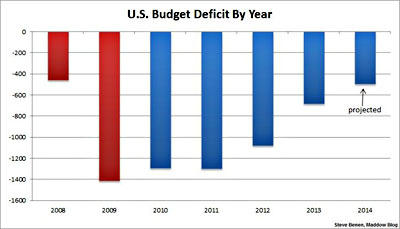
    Hey, looky here! Steve Benen highlights the chart on the right, which shows that President Obama is making steady progress reducing the massive federal deficit that was rung up in FY2009 by George Bush and the Republican Party. Nice work, Obama!

    But wait. Does this seem a wee bit unfair? Fine. You’re right. Bush wasn’t responsible for the deficit. The Great Recession was responsible for the deficit. Nor is Obama (or Boehner or McConnell or anyone else) responsible for the reduction in the deficit. That happened because the economy started to recover. That’s it. That’s the whole story. Deficits always go up during recessions and they always go down after recessions end. Tax and spending policy makes a difference, but not much of one. Taxes and spending almost always go down during recessions, and they almost always go back up during recoveries.

    However, with the deficit now around 3 percent of GDP, we’re back in fairly normal territory, which means that tax and spending policy does make a difference. (Until the next recession, anyway.) However, there’s an iron law that everyone should remember but nobody ever does. Here it is:

    • If we drive the deficit down to zero, then private savings have to equal our trade balance.

    In other words, if we run a trade deficit, then we’ll have negative private savings. If we want positive private savings (and we do), then we either have to run a trade surplus or else we have to offset private savings with a big budget deficit. There is no way around this. It’s an accounting identity. So whenever you hear someone yakking away about the horrors of the federal deficit, ask them what they want in its place. There’s no hedging on this. You either want a trade surplus (no more living beyond our means!) or negative private savings (bad for growth). It’s one or the other, whether you like it or not.

