I already have a chart of the day, so I suppose this one can’t also be a chart of the day. But it’s certainly the head scratcher of the day.
It comes via Brian Fung, and it shows the reaction of the stock market to yesterday’s news that FCC chair Tom Wheeler plans to impose strict net neutrality rules on broadband internet suppliers. This mostly applies to cable companies, and the prospect of strong regulation should have sent their stocks downward. Instead, they spiked upward:
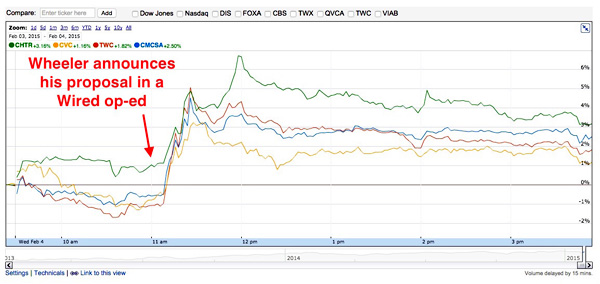
WTF? Why is Wall Street so excited at the prospect of tough new regulations on cable companies? Fung doesn’t know either:
When I confessed to MoffettNathanson’s Craig Moffett that I couldn’t make heads or tails of what we were seeing, Moffett shrugged. “Nor do I,” he said. “I think it just shows you that the market doesn’t really understand these issues.”
That’s a little hard to believe. Wall Street analysts are actually pretty bright folks, and they generally understand the industries they follow pretty well. And while this may be a “tech” issue—which seems to automatically reduce IQs by 30 points among journalists—the truth is that it only gets complicated when you dive fairly deep into the weeds. Basically, under Wheeler’s proposal, cable companies would no longer be able to sign special deals to provide certain companies with faster service in return for higher payments. That’s pretty unambiguously a bummer for cable companies.
So let’s take another shot at this:
Whether or not they understand net neutrality, investors are apparently relieved that Wheeler’s draft rules aren’t more restrictive, according to BTIG analyst Rich Greenfield. What shareholders feared the most was the FCC swooping in to tell Internet providers what prices they could and couldn’t charge to consumers — and the proposal currently doesn’t call for that.
In short, the markets are responding favorably because price regulation is off the table, at least for now. “I think it is, in the near term, a knee-jerk reaction that it wasn’t worse,” said Greenfield.
This is….slightly more plausible, I guess. But as Fung points out, price regulation was never on the table. Even President Obama is against it. So this really doesn’t hold water either.
In other words, it’s a mystery. I’d say there are two basic possibilities:
- Wall Street analysts are idiots.
- Journalists like me are idiots. Buried deep down, Wheeler’s proposal actually benefits cable companies in some obscure, nefarious, loophole-y way. Maybe it has something to do with how interconnect charges between cable companies and long-haul broadband suppliers can now be gamed? Or something. In any case, the theory here is that Wall Street analysts have figured something out that the rest of us haven’t.
The only other possibility that comes to mind is simply that Wall Street likes certainty. Wheeler’s net neutrality proposal might not be what they wanted, but at least it’s a firm rule, which means that everyone now knows what to expect going forward. Investors like that, so they bid up cable stocks a bit.
That explanation doesn’t do much for me either, though. I eagerly await a plausible explanation for this from some genuine expert who knows the arcane details of what this all means and why Wall Street might be more excited about net neutrality rules than common sense would suggest.