It’s Not the 1 Percent Controlling Politics. It’s the 0.01 Percent.


Even before presidential candidates started lining up billionaires to kick-start their campaigns, it was clear that the 2016 election could be the biggest big-money election yet. This chart from the political data shop Crowdpac illustrates where we may be headed: Between 1980 and 2012, the share of federal campaign contributions coming from the very, very biggest political spenders—the top 0.01 percent of donors—nearly tripled:
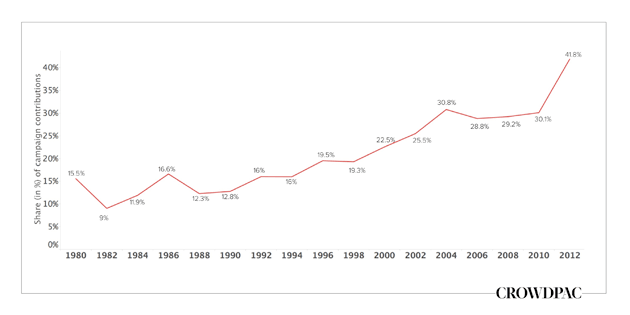
In other words, a small handful of Americans* control more than 40 percent of election contributions. Notably, between 2010 and 2012, the total share of giving by these donors jumped more than 10 percentage points. That shift is likely the direct result of the Supreme Court’s 2010 Citizens United ruling, which struck down decades of fundraising limits and kicked off the super-PAC era. And this data only includes publicly disclosed donations, not dark money, which almost certainly means that the megadonors’ actual share of total political spending is even higher.

It’s pretty fair to assume that most of these top donors are also sitting at the top of the income pyramid. Out of curiosity, I compared the share of campaign cash given by elite donors alongside the increasing share of income controlled by the people who make up the top 0.01 percent—the 1 percent of the 1 percent. The trend lines aren’t an exact match, but they’re close enough to show how top donors’ political clout has increased along with top earners’ growing slice of the national income. Again, note the bump around 2010 and 2011, when the Citizens United era opened just as the superwealthy were starting to recover from the recession—a rebound that has left out most Americans.


Correction: An earlier version of this article incorrectly stated that a few hundred people control 40 percent of election contributions, based on my own calculations. According to Crowdpac, the number is around 25,000.
What’s independent journalism worth to you?

Our news will always be free to read, watch, and listen to online. But what is its value?

Unbiased reporting on the issues that billionaire-owned newsrooms won’t touch. Fearless research into the dark corners of government and corporations. Ferociously fact-checked news that focuses on the facts, and the facts alone.

It IS free for you and every reader, viewer, and listener to utilize. But it’s not free for our team to make. So, what’s it worth to you? Let us know by making a donation: Make a one-time donation today to support this work. Or make a monthly sustaining donation to help us plan for the future.

Whatever you choose, know that you’re supporting more independent, investigative journalism in a time when we need it most.

What’s independent journalism worth to you?

Our news will always be free to read, watch, and listen to online. But what is its value?

Unbiased reporting on the issues that billionaire-owned newsrooms won’t touch. Fearless research into the dark corners of government and corporations. Ferociously fact-checked news that focuses on the facts, and the facts alone.

It IS free for you and every reader, viewer, and listener to utilize. But it’s not free for our team to make. So, what’s it worth to you? Let us know by making a donation: Make a one-time donation today to support this work. Or make a monthly sustaining donation to help us plan for the future.

Whatever you choose, know that you’re supporting more independent, investigative journalism in a time when we need it most.

We Recommend

Latest

Sign up for our free newsletter

Subscribe to the Mother Jones Daily to have our top stories delivered directly to your inbox.

Get our award-winning magazine

Save big on a full year of investigations, ideas, and insights.

Subscribe

INDEPENDENT. BECAUSE OF YOU.

Mother Jones has no billionaires calling the shots—just readers like you making fearless reporting possible

Donate