Do Anti-Poverty Programs Work Better Than We Think?

Get your news from a source that’s not owned and controlled by oligarchs. Sign up for the free Mother Jones Daily.


Poverty data generally comes from the Census Bureau, which bases its analysis on the Current Population Survey. But do poor people under-report or underestimate the value of the programs they participate in? They might, and it seems to me it’s pretty easy to figure this out. Add up the value of, say, all SNAP reports from the CPS, and then compare it to the actual amount of SNAP money the government sends out. If it doesn’t match pretty closely, then the survey is off.

A pair of researchers recently took a look at how effective anti-poverty programs are, but they never mention this. I guess it must be harder than I think. Instead, they compare CPS data to detailed administrative data from the state of New York that’s known to be highly accurate. They did this for four programs: TANF (basic welfare), SNAP (food stamps), subsidized housing, and general assistance. It turns out that poor people underestimate their annual benefits by about $1,500. This produces two conclusions. First, the authors believe that survey data in general is becoming less reliable over time. Second, they believe that anti-poverty programs lift a lot more people out of poverty than we think.

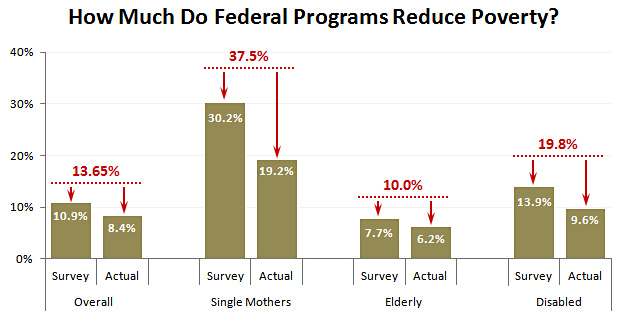
The chart below shows their basic conclusion. The overall poverty rate, for example, is 13.65 percent. Using conventional CPS data, that goes down to 10.9 percent after benefits. Using the higher-quality data, however, it appears that anti-poverty programs actually reduce the poverty rate to 8.4 percent. The effect is even more dramatic in households headed by single mothers. Apparently the war on poverty is going better than we thought.

DECEMBER IS MAKE OR BREAK

A full one-third of our annual fundraising comes in this month alone. That’s risky, because a strong December means our newsroom is on the beat and reporting at full strength—but a weak one means budget cuts and hard choices ahead.

With only days left until December 31, we've raised about half of our $400,000 goal—but we need a huge surge in reader support to close the remaining gap. Whether you've given before or this is your first time, your contribution right now matters.

Managing an independent, nonprofit newsroom is staggeringly hard. There’s no cushion in our budget—no backup revenue, no corporate safety net. We can’t afford to fall short, and we can’t rely on corporations or deep-pocketed interests to fund the fierce, investigative journalism Mother Jones exists to do. That’s why we need you right now. Please chip in to help close the gap.

DECEMBER IS MAKE OR BREAK

A full one-third of our annual fundraising comes in this month alone. That’s risky, because a strong December means our newsroom is on the beat and reporting at full strength—but a weak one means budget cuts and hard choices ahead.

With only days left until December 31, we've raised about half of our $400,000 goal—but we need a huge surge in reader support to close the remaining gap. Whether you've given before or this is your first time, your contribution right now matters.

Managing an independent, nonprofit newsroom is staggeringly hard. There’s no cushion in our budget—no backup revenue, no corporate safety net. We can’t afford to fall short, and we can’t rely on corporations or deep-pocketed interests to fund the fierce, investigative journalism Mother Jones exists to do. That’s why we need you right now. Please chip in to help close the gap.

We Recommend

Latest

Sign up for our free newsletter

Subscribe to the Mother Jones Daily to have our top stories delivered directly to your inbox.

Get our award-winning magazine

Save big on a full year of investigations, ideas, and insights.

Subscribe

Support our journalism

Help Mother Jones' reporters dig deep with a tax-deductible donation.

Donate