The Great Mystery of Commute Time and Income Mobility

Get your news from a source that’s not owned and controlled by oligarchs. Sign up for the free Mother Jones Daily.


Here’s something I ran across accidentally today. In a working paper released a few months ago, Raj Chetty and Nathaniel Hendren try to estimate the effect on low-income children of moving to better neighborhoods. In particular, which traits correspond to higher incomes 20 years later?
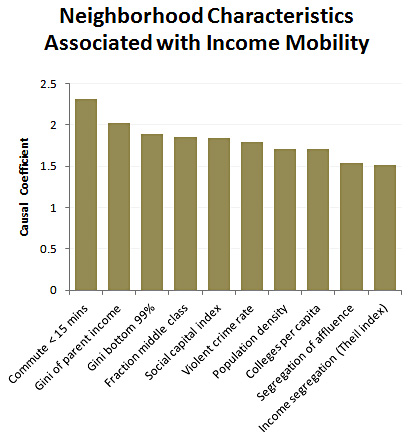
All the usual suspects have high correlations: segregation, social capital, crime, income inequality, population density, etc. But the very highest correlation—by quite a bit—is for commuting time. Moving to a neighborhood where most people commute less than 15 minutes has a big impact:

Twenty years of exposure to a [commuting zone] with a 1 standard deviation higher fraction of people with commute times less than 15 minutes increases a child’s income by [7%]….These correlations with commute times are unlikely the direct effect of being closer to jobs….It is likely some characteristic of places correlated with commute times that drives the underlying pattern.

In other words, this doesn’t mean that if mom or dad gets a job closer to home, junior will enjoy a higher income when he grows up. It means that if the family moves to a neighborhood that’s close to where its residents work, junior’s income will benefit.

This seems a little unlikely, though it’s not impossible to imagine that neighborhoods where parents are home more of the time have a beneficial effect on kids. Still, the authors are most likely right: commute time is probably standing in for something else. Perhaps neighborhoods that are close to lots of jobs have certain characteristics that are good for kids, and short commutes are just an accidental bonus.

Either way, this sure seems interesting enough to follow up on. Is it really commute time that matters? If not, what is it a proxy for?

NOTE: The chart shows the effect on boys whose parents have incomes in the bottom quarter. The effect is pretty much the same for girls.


DECEMBER IS MAKE OR BREAK

A full one-third of our annual fundraising comes in this month alone. That’s risky, because a strong December means our newsroom is on the beat and reporting at full strength—but a weak one means budget cuts and hard choices ahead.

The December 31 deadline is closing in fast. To reach our $400,000 goal, we need readers who’ve never given before to join the ranks of MoJo donors. And we need our steadfast supporters to give again—any amount today.

Managing an independent, nonprofit newsroom is staggeringly hard. There’s no cushion in our budget—no backup revenue, no corporate safety net. We can’t afford to fall short, and we can’t rely on corporations or deep-pocketed interests to fund the fierce, investigative journalism Mother Jones exists to do.

That’s why we need you right now. Please chip in to help close the gap.

DECEMBER IS MAKE OR BREAK

A full one-third of our annual fundraising comes in this month alone. That’s risky, because a strong December means our newsroom is on the beat and reporting at full strength—but a weak one means budget cuts and hard choices ahead.

The December 31 deadline is closing in fast. To reach our $400,000 goal, we need readers who’ve never given before to join the ranks of MoJo donors. And we need our steadfast supporters to give again—any amount today.

Managing an independent, nonprofit newsroom is staggeringly hard. There’s no cushion in our budget—no backup revenue, no corporate safety net. We can’t afford to fall short, and we can’t rely on corporations or deep-pocketed interests to fund the fierce, investigative journalism Mother Jones exists to do.

That’s why we need you right now. Please chip in to help close the gap.

We Recommend

Latest

Sign up for our free newsletter

Subscribe to the Mother Jones Daily to have our top stories delivered directly to your inbox.

Get our award-winning magazine

Save big on a full year of investigations, ideas, and insights.

Subscribe

Support our journalism

Help Mother Jones' reporters dig deep with a tax-deductible donation.

Donate