• In Obama’s America, Nobody Can Buy a Good Tomato


    Julia Belluz writes today about one of my saddest pet peeves: the sad state of tomatoes in America.

    Harry Klee, a horticulture professor at the University of Florida, spent years developing a nutrient-dense tomato that also happens to taste great. It’s been called — by a panel of 500 experts — one of the most delicious tomatoes on the planet….Klee’s tomato, the Garden Gem, is also eminently durable, with a great shelf life and track record of disease resistance — properties growers care about. But he’s been told the Garden Gem is a little too small (about a half or a third the size of your average supermarket tomato). And that means it’d require more labor to pick, and therefore a little more cost. The fact that it’s delicious doesn’t count for much.

    “The bottom line here with the industrial tomatoes is that tomatoes have been bred for yield, production, disease resistance,” Klee told me….This greatly distresses Klee. “I have a lot of worries, and one is that we are raising a whole generation of people who don’t know what a tomato is supposed to taste like,” he said. “If they go to Italy and buy a tomato at a roadside stand, it’s a life-changing event.” For now most Americans are stuck with massive, perfectly red, eminently tasteless tomatoes.

    Well, I want a Garden Gem, even if it is small. Of course, I’d want one even more if it were large. When I was growing up (cue Boomer nostalgia music) we bought tomatoes from a local stand and they were both huge and delicious. We ate them like apples. Were they the best tomatoes on the planet? Probably not. But they were pretty good! Light years better than anything I can get in the supermarket today. So it’s not impossible to grow tomatoes that are both tasty and large.

    Thankfully, this is one of the things Donald Trump will probably fix once he becomes president. There will no longer be any undocumented workers around to pick them, but that’s a problem for another day.
  • U6 Is Now the Last Refuge of Scoundrels


    This is getting ridiculous. On Tuesday Donald Trump repeated his fatuous nonsense about the real unemployment rate being 42 percent. Then Neil Irwin of the New York Times inexplicably decided to opine that “he’s not entirely wrong” because there are lots of different unemployment rates. Et tu, Neil? Bill O’Reilly picked up on this theme today, with guest Lou Dobbs casually declaring that unemployment is “actually” 10 percent. Finally, in the ultimate indignity, Bernie Sanders decided to take this idiocy bipartisan: “Who denies that real unemployment today, including those who have given up looking for work and are working part-time is close to 10 percent?”

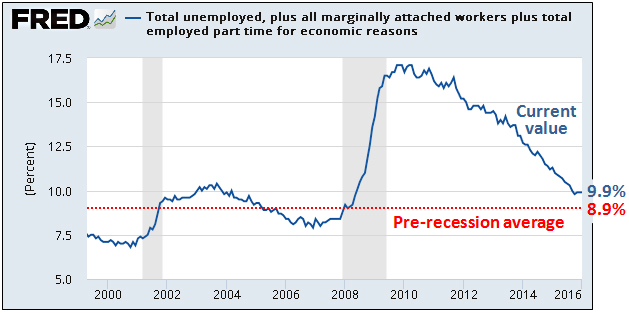
    Can we cut the crap? Trump is obviously just making shit up, but the 10 percent number is colorably legitimate. It’s officially called U6, a measure of unemployment plus folks who have been forced to work part time plus workers who are “marginally attached” to the labor force. Right now it stands at 9.9 percent.

    But you can’t just toss this out as a slippery way of making the economy seem like it’s in horrible shape. If you’re going to tout U6, you have to compare it to what’s normal for U6. And what’s normal in an expanding economy is about 8.9 percent. This means that even big, bad U6 is within a hair of its full-employment value.

    The US economy is not a house afire. That said, unemployment is low. Inflation is low. Wages are finally growing. The economy is expanding. Gasoline is cheap. Interest rates are low and houses are affordable. I’m getting pretty tired of the endlessly deceitful attempts to make it seem as if we’re all but on the edge of economic Armageddon, and the last thing we need is for liberals to sign up for this flimflam too. It’s good politics, I guess, but it’s also a lie.

  • Tonight’s Debate Really Drove Home the Bernie vs. Hillary Dilemma


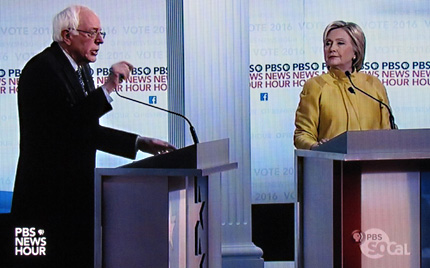
    Here’s roughly how the first hour of tonight’s debate went:

    Bernie: Free health care for everyone!

    Hillary: Let’s not overpromise. Maybe we can get partway there. You know, one percent at a time.

    Bernie: When I’m president we’ll have free college for everyone!

    Hillary: But we have to get the policy right. All the stakeholders need to buy in. It’s tricky.
    Bernie:  We need radical transformation of our criminal justice system!

    Hillary: A commission had some good ideas recently and I endorse them.

    Bernie: Let the children in!

    Hillary: Yes, but first we need an appropriate process.

    OK, I’m kidding. Sort of. But this is the bind Hillary Clinton is in. Bernie Sanders delivers all these big, stemwinding proposals and doesn’t really have to explain how he’s going to pass any of them or get them paid for. But he sure is visionary! Hillary, conversely, is just constitutionally incapable of talking like this. When a problem is raised, her mind instantly starts thinking about what works and who will vote for it and where the payfors are going to come from. And that means she sounds like an old fuddy duddy patiently explaining why your bright idea won’t work. No wonder young voters don’t care much for her.

    This has been true the entire campaign, of course, but I thought tonight’s debate brought it into much sharper relief than usual. Did it hurt her? I’ve pretty much given up trying to divine the reactions of the studio audience to these debates, so I don’t know. I guess that if you think we need to dream big dreams and the fuddy duddies ought to stand aside, you’re more convinced than ever that Hillary is part of the problem, not part of the solution. If you have some respect for how hard the political process is, and how slowly progress is made, you’re more convinced than ever that Bernie is talking through his hat and Hillary is the only reasonable choice.

    And for those who are undecided? I guess we’ll find out soon enough.

    Debate transcript here.

  • Republican Tax Plans Will Be Great for the Ri—zzzzz


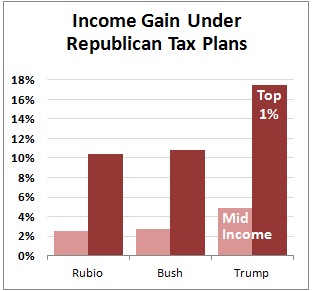
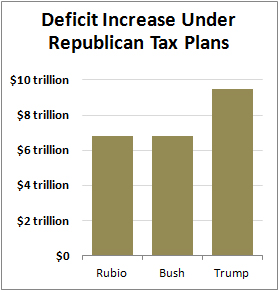
    Our good friends at the Tax Policy Center have now analyzed—if that’s the right word—the tax plans of Donald Trump, Jeb Bush, and Marco Rubio. You can get all the details at their site, but if you just want the bottom line, you’ve come to the right place.

    The chart on the left shows who benefits the most from each tax plan. Unsurprisingly, they’re all about the same: middle income taxpayers would see their take-home pay go up 3 or 4 percent, while the rich would see it go up a whopping 10-17 percent. On the deficit side of things, everyone’s a budget buster. Rubio and Bush would pile up the red ink by $7 trillion or so (over ten years) while Trump would clock in at about $9 trillion. That compares to a current national debt of $14 trillion.

    No one will care, of course, and no one will even bother questioning any of them about this. After all, we already know they’ll just declare that their tax cuts will supercharge the economy and pay for themselves. They can say it in their sleep. Then Trump will say something stupid, or Rubio will break his tooth on a Twix bar, and we’ll move on.

  • No One Wants to Take Orders From Marco Rubio


    When the “establishment” is trying to figure out who they support in a presidential primary, I figure one of the key issues is: “Can I imagine myself taking orders from this person?”

    OK, not “orders,” precisely. But you know what I mean. The president is the party leader, and one of the whole points of being part of the establishment is that you’re the kind of person who accepts the leadership of your president. This explains, for example, why the establishment is horrified about Donald Trump. They can’t imagine taking orders from a politically ignorant jackass like him. And they hate Ted Cruz’s guts, so they can’t abide the idea of taking orders from him either.

    But what about Marco Rubio? Everyone’s been wondering lately why the establishment didn’t rally around Rubio earlier, since he seemed like sort of an obvious choice. My guess is that it’s not because they hate Rubio, or because they think he’s a buffoon. But they do think he’s a nervous and overly ambitious young man who’s a bit of an empty suit. If he’s the nominee, they’ll suck it up and support him. But the idea of taking orders from this pipsqueak sticks in their craw.

    They’re in quite the pickle, aren’t they?

  • Here’s a Chart That Puts the Bernie Bro Phenomenon In a Whole New Light


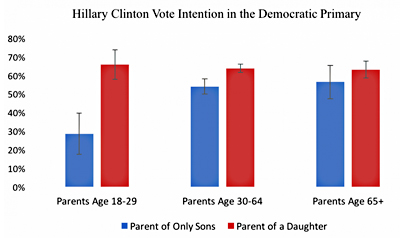
    Why do millennials love Bernie Sanders? Here’s a weirdly intriguing possibility: because they don’t have enough daughters. According to Michael Tesler, millennial parents with sons overwhelmingly support Sanders. But millennial parents with daughters overwhelmingly support Hillary Clinton. (There’s a similar effect among older voters, but it’s very small.) And although Tesler doesn’t say this, presumably single millennials are big Bernie fans too.
    Is this kind of eerie, or is it totally predictable? I could make a case either way. But even if it’s predictable, the size of the effect is eye-popping. Make of it what you will.

  • Do Strict Photo ID Laws Massively Depress Minority Turnout?


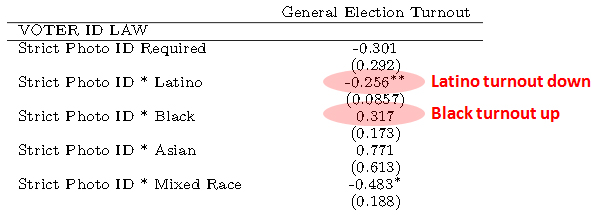
    Josh Marshall is highlighting yet again a new study that demonstrates a large effect of strict photo ID laws on minority turnout. So why haven’t I? Because I honestly can’t makes heads or tails of it. Here are the authors:

    In the general elections, the model predicts Latino turnout was 10.3 points lower in states with photo ID than in states without strict photo ID regulations, all else equal. For multi-racial Americans, turnout was 12.8 points lower under strict photo ID laws. These effects were almost as large in primary elections. Here, a strict photo ID law could be expected to depress Latino turnout by 6.3 points and Black turnout by 1.6 points.

    Do you notice something missing? They mention Latinos and multi-racial voters in general elections, but not blacks. Why not? Apparently because of this:

    Their regression suggests that black turnout was up in states with strict photo ID laws. For some reason, though, the result isn’t statistically significant, so they ignore it. Conversely, their result for primaries shows black turnout down. But even though it’s a weaker result, it is statistically significant, so they report it.

    And there are other things that make no sense. Not only do the authors report numbers for depressed turnout that are far larger than anyone has gotten before, but they suggest that photo ID laws cause black turnout to rise while mixed-race turnout declines. That’s pretty hard to fathom.

    There are other problems. Their charts are incomprehensible. They rely on data collected over the internet. And the results in this paper are precisely the opposite of what one of the authors reported just a year ago in a paper using the same methodology: namely that strict photo ID laws do depress overall turnout, but don’t depress minority turnout any more than white turnout (“there is little evidence that racial minorities are less likely than Whites to vote when states institute voter identification requirements”).

    Beyond that, the authors have applied so many controls that it’s hard to tell if there’s any real data left by the time they’re done. Check this out:

    We also control for individual demographic characteristics…age…education level…family income…nativity…gender, marital status…having children, being a union member, owning a home, being unemployed, and religion…and whether the respondent was registered to vote in the pre-election survey…We also have to incorporate other state level electoral laws…early voting…all-mail elections…no excuse absentee voting…the limit on the number of days before the election that residents can register to vote….Finally, to help identify the independent effect of ID laws, our analysis has to include the electoral context surrounding each particular election…political competitiveness of each state…the presence of different electoral contests…whether the Senatorial and Gubernatorial contests are open seats or not, whether the Senatorial and Gubernatorial contests are uncontested or not, and finally the region (South or not).

    Holy hell! I wonder how they decided on these controls rather than others? They don’t say.

    It’s quite possible that the analysis in this study is too sophisticated for me to understand. I’m hardly a statistical guru. In fact, I can’t even tell precisely what their regressions are measuring. The numbers in the table don’t seem to bear any relationship to the results reported in the text. So maybe I just have no idea how to read this stuff.

    But for now, I’d take this with a huge grain of salt until someone with the right chops weighs in on it. I don’t doubt that strict photo ID laws depress turnout among minorities, but I doubt very much the effect is as big as this study suggests.

  • Get Your Memes Right: The 1994 Crime Bill Didn’t Create Mass Incarceration


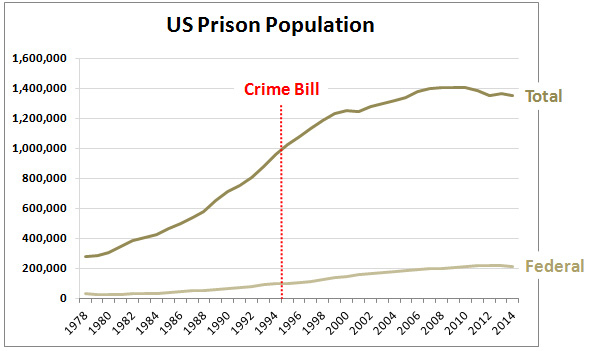
    German Lopez points out today that the 1994 crime bill wasn’t responsible for mass incarceration:

    States preside over the great bulk of the US justice system. So it’s actually state policies that fueled mass incarceration….Federal criminal justice policy, including much of the 1994 crime law, focuses almost entirely on the federal system, particularly federal prisons….In the US, federal prisons house only about 13 percent of the overall prison population.

    That’s true. And there’s one other thing to add to that: by 1995, when the crime bill took effect, state and federal policies had long since been committed to mass incarceration. Between 1978 and 1995 the prison population had already increased by more than 250 percent. Between 1995 and its peak in 2009, it increased only another 40 percent—and even that was due almost entirely to policies already in place.

    Depending on your reading of history, mass incarceration was either (a) a reasonable response to a huge crime wave, (b) a defensible idea that got way out of hand, or (c) a racist scourge that destroyed the black community. In fact, there’s a good case that it was all three of these things: there really was a big surge in crime in the 70s and 80s that created a growing pool of violent offenders; even the defenders of mass incarceration mostly agree that it had already gone too far by the early 90s; and it’s difficult to believe that it ever would have gone as far as it did if it weren’t for the contemporary media-political inspired hysteria over black “predators” flooding our neighborhoods.

    That said, whatever else the 1994 crime bill did, it didn’t create the carceral state or even give it much of a boost. That had happened many years before.

  • The NSA’s Credibility Takes Another Hit


    Henry Farrell passes along the news that the NSA is merging two of its major divisions into a single directorate:

    The NSA has traditionally had two big responsibilities. The first — spying and surveillance — gets the lion’s share of public attention (and, it would appear, resources). Yet the second responsibility — protecting U.S. networks from external attack — is also very important….Protecting private U.S. networks and computers from intrusion means creating secure cryptographic standards that make it a lot harder for outsiders to break in. The problem is that other networks in other countries are likely to start using the same standards. This means that the better that the NSA does at securing U.S. computers and networks against foreign intrusion, the harder it is going to be for the NSA to break into foreign computers and networks that use the same standards. If, alternatively, it cheats by promoting weak standards, the security of U.S. networks will be weakened, but it will also be easier for the NSA to break into foreign ones.

    As Farrell points out, the Snowden leaks showed that the NSA did cheat: they deliberately tried to introduce weaknesses into crypto standards so they’d be able to break into foreign networks. This makes their merger of offense and defense a big problem:

    When the NSA had visibly separate organizational structures, with separate budget lines for offense (attacking other people’s systems) and defense (defending one’s own systems), it helped reassure outside observers a little that the defense perspective has its internal advocates within the organization, even if those advocates often lost. In a combined structure, that is no longer the case. Outsiders will find it harder to adjudicate whether the organization is prepared to prioritize defense over offense (at least some of the time).

    And that has consequences….It may make it less likely that businesses will trust the NSA with information about vulnerabilities….It may further erode the dominance of U.S. security standards (and U.S. firms) in world markets. It will surely make the cryptographic community more skeptical of cooperating with the NSA. Because the NSA is the kind of organization it is, it has great difficulty in communicating its true intentions and getting others to believe them, even when it wants to. Split organizational structures (which are costly because they go along with budget lines, factional fighting and so on) are one of the very few ways that it can credibly communicate its priorities to outsiders, and reassure them, if it wants to reassure them, that it is interested in protecting networks as well as subverting them.

    To be honest, I’m surprised the crypto community—especially overseas—is willing to cooperate with the NSA at all, given what we now know. They are plainly pretty obsessed with sneaking backdoors into both crypto standards and network devices. If the Snowden leaks didn’t destroy their credibility on this subject forever, I’m not sure what would.

    In any case, this is some boring bureaucratic news that might have some real-world consequences. You’ll probably never hear about it again, so I figured it might be worth hearing about it at least once.