• Lead and Dropout Rates: An Itsy Bitsy Mystery

    In a meandering post yesterday that ended up on the subject of lead and crime, I posted some charts showing the correlation of childhood lead levels with crime, teen pregnancy, and high school dropout rates. Here’s the dropout chart:
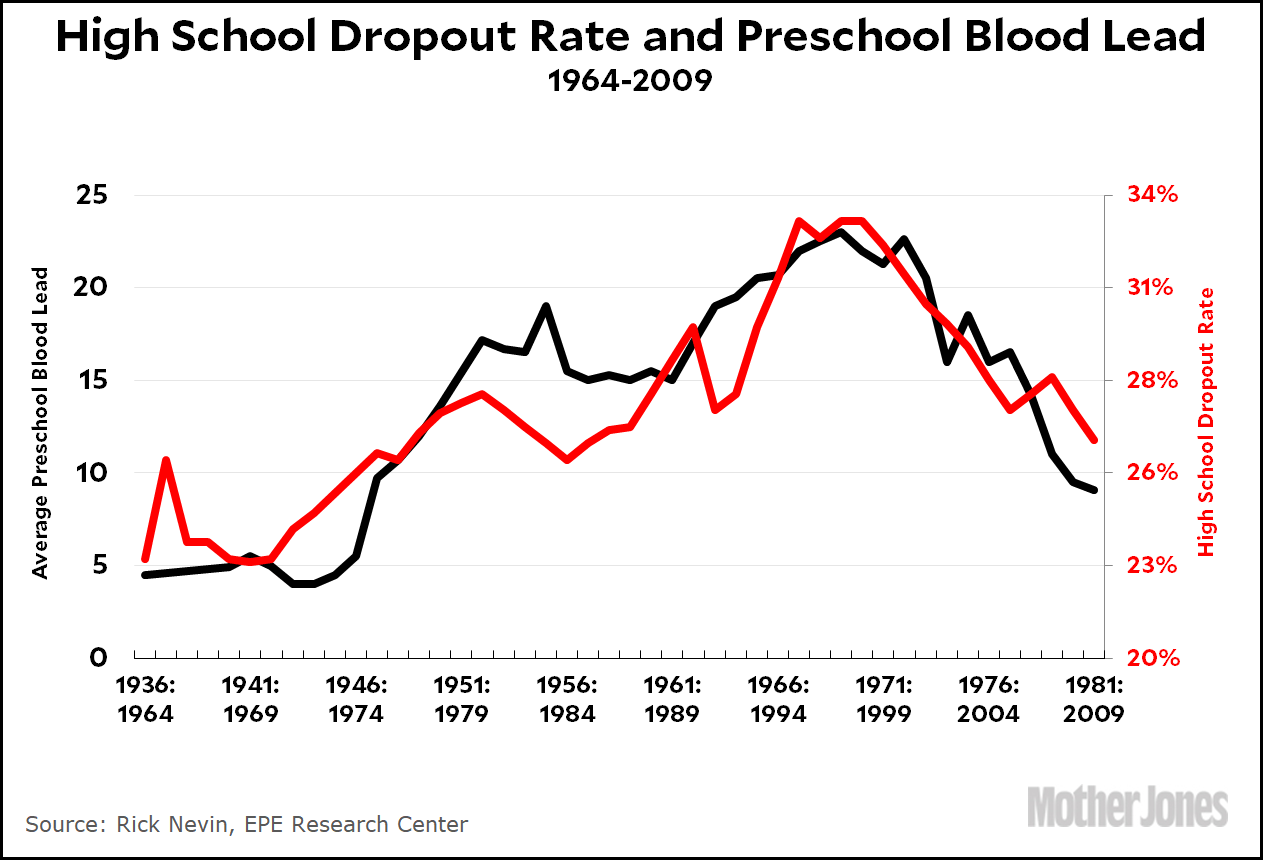
    This correlation should come as no surprise. The connection between lead and crime may still be debatable, but the connection of lead with IQ and learning deficiencies is rock solid. There’s literally no one who doesn’t accept the research on this. So it makes sense that as lead poisoning in children increases, the dropout rate of these children a couple of decades later would increase too.

    But if you look at this chart closely, you’ll see something funny: the best fit suggests a lag time of 28 years. That’s not right. The lag time ought to be 16 or 17 years, or at least something in that ballpark. What’s going on?

    One possibility, of course, is that this is just a chance correlation. Something else caused the rise and fall of the dropout rate and lead had only a little to do with it. Without further study, there’s no way to know for sure. Alternatively, this could be a statistical artifact. Dropout rates are tricky to measure, and not everyone agrees on how to do it. Does a GED count as “graduation,” for example?

    In other words, there could be a bunch of things wrong here. But let’s suppose this correlation is real. If so, what would account for the 28-year lag?

    The best guess I can come up with is that dropout rates depend about equally on both parents and kids. The rate increases if the kids are duller or if the parents are duller. So if the lag time for the the children themselves is, say, 16 years, and the lag time for the parents is 40-years, the best fit for the final curve is a 28-year lag.

    I have no idea if this holds water, and I’m not even slightly invested in it. I’m mostly curious about whether this correlation is meaningful, and if it is, whether there’s some reasonable explanation for the odd lag time. If you have any guesses, toss ’em out in comments.

  • Republicans Working Hard to Make Tax Bill Even Stupider

    Alex Edelman/CNP via ZUMA

    From CNBC:

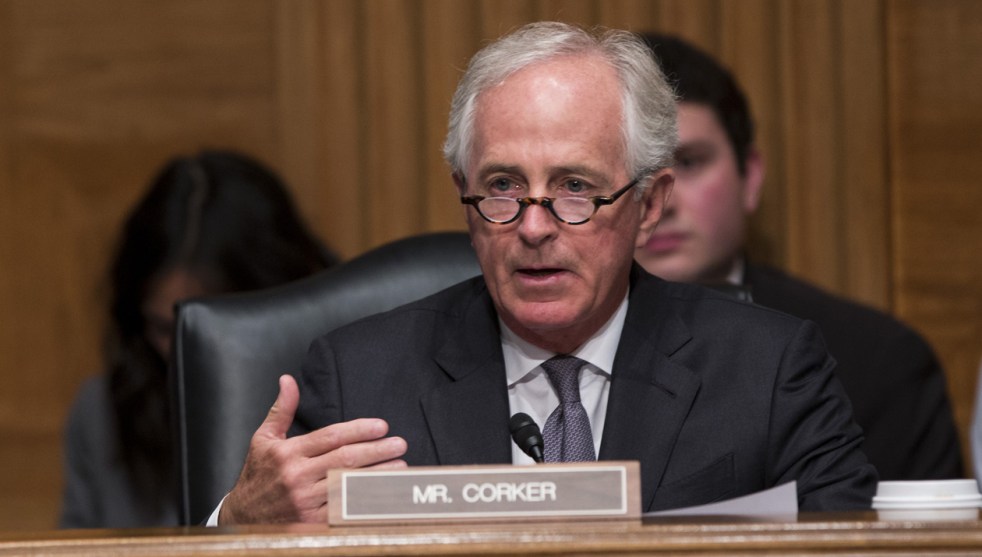
    Sen. Bob Corker said Tuesday a “backstop” to curb future budget deficits could help to win his crucial vote for the GOP tax bill. The Tennessee Republican and others are seeking the protection in case the nearly $1.5 trillion in proposed tax cuts do not meet the GOP’s expectations for sparking economic growth. The “trigger” described by Corker would raise taxes if the plan does not boost the U.S. economy enough.

    “What several of us have asked for is a backstop or trigger in that event we don’t meet the projections that have been laid out — since we’re not going to score it — that we have a backstop. And so that’s what we’ve been working on throughout the weekend and feverishly today,” Corker told CNBC’s “Squawk Box.”

    The Senate could just wait to score the bill, of course. That would certainly be the easiest option. The thing is, everyone knows what a CBO score would show: even with dynamic effects taken into account, the Republican tax bill blows up the deficit big time.

    So instead of dealing with that certainty, Republicans are apparently trying desperately to whomp up some kind of “trigger” language in record time. I’ll toss out three options for how this could turn out:

    1. The trigger will be mostly for show and will have little actual power.
    2. The trigger will be effective, which means that taxes will go up when the economy is slow and down when the economy is booming.
    3. The trigger will be a Rube Goldberg concoction and no one actually knows what it will do.

    Mitch McConnell, of course, would prefer #1. Corker, presumably, prefers #2 even though it makes no sense. And in the end, I suppose we’re most likely to get #3.

  • Yet Another Person Bails on the State Department “Redesign”

    Mai/Rex Shutterstock via ZUMA

    Like Spinal Tap drummers, the folks tapped to lead Rex Tillerson’s overhaul of the State Department just keep imploding. The latest is Maliz Beams, former CEO of Voya, who lasted only 90 days:

    An early leader of the overhaul was William Inglee, a former Lockheed Martin executive, who quickly moved on. Then came Deputy Secretary of State John Sullivan, who was confirmed by Congress in May but stopped leading the effort after a listening tour involving 300 interviews of diplomats and civil servants. Then Beams stepped in to begin distilling the various ideas and recommendations of the overhaul into a workable concept, but in her three-month tenure, she never finished the job.

    That’s from BuzzFeed. There are two basic possibilities here:

    1. Tillerson is crap at hiring people.
    2. The people are fine, but after they take the job they quickly realize that Tillerson’s plans are unworkable and poorly thought out.

    If I had to choose, I’d guess that it’s a little bit of #1 and a lot of #2.

  • Lunchtime Photo

    This is the Shrub of Doom. Beware its fell power.

    I took this in the late afternoon on R568 in County Kerry. Even in real life it looked pretty bleak and eerie, but naturally I amped that up a bit in this picture. OK, I amped it up a lot. But the effect is kind of cool. You expect that maybe Mordred or Voldemort are lurking just outside the frame. Or maybe Vladimir and Estragon.

  • Tillerson: State Department Won’t Need Much Money After Trump Solves World Problems

    Secretary of State Rex Tillerson gave a major speech today. Laura Rozen reports:

    As a joke, this might not have been bad. But it wasn’t a joke:

    Tillerson said the department’s budget in recent years had ballooned to some $55 billion and was filled with spending inefficiencies. He also said the State Department would need less money as global conflicts wind down. Although it’s not the first time Tillerson has made such a claim, critics note that he’s given no specifics about which conflicts he sees petering out. They warn that new conflicts could easily emerge from North Korea to Iran.

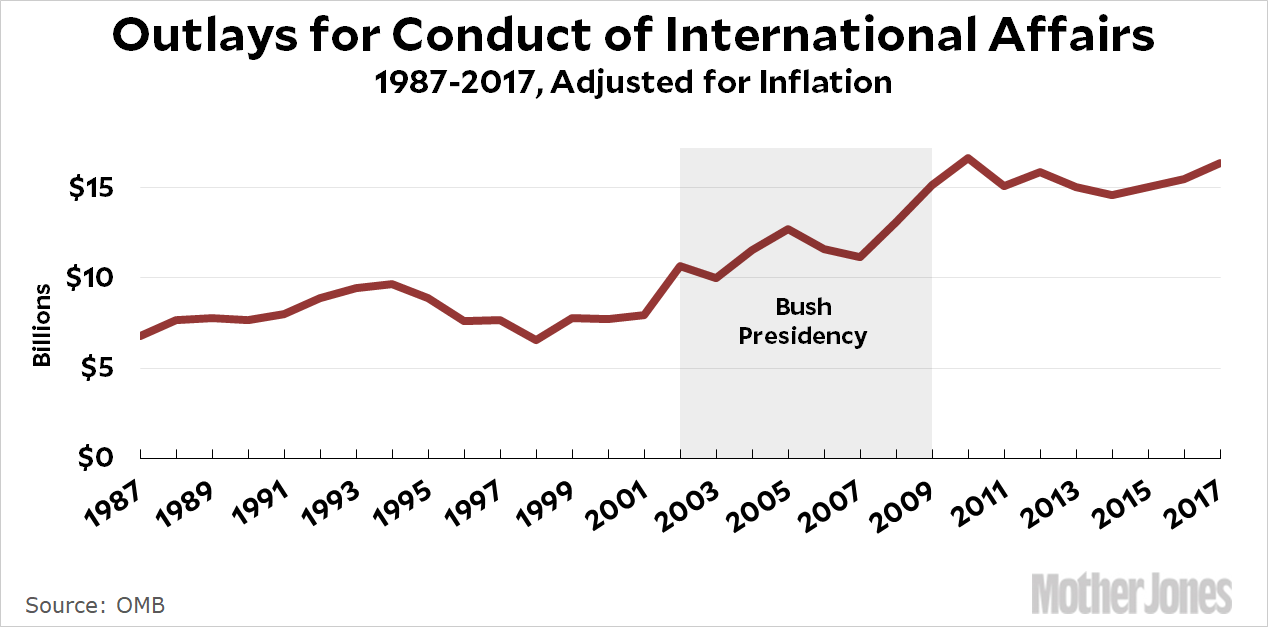
    As for the budget ballooning to $55 billion, the bulk of that is humanitarian and military assistance, which is a whole different subject. For the State Department’s core duties, their budget looks like this:

    Does Tillerson have a point? State Department outlays did increase substantially after 9/11, roughly doubling from $8 billion in the final Clinton budget to $15 billion in the final Bush budget. Was that too much? Should it be cut back now that our wars in the Middle East are kinda sorta winding down? Maybe. I’d sure like to hear someone actually make the case, though, rather than just tossing out a phony number and pretending that it’s justification enough.

  • What Happens When the Bitcoin Bubble Bursts?

    Jaap Arriens/NurPhoto via ZUMA

    Charlie Stross, who has finished work on his latest novel and now has too much time on his hands, tweeted this yesterday:

    He reports today that this led to a flood of Twitter spam calling him an idiot, a shill, etc. etc. The usual. But what he didn’t expect was that a lot of it came from the alt-right/neo-Nazi crowd. If you think about it, though, this isn’t so mysterious after all: the alt-right folks are obsessed with “fiat money” and hyperinflation and so forth, so it’s unsurprising that they’re into Bitcoin as a hedge against government-controlled money. It’s the same reason they’re into gold. Like gold, there’s a hard limit to the amount of Bitcoin in circulation, and it’s practically an article of faith among these folks that a highly constrained money supply is the only real guarantee of value.

    But then Stross puts this together with his belief that Bitcoin is a bubble that will eventually collapse:

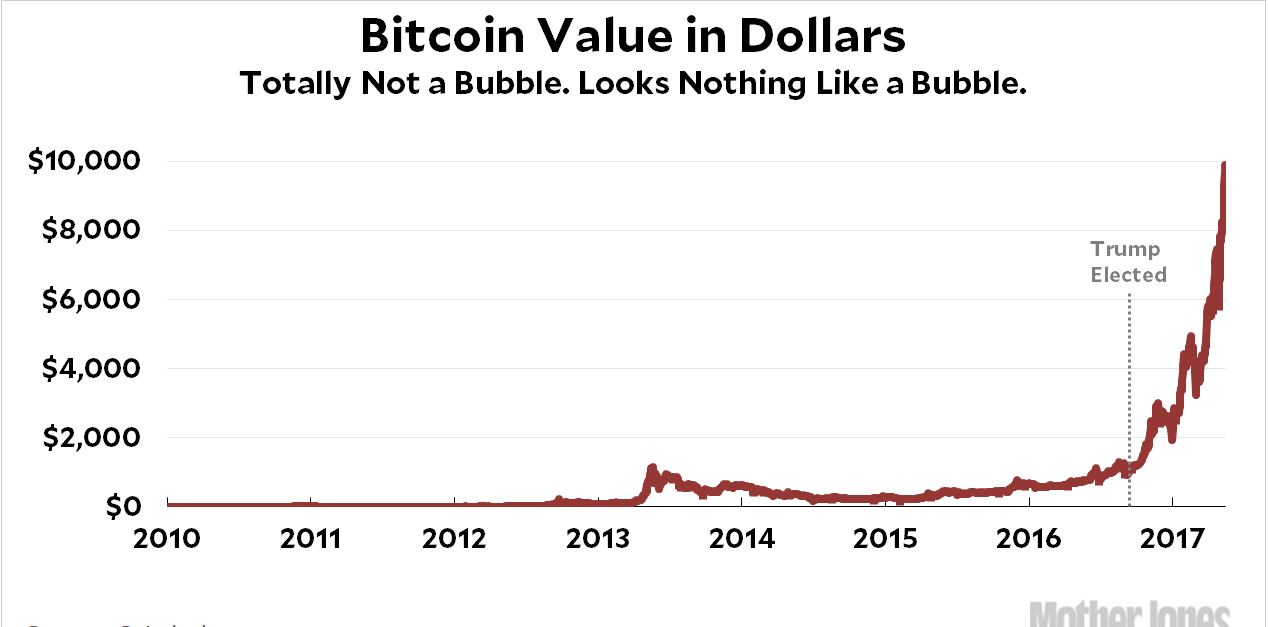
    If, as I think, BTC doesn’t deliver, then the bubble will eventually burst. I called it a long time ago: and although BTC continues to follow an overall upward trend (there have been, ahem, fluctuations that would have ben recognized as a full-on collapse in any conventional currency) we’re going to run out of new BTC to mine sooner or later. At that point, the incentive for mining (a process essential for reconciling the public ledgers) will disappear and the currency will … will what? The people most heavily invested in it will do their best to patch it up and keep it going, because what BTC most resembles (to my eye, and that of Jamie Dimon, CEO of JP Morgan Chase) is a distributed Ponzi scheme. But when a Ponzi scheme blows out, it’s the people at the bottom who lose.

    The longer BTC persists, the worse the eventual blowout—and the more angry people there are going to be. Angry people who are currently being recruited and radicalized by neo-Nazis.

    This is a fairly exotic concern, and perhaps not in my Top 100 list. Bitcoin is still mostly a Chinese thing, I think, and I doubt that there are more than a few hundred neo-Nazi types who are invested in it. Still, this is at least a more intriguing thing to worry about than whatever Donald Trump rage-tweeted about last night.

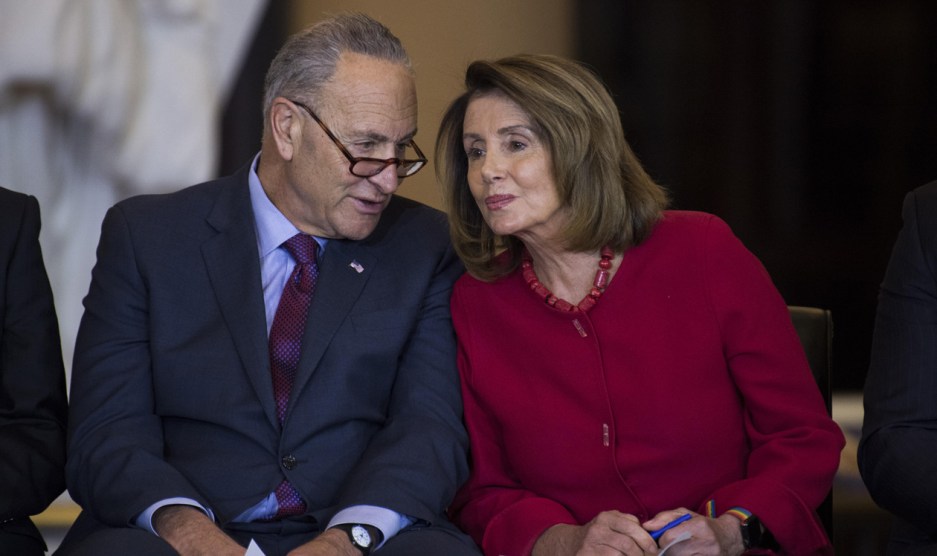
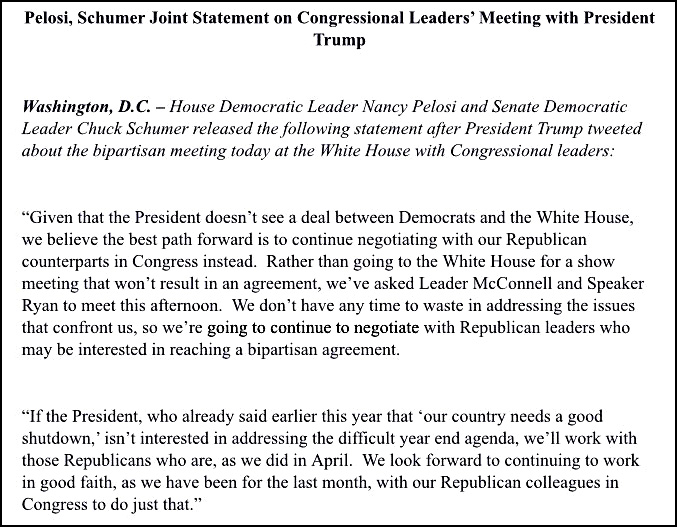
  • Chuck and Nancy Blow Off Meeting With Donald Trump

    Tom Williams/Congressional Quarterly/Newscom via ZUMA

    My my. Democrats are showing some spine. Donald Trump tweeted this earlier today:

    And here’s the Democratic response:

    Shazam! I guess Trump isn’t the only one who can pre-emptively pull out of a meeting. Now he can either (a) back down, (b) accept that he’s irrelevant, or (c) launch more insulting tweets. I’m guessing C.

  • How Do You Round Up Votes for a Republican Tax Bill? Take a Guess…

    Here is your headline of the day:

    Of course that’s what they’re doing. How else would you round up votes from a bunch of Republicans?

    I’ve sort of given up on the latest batch of estimates about the effect of the tax bill. They all say the same thing: It gives big cuts to the rich; big cuts to corporations; big cuts to hedge fund zillionaires; and a few crumbs for the middle class that disappear over time. And none of this has the slightest effect. Republicans just don’t care. It doesn’t matter that the economy is strong and doesn’t need a tax cut. It doesn’t matter that CBO hasn’t had time to produce an official estimate of the bill. It doesn’t matter that American corporations are already among the lowest-taxed in the world. It doesn’t matter that the bill will have virtually no effect on growth. It doesn’t matter that the rich have done so well over the past few decades that they hardly need another windfall.

    Republicans are just going to do it, and that’s all there is to it. So why not turn off your brain and go read about Prince Harry instead? He’s also rich, but at least he doesn’t spend his time whining about how meager his allowance is.

  • Robots Are Becoming Alarmingly Strong

    From the Los Angeles Times:

    Scientists at the Massachusetts Institute of Technology and Harvard University have developed a variety of origami-inspired artificial muscles that can lift up to a thousand times their own weight — and yet be dexterous enough to grip and raise a delicate flower. The devices, described in the Proceedings of the National Academy of Sciences, offer a new way to give soft robots super-strength, which could be used everywhere from inside our bodies to outer space.

    Cool! But before you get too alarmed at the prospect of robots with the strength of Superman, check out the PNAS paper itself:

    This 10 cm-long linear actuator was fabricated within 10 min, with materials costing less than $1. This actuator weighs 2.6 g, and it can lift a 3 kg object within 0.2 s using a -80 kPa vacuum.

    Sure enough, that’s a thousand times its weight. But it’s still only about six pounds. Robots with grippers made of FOAM (fluid-driven origami-inspired artificial muscles) won’t be destroying human civilization any time soon.

    Joking aside, this really is intriguing. Robotics engineering seems to be advancing about as fast as artificial intelligence—and of course, the two are synergistic. Muscles are controlled by intelligence, and they get better with both exercise, which improves their raw capability, and practice, which improves their response to intelligent control. The same will be true of artificial muscles. Engineering will improve their raw capability and better AI will provide more precise control. In 20 or 30 years our grandchildren will be appalled at the idea that we ever let clumsy, unreliable human beings perform surgery on us. What kind of madman would submit to that?