• Lunchtime Photo

    As you know, one of my goals for the trip to Ireland was to see the Milky Way. And I have good news! It turns out that we were living smack in the middle of the Kerry Dark Sky Reserve, the only Gold Tier reserve in the northern hemisphere. So dark skies have not been a problem.

    Unfortunately, dark skies are only useful if they’re also clear skies, and we had very few of those. Overall, we had great weather, but the nights were generally overcast at best and stormy at worst.

    However, our very first night in Kerry was mostly clear, so I went out to see the Milky Way. And I did. But I suspect the skies still weren’t super clear, because even after letting my eyes adjust I wasn’t able to see very much. Neither was my camera. The picture below was the best I got.
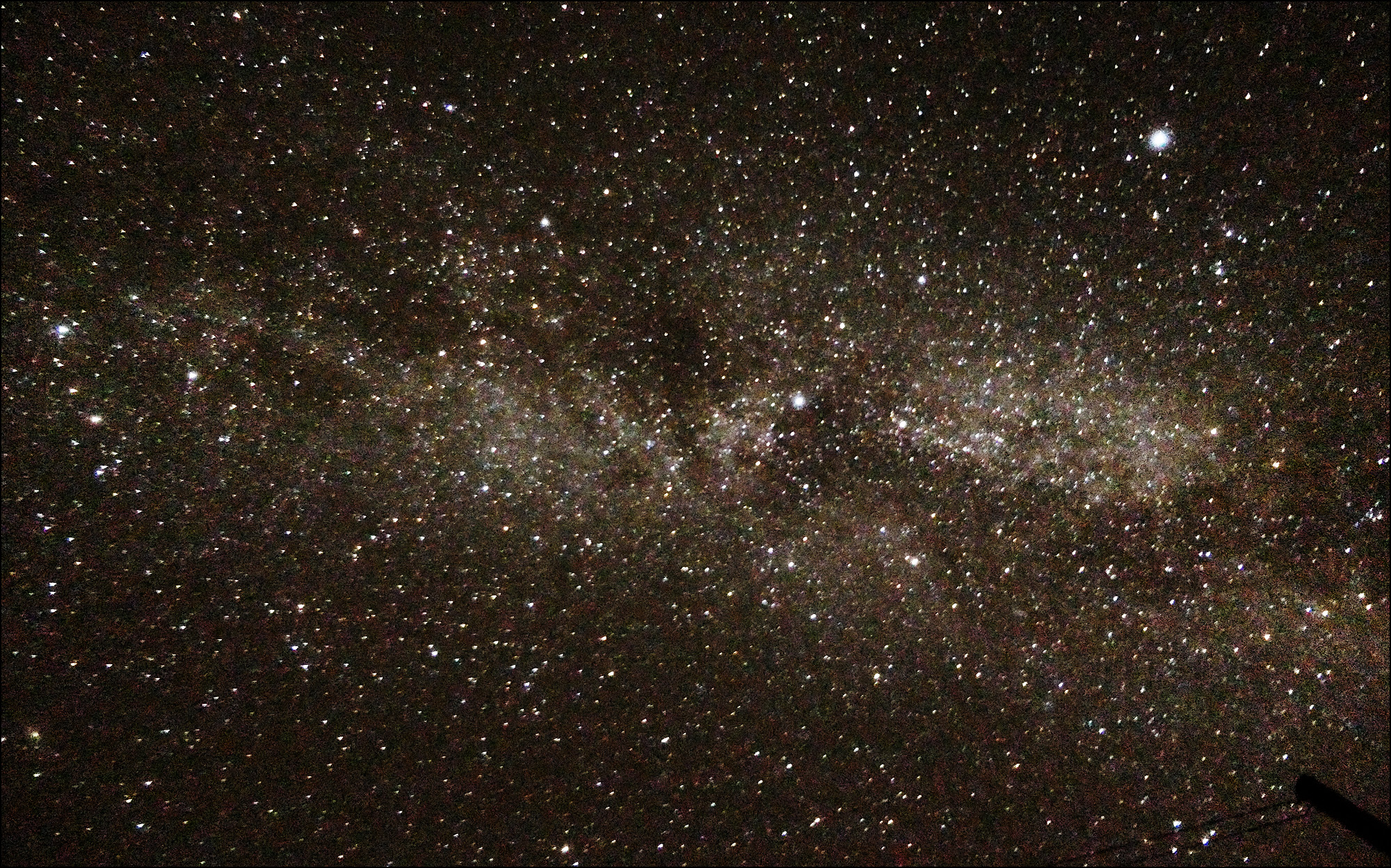
    I imagine that the poor result is partly a result of subpar conditions and partly just the best my little camera can do. A DSLR with a faster sensor and a sharper lens would do a much better job. Overall, I was disappointed that this was the best I could do, but on the bright side, I have taken a picture of the Milky Way now.

    But wait! On our last morning in Kerry, I woke up at 5 am and didn’t feel like going back to sleep. When I looked out the window, it was full of stars. A clear night! So I hustled out of bed and went out to take more photos. I couldn’t find the Milky Way at all. It might have already set by that time, or it might have been obscured by clouds to the north. I’m not sure. But since it was only a couple of hours before I sunrise, I did get this:

    The bright spot on the left is Venus, glowing even more brightly in person than in the picture. If you squint, the tiny dot near Venus but just below the cloud is probably Mars. In the long exposure, you can see a bit of sunlight already starting to appear. On the right, I have no idea what the orange glow is. The bright star is Sirius. Here’s another view:

    Above Sirius at the top of the frame is Orion, with its famous belt of three stars. This is literally the only constellation I know, since you can see the belt even in the Southern California suburbs.

    Thus ends my astronomy outing. I’m not sure if this will be worth it, but when I get home I think I might try again in some nice, dry desert with crystal clear skies. That should provide a better view of the Milky Way. Whether my camera is up to the task of getting a good picture is another question entirely. I suspect it isn’t.
  • Trying to Persuade Voters? Good Luck With That.

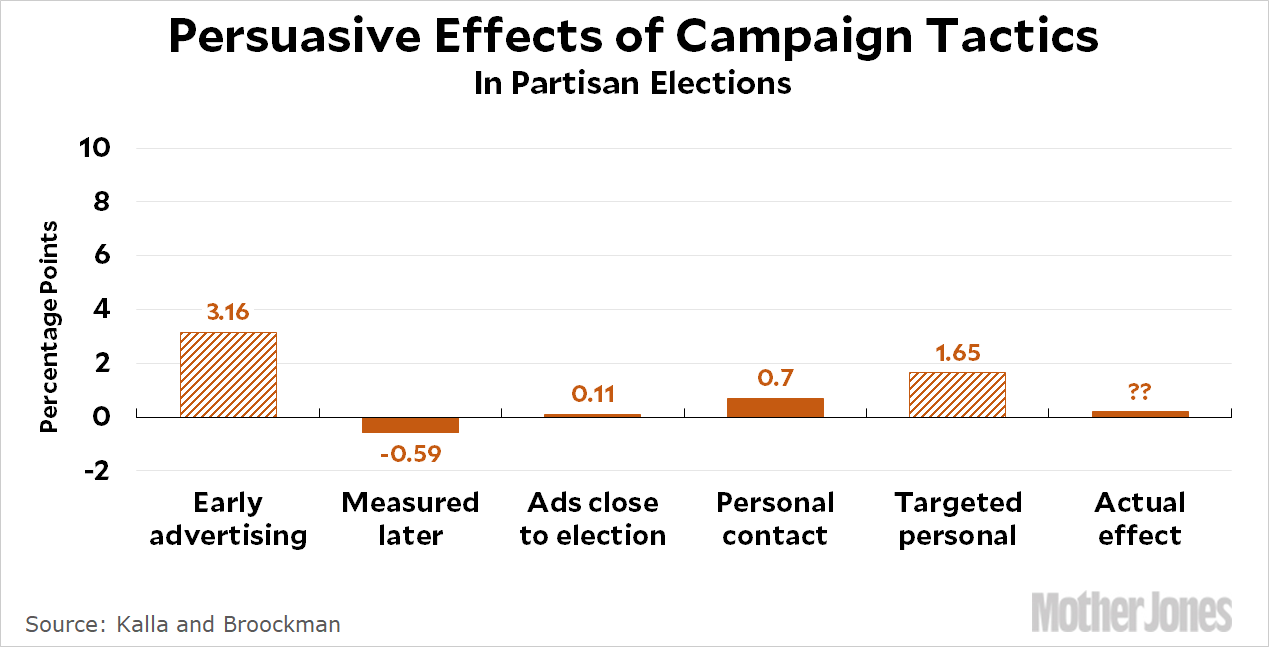
    It’s taken me a while to get to this, but it’s probably of considerable interest to us political junkie types. Joshua Kalla and David Broockman, who have been involved for some time in research on campaign tactics, recently undertook some very powerful field experiments to get a better fix on what works and what doesn’t when it comes to persuading voters. They reported their findings in a recent paper, and the bottom line is grim: party cues are now so powerful that nothing works in partisan general elections. Here are the basic findings, which I’ll explain below:

    The first bar shows the effects of advertising a few months before an election. It looks promising! But as the second bar shows, it wears off by Election Day. In fact, the impact might even backfire, producing fewer votes than doing nothing at all.

    So how about just running the ads within two months of the election? Sorry. The effect is minuscule.

    How about door-to-door canvassing, the gold standard of campaigning? Previous field experiments had suggested it actually has a negative effect, but the new, more powerful studies were slightly more positive: the effects aren’t negative, but they’re pretty close to zero.

    Finally, there’s something that Kalla and Broockman call “targeted” persuasion. This involves detailed surveys to identify voters who might be persuadable on a particular issue (abortion, say) and then hitting them with ads or phone calls on just that subject. At first glance this seems promising, with an average effect of about 1.65 percentage points.

    But that’s 1.65 percentage points among a very small group. As a percentage of the entire electorate, it’s much smaller. And it’s very expensive to do this kind of thing.

    In other words, nothing works:

    The best estimate for the persuasive effects of campaign contact and advertising—such as mail, phone calls, and canvassing—on Americans’ candidate choices in general elections is zero. Our best guess for online and television advertising is also zero, but there is less evidence on these modes.

    The paper is not entirely bad news. Ordinary campaigning works fairly well in primary elections, where both candidates are from the same party, and for ballot measures. The authors also emphasize that although few people are genuinely persuadable, there are other tools that do work: registration drives among likely supporters and ground-game efforts to get your supporters to the polls (GOTV).

    But if you’re hoping to change people’s minds in a partisan race, good luck. You probably won’t. This is why American elections have become such dismal slogs of attack ads and appeals to the base. Nothing else really seems to have much effect.

  • Let’s Make “Pass-Through Income” a Household Word

    I’ve begun to sense a disturbance in the force: there’s a part of the Republican tax cut plan that even a lot of conservatives are having a hard time with. That’s not because it’s a cut, but because it seems like a large and wholly abitrary cut to a small and very specific set of favored people.

    The subject is pass-through income. If you’re, say, a partner in a law firm, the firm almost certainly doesn’t pay corporate taxes. Rather, it’s organized as a partnership or S-corporation. This means that its profits are distributed directly to the partners, who then pay individual taxes on the income. Most hedge funds, private equity funds, law, consulting, and accounting firms are partnerships.

    In other words, most people with pass-through income aren’t folks who own a dry cleaning shop or a roadside diner. They’re highly compensated professionals who are paying a top income tax rate of 39.6 percent. Under the Republican plan, this would be reduced to 25 percent, while the top individual rate would be reduced to 35 percent.

    But why? Why should a Fortune 500 CEO pay 35 percent while a white shoe lawyer pays 25 percent? What’s the rationale for this? Why should the tax code provide this windfall to a small and very select group of taxpayers?

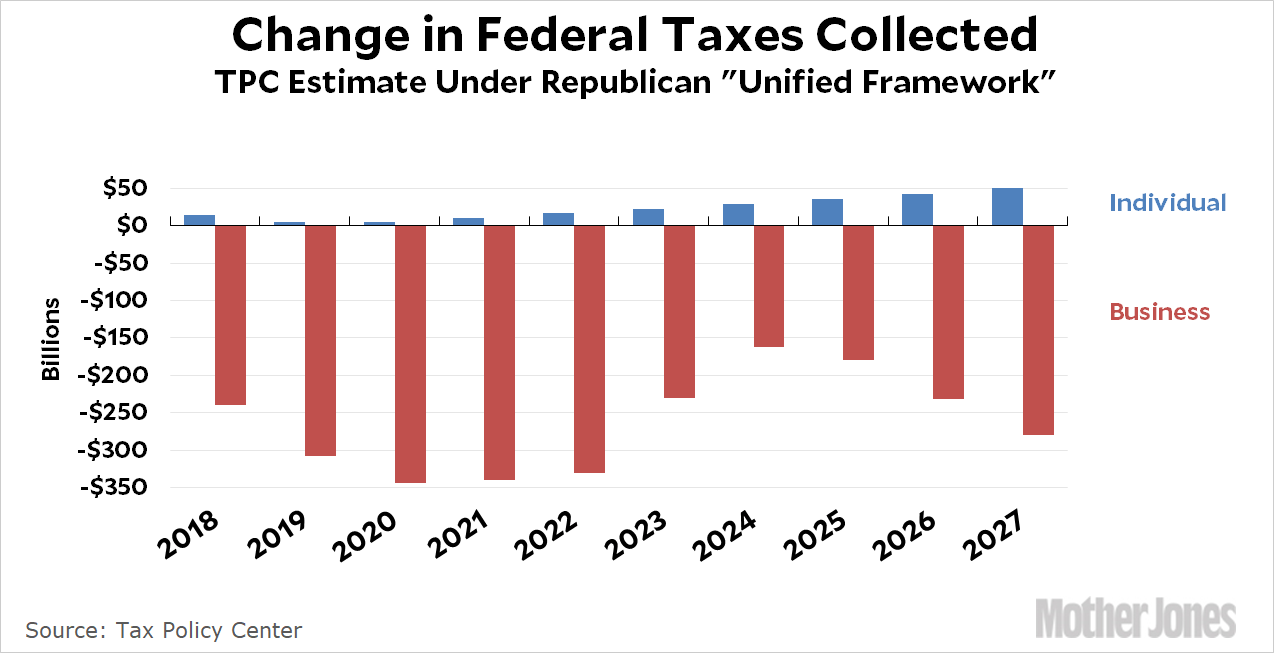
    According to TPC’s estimates, the pass-through provision accounts for nearly a third of the total cost of the Republican tax plan. And it seems wholly unjustified, even by conservative principles. With a little work, I suspect that a focus on the pass-through provision could be pretty effective. It’s obviously unfair and there are probably several conservative senators who are already on the fence about it—especially if the cost of the bill gets slashed by a third if they eliminate it.

    It’s just a thought, but it might be a good idea for liberals to make pass-through income a household word.

  • Should You Take a Vacation in South Kerry?

    So what’s the verdict on vacationing in South Kerry? That’s a little complicated. It’s certainly one of the most beautiful places you could ever hope to see, and Marian and I both loved it. Just to remind you, this was the view from our backyard every morning:

    If that doesn’t get you drooling, you belong to a very different species than me. Unfortunately, there was one problem in paradise, and it wasn’t the weather, which was great the whole time we were there. It’s the roads, which are basically insane. Here are the four stages of driving in South Kerry:

    1. Frequent bouts of white-knuckled terror.
    2. A mild but continual state of alarm.
    3. Meh. I’ve seen worse in West Virginia.
    4. I wish I could have driven these roads in my old Porsche.

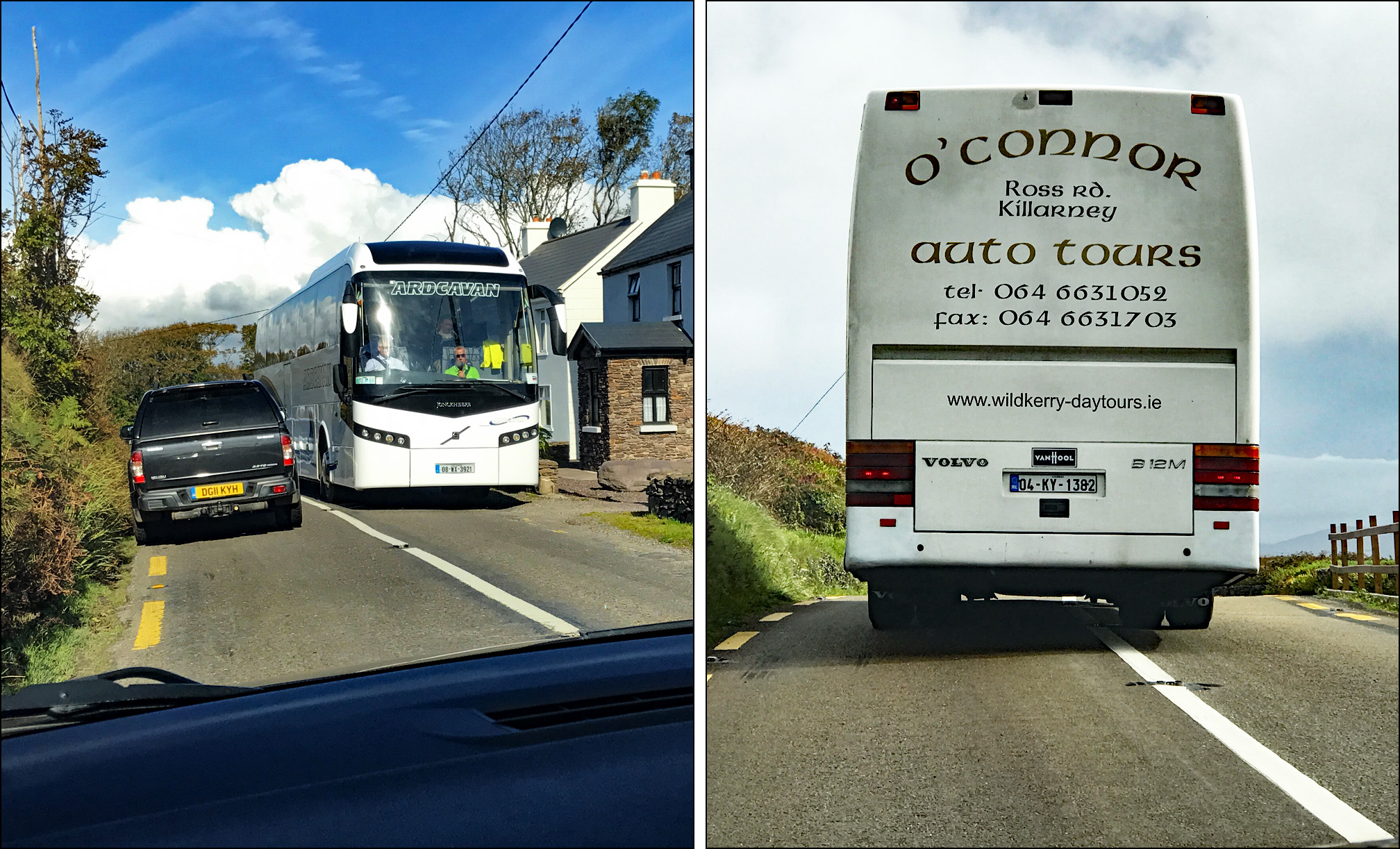
    I got to Stage 2 within a few days, and I suppose I would have gotten to Stage 3 in another few weeks or months. It’s certainly true that over time you get better at centering your car in the narrow lanes; better at anticipating the curves; and better at trusting that cars coming in the opposite direction won’t barrel into you. Nonetheless, the roads have no shoulders and the lanes of even major routes are barely wide enough for a car, let alone a bus. This is what you have to put up with practically every minute you’re on the road:

    There’s a vicious circle at work here. Because the roads are so treacherous, it makes a lot of sense to ditch the idea of driving and instead put yourselves in the hands of a tour operator. This in turn puts more buses on the road and makes driving even more treacherous, which prompts more people to take tours, which—well, you get the idea.

    But it gets worse. I’m a relatively panic-free kind of person, and I’m also—surprisingly, I guess—fairly good at judging how much room my car has. But lots of people are considerably more nervous than me and/or not so good at judging how much room their car requires to get through a narrow space. Long story short, Marian spent much of the trip in terror even though she never drove the car herself. Just being a passenger was enough.

    So this is a tough call. South Kerry¹ is a wonderful place to visit. But the state of the roads makes it hard to say it’s a relaxing place. You just spend too much time focused intensely on the road and gripping the steering wheel really hard when a tour bus barrels by about six inches off your right side. If you’re the fighter jet type, go ahead. But if you’re nervous about navigating even small roads in the United States, it’s not a good idea to drive around in South Kerry. As much as I loathe tour buses—and I loathe them even more now—that’s the better option for you.

    ¹We only saw a small part of Ireland, but oddly, the road problem seemed to be limited to the south. North of Kenmare, the lanes widened a few feet, and that makes a world of difference. I’m not sure if and where the dividing line really is, but the south half of County Kerry really does seem to be uniquely scary.

  • What’s the Deal With the Heathrow Express Train?

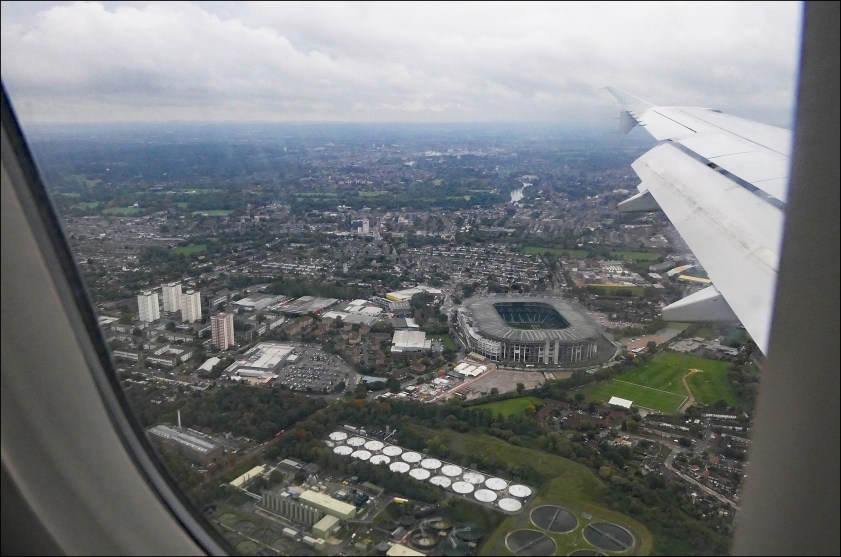
    Twickenham Stadium, the home of rugby union in England. Also the home of the NFL in London, as well as occasional concerts, including U2, Lady Gaga, and Rihanna.

    We’re in London now. Kensington is our home away from home for the next three weeks.

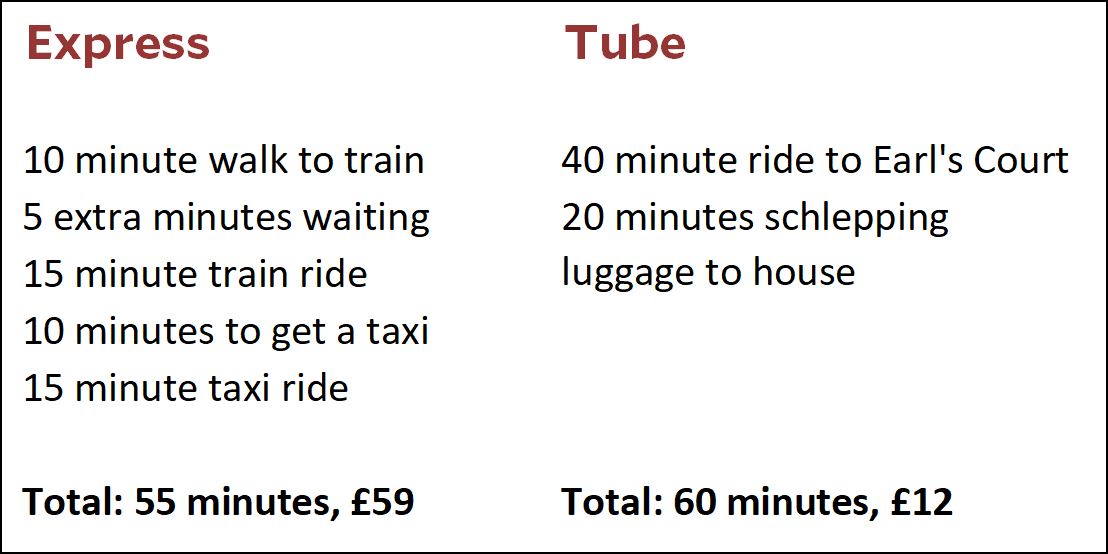
    I’ve never used the express train from Heathrow before, but I did this time. What’s the consensus on this? Is it worth it? That depends a bit on where you’re going, I suppose, but here’s how it seemed to play out to me. The starting point is the entrance to the tube station in Terminal 2/3:

    Basically, we paid about $60 to avoid the 20-minute schlep with luggage. Which might be worth it, I suppose, but it seems kinda pricey. I think we would have been better off taking a taxi from the airport or else using the tube and then taking our chances on finding a taxi at Earl’s Court. Live and learn.

    BY THE WAY: I forgot to mention this, but if you want to follow our vacation more regularly—and really, why wouldn’t you?—you can check out my Facebook page. I’m not much of a Facebooker, but for vacation photos and commentary it seems like the best tool for the job.

  • Donald Trump Is Upset At People Who Think Puerto Rico Is a Disaster

    Yesterday and today, the mayor of San Juan complained—accurately—about the slow federal response to disaster relief in Puerto Rico. “If anyone can hear us,” she said, “if Mr. Trump can hear us, let’s just get it over with and get the ball rolling.”

    Mr. Trump heard her:

    Then he tweeted some more about what a great job he was doing. Then he went out and played a round of golf. When he got back, he tweeted yet again about what a great job he was doing—which everyone would know if only the Democrats and the news media would stop lying about how bad things were in Puerto Rico.

    Forty more months of this kindergarten stuff. Fucking hell.

  • Republican Tax Plan Literally Benefits Only Millionaires

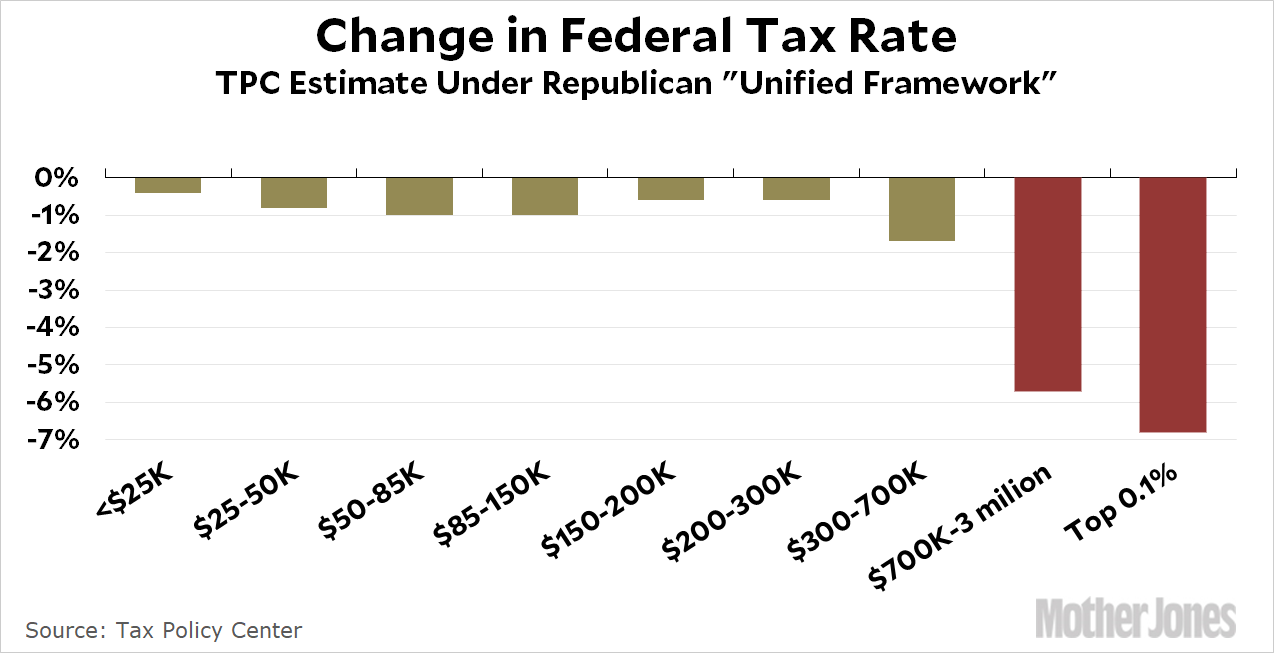
    The folks at the Tax Policy Center have released a preliminary analysis of the Republican tax cut plan, and it’s about what you’d expect:

    The bottom line—tiny benefits for ordinary people, huge benefits for the rich—is pretty normal for Republican tax plans. What’s astonishing, I guess, is how far up the income scale you have to go before you leave the “ordinary person” category. If you make less than $300,000, you get a tiny pittance—less than a thousand dollars. Even folks who make $700,000 don’t get much: less than a 2 percentage point change, which works out to about $7,000.

    To get any real benefit, you literally have to make a million dollars a year. That’s the point where the tax break really produces any benefit: a reduction of 6-7 percentage points, or $100,000+. Republicans just don’t care about anyone making less than that.

    But here’s another chart. It’s kind of odd:

    Once you factor in everything, including the elimination of the state tax exemption and the elimination of the estate tax, TPC estimates that the individual tax plan raises more money than the current tax structure. The deficit-busting stuff comes solely from the business tax side of things. This means that most of the benefit to the rich also comes from the change in business taxes.

    I would really like to see a TPC estimate of just the individual tax changes. I suspect the distribution chart would look like a U. The elimination of the state tax deduction wouldn’t affect the poor and working class, who mostly just take the standard deduction. It would start to hit at upper middle class levels, and would probably make the tax plan a net negative for them. At the very top, it would cut a bit off the benefit, but the elimination of the estate tax would make up for it.

    How about it, TPC? Can you do a microsimulation of the individual and business taxes separately? I’m genuinely curious to see who benefits most from each one.

  • Friday Cat Blogging – 29 September 2017

    At the very last minute of our stay in Kerry, the sun came out and so did the cat at the bottom of the hill. His owner gave us grief the last time we got out of the car in front of her driveway, so we haven’t tried to make friends with him since our first day. However, she was gone Wednesday afternoon, so I stopped briefly to snap a few pictures. I don’t know this cat’s name, but since we live on Coad Road I’ve been calling him the Coad Cat. He looks kind of sour in this shot, but that’s just the set of his face. In reality he’s a handsome and (normally) sociable critter.

  • Economists Think Republicans’ Tax Numbers Are a Joke

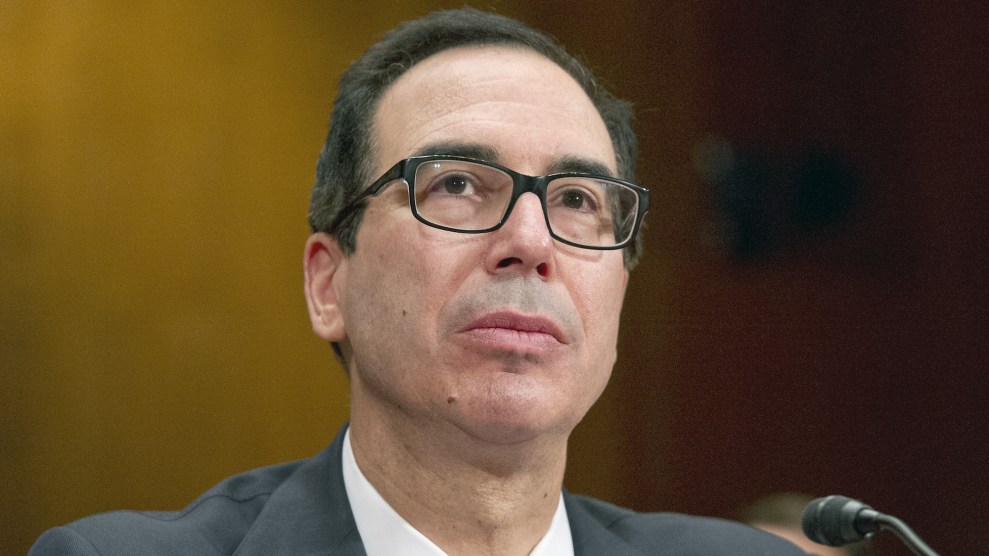
    Treasury Secretary Steven Mnuchin testifying before the Senate Appropriations Committee in July.Ron Sachs/Zuma

    While Kevin’s on vacation, we’ve invited other Mother Jones writers to contribute posts.

    As Republicans have taken to the airwaves to push their new tax plan, they’ve claimed their cuts will trigger stunning economic growth—and thereby bring in more tax revenue than they expect to lose from the cuts. It’s a classic line from supply-side economics backing Republicans, eager to justify tax cuts by promising growth and tax gains that, history has shown, will never come.

    On Thursday, Treasury Secretary Steven Mnuchin stepped up to the plate, promising a revenue boom that could go to deficit reduction: “We think there will be $2 trillion of growth so we think this tax plan will cut down the deficit by a trillion dollars,” he said. “That’s a large number.” 

    Unfortunately for Mnuchin, hardly anyone credible believes him. The nonpartisan Committee for a Responsible Federal Budget said the Republican tax framework released on Wednesday could add $2.2 trillion in deficit spending by handing out tax cuts “like Halloween candy.”

    “Deficit-financed tax cuts are a recipe for a short-term economic sugar high followed by sluggish long-term growth,” Maya MacGuineas, the group’s president, warned in a statement.

    Bruce Bartlett, who, as a former domestic policy adviser to Ronald Reagan, says he helped enshrine the very notion that cuts benefit the economy as part of “the Republican tax myth,” wrote on Thursday that “there’s no evidence that a tax cut now would spur growth.” 

    As Bloomberg columnist Noah Smith makes clear, almost all economists side with Bartlett and MacGuineas. In May, the IGM Forum at the University of Chicago’s Booth School of Business surveyed dozens of top economists on whether a similar Trump tax plan would pay for itself through economic growth. After factoring in the economists’ confidence, over four-fifths strongly disagreed that it would. 

    They were also asked a question essential to Mnuchin’s prediction that Trump’s tax cuts will, in the end, lead to deficit reduction. The economists were surveyed if, in general, previous tax plans relying on substantial future economic growth turned out, as you might expect they would, to bring in less money.

    None disagreed that they had.

    Perhaps Republicans’ favorite example from history is Ronald Reagan’s 1986 tax cut. On Wednesday, House Speaker Paul Ryan cited those cuts, claiming that they had given Americans a tax system they to be proud of. But the most comprehensive analysis of the Reagan cuts suggests they didn’t lead to economic growth. The next year, the Dow Jones dropped by 22 percent in one day, the largest crash in US history. 

    Mnuchin has held fast in defending the administration’s use of optimistic growth projections when calculating tax reform’s impact. When CNBC asked him whether the administration’s plan would be revenue neutral, Munchin offered a telling response, hinting at the the friendly math they would rely on: “It depends on how you score it…under our models, we are absolutely committed to revenue neutrality.” 

  • Let Us Now Praise Bigger and Better Twitter

    I feel like I should take a public position on any topic that gets sufficiently contentious, so here it is with no hemming and hawing: I think it’s a good idea to increase the Twitter limit to 280 characters.

    There. I said it. And I’ll bet everyone will agree before long. Tweets will retain their character as very brief public communications, but the character increase will allow a little more breathing room. Even short thoughts can’t always be easily condensed to 140 characters.