• Wisconsin Is Going to Lose a Bundle on the Foxconn Deal

    It’s official: Wisconsin has approved a deal to bring a huge Foxconn facility to its state. The way this deal works is that Foxconn pays taxes to Wisconsin and Wisconsin provides Foxconn with refundable tax credits—that is, money that’s paid regardless of whether Foxconn has any tax liability. What this means is that it’s possible for Wisconsin to pay Foxconn more than Foxconn pays in taxes. In fact, it’s not only possible, it’s what they expect. Here’s what the deal looks like in cheese-colored chart form:
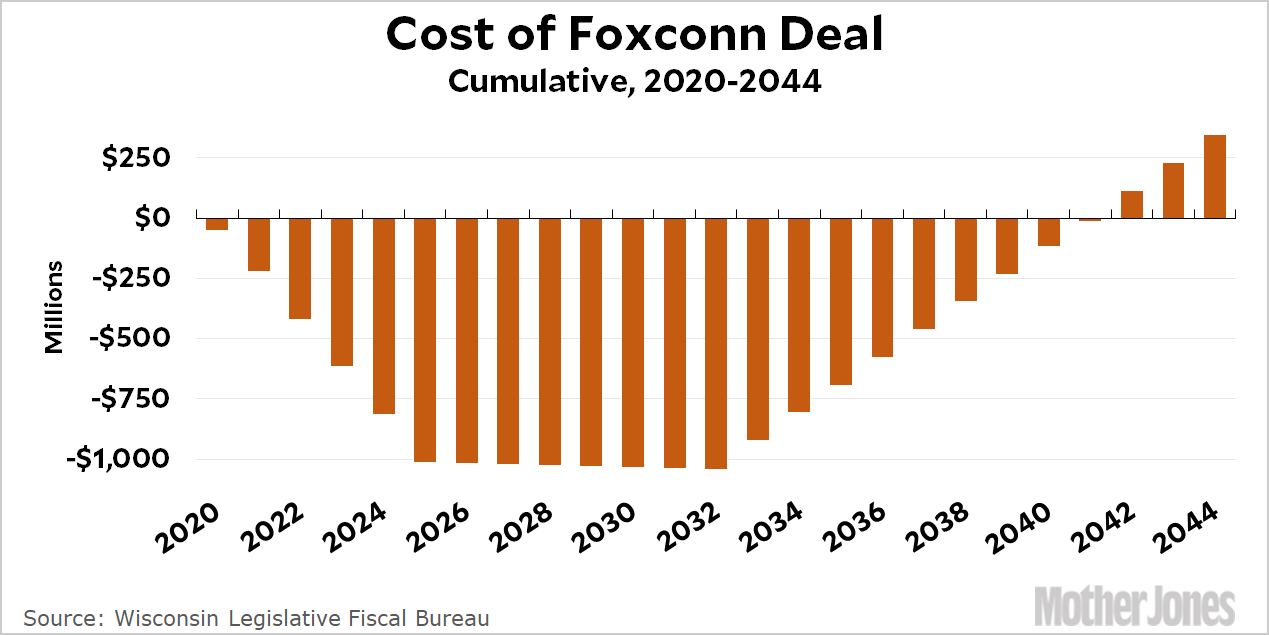
    According to estimates from the Legislative Fiscal Bureau, the money Wisconsin pays to Foxconn will be higher than the combined taxes they get directly from Foxconn and from workers at the Foxconn facility. This annual deficit won’t become positive until 2033. The cumulative deficit won’t become positive until 2042. And this all assumes that Foxconn produces the 13,000 jobs it says it will. If it doesn’t, the deal will look even worse for Wisconsin.

    Why enter a deal that’s certain to cost Wisconsin money in the short term and will only become profitable in the long term if Foxconn is still around in 25 years—a long time in the tech industry? Beats me. It allows Scott Walker to say that he’s a “jobs governor,” I suppose. And there’s apparently some hope that the Foxconn facility will become the hub of a new “Wisconn Valley.” This completely misunderstands both the nature of modern supply chains and the nature of the industries that made Silicon Valley a geographical hot spot.

    Until now, Wisconsin’s most famous product has been cheese. In the future, state Republicans hope that Wisconsin will be famous for assembling consumer tech products. In reality, their new most famous product is old-fashioned gullibility. They got taken to the cleaners.
  • The Cynicism Behind Graham-Cassidy Is Breathtaking

    Ron Sachs/CNP via ZUMA

    It’s hard to know how to react to the cynicism of the Graham-Cassidy health care bill. For starters, it’s as bad as all the other Republican repeal bills. Tens of millions of the working poor will lose insurance. Pre-existing conditions aren’t protected. Medicaid funding is slashed. Subsidies are slashed.

    But apparently that’s not enough. Republican senators (and President Trump, of course) obviously don’t care what’s in the bill. Hell, they’re all but gleeful in their ignorance. Nor is merely repealing Obamacare enough. Graham-Cassidy is very carefully formulated to punish blue states especially harshly. And if even that’s not enough, after 2020 it gives the president the power to arbitrarily punish them even more if he feels like it. I guess this makes it particularly appealing to conservatives. Finally, by handing everything over to the states with virtually no guidance, it would create chaos in the health insurance market. The insurance industry, which was practically the only major player to stay neutral on previous bills (doctors, nurses, hospitals, and everyone else opposed them) has finally had enough. Even if it hurts them with Republicans, Graham-Cassidy is a bridge too far:

    The two major trade groups for insurers, the Blue Cross Blue Shield Association and America’s Health Insurance Plans, announced their opposition on Wednesday to the Graham-Cassidy bill….“The bill contains provisions that would allow states to waive key consumer protections, as well as undermine safeguards for those with pre-existing medical conditions,’’ said Scott P. Serota, the president and chief executive of the Blue Cross Blue Shield Association.

    ….America’s Health Insurance Plans was even more pointed. The legislation could hurt patients by “further destabilizing the individual market” and could potentially allow “government-controlled single payer health care to grow,” said Marilyn B. Tavenner, the president and chief executive of the association. Without controls, some states could simply eliminate private insurance, she warned.

    Literally nobody in the health insurance industry likes this bill. The chaos and misery it would unleash are practically undebatable. It’s being passed for no reason except that Republicans have screwed up health care so epically that they have only a few days left to pass something, and Graham-Cassidy is something.

    If there’s any silver lining at all to this mess, it comes from AHIP’s Marilyn Taverner: the bill is so horrifically bad that it might allow “government-controlled single payer health care to grow.” That’s probably true. No matter how enamored they are of Donald Trump, the American public can be suckered only just so long. If you make things bad enough, eventually they’ll start to wonder why America is the only advanced country on the planet where health care sucks so badly. Maybe all those countries with single-payer health systems have a good idea after all?

    If that happens, I’ll be a happy camper. But I sure wish we didn’t have to do it on the backs of the poor and the sick.

  • The Big Fed Selloff Is About To Begin

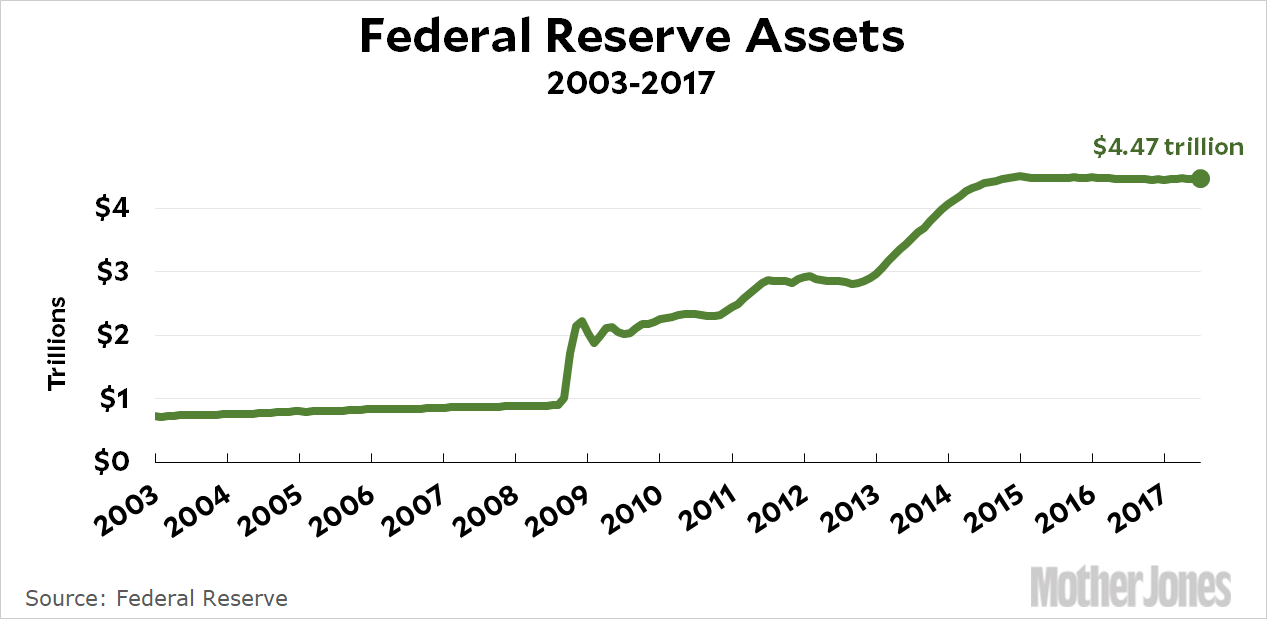
    The Fed announced today that the economy was in such whopping good shape that they plan to start selling off all the assets they accumulated as a result of three rounds of quantitative easing during the Great Recession. Is this a good idea? Is the economy really doing that great? That’s above my pay grade. To be honest, I don’t quite understand why they can’t just light the whole mess on fire and forget about it. Bad precedent, I suppose.

    Anyway, just to give you some context, here’s the job facing the Fed. They’ve got a lot of assets to get rid of. I guess we’ll find out soon enough if the economy is doing well enough that the Fed’s selloff doesn’t tank the stock and bond markets. Cross your fingers.

  • Lunchtime Photo

    We spent Wednesday in the town of Kenmare. Marian made a beeline for the Kenmare Lace and Design Center, which turned out to be about the size of a large living room. It’s dedicated mostly to the lace design of the Poor Clare nuns, who founded a convent in Kenmare in the 19th century and became famous for their lace work. Nora, the proprietor, seemed thrilled to have a visitor who really knew something about this stuff, and was happy to spend hours with Marian talking about it and demonstrating various lacemaking techniques.

    The pronunciation of Kenmare is hard to figure out. The locals I talked to seemed to say Ken-mair, but Nora at the lace museum said it was Ken-mahr. However, Marian says that when she answered the phone she seemed to say Ken-mahr-ee, or perhaps Ken-mahr-uh. Personally I think this is all just a way of playing mind games with the tourists. Pronounce it any way you like as long as you pay before leaving.

    Kenmare hosts a street market every Wednesday. We didn’t end up buying anything, but these two guys spent a good part of the afternoon watching the shoppers go by.

  • Is There Anyone In the Trump Administration Who Isn’t Corrupt?

    I’m on vacation and in a different time zone, so it’s hard to stay caught up with everything. Let me see if I have this straight:

    • EPA chief Scott Pruitt is sucking up ennvironmental investigation resources by demanding a 24/7 security detail This requires 18 agents instead of the usual six.
    • HHS Secretary Tom Price uses government chartered planes to fly from DC to Philadelphia.
    • Treasury Secretary Steve Mnuchin requested a government plane for his honeymoon. This is in addition to his government-funded excursion to view the eclipse from the roof of Fort Knox.
    • Paul Manafort, former campaign manager for Donald Trump, has been under investigation on Russia-related charges since 2014. The charges are serious enough that the FBI got warrants to tap his phone both before and after Trump’s election.
    • And according to the New York Times, Robert Mueller’s document requests from the White House indicate that “several aspects of his inquiry are focused squarely on Mr. Trump’s behavior in the White House.”

    Do I have this right? Is there anyone in the Trump administration who’s not prima facie corrupt? Maybe Rex Tillerson, but only because he’s already rich and doesn’t seem to actually give a shit about his job anyway.

  • The Trump Administration Didn’t Like a Report That Says Refugees Have a Net Positive Impact. You’ll Totally Believe What They Did Next.

    Ron Sachs/CNP via ZUMA

    As part of his executive order banning refugees, Donald Trump ordered HHS to produce a report about the economic impact of refugees. The answer, according to HHS, is that refugees contributed $269 billion in tax revenue and used $206 billion in services, for a net positive impact of $63 billion over the past decade. However, when the final report was released, it presented only half the story:

    “In an average year over the 10-year period, per-capita refugee costs for major H.H.S. programs totaled $3,300,” it says. “Per-person costs for the U.S. population were lower, at $2,500, reflecting a greater participation of refugees in H.H.S. programs, especially during their first four years” in the United States.

    Why would HHS leave out the tax contribution side of the story? Apparently our old friend Stephen Miller insisted it be removed:

    An internal email, dated Sept. 5 and sent among officials from government agencies involved in refugee issues, said that “senior leadership is questioning the assumptions used to produce the report.” A separate email said that Mr. Miller had requested a meeting to discuss the report. The Times was shown the emails on condition that the sender not be identified. Mr. Miller personally intervened in the discussions on the refugee cap to ensure that only the costs — not any fiscal benefit — of the program were considered, according to two people familiar with the talks.

    OK, but the Trumpies can’t very well admit that, can they? So what’s the official explanation?

    John Graham, the acting assistant secretary for planning and evaluation at the health department, said: “We do not comment on allegedly leaked documents” and that no report had been finalized. He noted that Mr. Trump’s memorandum “seeks an analysis related to the cost of refugee programs. Therefore, the only analysis in the scope of H.H.S.’s response to the memo would be on refugee-related expenditures from data within H.H.S. programs.

    Roger that. It’s an HHS report, so they can only use HHS data. Tax info would come from the Treasury Department, and that’s totally out of bounds. It would be inappropriate for an HHS report to present Treasury information.

    What a bunch of clowns.

  • Americans Want to Believe We’ve Made a Lot More Progress on Race Than We Actually Have

    Andrew Rich/iStock

    While Kevin’s on vacation, we’ve invited other Mother Jones writers to contribute posts.

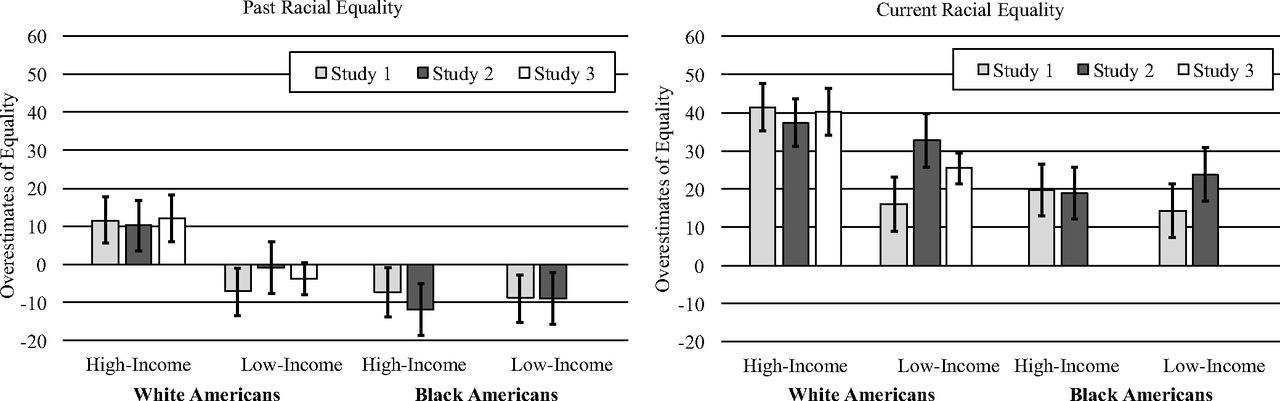
    Turns out Americans have too rosy a view of racial equality in the country. In a new paper published Monday in Proceedings of the National Academy of Sciences, a group of Yale psychologists has found that people in the US vastly overestimate the progress made in closing the economic disparities between black and white America.

    Over the span of multiple studies, researchers asked white and black participants from both ends of the income spectrum to estimate the differences between average white and black Americans in health benefits, hourly wages, wealth, and income both presently and historically. For instance, researchers asked questions such as, “For every $100 in wealth accumulated by an average White family, how much wealth has the average Black family accumulated in 1983/2010?” (The answer’s $5.04

    Participants’ responses are particularly startling when it comes to economic progress. On average, the researchers found, all participants, regardless of race and income, overestimate progress by about 25 percent. Wealthy white participants are the most optimistic, but black participants—both wealthy and poor—also overestimate the current state of economic progress (though, when asked about historical progress, black respondents actually underestimate the reality). “Overall, these findings suggest a profound misperception of and unfounded optimism regarding societal race-based economic equality—a misperception that is likely to have any number of important policy implications,” the researchers note

    Kraus, Rucker, Richeson, Proceedings of the National Academy of Sciences

    As Jennifer Richeson, one of the paper’s authors, told the New York Times: “It seems that we’ve convinced ourselves—and by ‘we’ I mean Americans writ large—that racial discrimination is a thing of the past. We’ve literally overcome it, so to speak, despite blatant evidence to the contrary.” 

    For context, here’s a quick refresher on the reality of the country’s economic divisions. New US Census data released last week show that even as the median household income across the United States reached an all-time high of $59,039 in 2016, the median income for an African-American household in 2016 was $39,490. Though a five percent increase from 2015, that’s still roughly $1,800 less than the income Black households made in 2000, the Washington Post notes. By comparison, white, Asian, and Hispanic Americans have over time carried the income gains that have boosted topline numbers. White American households, for instance, made just over $65,000 in 2016, up even if slightly from 2000 when they made $63,609.


    The picture is even starker when considering wealth rather than income. Over the course of three decades, the racial wealth gap has widened to an alarming extent: While the median household wealth for African-Americans has dipped a shocking 75 percent from $6,800 in 1983 to $1,700 in 2013, and that of Latino households has been slashed in half, white American households saw an increase of 14 percent, from $102,200 in 1983 to $116,800 in 2013, according to the Institute for Policy Studies. As my colleague Dave Gilson and I have pointed out, that means the median wealth of white households is 13 times larger than African-American households and 10 times larger than Latino households.  


  • Republican Texas House Leader Wants State to Admit Civil War Was About Slavery

    Today, Texas House Speaker Joe Straus, joined the continuing push to take down Confederate monuments by calling for the removal of a plaque at the statehouse entitled the “Children of the Confederacy Creed” that asserts the Civil War “was not a rebellion, nor was its underlying cause to sustain slavery.”

    In a letter sent to members of the State Preservation Board—of which he is a member along with Gov. Greg Abbot and Lt. Gov. Dan Patrick—the Republican lawmaker described the plaque as “not accurate,” and explained, “Texans are not well-served by incorrect information about our history.” (Strauss and Patrick, were engaged in a recent public fight during the legislative session over Patrick’s unsuccessful push to mandate everyone use the bathroom of their sex assigned at birth.) Just last week, a Confederate monument was removed in a Dallas park. 

    Neither Abbott nor Patrick have responded to the letter. Last month, during a debate following the violent protests against the planned removal of a Charlottesville, Virginia, monument commemorating Robert E. Lee by white nationalists and white supremacists, the Texas governor said removing Confederate monuments “won’t erase our nation’s past, and it doesn’t advance our nation’s future.” Patrick also criticized the overnight removal of a Confederate monument at the University of Texas.  

    The statehouse plaque was erected by the Texas Division of the Children of the Confederacy in 1959. “It most likely reflects something about resistance to Brown v Board of Education and the end of a Jim Crow system,” University of Texas historian Walter Buenger told the CBS station in Austin, Texas.

    So far social media reactions are mixed, with some users applauding Straus and others accusing the House Speaker of not knowing his history, arguing that states rights caused the Civil War. One user wrote, “He needs to resign his position as Speaker and go back to school to LEARN HIS HISTORY!”

    That’s not a surprise considering what’s taught in Texas public schools. In 2010, a school board member called slavery a “side issue to the Civil War,” when the board adopted new standards mandating that students be taught that the war was caused by “sectionalism, states’ rights and slavery.” Some members of the state board of education have said the standards were prioritized in this way to underscore that slavery was not the central issue leading to the Civil War, despite the fact that historians are overwhelmingly agree that slavery was the cause of the Civil War.

    Just before those standards were adopted, I attended a Texas public school and was taught that the Civil War was about states rights and not slavery. Kevin Drum has been asking readers what bad history they’ve had to unlearn about the Civil War—you can share in the comments section here

  • The Left Seems Pretty United In Opposition to Antifa

    Paul Kuroda via ZUMA

    Here’s an article that was posted prominently online today in the Wall Street Journal:

    How Antifa Violence Has Split the Left

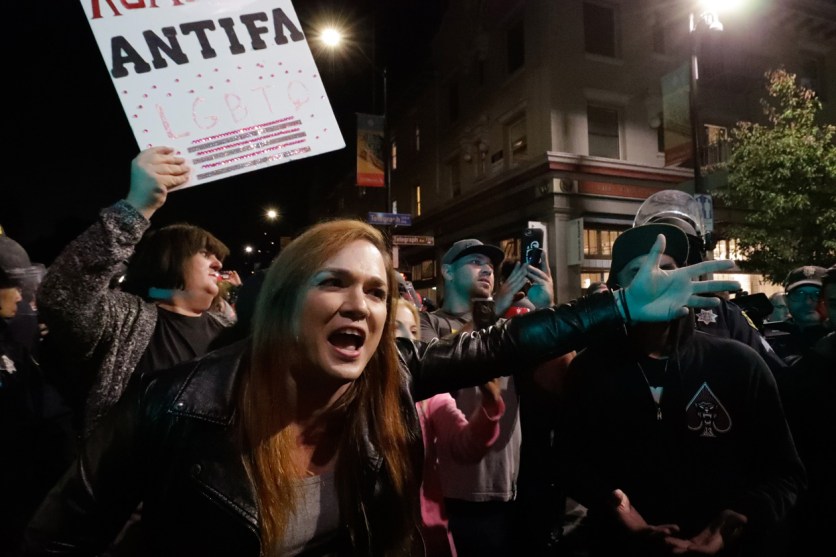
    Broadly labeled antifa, for “antifascist,” such protesters are part of a loose affiliation of far-left groups and individuals who unite around a willingness to confront, sometimes violently, anyone they perceive to be an agent of racism, anti-Semitism or fascism….The antifa tactics are testing the liberal movement that has galvanized in opposition to Mr. Trump—creating a rift among its leaders, organizers and demonstrators about whether to denounce a radical fringe, some of whose antidiscrimination objectives, if not tactics, they share.

    I read the entire piece, which was apparently extensively reported since it includes three bylines. The reporters quote one guy you’ve never heard of who credits antifa for rescuing him from an attack by white supremacists. About a thousand words later they note that “some organizers” of a counter-protest in San Francisco last month declined to explicitly condemn “physical confrontations.” However, those same organizers “took to internet message boards to ask protesters not to initiate any violence.”

    That’s it. That’s all they could dig up in the way of lefty sympathy for antifa. Every other person they quoted—including every single Democratic politician—offered straightforward condemnation.

    So: has antifa really split the left? If by “split,” you mean that the far left disagrees with the mainstream left, just like it always has, then I guess so. By any other measure, though, there appears to be nothing but unity. The vast majority of the left has no use for antifa and no use for violence on city streets. It’s indefensible to suggest otherwise unless you can deliver some real evidence.