The Skellig Islands are famous for several reasons:
They are beautiful, pristine, world treasures, etc.
There’s a 6th century monastery at the top of Skellig Michael.
Little Skellig hosts gazillions of gannets. Also puffins, but only through August 7, when they depart for Iceland (boo!).
The final scene of Star Wars VII was filmed there. Bird conservationists were unhappy about this, but it has made the Skelligs considerably more famous. References to Star Wars are all over the place in Portmagee, where the boats go in and out.
Here are Skellig Michael (left) and Little Skellig (right) merged into a single silhouette:
If you want to know what Skellig Michael looks like without all the artsy effects, here it is:
Here are the steps on Skellig Michael that Rey had to climb to find Luke Skywalker. There are 618 steps in all. I didn’t even consider climbing them. In fact, we didn’t take a tour that landed on the islands at all, since they are strictly limited and have to be booked well in advance—especially now that the place is so popular with Star Wars fans. The ruins of the 6th century monastery at the top filled in as a Jedi temple in the movie.
Curious about what a gannet looks like? This will save you a trip to Wikipedia:
And here is Jim, the doughty boatman who took us out. We booked the trip at the last minute because Monday was such a gorgeous day, and Jim told us that on a scale of 1 to 10, the seas were a zero that day. This was great news for me, since I’m pretty susceptible to seasickness.
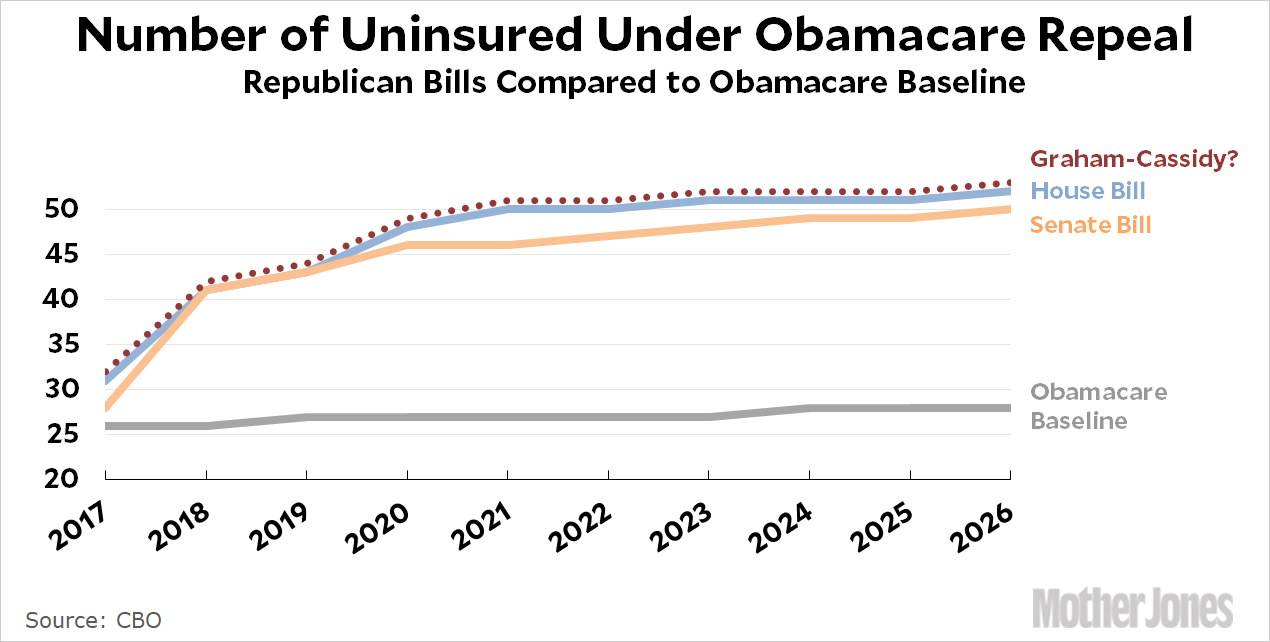
I suppose you have to give Republicans credit for persistence: they’re now trying yet again to repeal Obamacare. The first attempt ended when Paul Ryan couldn’t round up the votes in the House. The second attempt ended when Mitch McConnell couldn’t round up the votes in the Senate. Now we have Graham-Cassidy, which is considerably worse than either of the first two. Literally its only selling point is that it’s not Obamacare.
The plan for passage is similar to Repeal 2.0: do it fast before the CBO can tell us how many people would lose health insurance if it passes. But we don’t really need the official CBO score for that since we already know that Graham-Cassidy would eliminate the individual mandate and slash spending on Medicaid. Those two things account for the vast bulk of CBO’s score, which means that its score of Graham-Cassidy will be very similar: about 23 million people would be tossed off their insurance plans over the next decade.
But could it be even worse? Sure. Graham-Cassidy also eliminates protections for pre-existing conditions, which would make insurance unaffordable for even more people. The CBO score could easily end up at 25 or 26 million.
The clever part of the Republican plan is that the public might not ever see screaming headlines about this. Even though it’s plainly obvious what Graham-Cassidy would do, mainstream news organizations aren’t allowed to just say so. They have to wait for “official” numbers. Those may or may not come before the bill gets a vote.
You can read more of the details about the bill elsewhere, but here are the big takeaways:
Basically turns everything over to the states. It gives each state a chunk of money and allows them to do nearly anything they want with it.
Eliminates protections for pre-existing conditions even though it says otherwise. The trick is that although insurers are required to cover everyone, they can charge anything they like. In practice, this means a pre-existing condition will prevent you from ever getting insurance.¹
Slashes spending on Medicaid and turns it into a block grant.
Slashes federal subsidies and turns them into a block grant too.
Allows states to eliminate Obamacare regulations governing essential medical benefits. This means it’s back to reading the fine print if you buy a medical policy. Maybe it covers doctors’ visits, maybe it doesn’t. It all depends on what your state’s governor decides.
Now, Republicans still have big problems remaining. First, the bill has to be passed within this fiscal year, which ends on September 30. That’s 11 days away. They have to get at least a preliminary CBO score so that they officially know that Graham-Cassidy would reduce the deficit (required under rules for reconciliation bills). And then they have to get the OK from the Senate parliamentarian. This could be a big problem since the parliamentarian is unlikely to agree that the new rules about pre-existing conditions meet reconciliation requirements. And if Graham-Cassidy has to be changed to require coverage of pre-existing conditions for everyone at the same price, it would blow up the bill and rquire a new CBO score.
The odds are against this happening within 11 days. But it’s still possible. Republicans really, really want to stick it to Obamacare no matter what the cost. Liberals better start manning the barricades again.
¹Unless you’re one of the lucky ducks in a blue state that decides to keep Obamacare rules intact. But even that might not matter, since funding in blue states would be cut way back and they probably couldn’t afford to offer Obamacare-style protections.
Here’s some potentially good news on the climate front. The most aggressive climate goal we have is to keep global temperatures from rising more than 1.5°C above their pre-industrial average. The most recent IPCC report suggests that to do this, we need to limit total future carbon emissions to about 250 billion tonnes of CO2 (GtCO2). This is all but impossible.
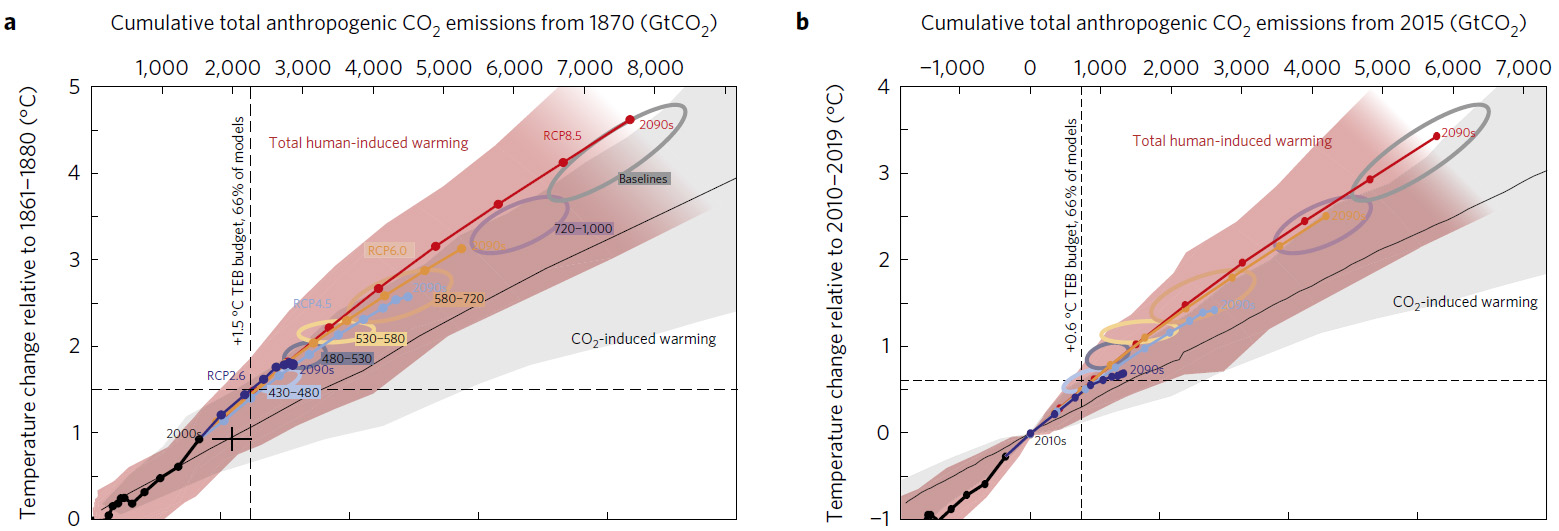
However, a team that includes some of the world’s leading experts on carbon budgets has published a new paper that resolves some contradictions in the IPCC figures and comes up with a much higher carbon budget: about 900 Gt. The following chart will make you cringe at first sight, but don’t worry. It’s fairly easy to explain.
On the left is the IPCC approach. It starts at 1870 and shows how much carbon is required to reach different temperatures. The intersection of the dotted lines indicates that temperatures will rise 1.5°C from 1870 when cumulative carbon emissions hit 2,150 Gt. Since we’ve already emitted 1,900 Gt, that means we have only about 250 Gt to go.
However, this approach doesn’t really match what we see happening right now, so the authors of the new study took a different approach: they started at 2015 instead. Since temperatures have already risen 0.9°C since 1870, our new target is to keep further increases below 0.6°C.
That’s what the chart on the right shows. The intersection of the dotted lines indicates that temperatures will rise 0.6°C from 2015 when we’ve emitted an additional 900 Gt of carbon. The good news here is that this is achievable. It’s not easily achievable, but it’s certainly not impossible.
For more detail on this, Glen Peters has you covered here. He warns that the real-life carbon budget for staying under 1.5°C is probably lower than the theoretical estimate, and he also has some warnings about the whole concept of carbon budgets in general. This is primarily because multiple studies have come up with vastly different estimates of how much carbon we can afford to emit this century if we want to stay below 1.5°C. It’s better, he argues, to simply say that “we need net-zero emissions by 2050 to 2100, as specified in the Paris Agreement.”
Nonetheless, he also says, “The implications of this paper are breathtaking.” As always, this is only one paper, so don’t take it to the bank yet. But this is serious work by leading experts. If it pans out, it means that we actually have a shot at staying below 1.5°C.
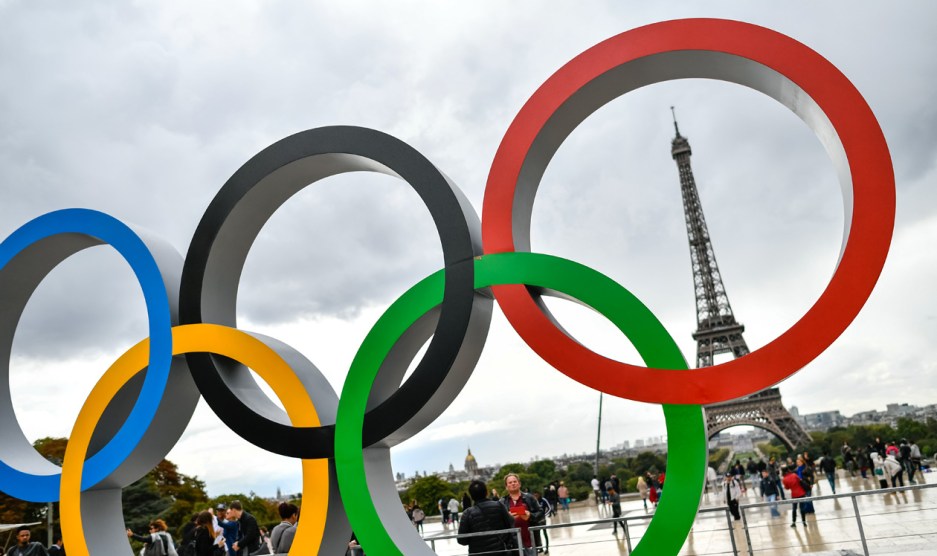
Ladies and gentlemen, I present possibly the most ridiculous story ever written. This weekend the New York Times explained how Paris won the 2024 Olympics after repeated failures in recent years:
Paris Won the 2024 Olympics by Learning From Its Mistakes
Although the Olympic bidding process is notoriously opaque, Paris’s successful bid for the 2024 Olympics seems to have benefited from the hard-learned lessons of its past failures. Here are some of the things it did differently this time.
….“The main conclusion was that you had to put sports much more at the center of the bid”…. Emmanuel Macron, used his image as a young, new and popular president to push the bid into the homestretch…. “It’s important to show some unity to the I.O.C. members,” said Thierry Rey…. Bid leaders argued that their Games would be ecologically responsible, and that 95 percent of the sports venues were either already built or would be temporary…. And there was one more lesson learned by the French, according to Mr. Lee of Vero, and this one was perhaps the hardest. You must lobby, which he described as “the L word in France.”
Oh please. Hamburg, Budapest, and Rome withdrew after realizing that bidding for the Olympics was stupid and immensely costly. Los Angeles voluntarily agreed to host the 2028 games. Paris was the only city left bidding for the 2024 games. That’s why they won.
How is it possible to write more than a thousand words on this subject without mentioning that tiny little fact?
While Kevin’s on vacation, we’ve invited other Mother Jones writers to contribute posts.
Kevin, as you’re probably aware, has strongopinions on the Equifax disaster, so let’s keep that ball rolling while he enjoys fiddle tunes and a half-pint in the Irish pubs.
Over at the New York Times, finance columnist Ron Lieber has kept busy shaming the credit-reporting giants, posing questions from readers on their handling (or lack thereof) of the unprecedented (so far as we know) Equifax breach that compromised the personal and financial data of up to 143 million Americans. (Equifax reluctantly answered some of Lieber’s questions but not others—and not always accurately.)
This whole nightmare has reminded Americans what the credit-reporting industry is: a rapacious, unaccountable corporate beast that sucks up, stores, and sells our secrets whether we like it or not, and seeks to avoid any liability should anything go wrong. Then, when something inevitably does go wrong, the big three—Experian, TransUnion, and until last week, Equifax—take advantage of laws that allow them to charge us to freeze our credit files so they don’t fall into unauthorized hands. (Innovis, a smaller player, doesn’t charge for this service.)
As my colleague Hannah Levintova noted last week, Sen. Elizabeth Warren (D-Mass.) just introduced a bill that would impose new regulations on the industry; in a letter to Equifax, Warren took issue with the company’s “sluggish response to the hack, its lack of transparency about exactly what information may have been accessed by hackers, and Equifax’s initial attempt to enroll affected customers in free credit monitoring—only if they give up their right to sue the reporting agency.”
By the time I got around to taking care of my own credit freezes, Equifax had already been shamed into temporarily waiving its fees. Experian’s freeze cost me $10 and I had to agree to its fine-print “terms of use,” which I actually read, and they seemed fine—even if it gave me the willies to enter my social and credit card numbers.
TransUnion was another story. First of all, the company has been diverting customers who want a credit freeze and urging them instead to “lock” their credit by signing up for a currently free TransUnion service called TrueIdentity. The Times’ Lieber has asked TransUnion for more details about locking, a sort of credit-freeze-lite that isn’t described in consumer law, but he hasn’t received a satisfying response. And when you sign up for TrueIdentity, as far as your right to take legal action, you basically have to give them your first-born.
But I didn’t even get that far. Before I could request a freeze with TransUnion, I was directed to register with its website. To do so, I had to enter my social security number, address, etc.—and then agree to legal terms that stopped me in my tracks.
Tell me if the following excerpt from TransUnion’s “Disclaimer of Warranties and Liability” doesn’t give you pause. To me it suggests that, in order to interact with the company at all, I have to absolve them of liability for anything that might happen to my data on their watch. (You’ll find an identical clause in TrueIdentity’s terms of service.)
…YOU AGREE THAT YOUR ACCESS TO AND USE OF OUR SITE, PRODUCTS, SERVICES AND CONTENT ARE AT YOUR OWN RISK. BY USING OUR SITE, YOU ACKNOWLEDGE AND AGREE THAT NEITHER TRANSUNION, ITS DOMESTIC SUBSIDIARIES, NOR ITS AFFILIATES HAVE ANY LIABILITY TO YOU (WHETHER BASED IN CONTRACT, TORT, STRICT LIABILITY OR OTHERWISE) FOR ANY DIRECT, INDIRECT, INCIDENTAL, CONSEQUENTIAL OR SPECIAL DAMAGES ARISING OUT OF OR IN ANY WAY CONNECTED WITH YOUR ACCESS TO OR USE OF OUR SITE, CONTENT, PRODUCTS OR SERVICES (EVEN IF WE HAVE BEEN ADVISED OF THE POSSIBILITY OF SUCH DAMAGES)…
Does this seem reasonable? I’m no lawyer, so I showed this language to one, and he seconded my assessment that it’s “about as broad as it gets.” In California, at least, it’s probably not enforceable, he added, because you could argue that it’s coercive: If you have to freeze your TransUnion credit file, it’s not like there’s somewhere else for you to go.
Why would TransUnion ask such a thing from consumers who, through no fault of their own, are scrambling to keep their data out of the hands of crooks? I emailed Dave Blumberg, TransUnion’s senior director of public relations, late last week to ask whether the company really considers this waiver fair or necessary. I let him know a response was needed urgently and, well…can you hear the crickets?
Maybe we should all start emailing and tweeting and Facebooking questions to Dave and all the rest of ’em until they give us some real answers. In the meantime, we’d love to hear about your own experiences trying to deal with this stuff. Let us know in the comments.
One of the worst things about the Trump era is the way it’s normalized bald-faced lying. I don’t mean cherry picking or exaggerating or twisting facts. I mean people just telling outright lies because they figure no one will bother checking—and if they do, well, who cares? You can ignore it or bluster your way through it, just like Donald does.
Here’s an example. It’s not an important one, but it happened to catch my eye a couple of days ago. Over at National Review, Michael New decided for some reason to criticize a month-old column about teen pregnancy programs by Aaron Carroll. Here is New:
Carroll’s interest in the rigorous evaluation of sex-education programs is commendable. However, like many of his colleagues, Carroll eagerly criticizes abstinence-based programs without evaluating the effects of other types of teen-pregnancy-prevention curricula.
This is just flatly untrue. Carroll’s column is here. Click the link if you want to check me. The bulk of the column is indeed about abstinence-only sex education, but paragraphs 12 and 13 are explicitly about reviews of “other” curricula (“Comprehensive programs reduced sexual activity, the number of sex partners, the frequency of unprotected sexual activity, and sexually transmitted infections… increased the use of protection… improved knowledge, attitudes, behaviors and outcomes”).
I understand that this is hardly the biggest deal in the world. What gets me, though, is that it’s not just untrue, it’s obviously untrue to anyone who clicks the link and scans Carroll’s piece even casually. It’s the kind of thing you’d put in print only if you’ve learned from Donald Trump that nothing matters anymore. Just say whatever’s convenient and move on.
By the way, New also says this:
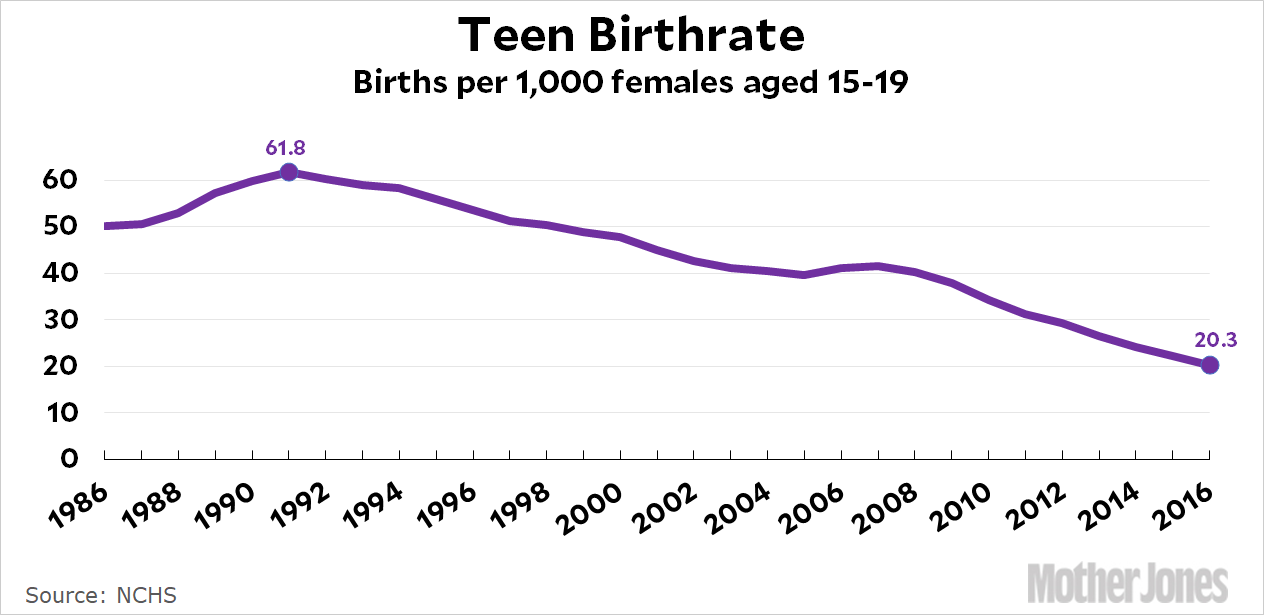
Overall, the decline in the teen-pregnancy rate is one of the unheralded public-policy success stories of the past 25 years. Teen-pregnancy rates reached their peak in 1990 and have fallen every year since then.
This is absolutely true, and it’s true for teen birthrates as well. Here are the overall teen birthrate stats from the CDC:
Neither New nor Carroll suggest how teen pregnancy and birthrates could have plummeted so astonishingly over the past 25 years. But whatever caused it, it has to be something that’s been happening steadily for the past quarter century, so it’s not abstinence-only sex education, and it’s probably not contraceptive use either. It’s a mystery. What kind of thing might have peaked around 1990; affected the entire country; and had a bigger impact on blacks and Hispanics than on whites? Can you think of anything else like this? I can.
One of the great things about County Kerry in Ireland is that it makes photography easy. Maybe too easy. Basically, you just pull off the road every once in a while, point your camera in a random direction, and take some pictures. They’ll all be great.
But let’s start out with something simple. This perfect rainbow greeted us on our first day here. And there was no price to pay, either. The weather was great, with just an occasional light sprinkle. That was enough.
By the way, you have Marian to thank for this. I didn’t even notice the rainbow because I was too busy trying to keep the car in one piece. I’m a bit of a leadfoot driver, but the speed limits here are pretty unbelievable. Even on small, twisty roads, the posted speed limit is 60 mph, and I rarely feel safe above 30-40 mph. But the Irish drivers hurtle along even though the lanes are only a few inches wider than the cars themselves and hairpin turns can appear out of nowhere at any time. On the bright side, we’re still alive and I’ve got loads of beautiful pictures.
For those of you keeping score at home, this picture was taken in the vicinity of Loher. Today we’re driving up to Portmagee to take a boat tour of the Skellig Islands. The weather is spectacular right now, clear and sunny and nicely cool, so it should be a nice trip. Puffin season is over, to my great sorrow, but I’m sure there will be plenty of other attractions.
The bill, titled the Freedom from Equifax Exploitation (FREE) Act, would require credit reporting agencies to offer customers free options to impose or lift a “credit freeze” that stops the sharing and selling of personal credit information to third parties. Currently, there is no federal rule requiring that credit reporting agencies offer any sort of freeze option, and agencies that do, charge between $2-$10 each time a freeze is imposed or lifted.
….The bill—also sponsored by Sen. Brian Schatz (D-Hawaii)—would also offer consumers better fraud alert protections in the wake of the breach, requiring credit reporting agencies to offer up to seven years of renewable fraud alert protections.
As happy as I am to see Warren responding to this—even if there’s precious little chance of Republicans offering their support—I’m surprised that her bill is so weak. It should be stronger and less complicated.
A “credit freeze” is a simple thing: it means that if you apply for credit and someone asks for a credit report, Equifax¹ has to contact you first to make sure that it was really you who applied for credit. That’s it. This should be the default. No hassles, no loopholes. Your personal financial information never gets shared with anyone else until you give explicit permission.
In some cases this would delay getting credit. But these days, it would be a minor imposition for most people. Think about what happens when you forget a password and have to change it. You get an email or a text within seconds and then you click a Confirm button. Done. It could work the same way for credit. There should be a single central clearinghouse that links Social Security numbers with email addresses and phone numbers, and credit reporting agencies would all use that clearinghouse to contact credit applicants for confirmation.
Note that this would be kept entirely separate from the credit report itself. This means that if a hacker does somehow get hold of your credit report, they still don’t know your email address or phone number, so they can’t use the information in the report to go on a credit application spree.
Is this perfect? No, but nothing is perfect. It means you have to keep your contact information up to date if it changes. If you forget, it could result in a long delay getting credit approved. And what if you don’t have email or a smartphone? Then the credit reporting agency would have to contact you via phone, or maybe even postal mail. If that’s too much of a hassle for you, you could apply to have your account permanently accessible to anyone who wants to see it—i.e., permanently unfrozen. Needless to say, if you did that you’d be responsible for any credit hacking or identity theft.
These days, a simple text/email confirmation would be easy for 95+ percent of us, with that number increasing every year. It’s a better solution than Warren’s.
Could more be done? Probably. If the credit reporting agencies were made statutorily responsible for identity theft, I’ll bet they’d think of a few more ideas. So how about it, Senator Warren? Why not a bill that requires identity confirmation in all cases and makes credit reporting agencies responsible for identity theft? It’s simple, easy, and effective. It would make the credit reporting agencies unhappy, and it would drive up their costs, but I think I can live with that.
¹And TransUnion and Experian and anyone else who sells credit reports.
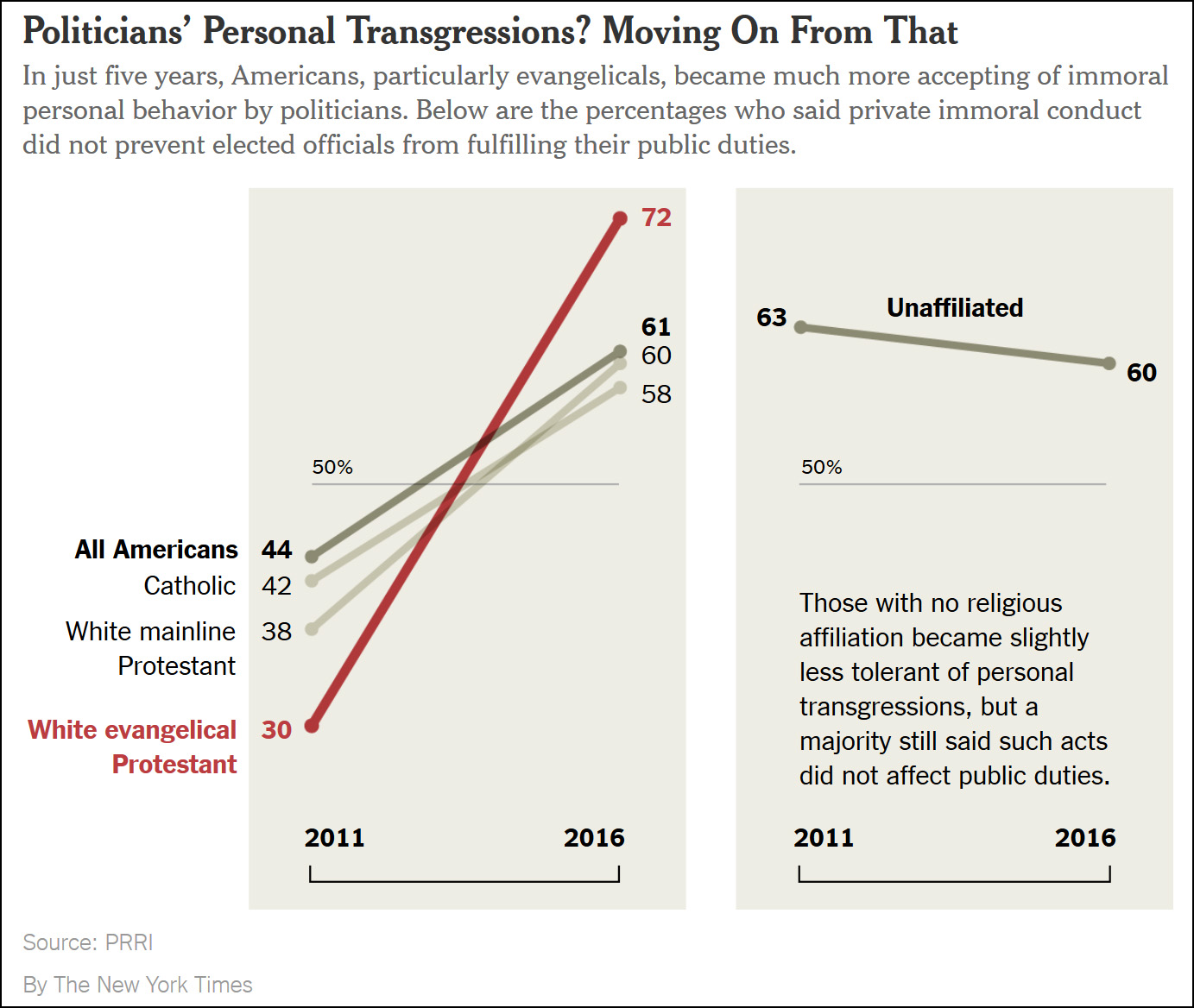
While I’ve been tromping around in Ireland, I see that this chart from Thomas Edsall has been making the rounds:
Edsall comments on this and other recent poll results:
What happened in the interim? The answer is obvious: the advent of Donald Trump….Michael Barber and Jeremy C. Pope, political scientists at Brigham Young University, reported in their recent paper “Does Party Trump Ideology? Disentangling Party and Ideology in America,” that many Republican voters are malleable to the point of innocence.
….Nathaniel Persily, a professor of law and political science at Stanford, described his surprise at the docility of Republican officials in an email: “While I and others had written extensively about the partisan tribalism of both elites and the mass public, I guess I would have expected greater defections by Republicans in the wake of Charlottesville.”
As these quotes make clear, the issue here isn’t religion per se, but Republican affiliation. An awful lot of Republicans apparently have very weak views on most subjects and are willing to support whatever Trump supports. Conversely, those with no religious affiliation, who are heavily Democratic, changed their views hardly at all. That’s not to say they’re unaffected by tribalism, but apparently they’re affected a lot less.
Any way you look at it, though, the strongest effect by far came from white evangelicals, who were almost literally willing to flip their views upside-down when Donald Trump told them to. I’m reminded of the famous description of evangelicals in a Washington Post article 25 years ago as “largely poor, uneducated and easy to command.”
The Post apologized almost instantly, but this nonetheless became legendary on the right as shorthand for the contempt that Beltway elites feel toward evangelicals. But maybe the Post should have held its ground after all. In the age of Trump, it seems like maybe it’s evangelicals who ought to be the ones apologizing. Compared to other religious traditions, evangelicals in general really are poorer, less educated, and easier to command.
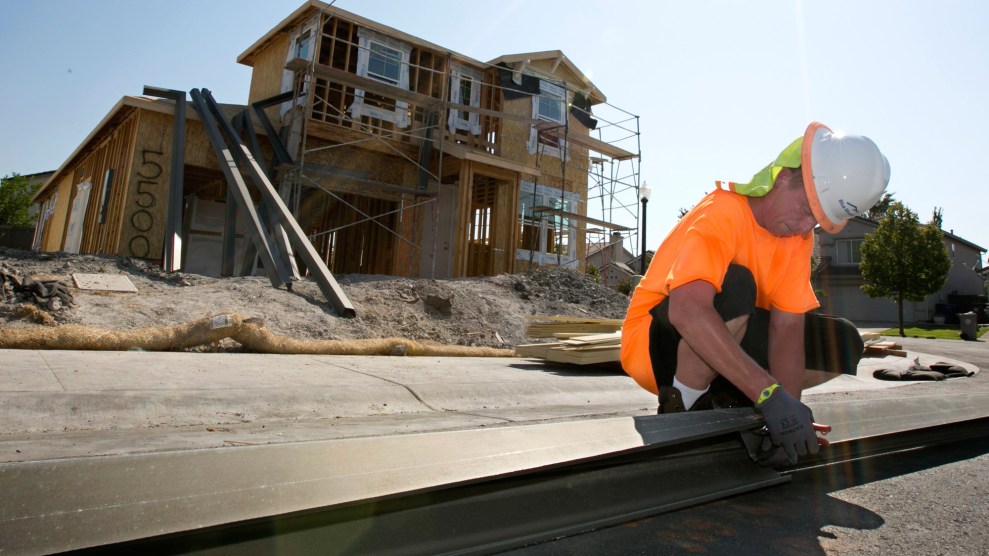
California has an affordability problem. The median cost of a home is $505,800—up $321,000 from five years ago. Homelessness is also on the upswing, with more than 118,000 people without shelter—more than any other state in the country. Californians “are living during the worst housing crisis our state has ever experienced,” said David Chiu, a state assemblyman out of San Francisco and chair of the state housing committee.
So on Thursday evening, with justa hint of late-night drama, the California Assembly passed a package of six bills aimed at boosting funding and easing regulations with the potential to spur affordable housing development throughout the state. The bills are now with Gov. Jerry Brown for his signature.
One measure, Senate Bill 3, authorizes a $4 billion bond measure for the 2018 ballot, with $1 billion going toward funding home loans for California’s military vets and the rest boosting existing affordable housing programs. Another, Senate Bill 35, streamlinesthe approval process for developers in cities that have fallen behind on state housing production goals. Three other bills, meanwhile, seek to strengthen existing laws and compel cities to sign off on more housing developments.
The most controversial measure of the night came in the form of a proposed fee on certain real estate transactions: Senate Bill 2 establishes a scheme that attaches a $75 price tag to real estate documents like those filed during mortgage refinancing. The total fees would not exceed $225. Proceeds are set to be funneled into financing for affordable housing programs; state Senate estimates show that the plan could generate between $200 and $300 million each year and more than $5 billion over the next five years.
With Democrats holding a super-majority in the California legislature, the proposed fee required a two-thirds vote to pass. Even after Republican Assemblyman Brian Maienschein broke from his party and announced on the floor he would vote in favor of SB 2, the measure remained two votes shy of approval. Assembly Speaker Anthony Rendon left the vote open for almost an hour while lawmakers lobbied two Democratic holdouts, Marc Levine and Adrin Nazarian. A third, Sabrina Cervantes, a Democrat from the potential swing district of Riverside, voted against the measure. During the legislative recess, Levine had spoken out against the fee hike and instead wanted to pay for affordable housing by taxing corporations more. In the end, Levine and Nazarian voted for the funding measure.
The state Senate already approved earlier versions of the measures and met Friday to finalize the package. Brown, who negotiated the package with lawmakers, is expected to sign it.
After the Assembly’s progress Thursday night, the governor tweeted his approval:
And we respect that! But maybe you’re of a mind to support our work directly instead? We have until December 31 to raise the last $400,000 we need to keep our nonprofit newsroom running at full strength into 2026. Will you make a gift today?
We noticed you have an ad blocker on. Can you pitch in a few bucks to help fund Mother Jones' investigative journalism?
Billionaires own the media,
but they don’t own us.
At Mother Jones we know these aren’t conventional times, and they require unconventional coverage. That’s what deliver every day: fierce, independent journalism you can’t find elsewhere. Perhaps never in the history of our country has that been more necessary than now. But we can’t do it without reader support—your support. Please chip in today.
Billionaires own the media,
but they don’t own us.
At Mother Jones we know these aren’t conventional times, and they require unconventional coverage. That’s what deliver every day: fierce, independent journalism you can’t find elsewhere. Perhaps never in the history of our country has that been more necessary than now. But we can’t do it without reader support—your support. Please chip in today.