• Raw Data: The Rate of Return on Everything

    This has nothing to do with politics of any kind at the moment, but Tyler Cowen pointed me to a new paper that’s pretty interesting. The authors have compiled a massive new database that shows the returns on treasury bills, treasury bonds, stocks, and housing for 16 different countries over the past 150 years. The countries covered include the United States, Japan, and 14 major European economies, and that allows the paper to show us average returns for advanced economies worldwide, rather than just a single country with its idiosyncratic features. Here, for example is the average real rate of return for governments bills and bonds:¹
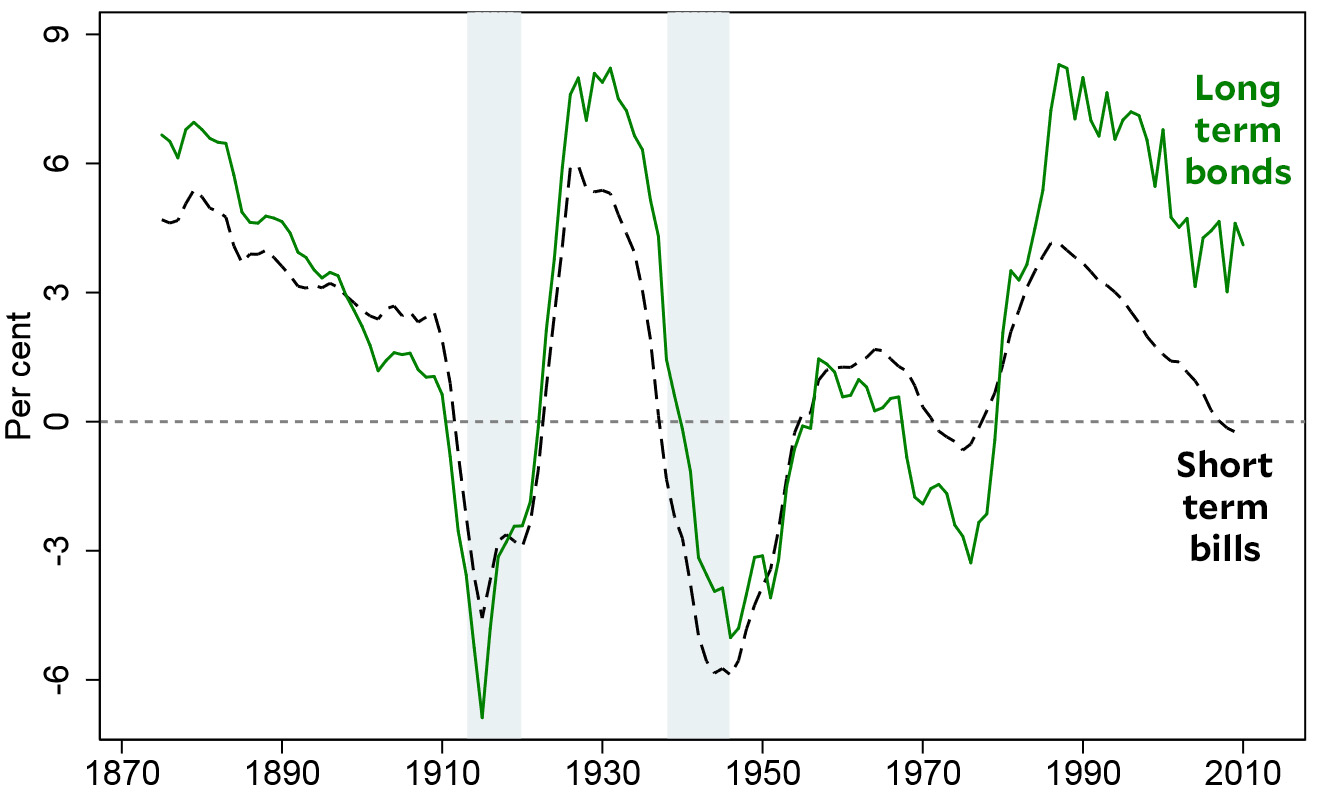
    These are both safe assets, but their returns are surprisingly volatile. In wartime, returns plummet, but even in peacetime they range from -3 percent to 8 percent. And another thing: until 1990, returns on bills and bonds were pretty close, usually within about 1 percentage point of each other. But since 1990, they’ve diverged considerably. For the past 30 years, long-term bonds have consistently returned about 4 percentage points more than short-term bills. It’s not clear why this is, although presumably it means that investors have had expectations of declining inflation for quite a long time. Here’s a chart that combines all safe assets to provide a clearer view of the volatility of returns:
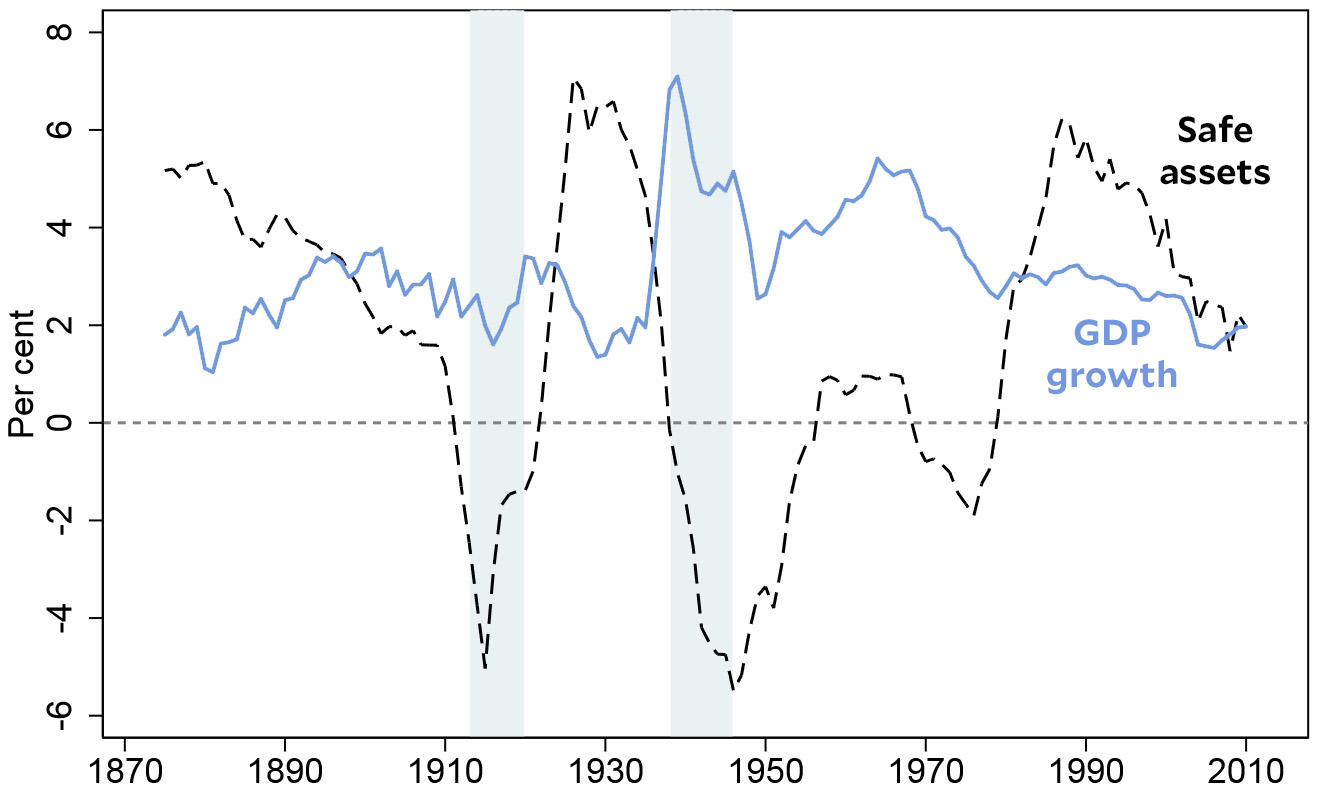
    Even not counting wartime, the return on safe assets has roller coastered between -2 percent and 7 percent. As you can see, there’s no apparent relationship with economic growth, and the authors point out that the average return on safe assets over the past 150 years is roughly 2 percent, about what it is today. This suggests that current returns on government bonds are nothing out of the ordinary.

    But what about risky investments? Here are returns on housing and on stocks:
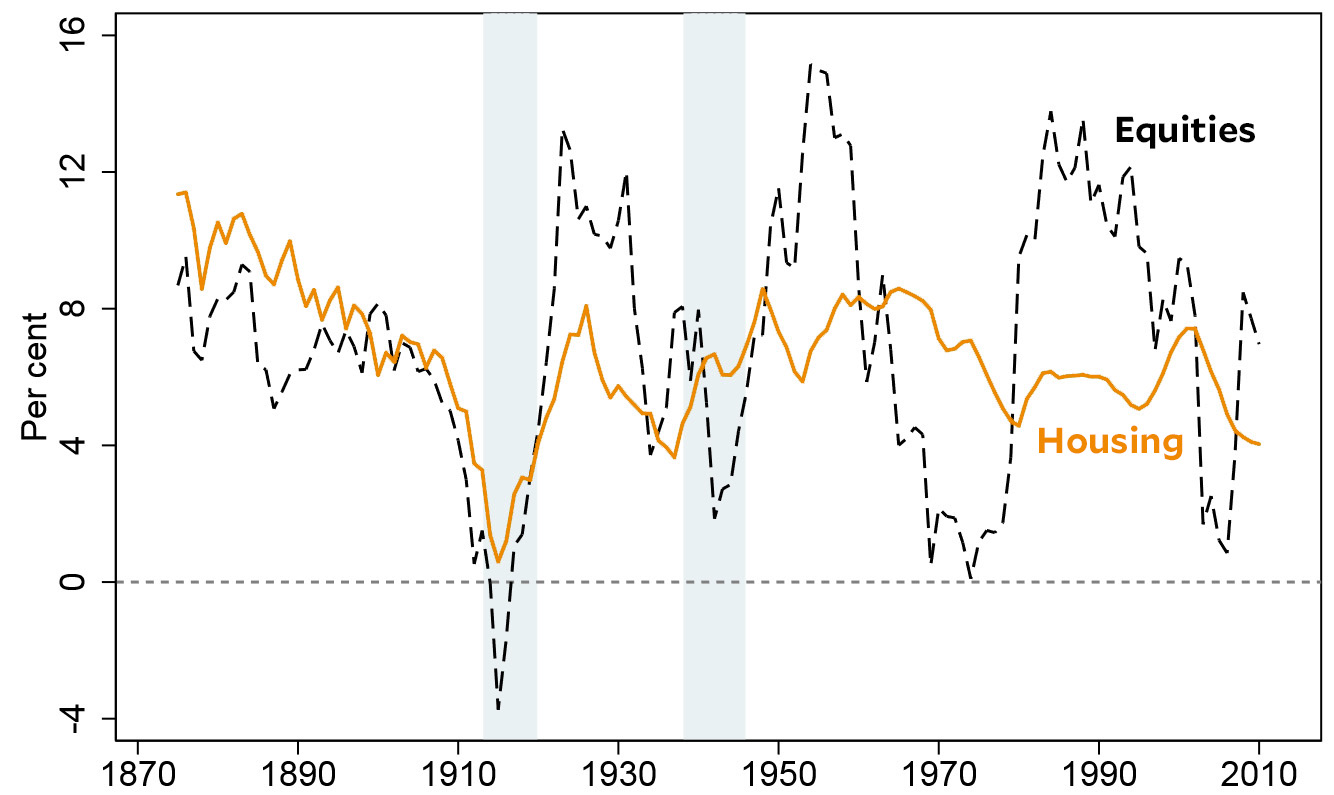
    With the exception of World War I, housing returns have been remarkably stable. With only a couple of exceptions, the return has been between 5 percent and 8 percent year in and year out.² Equities do about as well on average, but are far more volatile, ranging from 0 percent to 15 percent depending on the strength of the economy. If we then take a look at both risky and safe assets together, we can see the evolution of the risk premium over time. Here it is:
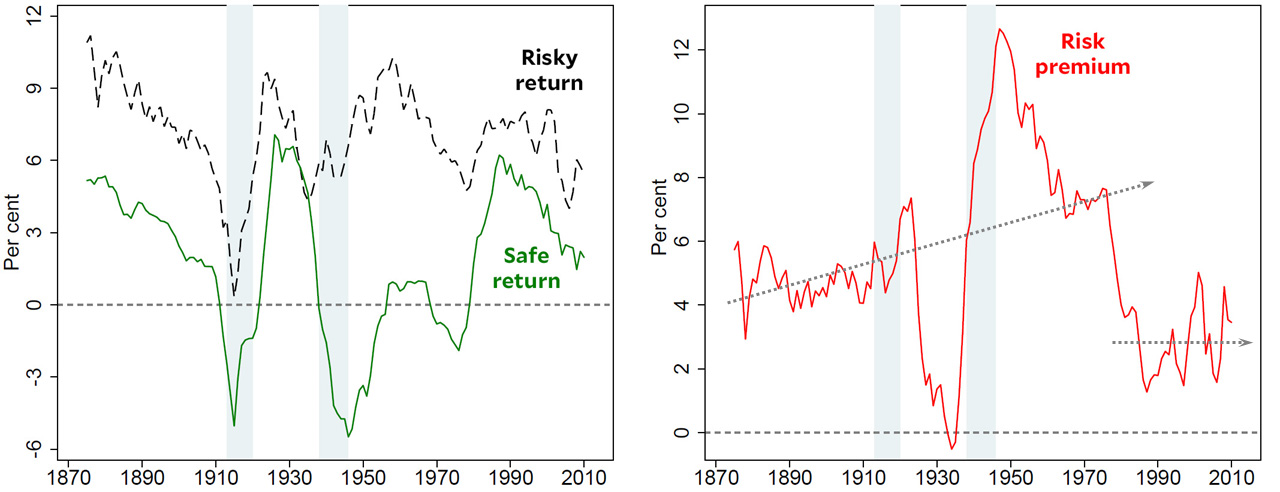
    With the exception of the huge change during the Depression and World War II, the trend is fairly clear. From 1870 to 1970, the risk premium gradually rose from about 4 percent to 7 percent. Then there was a big drop, and ever since the mid-80s the risk premium has hovered around 2-4 percent. For the better part of a century, investors required a premium of 4-7 percent to entice them to invest in equities instead of treasury bonds. But following the collapse of the Bretton Woods regime in the 70s and the global financial deregulation of the 80s, investors have required a premium of only 2-4 percent. This is, presumably, because the neoliberal revolution prompted investors to have greater confidence in steady economic growth and therefore in steady corporate growth.

    I don’t have any big conclusions to offer about all this. Mainly, it’s just interesting raw data, something to provide context when we discuss things like flight to safety or the equity premium puzzle. As this data shows, real returns on both safe and risky assets bounce around a lot, so it’s usually best not to overreact to changes that, in historical context, might not be as dramatic we think.

    ¹The data throughout these charts is for real rates of returns. That is, everything has been adjusted for changes in the inflation rate.

    ²All of these charts show 10-year averages, which is why the great housing boom of the early aughts looks less impressive than you’d think. The stratospheric period of the housing boom lasted only a few years, so the point at 2001 (an average of 1996-2006), which represents its peak, includes only about three years of enormous returns averaged with seven years of merely high returns.

  • Is “Medicare for All” a Winner for Democrats in 2018?

    Bill Clark/Congressional Quarterly/Newscom via ZUMA

    Atrios says:

    Gotta Give People Something to Vote For

    The issue has never been annoying bernie bros who piss you off on the internet. It’s the vast number of people who don’t bother voting because why should they…. “Trump sucks” might win 2018, but if Dems don’t deliver then “Dems suck” will win in 2020.

    This is true, but it’s also a problem. Donald Trump will be president until 2020 no matter how well Democrats do in next year’s midterm elections. Given that, there’s really no way for them to deliver anything. And even if they do, Trump will probably get the credit for it. Presidents always do.

    Still, if there is anything that Dems could credibly promise, my best guess is some version of universal health care. The basic pitch would be that they’ve learned their lesson: incremental change doesn’t work because Republicans will sabotage it the first chance they get. If we want real health care for everyone, with no nonsense about out-of-network swindles or narrow networks or skyrocketing costs, then we need something like Medicare for All. Maybe that’s what Dems should propose. Maybe something else. Or maybe an improved version of Medicare for All (probably my choice)¹ that phases in over time. And liberals being liberals, it should be accompanied by a hundred-page white paper explaining precisely how it would work and precisely how it would be paid for.

    I dunno. Do you think Democrats could get their entire caucus to buy into this? After the events of the past year, you’d sure think so. But then, we’re talking about Democrats here. You just never know.

    ¹Or maybe an improved version of Medicaid for All.

  • There’s No Reform in the Republican Tax Reform Bill

    Matt Yglesias writes today that, to the extent tax cuts have any effect at all, it’s only if people think they’re permanent. But with political polarization so strong, there’s no way that anyone can believe a tax change passed on a party-line vote is likely to last:

    These days, nobody likes preachy blue-ribbon commissions, and bipartisanship is a total nonstarter in Congress. But if you actually want to generate supply-side tax effects, you need to create an expectation of permanence. And bipartisanship seems like one of the only plausible ways to accomplish that.

    This gets at my biggest gripe about the Republican tax bill. If they had truly wanted to pass corporate tax reform—of the kind passed in 1986—they could have gotten plenty of Democrats on board. Then there would have been no need to worry about all the weird reconciliation rules and no need to worry that it might get reversed a few minutes after Democrats are next in power. That’s because actual reform really is pretty bipartisan, and there are plenty of Democrats willing to look at ways to simplify the corporate code, close special loopholes and subsidies, and then lower rates.

    But that was never what Republicans wanted to do. They like to call their plan a “sweeping” tax reform, but it’s not. It’s just a hodgepodge of changes designed to reduce corporate taxes—which are already among the lowest in the world—and act as a vehicle for a few other Republican hobbyhorses, like reducing the estate tax and killing the Obamacare mandate. It’s a nice payoff for corporations and the rich, but that’s it. There’s barely a paragraph of genuine reform in the whole thing.

  • AT&T Is Seriously Sucking Up to Donald Trump

    Here is AT&T on the Republican tax plan:

    June 2017:AT&T is on pace to invest around $22 billion in the United States this year, CEO Randall Stephenson told CNBC on Thursday….Ahead of the tech meeting, Stephenson told “Squawk Box” the company will increase its capital investments if Trump delivers on tax reform by the end of the year.”

    Today: “Once tax reform is signed into law, AT&T plans to invest an additional $1 billion in the United States in 2018….Since 2012, AT&T has invested more in the United States than any other public company. Every $1 billion in capital invested in the telecom industry creates about 7,000 jobs for American workers, research shows.”

    In the most recent quarter, American companies increased their investments in equipment by 6.3 percent. AT&T appears to be planning an increase of 4.5 percent. I am unimpressed.

    But that’s not all! There’s also this:

    December 15: “AT&T today provided details of a tentative agreement reached with the Communications Workers of America in Mobility Orange contract negotiations….Among provisions of the offer: Retroactive wage increases back to Feb. 12, 2017, and a $1,000 lump sum, if the agreement is ratified by Jan. 12, 2018.”

    Today: “Once tax reform is signed into law, AT&T plans to…pay a special $1,000 bonus to more than 200,000 AT&T U.S. employees — all union-represented, non-management and front-line managers.

    Why do I have a feeling that this $1,000 bonus was already in the works for everyone, not just Mobility Orange folks? I guess I’m just cynical.

    In any case, AT&T sure does seem to be going out of its way to suck up to President Trump. I wonder why that could be? It’s a mystery….

    POSTSCRIPT: I should make clear that I don’t blame AT&T for these announcements. Given Trump’s well known ego, it would probably be a breach of fiduciary responsibility if they didn’t slather him with praise at every opportunity.

  • Gary Cohn Is Dumbfounded. Here’s a Chart to Help Him.

    White House economic adviser Gary Cohn just can’t figure out why the Republican tax plan is so unpopular:

    “To be honest with you, I don’t know,’’ Cohn said Wednesday at a Washington event hosted by Axios, when asked why the plan lacked public support. Middle-income Americans “are getting the largest percentage tax savings of anyone in the whole distribution. So we have clearly not communicated that.” Only 24 percent of Americans think the plan is a good idea, and almost two-thirds believe it was designed to help the wealthy, according to an NBC News/Wall Street Journal poll released Tuesday.

    I dunno. Does Cohn really not get it? Or is he just playing his assigned role? The thing is, there’s a very narrow sense in which Cohn is correct. If someone is paying taxes of 5 percent, and you give them a tax cut of 0.5 percent, that’s a reduction of a tenth. If a millionaire is paying 30 percent and you give them a tax cut of 1.5 percent, that’s three times as big but it’s a reduction of only a twentieth. But if Cohn assumes that this is how people view things, he’s either dumb or delusional.

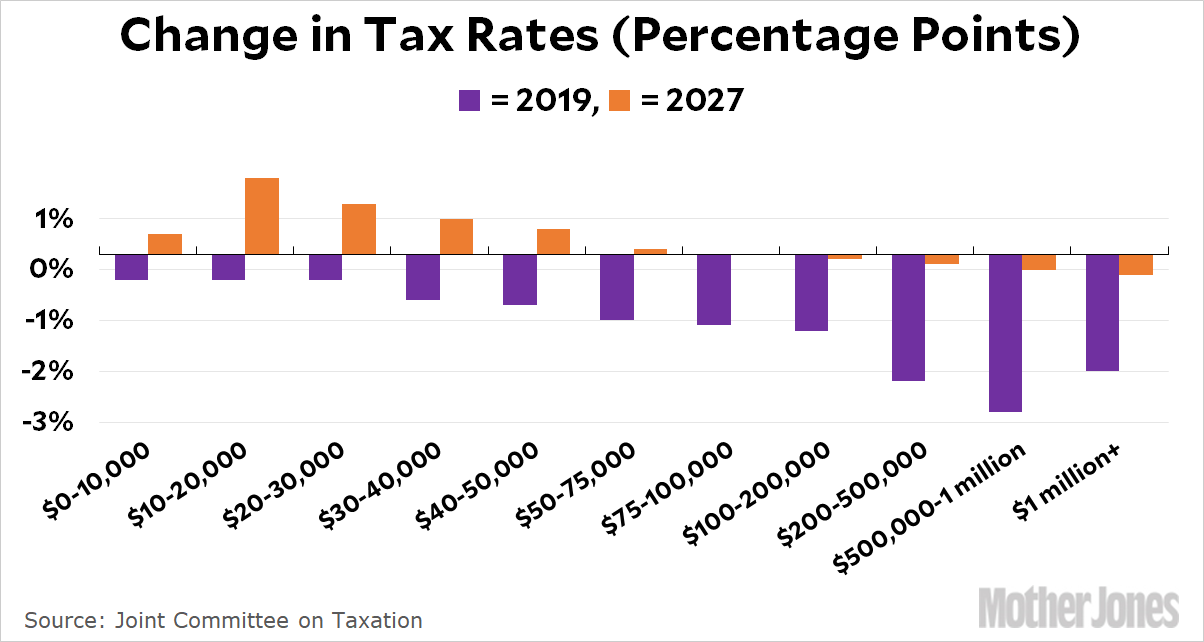
    So let’s go over it for him. I won’t bother showing you projections from the TPC since they’re all a bunch of commies, but here are the estimates from Congress’s own Joint Committee on Taxation:

    The immediate impact of the tax bill is to give small benefits to the middle class and big benefits to the rich. The impact in 2027 is for the middle class to see a tax increase while the rich continue to get a small tax cut. No matter which year you choose, the rich do a whole lot better than the middle class.

    Plus there’s the fact that the whole bill is designed as a big cut in corporate taxes, which the public has been opposed to by huge margins for the entire past year. Bottom line: this is not hard to understand. The public dislikes the tax bill because it’s obviously a gigantic giveaway to corporations and the rich.

    And as long as we’re on the subject of Cohn, he also said this:

    He said if he could change one thing about the plan, he would strip the carried-interest provision in the tax code that largely benefits Wall Street investors. Trump, who promised to end the provision during his presidential campaign, was unable to convince lawmakers to make the change, Cohn said. “We’ve been trying to cut carried interest — we probably tried 25 times,” Cohn said. “We hit opposition in that big white building with the dome at the other end of Pennsylvania Avenue every time we tried.”

    I don’t recall so much as a single leak suggesting that anyone in the White House ever pushed for this. But let’s assume Cohn is telling the truth. It means that on an issue of huge importance to the president (25 times he tried!) he couldn’t get Congress to throw him even this small bone. Is Trump really treated with such immense disdain by his fellow Republicans? Apparently so. He must have really been pissed off about this. I know he’s the shy, retiring type, but you’d think he might have at least tweeted something about it.

  • If You Live in a Red State, the Trump Administration Wants to Steal Your Tips

    The Trump administration has proposed a new rule that allows restaurant owners to collect all tips and then distribute them among both tipped and nontipped employees:

    The proposal would help decrease wage disparities between tipped and non-tipped workers…such as restaurant cooks and dish washers. These “back of the house” employees contribute to the overall customer experience, but may receive less compensation than their traditionally tipped co-workers.

    Isn’t that sweet? Trump is looking out for cooks and dishwashers, the hardworking, unsung heroes who keep our nation’s restaurants going. But perhaps you think maybe there’s more going on here? I don’t know what’s made you so cynical about our president, but just this one time you’re right. The Economic Policy Institute has done some calculations, and Eli Day reports on the fine print:

    Here’s the rub: The rule doesn’t actually require that employers share those tips with untipped staff. Under the proposal, employers can pocket those tips as long as workers earn the minimum wage….According to EPI’s estimates, employers across the country are likely to pocket $5.8 billion worth of employees’ wages if the rule goes through, in addition to an estimated $50 billion in wage theft already occurring nationwide.

    Here’s the funny thing: the Department of Labor is required by law to produce an estimate of the amount of tips that will be transferred from workers to employers under the proposed rule. But they didn’t. Is that because it’s impossible? Not at all: EPI includes a mind-numbingly complete appendix that explains their methodology—methodology that could easily be used by DOL’s wonks to create their own assessment. The problem, of course, is that DOL doesn’t want to produce an official document that suggests their rule will lead to billions of dollars in lower wages for working-class restaurant servers. So they didn’t. That’s the Trump way, after all. He’s a hero of the working class, haven’t you heard?

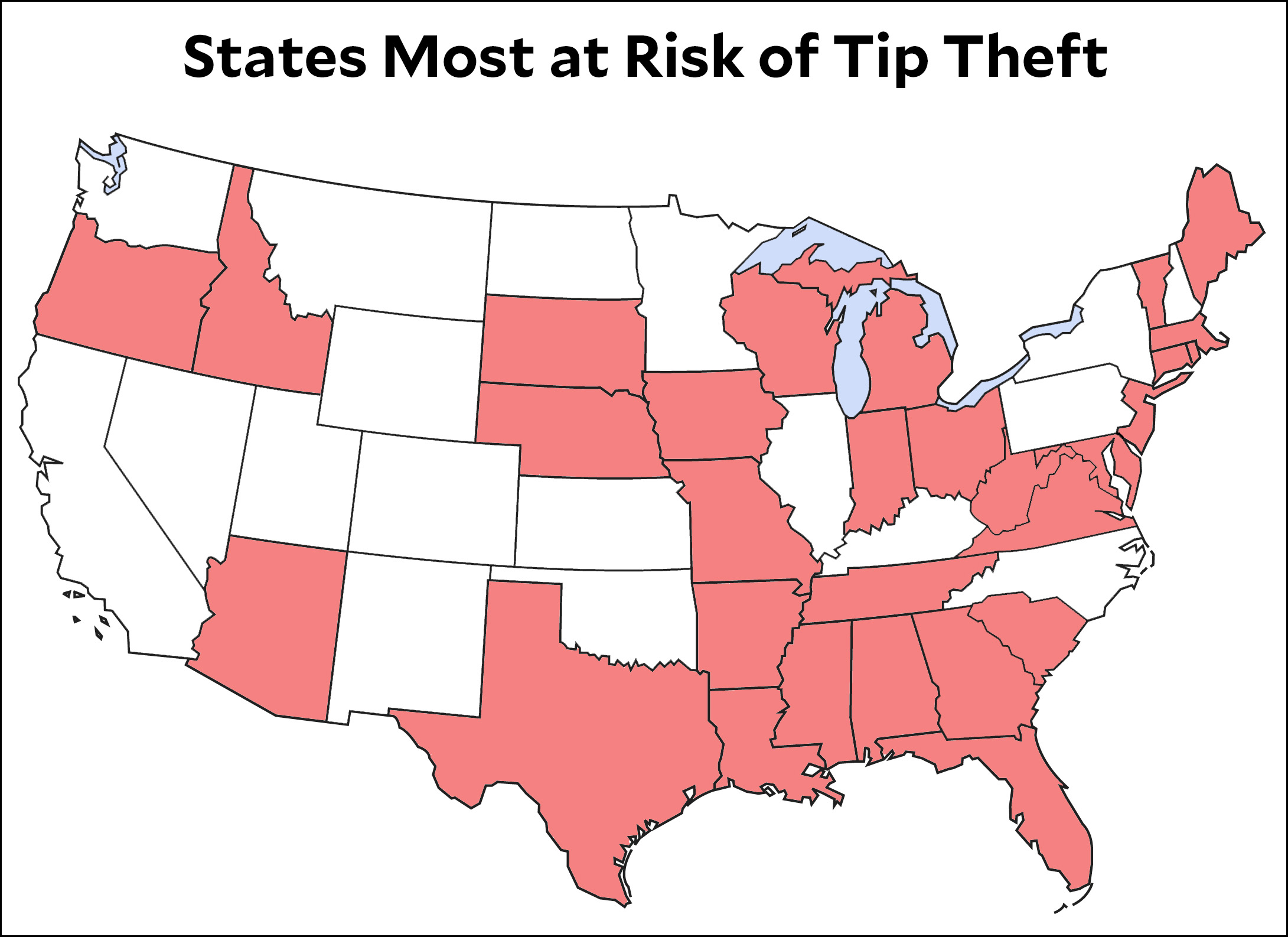
    Anyway, this rule will affect different states differently, since some states have their own rules that protect tipped workers. Servers in blue states like California, Illinois, and New York have little to worry about. But the folks in red states who voted for Trump are about to get screwed big time. On average, servers in these states will lose nearly half of their tip income under the new rule—and that’s after accounting for their increased minimum wage. Here’s a map. Read it and weep.

  • The Generic Ballot Is Predicting a Republican Bloodbath Next Year

    I am generally a skeptic of the “generic ballot” question. This is the one that asks if you plan to vote for a Democrat or a Republican in an upcoming congressional election, and Democrats always seem to hold a big lead. But then that lead fades away, and in the end they either win by a small amount or lose outright.

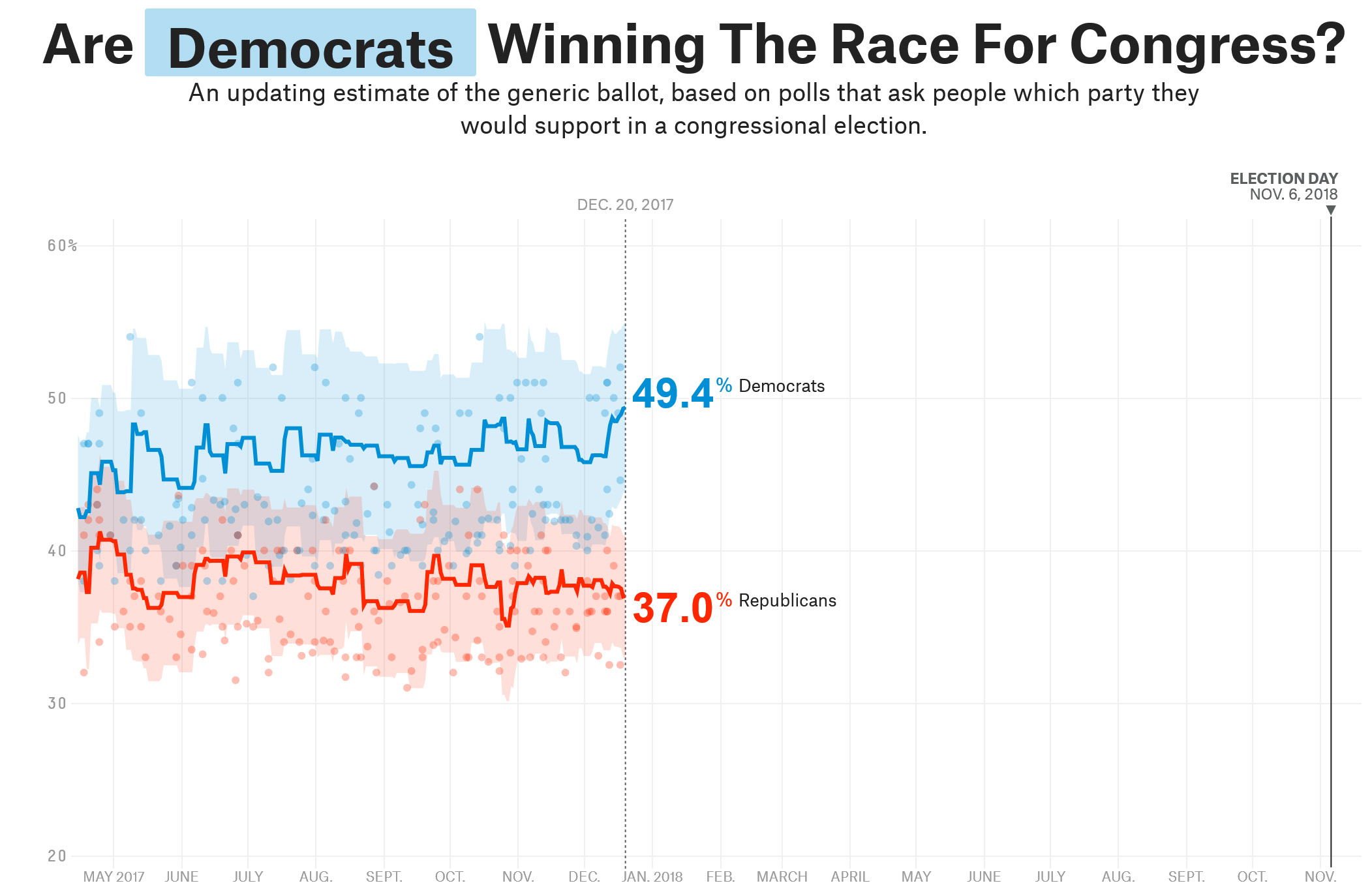
    But I have to admit that the current generic ballot is pretty impressive: according to 538, Democrats are leading by a whopping 12 points. And the folks at 538 claim that generic ballot results a year ahead of the election are actually pretty predictive: anything above 5 points for the out party translates into a big win in November. So perhaps there’s some genuine cause for optimism here.

  • How Are Women Doing in Post-Recession America?

    The Washington Post reports on job losses among women in the retail industry:

    Between October 2016 and October 2017, women who worked in the country’s stores lost 160,300 jobs, while 106,000 men found new work in the field, the analysis from the Institute for Women’s Policy Research found. “We’ve seen many news reports of the decline in retail jobs, jobs, but few have noted that the picture in retail is much different for women and men,” researchers at the Washington think tank wrote.

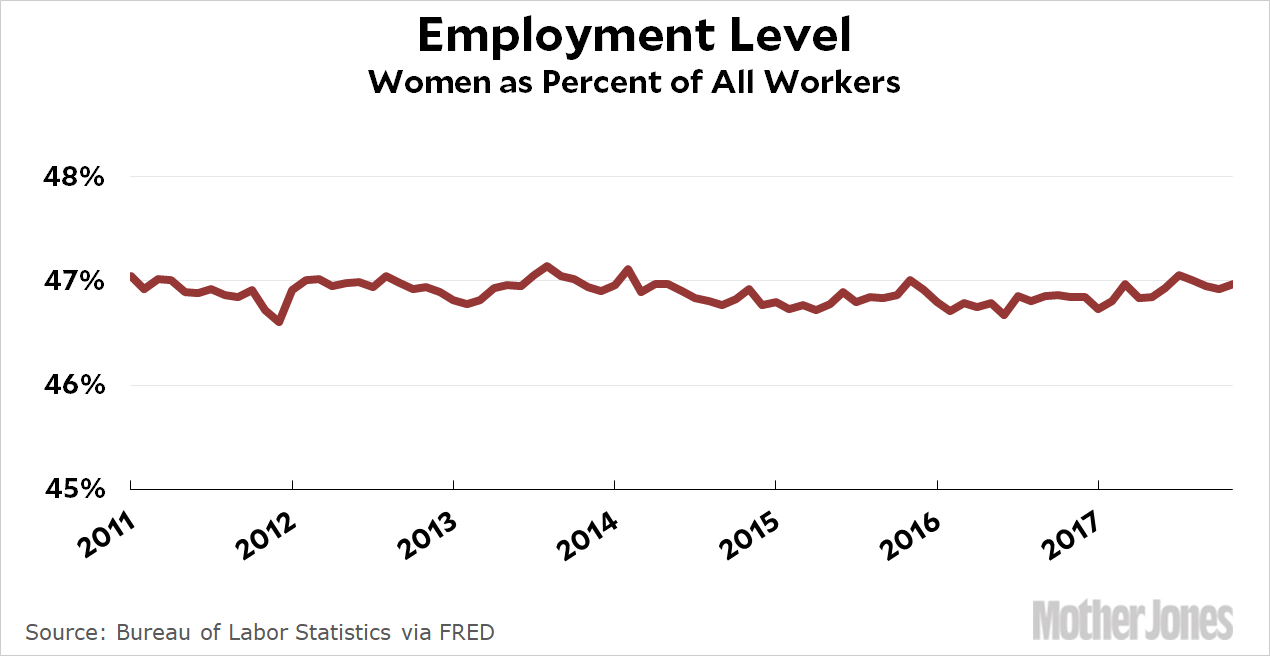
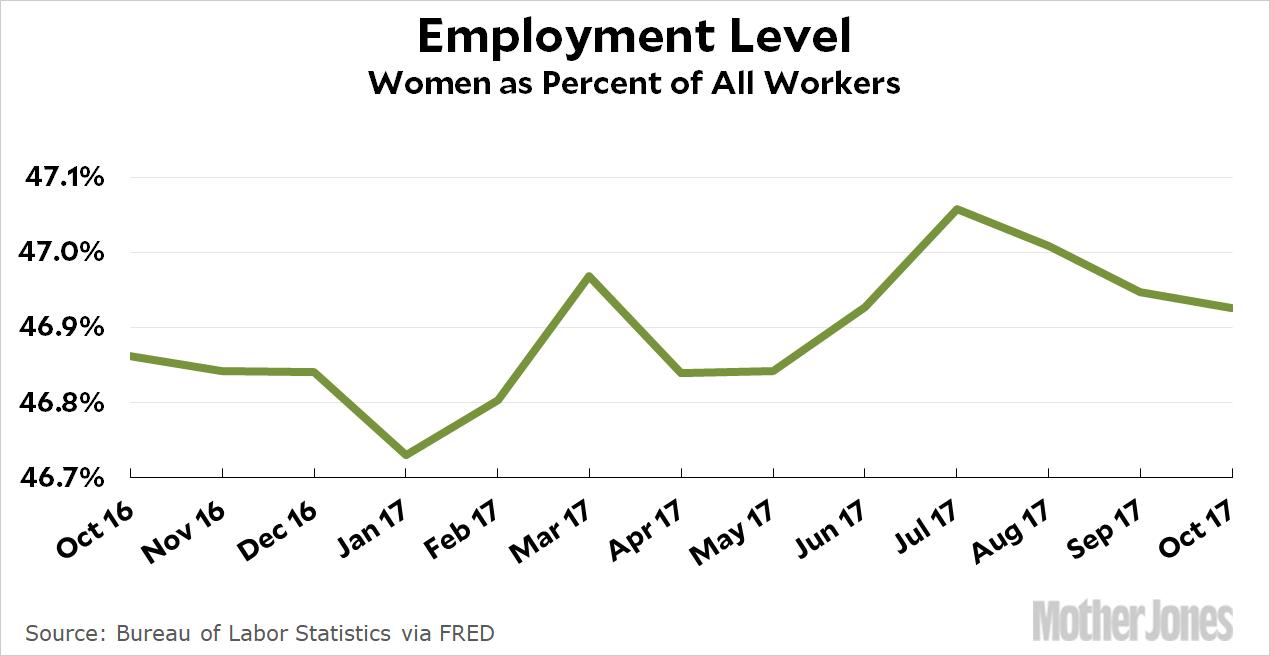
    That’s peculiar. But is it a more general phenomenon? Here’s the employment picture for women overall:

    Women’s share of the job market has been basically flat ever since 2011. In the past year, their share of the job market has increased slightly. So if women are losing jobs in retail, it must be because they’re moving to jobs in other sectors. Is that a step up or a step down? It turns out that women’s wages have risen slightly more than men’s, but probably not enough to mean anything. Most likely everyone is moving around fairly laterally, rather than into better or worse jobs.