• In the Trump Era, Steel Imports Are Way Up

    The New York Times reports that steel imports are up and steelworker jobs are suffering:

    The layoffs have stunned these steelworkers who, just a year ago, greeted President Trump’s election as a new dawn for their industry. Mr. Trump pledged to build roads and bridges, strengthen “Buy America” provisions, protect factories from unfair imports and revive industry, especially steel. But after a year in office, Mr. Trump has not enacted these policies. And when it comes to steel, his failure to follow through on a promise has actually done more harm than good.

    Foreign steel makers have rushed to get their product into the United States before tariffs start. According to the American Iron and Steel Institute, which tracks shipments, steel imports were 19.4 percent higher in the first 10 months of 2017 than in the same period last year. That surge of imports has hurt American steel makers, which were already struggling against a glut of cheap Chinese steel.

    Steel imports have been up every month of Trump’s presidency except November. Here’s a chart:
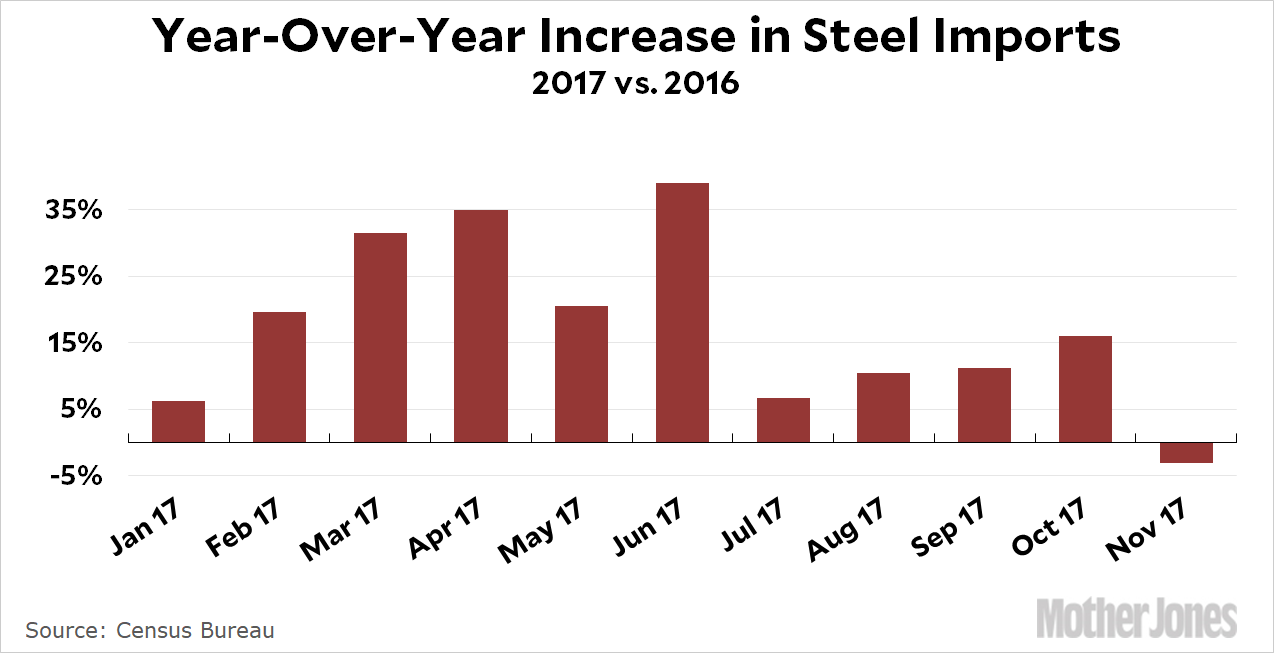
    I’m sure Trump will eventually respond to this with some kind of loud but ultimately meaningless gesture. In the meantime, this seems like the kind of thing Democrats might want to highlight in those upper Midwest states that voted for Trump last year.


  • Wells Fargo Accidentally Admits the Truth: The Republican Tax Bill Has No Connection to its $15 Minimum Wage

    Richard B. Levine/Levine Roberts/Newscom via ZUMA

    Sucking up to Donald Trump is tricky business. On Wednesday Wells Fargo announced that it was raising its minimum wage thanks to the passage of the Republican tax bill:

    Wells Fargo to Raise Minimum Hourly Pay Rate to $15, Target $400 Million in 2018 Philanthropic Contributions, Including Expanded Support for Small Businesses and Homeownership

    Company announces initial actions to support economic growth with tax reform

    “We believe tax reform is good for our U.S. economy and are pleased to take these immediate steps to invest in our team members, communities, small businesses, and homeowners,” said President and CEO Tim Sloan.

    That press release is a little vague. Was Wells really doing all this because of the tax bill? A pair of LA Times reporters called the press office to find out:¹

    Asked by the Times to clarify the connection Wednesday, Wells Fargo spokesman Peter Gilchrist said there was none….Asked directly to confirm that the pay raises were not a result of the tax bill, Gilchrist said, “That is correct.”

    But wait:

    On Thursday, Gilchrist backtracked. “We believe tax reform is good for our U.S. economy and are pleased to raise our minimum hourly pay to $15 as a result.” …He would not comment on the reason for the earlier statement.

    Needless to say, Wells Fargo is in a heap of trouble these days over a series of scandals that never seems to stop, so flattering the president is just good business. Maybe it won’t help, but it can’t hurt.

    In any case, I think we can take this as a case study in what’s really going on with all those companies announcing new initiatives thanks to the tax bill: they have nothing to do with the tax bill at all. It’s just business as usual. But they’re certainly eager to say it’s because of the tax bill. I suppose I would be too if I had a lot of business with the Justice Department or the SEC or the Pentagon.

    ¹Originally I had no link for this story, but now I do. After intense investigation, it appears that the latimes.com site automatically redirects me to beta.latimes.com, which doesn’t quite work yet and didn’t have this story available. That’s why I couldn’t find it. It’s not surprising for a beta site to have bugs, but it’s not clear why I’m unable to access the regular site.

    Oh, and this is only on Firefox. It works fine on Chrome and Edge. I deleted all my latimes.com cookies, but that didn’t help. The investigation continues.

    Later: I went in and removed all site-specific data for both latimes.com and beta.latimes.com. That did the trick.

  • Republican Campaign to Smear Robert Mueller Moves Into High Gear

    Pete Marovich via ZUMA

    From NBC News:

    On the orders of Attorney General Jeff Sessions, Justice Department prosecutors have begun asking FBI agents to explain the evidence they found in a now dormant criminal investigation into a controversial uranium deal that critics have linked to Bill and Hillary Clinton, multiple law enforcement officials told NBC News. The interviews with FBI agents are part of the Justice Department’s effort to fulfill a promise an assistant attorney general made to Congress last month to examine whether a special counsel was warranted to look into what has become known as the Uranium One deal, a senior Justice Department official said.

    Hillary Clinton gave away our uranium to Russia!

    Oh. So what’s the deal here? Is this just another Benghazi, an excuse to hold endless hearings that will trash Hillary Clinton’s reputation?

    Nope, not that either. Republicans don’t care about Hillary Clinton anymore. This is all about trashing Robert Mueller’s reputation. Keep this in mind whenever you read Uranium One news. Mueller was director of the FBI back when the Uranium One deal was approved, and Republicans are desperately hoping to find evidence¹ that Mueller protected Obama and Clinton by thwarting investigations of wrongdoing. Then they can push for Mueller to be fired. That’s what this is all about.

    ¹Or “evidence.” You know what I mean.

  • Atomic Tests During the 1950s Probably Killed Nearly Half a Million Americans

    You probably need something to cheer you up after the tax follies of this week. So how about a scholarly examination of how many Americans were killed by atomic bomb testing in the 50s? I think that should do the trick.

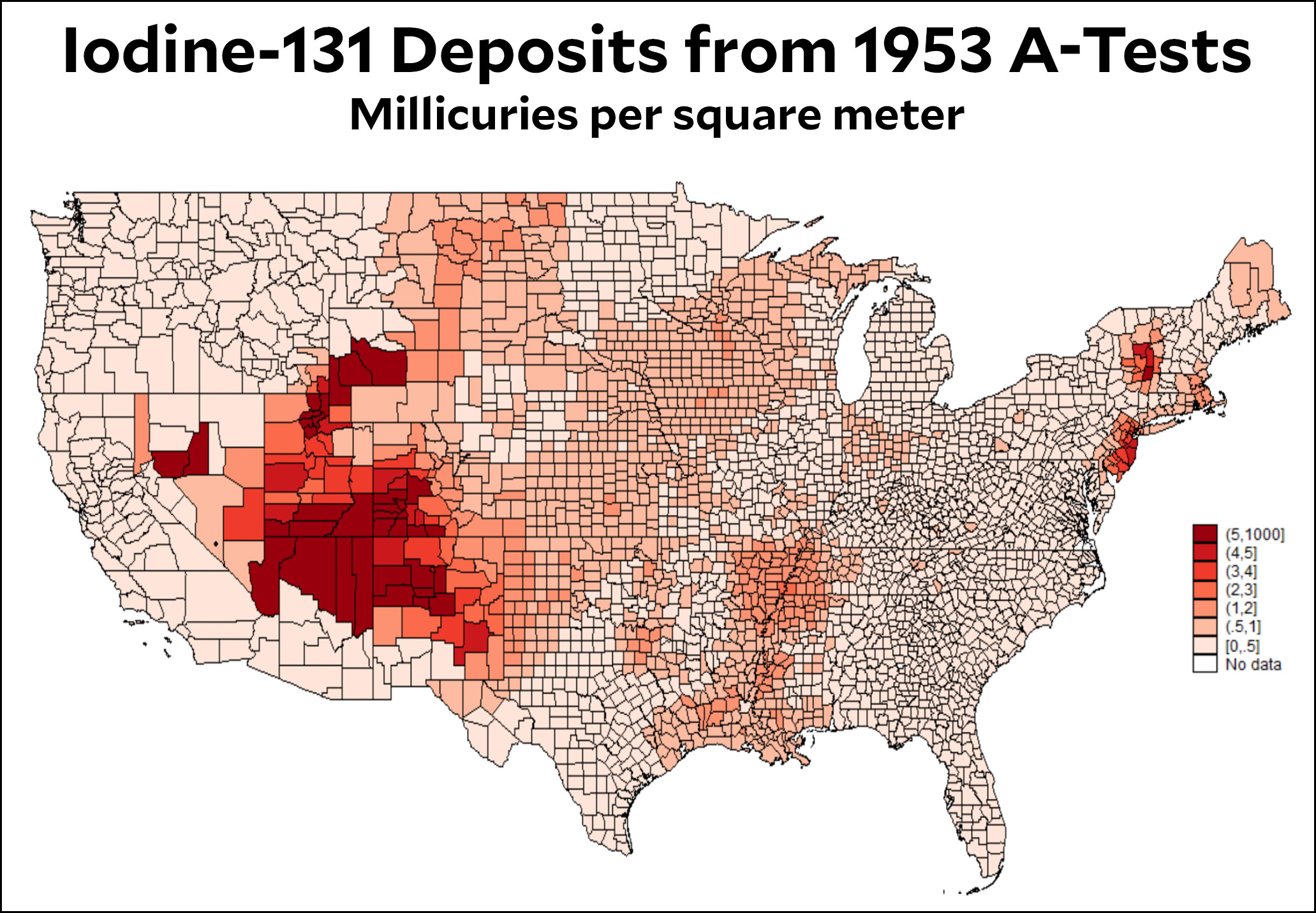
    Here’s the background. After 1949, the US moved most of its atomic bomb testing from the South Pacific to a test facility in Nevada. These were all above-ground tests that generated quite a bit of radioactive fallout, including an especially dangerous isotope of Iodine called Iodine-131. The map below shows the deposits of Iodine-131 from a typical series of tests done in 1953:

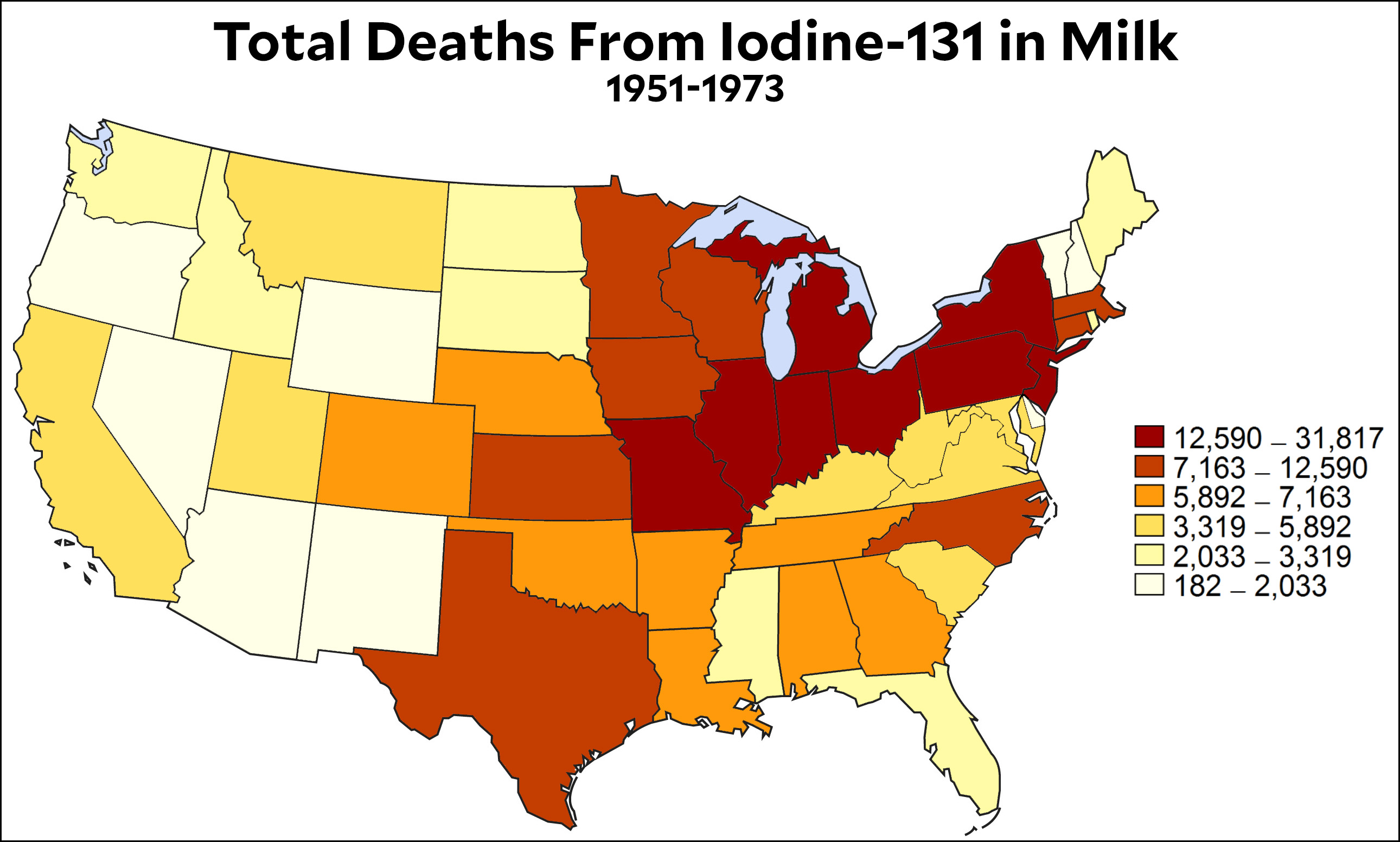
    As you’d expect, the highest concentrations are immediately downwind of the Nevada Test Site, with a couple of odd hot zones in New Jersey and upstate New York. Luckily, these are mostly areas of sparse population. Unluckily, this doesn’t matter much because it’s not the primary way that Iodine-131 kills people. Most of it ends up being carried by high-altitude winds and then deposited by rainfalls throughout the country. From there it gets into pastureland and then into the milk supply, where it attacks the thyroid. In a new working paper (i.e., still a bit preliminary) Keith Meyers made use of extensive datasets on milk consumption and local death rates and produced a map that shows which areas were most heavily affected:

    It turns out that the victims were mostly quite far away from Nevada. A combination of extensive dairy farming and high populations meant that most fatalities were in the upper Midwest extending all the way over to the Eastern seaboard. A rough calculation suggests that the total death toll from testing during the 50s clocked in at about 400,000, far higher than most previous estimates. Children were disproportionately affected because they drink more milk and have smaller thyroids.

    But there is, surprisingly, some good news here too. Starting in 1958, and then made permanent by the Partial Nuclear Test Ban Treaty, atmospheric testing was halted. Meyers figures that the testing which was moved underground between 1958-1992 probably saved millions of lives. So it could have been a lot worse.

    UPDATE: The original post said that underground testing saved 12-24 million lives, which is indeed the rough estimate in the paper. However, that comes with a number of caveats, and the actual number is most likely smaller. I’ve changed the text to reflect this.

  • Chart of the Day: All the Senate’s Discrimination Settlements

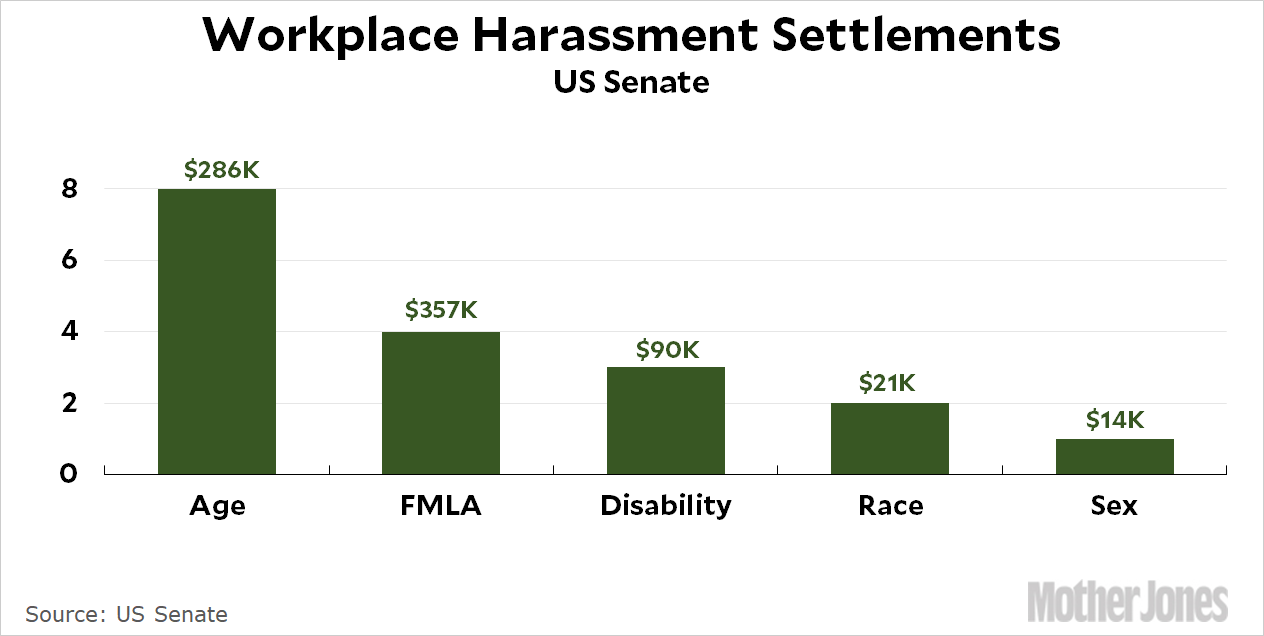
    The US Senate has released a list of the workplace harassment claims that it’s settled since 1997. There are a total of 13 settlements totaling $600,000, and since everything is better in chart form, here’s what the settlements were for:

    That looks like more than 13, doesn’t it? And more than $600,000, too. That’s because some of the settlements are for multiple issues. Violations of the Family and Medical Leave Act, for example, are almost always paired up with something else.

    Anyway, it looks like age discrimination is the biggest issue in the Senate, which is kind of ironic considering that the average age of senators is, like, 103 or something. But I guess they prefer offices full of young whippersnappers who will work 20 hours a day and demonstrate endless fealty because their vaulting ambitions haven’t yet been snuffed out.

    This list, by the way, is limited to settlements by the offices of actual senators. There’s a separate list for other Senate offices, and that one includes a $421,000 settlement for “race discrimination and reprisal.” That’s by far the largest settlement on either list, but if you think of it instead as a 28 bitcoin settlement, it doesn’t seem so bad, does it?

  • Obamacare Headed For Record Enrollment

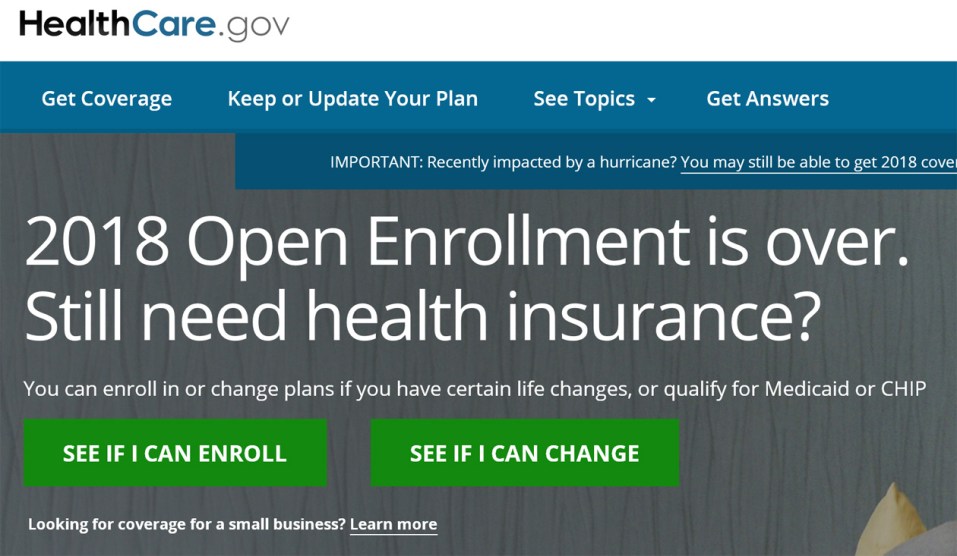
    This is true, but only for the federal exchange. Many of the largest state exchanges are open for several more weeks.

    This just came in from CMS:

    Presumably this number is solely for Obamacare signups on the federal exchange, and it’s only slightly lower than last year’s 9.2 million. That’s not bad.

    But wait. We already have 2.8 million signups via the state exchanges. That’s 11.6 million total, and many of the state exchanges are still open. California, for example, doesn’t close enrollment until the end of January. So signups on the state exchanges will surely finish up at—what? 3.5 million? If that’s the case, Obamacare would end up with total enrollment (federal + state) of 12.3 million, slightly higher than last year.

    But wait again. Even on the federal exchange, enrollment is still open in states affected by hurricanes. It’s not impossible that Obamacare enrollment by the end of January could be as high as 13 million. We’ll see.

    Maybe I’ve done some arithmetic wrong here. But it sure looks like Donald Trump’s efforts to sabotage Obamacare only made people more aware that it was out there and they should sign up for it.

    UPDATE: Yes, I did some arithmetic wrong. 8.8 + 2.8 = 11.6, not 12. I’ve revised the text.

  • Quote of the Day: Nothing in Writing, Please

    Greg Lovett/The Palm Beach Post via ZUMA

    From a Palm Beach Post story by Christine Stapleton and Lawrence Mower about Donald Trump’s purchase of Mar-a-Lago in the early 90s:

    Trump’s promise couldn’t be in writing, Trump attorney Rampell told the council, according to meeting minutes and transcripts. If the council insisted Trump’s commitment be in writing, his donation might be disqualified by the IRS as a charitable contribution.

    The backstory here is that the city of Palm Beach wasn’t happy with Trump’s plans for preserving the Mar-a-Lago estate. So Trump’s lawyers proposed a deal: if the city council approved Trump’s plan to create a private club, Trump would turn over much of the interior of the mansion to the National Trust for Historic Preservation. But the deal had to be under the table. Trump wanted a tax deduction for his charitable contribution to the NTHP, and it’s not charitable if it’s done in return for something, is it?

    So, wink wink nudge nudge, and the deal went through. But there was never any paper trail, so the IRS approved the charitable deduction. Life is good when you’re a millionaire.

  • Is Illegal Immigration Responsible for the Decline in Labor Force Participation?

    Why are prime-age men dropping out of the labor force? And what can we do about it? A few days ago the Two Jasons tackled this question and came up with very different answers. Here is Jason Richwine criticizing Jason Furman:

    How about restricting low-skill immigration to encourage recruitment of Americans? No, Furman says, because — well, actually, he does not mention immigration at all, not even to dismiss its importance. Omitting the i-word in discussions of labor-force dropout is an unfortunate habit on both the left and the right. Amy Wax and I wrote our Inquirer op-ed (based on a much longer essay in American Affairs) to show that employers turned to immigrants as the native work ethic declined. As evidence, we point both to the much higher labor-force participation of low-skill immigrants compared to low-skill natives, as well as to the near-universal preference expressed by employers for immigrant labor. Restricting the flow of foreign workers would generate a major incentive for business owners, politicians, and opinion leaders to reintegrate American men into the labor force. It is, in our opinion, a crucial part of any reform strategy.

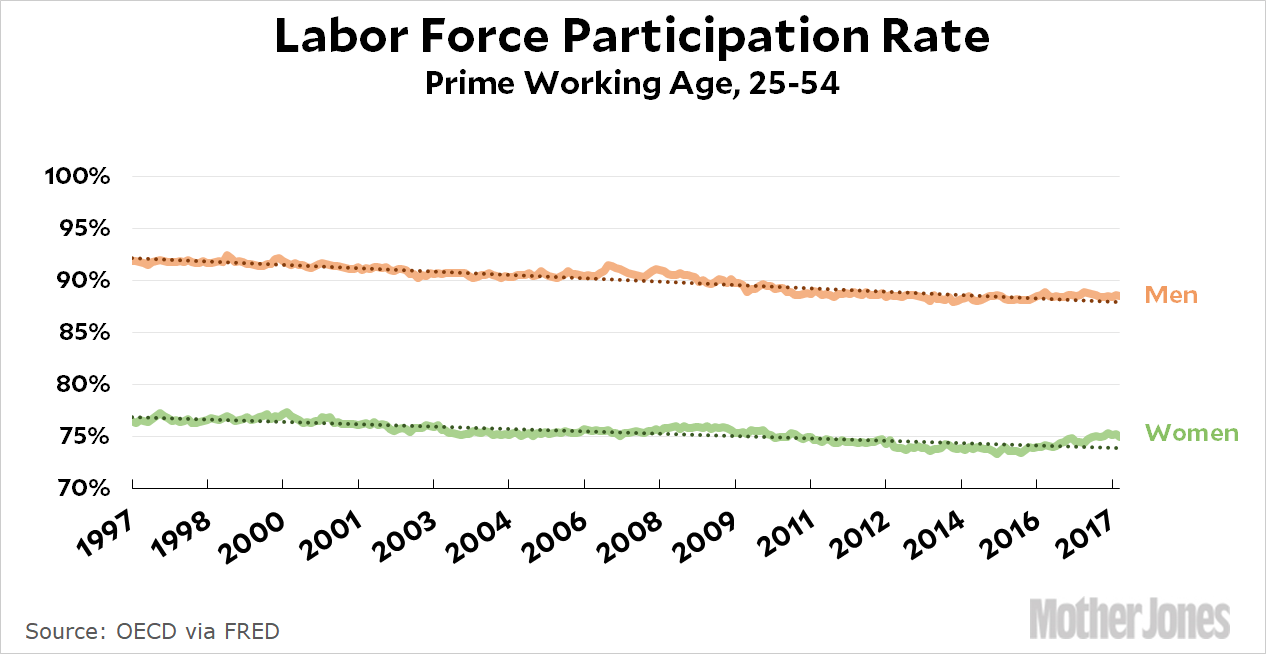
    I don’t have a huge dog in this fight since, by lefty standards anyway, I’m pretty open to policies that humanely restrict illegal immigration. But I have a couple of questions for Jason R that I’m genuinely interested in. First, there’s this:

    Labor force participation of women rose steadily starting with the feminist revolution of the 60s. However, participation peaked in the late 90s and has been declining ever since. In other words, for the past couple of decades this is a problem that’s not restricted just to men. Is illegal immigration affecting the labor force participation of women the same way?

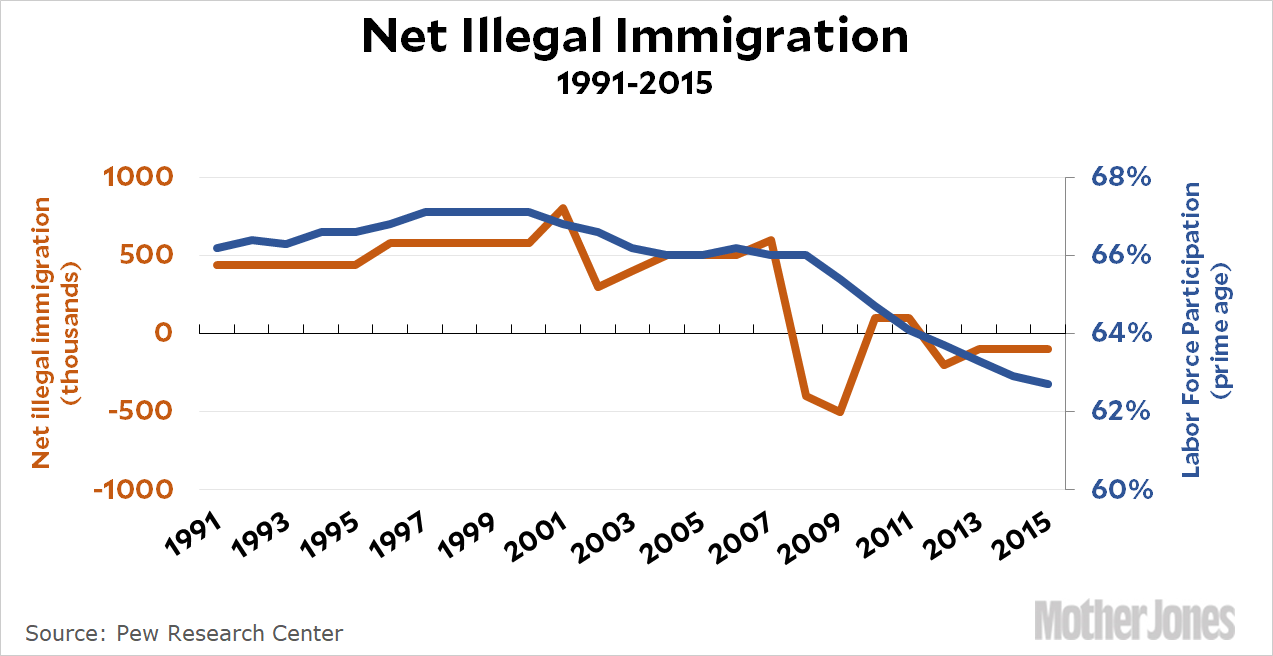
    Second, if illegal immigration really is a factor, then labor force participation of native workers should be correlated with the amount of illegal immigration. But it doesn’t seem to be:

    I don’t want to make too much of this, since the Great Recession obviously had a big impact on both illegal immigration rates and labor force participation. Still, overall labor participation turned down in 2000 and then turned down even more in 2009. But illegal immigration rates didn’t change in 2000, and then changed in the wrong direction in 2009. Lower immigration rates should have increased labor force participation. What’s more, labor force participation among men has been dropping steadily since the 60s, with the rate hardly changing at all even as illegal immigration has spiked up and down.

    There are so many other, bigger factors that affect labor force participation that I don’t really expect much from this comparison. But I’d expect at least a glimmer of something if unauthorized workers from Mexico really are causing native workers to just give up on the job market. Why don’t we see anything?

  • Do Voters Really Hate the Republican Tax Bill?

    Alex Edelman/CNP via ZUMA

    John Judis doesn’t think the Republican tax bill will hurt them in the 2018 midterms:

    I don’t buy the argument — voiced by Democratic pundits, political consultants, and even a few economists — that the bill will doom the Republicans to defeat in 2018 and even 2020. Like many things I read or hear these days from liberals, it’s wish fulfillment disguised as analysis.

    Democrats argue that the bill will be unpopular because it increases inequality by giving huge tax breaks to the rich and corporations. But most American voters don’t object to inequality and to the rich per se….The tax bill does give immediate benefits to the middle and lower classes. These include the increase in the child credit and standard deduction and lower rates….It is likely in the short run, that is, during Donald Trump’s presidency, to prolong the recovery and hold off an eventual downturn….Finally, I hear liberals and Democrats pointing to polls showing the tax bill is unpopular. I distrust these polls….Whether a policy is popular or not is usually settled during campaigns when the candidates try to interpret its results.

    I halfway agree with Judis. The middle class does benefit in the short run from the tax bill, and George Bush’s tax cuts demonstrated pretty clearly that most people are satisfied with a modest tax cut even if they know it’s mainly a sop to disguise a huge tax cut given to the rich. And to Judis’s arguments I’d add another: Corporations employ an army of tax attorneys, and by November 2018 they’ll know exactly what the tax bill does for them. Ordinary folks don’t, and they won’t. It’s not until they start doing their taxes a few months later that they’ll really figure it out.

    However, the sentence I highlighted is key, and it won’t necessarily work in Republicans’ favor. A popular president would be able to make a good case for the tax bill, but Trump isn’t popular and isn’t likely to be a year from now. It’s a lot easier for Democrats to paint the tax bill as a giveaway to corporations and the rich if the electorate already dislikes Trump and is primed to believe this. Popularity casts a golden sheen over everything a president does, but the opposite is true too. The tax bill will suffer merely for its proximity to Trump.

    All this depends, of course, on Democrats making a good case against the bill. That’s not a slam dunk given their recent history, but the opportunity is certainly there.