• What’s Up With the Kids Today?

    I have a project for some enterprising data journalist or PhD student. Maybe this just comes of reading Atrios so much, but I’d like to know if millennials are really being attacked constantly for their perceived deficiencies. You know the drill: slackers, Facebook addicts, always playing video games, etc.

    Obviously this stuff is out there. After all, I just reeled off a few examples and it only took me a few seconds to think of them. But is this worse than the Xers had it? Or the boomers? Or the Greatest Generation™? Or Aristotle’s pals compared to Plato’s? The problem is that I can’t think of any reasonable way to investigate this that’s open to a lazy blogger. Take this Google Ngram, for example, which plots the popularity of the phrase “kids today” in books since 1940:
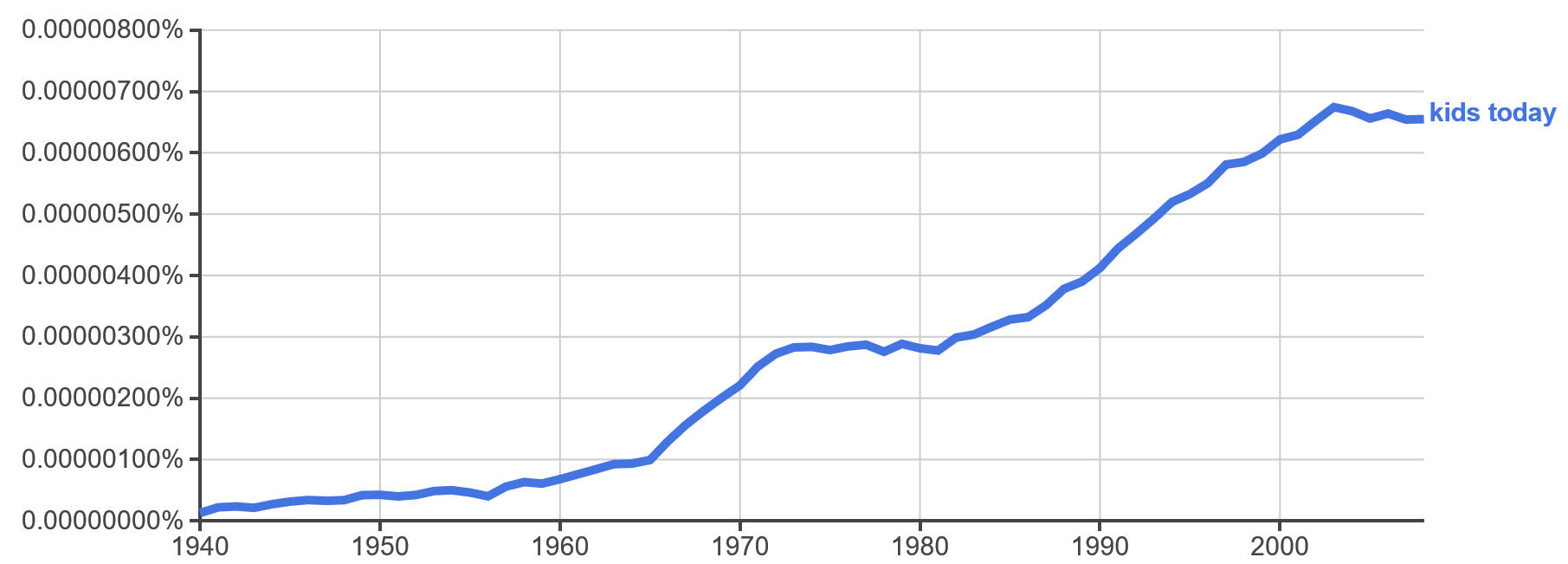
    Actually, this is kind of interesting. There’s a sudden surge around 1965 and another surge starting around 1981. Hmmm. And if I had to guess, I’d say that the phrase “kids today” is more often derogatory than not. But I don’t know that. Nor do I know what similar phrases were used in the past. Or if Google’s corpus of books is really representative. Or why Google still hasn’t gotten past 2008 in their Ngram viewer.

    In any case, this approach is hopelessly flawed. It would take some really diligent research to come up with a credible longitudinal estimate of disparagement toward the kids unless those Freakonomics guys can come up with some annoyingly clever natural experiment that provides a quick answer. But I’d like to know! Are kids today on the receiving end of more abuse than kids of yesteryear? Who wants to be the Albert Einstein of the generation gap who finally solves this puzzle?

    UPDATE: Several people have suggested that the 1965 surge is due to the song “Kids” from the 1963 movie version of Bye Bye Birdie:

    Maybe! The timing doesn’t seem quite right, but it’s close. We still need to figure out 1981, though.

  • Donald Trump’s Lies Are Different

    Rex Shutterstock via ZUMA

    The New York Times writes today that presidents have been lying for a long time:

    One of the first modern presidents to wrestle publicly with a lie was Dwight D. Eisenhower in May 1960, when an American U-2 spy plane was shot down while in Soviet airspace. The Eisenhower administration lied to the public about the plane and its mission, claiming it was a weather aircraft…In 1972, at the height of the Watergate scandal, President Richard M. Nixon was accused of lying, obstructing justice and misusing the Internal Revenue Service…President Clinton was impeached for perjury and obstruction in trying to cover up his affair with an intern, Monica Lewinsky, during legal proceedings.

    Ah, those were the good old days. Presidents lied infrequently, but when they did, they told real whoppers. And those whoppers were designed to cover up serious misdeeds.

    This is what makes Donald Trump so different. He tells lies constantly, but his lies are mostly trivial. It’s easy to understand why Nixon or Clinton lied, regardless of whether we approve. But it’s not so easy to understand the point of Trump’s torrent of fibs. Can he not help himself? Does he genuinely not understand what he’s doing? Is he unable to deal with the possibility that he isn’t the greatest human being in the history of the planet? It’s a mystery.

    One way or the other, he sure is one weird dude. My guess is that he’s also not entirely in control of his faculties anymore. Here is Robin Wright in The New Yorker:

    Why Is Donald Trump Still So Horribly Witless About the World?

    “Trump has an appalling ignorance of the current world, of history, of previous American engagement, of what former Presidents thought and did,” Geoffrey Kemp, who worked at the Pentagon during the Ford Administration and at the National Security Council during the Reagan Administration, reflected. “He has an almost studious rejection of the type of in-depth knowledge that virtually all of his predecessors eventually gained or had views on.”

    …“The sheer scale of his lack of knowledge is what has astounded me—and I had low expectations to begin with,” David Gordon, the director of the State Department’s policy-planning staff under Condoleezza Rice, during the Bush Administration, told me.

    This is decidedly not normal. Most people, even if they were abysmally ignorant, would learn some things over the course of two years of campaigning and being president. Even if, like Trump, they declined to read anything, they’d pick up stuff by osmosis. There’s a helluva lot of expert conversation that surrounds people like Trump, and you can hardly help but learn from it unless you’re actively trying to block it out.

    Apparently that’s what Trump does. It’s not just that he’s galactically ignorant, it’s that he actively works to stay that way. What kind of person is so afraid of facts and knowledge that he actually spends emotional energy to prevent learning anything, even if that learning is essentially free?

    Alternatively, Trump is no longer completely in control of his faculties and simply forgets stuff almost as soon as he hears it. My guess is that it’s some of both.

  • The Mystery of the Tight Labor Market

    The Wall Street Journal reports on the strength of the job market:

    Americans are less likely to be laid off than at any point in at least 50 years….The steep fall in layoffs is mainly a result of a vastly improved labor market. It means Americans have more job security than they may realize less than a decade after dismissals spiked in the 2007-2009 recession….After nearly seven years of consistent job growth, firms are reluctant to let employees go in a tight labor market in which available workers with a recent employment history are quickly snapped up.

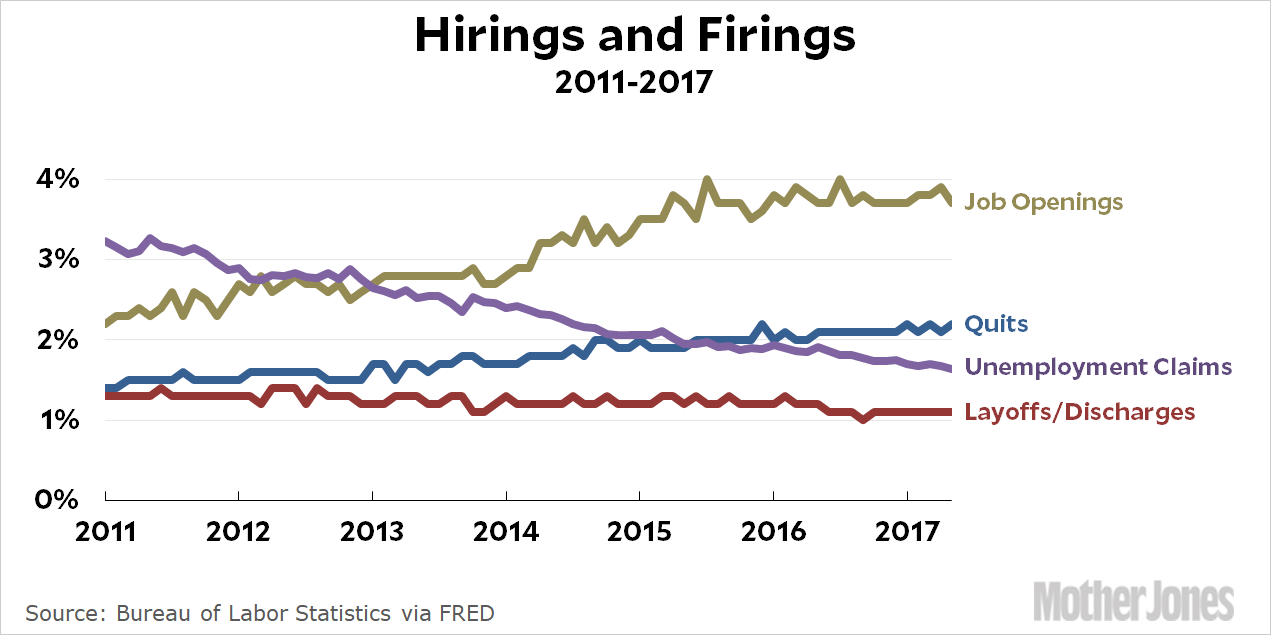
    The Journal is right about all this. Here’s a summary of the Labor Department’s JOLTS data since the end of the recession:

    Layoffs are going down. That’s good. Initial unemployment claims are going down. That’s good. Voluntary quits are going up. That’s good, because it signals that people are confident about finding a new job (or have already been recruited away into one). And job openings are up. That’s good, because it means there are more opportunities for job seekers.

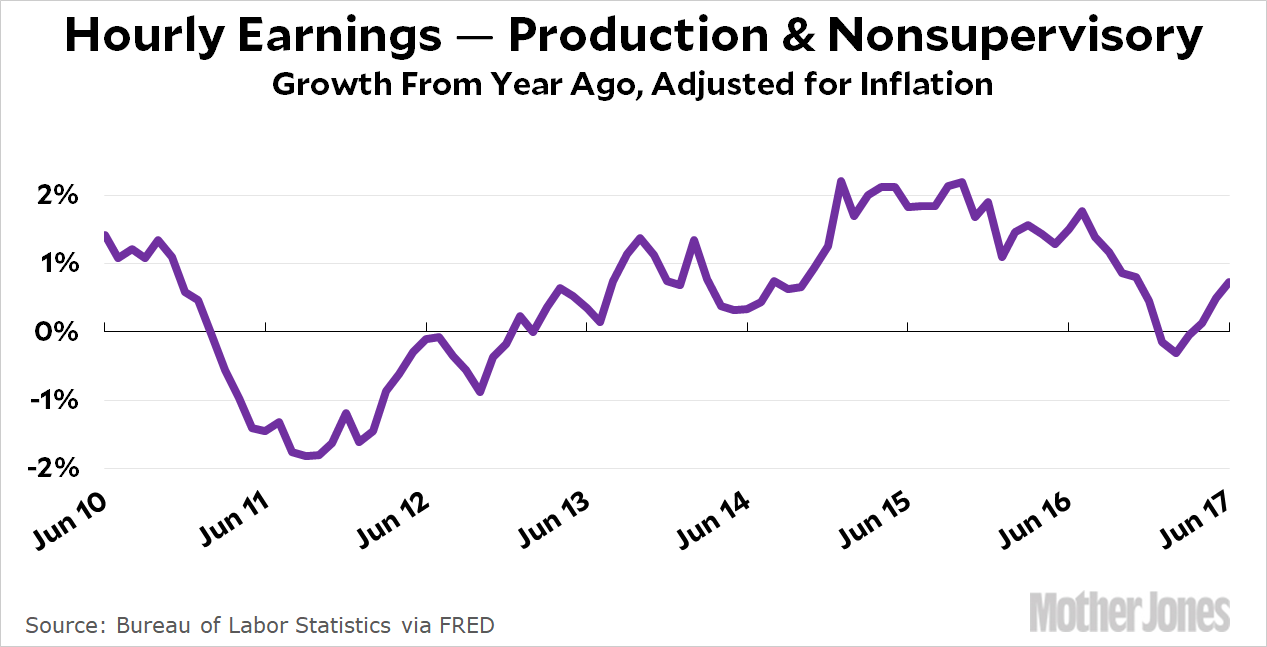
    And yet, we still have this chart that I posted on Friday:

    There are lots of job openings; managers report trouble finding workers; and voluntary quits are up. Despite all this, though, wages have barely moved. The most obvious way to fill job openings and keep people from quitting is to raise wages, but that hasn’t happened.

    There really is something of a mystery here. Nearly all the data points to a tight labor market with the exception of the single most important bit of data: wages. Rising wages are the clearest sign of a tight labor market, but we’re not seeing them. Not at the working and middle-class level, anyway. What’s going on?

  • Hiring Workers for Manufacturing Jobs Isn’t All That Hard

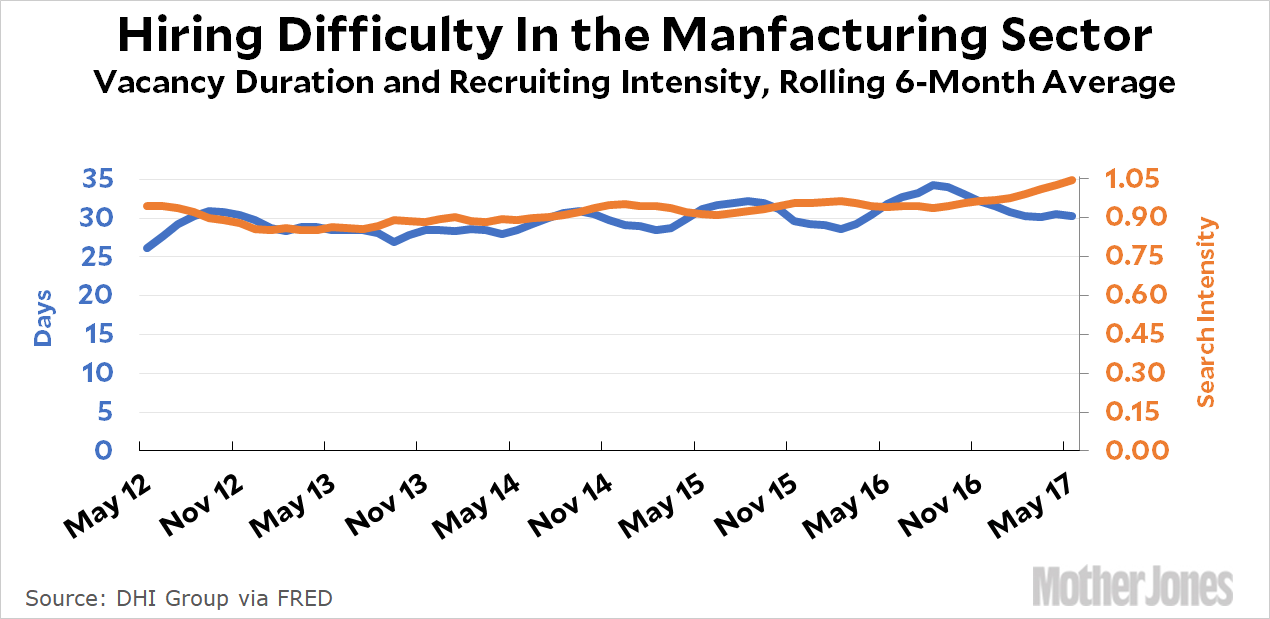
    FRED has some new data. Isn’t that exciting? They now have several new series from DHI Group that measure how difficult it is for firms to hire people. I was curious about the manufacturing sector, so here’s the data:

    As you can see, both average duration of job vacancies and average search intensity to fill jobs was pretty flat through the middle of last year. Average vacancy duration went up a bit in mid-2016 and companies responded by recruiting a little harder. Very quickly, vacancy duration returned to 30 days, roughly the average of the past five years.

    What this tells us is that it has gotten a little harder to find people in the manufacturing sector over the past couple of years, and companies have had to work a little harder to fill their positions. But only a little.

    However, if you look at this over a longer timeframe, what you see is that over the past five years, vacancy duration has been consistently higher than it was during the aughts, but recruiting intensity has been consistently lower. What this suggests is that for the past five years manufacturing companies have been deliberately leaving vacancies open longer than they used to. If lack of qualified workers was really a problem, they would have recruited harder. But until very recently, they didn’t.

  • GOP Would Rather Pass No Tax Reform At All Than Endanger Tax Cuts For the Rich

    This is from a couple of days ago:

    Hmmm. What’s to object to here?

    • Regular order allows tax reform to be permanent, and Republicans have been pulling their hair out to make sure their tax plan is permanent. So it can’t be that.
    • Republicans hate budget deficits, so surely it’s not that.
    • No one wants to increase the taxes of the middle class, so it can’t be that either.

    That only leaves one possibility: they object to the Democratic demand that a tax plan not cut the taxes of the rich. That’s the one thing they can’t abide, even if it means passing a plan via reconciliation with only Republican votes. Of course, this endangers everything, since it means they can’t afford to lose more than three votes in the Senate. It also guarantees that their tax cuts will be temporary.

    But that’s where we’re at. Republicans would rather run the risk of passing no tax reform at all than of agreeing to tax reform that doesn’t benefit the wealthy. Is anyone surprised?

  • Friday Kitten Blogging – 4 August 2017

    Hilbert and Hopper are taking the week off. Maybe a few weeks off. You never know!

    This is Mika, Professor M’s new Siberian kitten. Mika is not named after the better half of Morning Joe. Prof M’s other cat is named Mocha, and Mrs. M liked the idea of naming the new cat after the Hebrew prayer “Mi Chamocha,” which you can listen to here. So now they have Mika and Mocha.

    Also, Mika is male, because everyone likes transgressing gender stereotypes, right? Anyway, isn’t he cute? He’s been happily exploring his new house, and Mocha seems fine with the whole thing. She’s already started playing with her miniature new friend, but when the playing stops, it’s time for a nap. And what better place for that than Prof M’s desk?

  • Trump Approval Holding Steady In the One Place That Matters

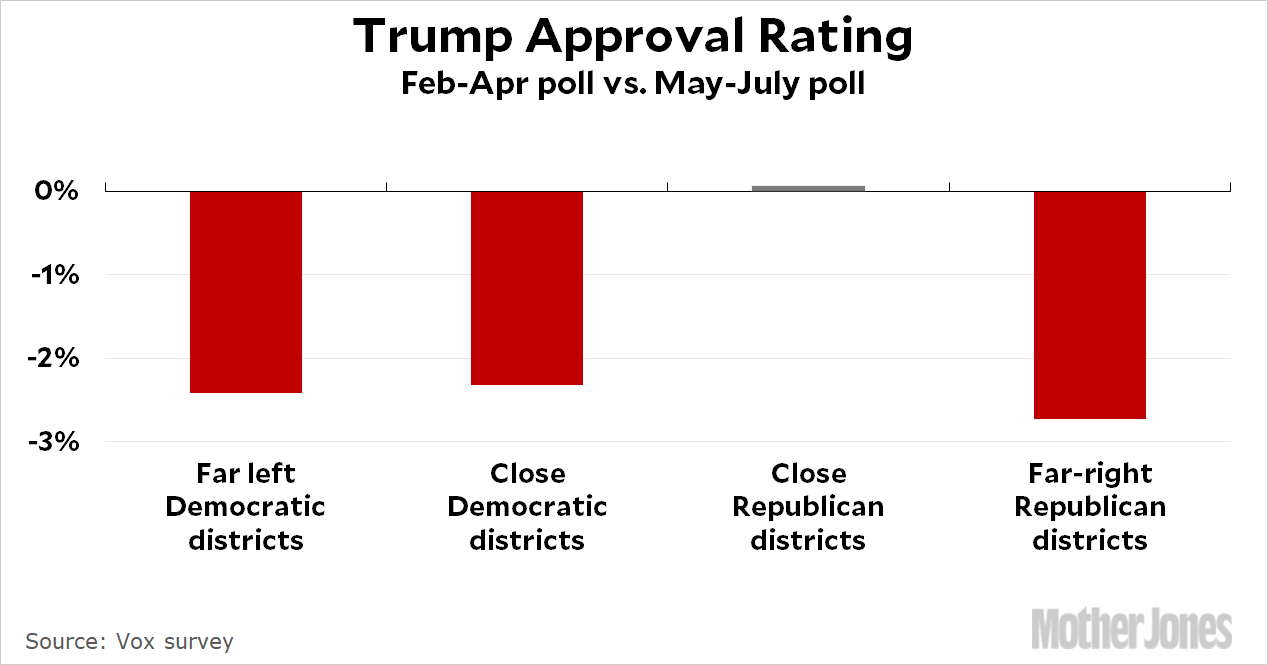
    Vox has a new survey out that bodes poorly for Democrats in next year’s midterm elections. It turns out that Donald Trump’s approval rating is down almost everywhere over the past few months—but that “almost” is a killer. The one place where Trump’s approval has held steady is the one place where Democrats actually need it to go down:

    Nobody cares much about safe left and right districts, where nothing is likely to change. Meanwhile, Trump’s declining approval in districts that Democrats hold by a small margin is positive for Dems, but only slightly. Given the dynamics of midterm elections, where the out-of-power party usually does well, they were always likely to hold most of these districts.

    What Democrats really want is to pick up some close districts currently held by Republicans. But that’s the one place where Trump is stubbornly holding on. If Democrats are hoping Trump will have some negative coattails that will help them next year, they aren’t seeing it yet.

    Of course, we still have more than a year to go. There’s no telling what Trump could do over the next 15 months.

  • Here’s What the Labor Market Really Looks Like

    There’s not a whole lot going on today, so here’s another chart about the economy for you. It shows the percentage of prime working-age adults who have jobs:

    Over the previous two economic cycles (1990-2000 and 2000-2008), this number averaged 79.8 percent. Today it’s 78.7 percent. So we still have some ground to make up just to reach the average of past cycles. At the top of the cycle, we ought to be around 81 percent or so.

    One of the problems with this statistic is that it can fluctuate depending on how many young workers go to college and how many older workers are retiring. As the baby boomers retire, for example, we should expect the overall ratio to drop steadily. This is why it’s best to look only at 25-54 year-olds. These are the folks who are out of school and aren’t retired, so they provide a pretty good look at how the labor market is doing.

    When you put this together with sluggish wage growth for middle-income workers, it shows that we still have some slack in the labor market even though the headline unemployment rate is a very healthy 4.3 percent. At the rate things are improving, we ought to have another three years of expansion left before the economy tops out. But will we?