The House plan envisions major cuts to federal spending over the coming decade, bringing the budget into balance by relying on accelerated economic growth to boost revenue. Under the House plan, defense spending would steadily increase over 10 years while nondefense discretionary spending would decline to $424 billion — 23 percent below the $554 billion the federal government is spending in that category this year.
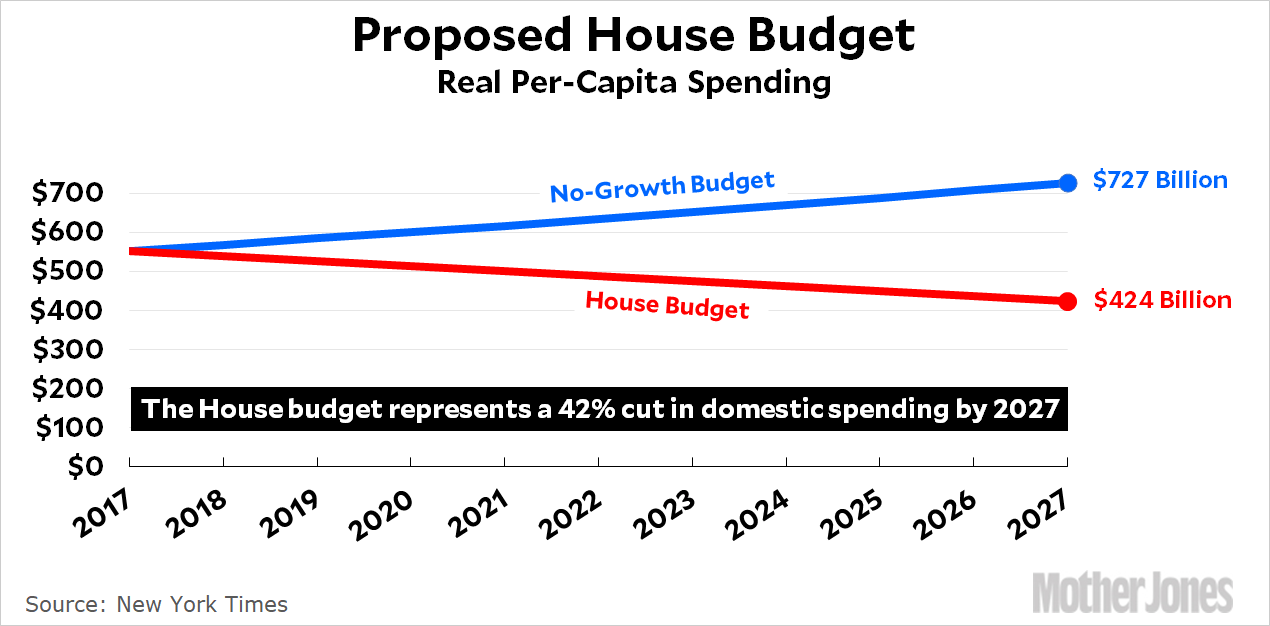
That sounds bad. But it’s even worse. As always with this stuff, you need to adjust for inflation and population growth. Here’s what that looks like:¹
At $554 billion, the domestic discretionary budget is currently $1,705 per person. Just to keep up with inflation and population growth, that needs to grow to $727 billion by 2027. Instead, Republicans want to cut it to $424 billion.
That’s not a reduction of 23 percent, it’s a reduction of 42 percent. The House budget would decimate spending on national parks, education, food assistance, housing, basic research, transportation, law enforcement, the EPA, and more.
Why? In order to fund a big tax cut for the rich. Like it or not, the combination of PAYGO and reconciliation rules force Paul Ryan to pretend to pay for his tax cut. But rosy economic assumptions and dynamic-scoring pixie dust only get him so far. He can only get the rest of the way by slashing spending on everything except defense.
By 42 percent. Remember that number.
¹I assumed inflation of 2 percent per year and population growth of 2.5 million per year.
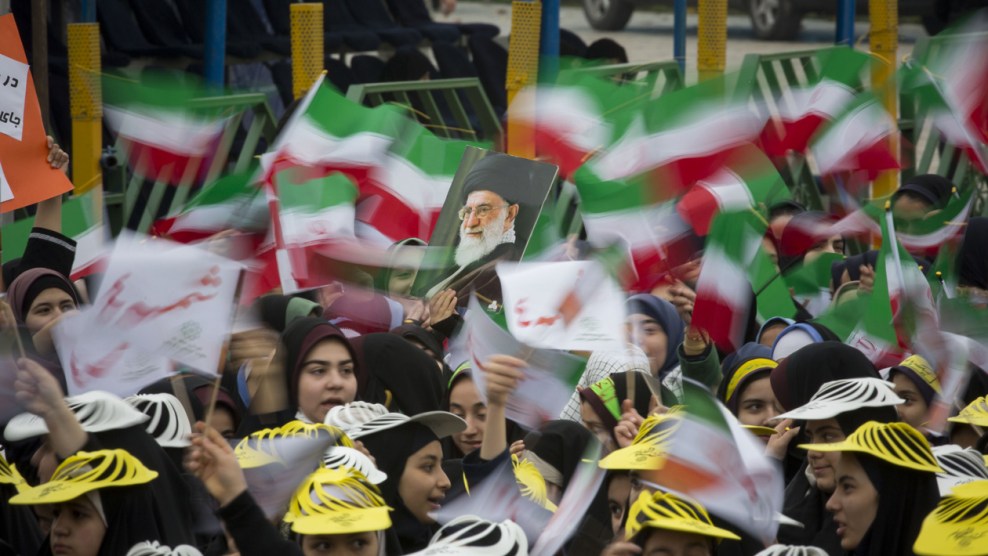
At an hourlong meeting last Wednesday, all of the president’s major security advisers recommended he preserve the Iran deal for now. Among those who spoke out were Secretary of State Rex W. Tillerson; Defense Secretary Jim Mattis; Lt. Gen. H. R. McMaster, the national security adviser; and Gen. Joseph F. Dunford Jr., the chairman of the Joint Chiefs of Staff, according to an official who described internal discussions on the condition of anonymity. The official said Mr. Trump had spent 55 minutes of the meeting telling them he did not want to.
But I don’t want to! Wah!
Come on, Donald. Buck up. If you want to lie about whether Iran has stuck to the deal, then just tweet out the lie and kill the treaty. If your advisers don’t like it, too bad. You’re the president. You can do anything you want, even if every single person you hired thinks you’re an idiot.
Anyway, the sense I get is that Trump will now treat the Iran deal the same way he’s treating Obamacare: he’ll do his best to sabotage it. I think we can look forward to a series of provocations designed to provoke some kind of response from Iran that Trump can use as a pretext for killing the deal. He can’t get any of the money back, of course, because Iran’s assets have already been unfrozen. So Iran will have its money and they’ll be free to develop a nuclear weapon if they want to—all without having to go to the trouble of breaking the treaty themselves.
Welcome to the world of Donald Trump, master negotiator.
In a strategy facing long odds, the majority leader said the Senate would instead vote “in coming days” on a bill the chamber passed in late 2015 to unravel most of the ACA, which former President Barack Obama vetoed in January 2016….But many Republican senators have balked at this strategy, saying they wouldn’t feel comfortable rolling back the ACA without being able to tell their constituents what would supplant it. Mr. McConnell’s new tactic likely represents his desire to wrap up and move on from a bruising fight
This is just political theater. The 2015 bill would repeal the funding for Obamacare, which would indeed destroy it. However, all the insurance industry regs would stay around, as would protections for pre-existing conditions. Insurers would still be required to cover all the essential benefits of Obamacare, and people with expensive conditions would all be allowed to sign up for coverage at the same price as anyone else. This combination would destroy the individual insurance market. Every insurer in the country would withdraw, which would affect everyone with individual insurance, not just the folks who got it through Obamacare.
Even in the GOP’s current fallen state, there are at least three Republican senators who would vote against this.
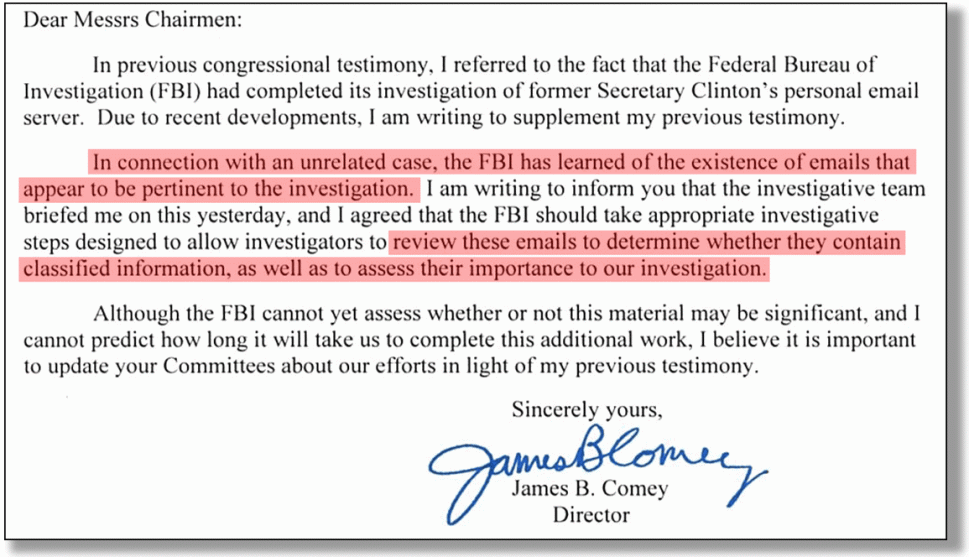
Joshua Green’s new book, Devil’s Bargain, confirms that the Trump campaign knew exactly what everyone else knew: the Comey letter is what allowed them to beat Hillary Clinton. The Daily Beast provides the summary:
“The last few days have proven to be pivotal in the minds of voters with the recent revelations in reopening the investigation of Secretary Clinton,” the memo read, according to Green. “Early polling numbers show declining support for Clinton, shifting in favor of Mr. Trump.” It added: “This may have a fundamental impact on the results.”
….“[Many in the campaign were] pessimistic but some in the [top] ranks saw glimmers of hope even before the Comey letter hit,” the second Trump 2016 vet said, still conceding however that it is very “difficult to write the history of [Trump’s] win without mentioning Comey.”
Green also reports that Trump’s internal numbers had him gaining momentum before the Comey letter, which then provided a “sharply upward” turn “in every state.” By the time they published the five-day-out memo, aides worried that the campaign was already leveling off.
This is no surprise to anyone who’s actually paid attention to the voluminous evidence that the Comey letter shifted the election by about three points, more than enough to turn an easy Clinton win into a loss. Can we all now please stop talking about the white working class?
Two more Senate Republicans have declared their opposition to the latest effort to overhaul the nation’s health-care system, leaving the measure without sufficient support to pass and potentially ending a months-long effort to make good on a longstanding GOP campaign promise.
Sens. Mike Lee (R-Utah) and Jerry Moran (R-Kan.) issued statements declaring that they would not vote for the revamped measure….The two conservatives timed the release of their statements and made clear that modest tinkering around the edges of the legislation drafted by Majority Leader Mitch McConnell (R-Ky.) would be insufficient to meet their demands.
This leaves only 48 senators who support the bill. Lee and Moran joined Susan Collins and Rand Paul in “calling for a long process of completely redrawing the legislation that would take months and months.”
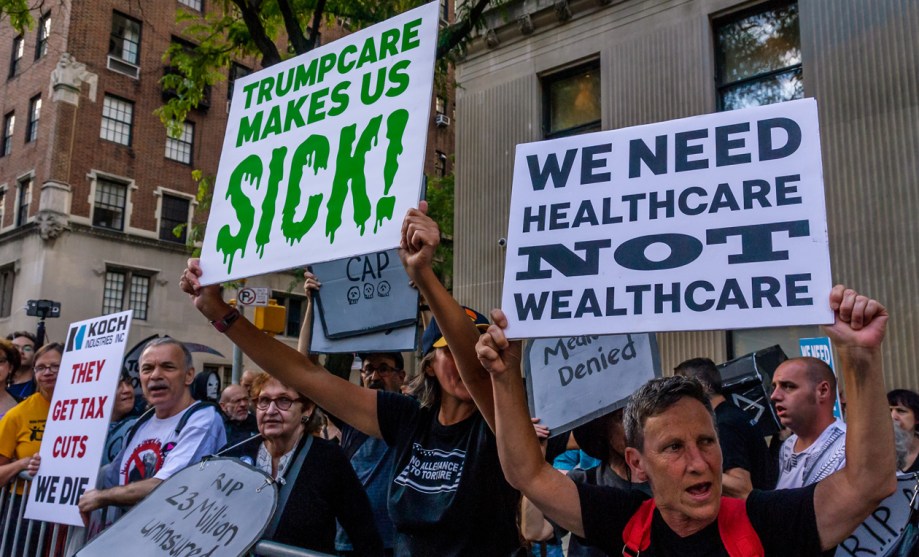
Of the four Senate rebels, only one is a Republican moderate who thinks Trumpcare is too harsh. The other three are hardliners who think Trumpcare doesn’t go far enough in repealing Obamacare and cutting back Medicaid.
So now what? Is Trumpcare dead for good? Or will Mitch McConnell be willing to spend the rest of the year trying to come up with a brand new health care plan while Trump himself dawdles around doing nothing? My guess is that it’s dead for good. The rest of 2017 will be spent on the budget and tax reform, and nobody is going to want to take up health care again during an election year.
UPDATE: President Trump has weighed in, via Twitter of course:
Republicans should just REPEAL failing ObamaCare now & work on a new Healthcare Plan that will start from a clean slate. Dems will join in!
I have two comments. First, Congress can’t repeal Obamacare. They can repeal parts of it, but the parts that are left would destroy the insurance industry. Second, Democrats will not join in if Republicans decide to do this anyway.
Of course, if Trump is serious about actually fixing the problems with Obamacare and truly making it better, Dems would be happy to join in. But Republicans have made it crystal clear that they have no interest in that.
Remember: this bill failed because even though it took away health coverage from 22 million low-income people, it wasn’t harsh enough toward the poor. This is what the modern Republican Party has become.
Earlier today I wrote about the development of artificial intelligence and how it will cause mass unemployment starting around 2025. There was some pushback on Twitter, and as usual it took two forms:
No way. Artificial intelligence is still very far away.
Sure, AI will be smart. That’s bad news for accountants and truck drivers. But it will never be creative or sociable. People will still prefer human waiters, human manicurists, etc.
It’s possible that true AI is very far away. But not likely. Just look around: it’s obviously moving ahead in leaps and bounds already. Your average smartphone today is nearly as good at answering random questions as Watson was back when it famously won a round of Jeopardy. We’ve gone from $100 million and a computer that filled a room to a palm-sized smartphone that costs $500 in six years.
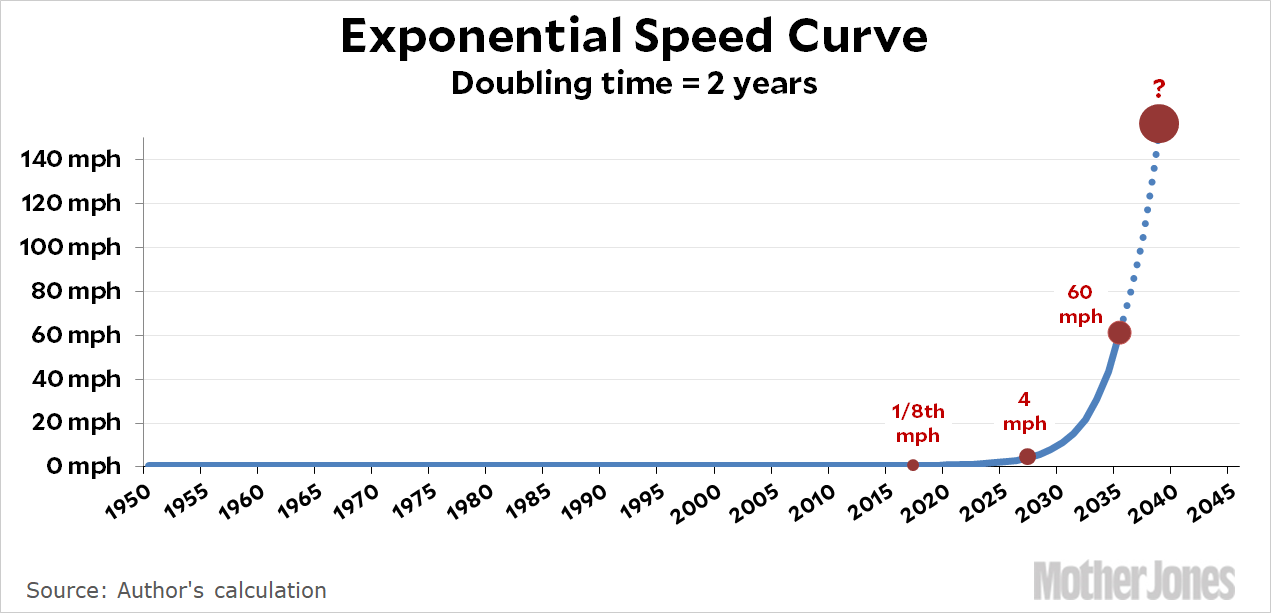
Think of it like this. Suppose you have a car with a top speed of 1 inch per year. Every couple of years that doubles. In the second cycle it accelerates to 2 inches per year. In the third cycle it accelerates to 4 inches per year. Not only is it accelerating, it’s accelerating more each cycle. But this acceleration is invisible: a few inches per year is so slow you can’t even see that the car is moving, let alone picking up speed.
After 32 cycles, the car is going about an eighth of a mile per hour. It’s finally moving to the naked eye, but only barely. That’s where we are now. It’s pretty unimpressive, and still hard to see how this will ever be anything useful. But we’re only five cycles away from going 4 mph. And then only four cycles away from going 60 mph.
In other words, today we don’t have AI at all. In ten years we’re likely to have AI that’s limited but genuinely useful. Ten years after that we’ll have AI that’s terrific. And ten years after that, AI will literally be able to do anything a human can.
The only way this doesn’t happen is—well, I’m not sure. The power of computer hardware is already pretty close to what we need, and it will keep getting better and cheaper even if Moore’s Law slows down. So the only thing standing in the way is a complete failure of software to improve enough to emulate human intelligence. It’s hard for me to see how that happens. If anything, software has more potential for exponential growth right now than hardware, and lots of people are working on this. So stop arguing about AI by pointing out that Siri is kind of dumb, and supermarkets can’t even make self-checkout work. That’s meaningless. Instead of thinking about the things that can’t be done today—when we don’t have AI—think about what can be done in ten or twenty years, when we do.
As for the argument about sociability, I find this even more baffling. It seems to spring from a desire to believe that there just has to be something unique about human beings. I don’t really see why. The human brain is, in a sense, an existence proof that it’s possible to construct a human brain. But if it’s possible at all, why shouldn’t it be possible to construct one using solid state electronics rather than organic chemistry? And if it’s possible to build one using solid state electronics, why shouldn’t it be able to learn sociability just like human children do?
Or, if you prefer, maybe it will be able to learn to feign sociability. It’s the same thing. Hell, plenty of humans have to feign sociability. So not only will we humans come to like our AI robots, we’ll probably prefer them to humans. Robots will talk about whatever’s on your mind, whether it’s Kardashian gossip or a book about the French Revolution. They’ll be endlessly patient. They’ll happily adjust to your personality. And whatever job they’re doing—waiter, yoga instructor, tutor, elderly caregiver—they’ll do it perfectly. Believe me, people will get to like this pretty quickly.
Now, I might be wrong. Who knows what the future holds? But although I’ve heard lots of bad arguments about why AI won’t take our jobs away—driverless cars crash sometimes! it’ll be like the Industrial Revolution!—I haven’t heard any good ones. The odds are strong that AI is coming, and that between 2025 and 2055 it will steadily take over every job currently performed by humans.
Over the weekend I regaled you with the story of my camera’s shutter. Today is the payoff. Using the mechanical shutter set at 1/2,000th of a second, and with the lens set to the point where it gets maximum magnification (about 150mm for my camera), I set out to take pictures of our local honeybees. Here’s one swooping in to steal a likely looking flower from one of its friends. Its wings are not completely stopped, but pretty close!
Next up I’ll try to get a picture of our local bumblebee.¹ They’re bigger, they tend to hover more, and their wings beat a little bit slower. This makes for a potentially more impressive photo. However, for those of you who aren’t big fans of our chitinous cousins, I promise nothing but non-insect pictures for the rest of this week.
¹The singular is deliberate. We seem to have exactly one.
Yesterday the Washington Post reported that the UAE had hacked into Qatar’s state media in order to plant incendiary statements that would give them an excuse to retaliate against Qatar. As a result, the UAE, Saudi Arabia, and other Gulf states have been blockading Qatar for the past two months.
This seems to be getting almost no attention today. Why? Do people not believe it? Does news about Qatar just not matter? Am I overestimating how big a deal this is?
This is a deliberate and calculated false-flag operation, designed specifically to create a fake casus belli. Isn’t that a massively big deal?
Axios reports that the Trump administration intends to handle its tax-cut agenda way differently than it handled health care. They’re already deeply prepared for the marketing push, with Sean Spicer in overall charge:
Activists and business leaders…all tell us the same thing: They’re surprised about how much planning and organizing the White House has already done….President Trump … barnstorming the Midwest … engaging CEOs across the country … town halls … write letters to their employees explaining the benefits of tax reform … local mayors and county commissioners … spend big on advertising support … Heritage Action, Americans for Tax Reform, the Business Roundtable, and the Koch brothers’ network … grassroots organizing campaign.
Wow. But what about the tax plan itself?
We expect the White House to float a few tax policy trial balloons in August….[One] major unsolved problem is how (or if) to pay for all these tax cuts. Some in the White House would happily just blow out the deficit, but Leadership suspects most Republicans wouldn’t be on board with that.
Ah. So activists and business leaders are pleasantly surprised by how well prepared the White House is to pass tax reform. Also, it will be one more month before the administration begins floating “tax policy trial balloons,” and, for the moment, the top economic minds in the Executive branch have no idea how to defray the cost of their desired tax cuts — which a recent analysis put at around $7.8 trillion over ten years — beyond “blow out the deficit.”
We’re now grading the White House policy proposals by the same exacting standards that a Montessori preschool teacher deploys when offering feedback on finger paintings.
That’s true, but keep something in mind: When you’re a “populist” who’s planning to propose a gigantic tax break for millionaires and big corporations, your comms strategy is 90 percent of what you need to do. The fiddly details of policy can be left to the nerds and the pols. It’s just a matter of deciding who gets the biggest slices of the pie, after all. The hard part is making sure that your fans are prepped to yell FAKE NEWS every time someone reports that the plan will be a gigantic tax break for millionaires and big corporations.
This is something Trump grasps instinctively, but back in March he hadn’t quite appreciated how it had to be scaled up now that he’s dealing with national politics. I think he now understands that it requires military discipline, months of unbroken persistence, and a presidential level of lying and browbeating. We’ll see if he can pull it off.
Let’s pay tribute today to old dogs learning new tricks.
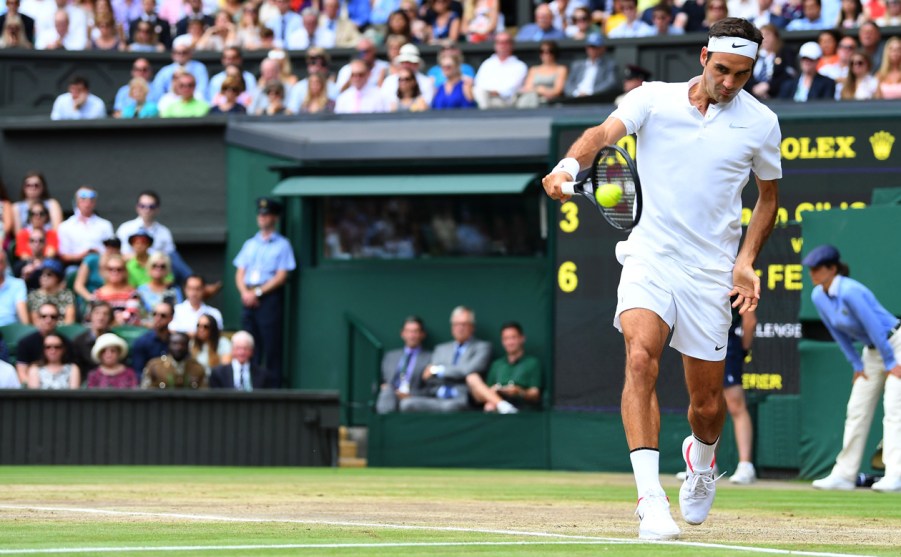
A few years ago Roger Federer was 32, retirement age for most men in the world of pro tennis. But instead of either retiring or accepting a few final years of declining play, Federer decided to switch rackets. This may not seem like too big a deal to you and me, but to a top player it’s almost like learning to use a prosthetic arm. It takes endless practice to rebuild your game around the new frame.
But Federer wanted a more reliable backhand, and a bigger frame was the way to get it. So he spent two years grinding away, learning to get accustomed to his new, larger racket. Then, just as it was starting to pay off, he injured his knee and had to get it surgically repaired. That meant more months of rehab.
Finally, this year, with his knee rebuilt and his game retooled, he started playing again at age 35. On his first outing at a major tournament, he won the Australian Open. Then he won the Indian Wells tournament. Then the Miami Open. Yesterday he won his eighth Wimbledon, breaking the record set by Pete Sampras. He doesn’t yet have his #1 ranking back, but there’s not much question that he’s currently the best player in the world.
Most of the other top men on the ATP tour are showing their age. Andy Murray is out for six months with a hip injury. Novak Djokovic is declining for reasons that are sort of mysterious. Rafael Nadal continues to be the king of clay, but he’s won only a single hardcourt major since 2010, and none in the past four years.
Federer is sort of ageless, but there’s more to it than that. He may have been an old dog, but he was willing to put in the long, exhausting slog it took to learn a new trick. Now, with a better backhand than he had when he was 25, he’s ready to fight for the #1 ranking again.
On a different scale, anyone can do what Federer did. But it takes hard work and a willingness to move outside your comfort zone. How many of us are willing to do that?
And we respect that! But maybe you’re of a mind to support our work directly instead? We have until December 31 to raise the last $400,000 we need to keep our nonprofit newsroom running at full strength into 2026. Will you make a gift today?
We noticed you have an ad blocker on. Can you pitch in a few bucks to help fund Mother Jones' investigative journalism?
Billionaires own the media,
but they don’t own us.
At Mother Jones we know these aren’t conventional times, and they require unconventional coverage. That’s what deliver every day: fierce, independent journalism you can’t find elsewhere. Perhaps never in the history of our country has that been more necessary than now. But we can’t do it without reader support—your support. Please chip in today.
Billionaires own the media,
but they don’t own us.
At Mother Jones we know these aren’t conventional times, and they require unconventional coverage. That’s what deliver every day: fierce, independent journalism you can’t find elsewhere. Perhaps never in the history of our country has that been more necessary than now. But we can’t do it without reader support—your support. Please chip in today.