According to the FBI, here’s what crime rates look like in Chicago over the past few years:
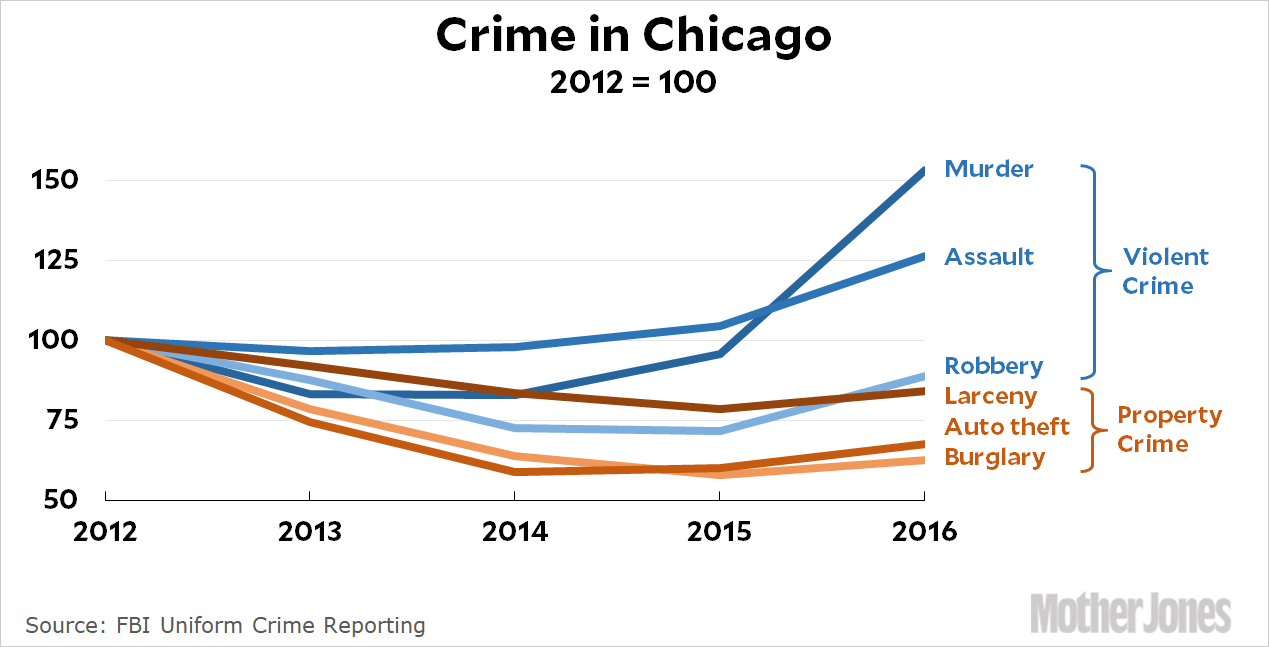
Between 2015 and 2016, property crime was basically flat. Among violent crimes, robbery and aggravated assault were up some, but homicide skyrocketed. Why? In late 2015, the Chicago Police Department reached an agreement to drastically cut back its use of stop-and-frisk, which has led some to call the murder epidemic a result of the “ACLU effect.” Is that fair?
Paul Cassell and Richard Fowles of the University of Utah think it is. After all, homicide spiked upward almost immediately after the stop-and-frisk agreement took effect. But what about New York City? They also reined in their stop-and-frisk program, but their murder rate declined. The authors try to show that New York City is so different from Chicago that the comparison is invalid, but their case is fairly unconvincing. There’s also this:
As Professor Franklin Zimring has noted in questioning whether NYPD’s success in lower crime rates could be directly transported to other cities, “New York’s success may have been assisted by its low rates of civil handgun ownership. Even when there were a substantial number of handguns on New York’s streets, the number in homes was much smaller than in other big cities.” This means that removing guns from New York’s streets may have been an especially powerful tactic there, because handguns were harder to replace than in other cities.
I don’t think this makes the point the authors want to make. If stop-and-frisk was an especially powerful tactic in New York City, then cutting back on stop-and-frisk should have led to an especially powerful rebound in homicide. It didn’t. Likewise, if replacing a gun in Chicago was easy, then stop-and-frisk should have been pointless, and ending it should have produced only a minor effect.
The other evidence they present is similar. Most other big cities, they say, didn’t see a big increase in murder rates in 2016. True enough. But six of them did, a fact they try to handwave away. If a third of the 20 biggest cities all saw big homicide increases, then there are obviously lots of reasons for homicide to increase. This means there’s no special reason to insist that the end of stop-and-frisk is the only possible explanation in Chicago.
What’s more, as the chart above shows, other crimes didn’t follow the path of homicide in Chicago. As the authors say, this could be because homicide is uniquely tied to guns, so it’s the most strongly affected by stop-and-frisk. That’s certainly possible. At the same time, common sense suggests that a generalized change in policing that supposedly reduces inhibitions on criminal activity would have an effect on lots of different kinds of criminal activity. That’s sort of the case in Chicago, but not entirely.
I dunno. We’ve got broken windows. We’ve got community policing. We’ve got stop-and-frisk. We’ve got targeted drug raids. We’ve got the Ferguson effect. And now we’ve got the ACLU effect. We have a long history of trying to blame crime rates on specific police tactics—or the lack of them—and in the long run they never seem to hold up. In the case of Chicago, we’ve got one data point, namely that homicides started to increase at the same time that stop-and-frisk ended. Despite the length of this latest paper, that’s really all the authors have—and even that’s belied by the fact that murder rates had already increased 15 percent the year before. Maybe Cassell and Fowles are right, but I’d keep an open mind about this until and unless we get a whole lot more evidence.