• Uber Really Shouldn’t Be In the Driverless Car Business

    Last night I mentioned something to a friend about the driverless car crash in Arizona:

    The fact that it’s an Uber car doesn’t surprise me. They’re exactly the kind of company that would cut corners: cheap optics, lousy safety drivers, pushing to drive at night before the software is ready, etc. A corporate culture that’s built to expand their taxi service no matter who gets hurt or who complains might build a good taxi service, but it’s the worst possible culture for mission-critical software.

    My point was that Uber famously has a corporate culture built around being a bull in a china shop, pushing the limits of expansion as far as they could and focusing obsessively on doing everything at light speed, before authorities could stop them or competitors could catch up. This is not the kind of company that’s likely to slow down to make sure their driverless cars work properly before pushing to the next stage. And sure enough, here’s the New York Times today:

    Uber’s robotic vehicle project was not living up to expectations months before a self-driving car operated by the company struck and killed a woman in Tempe, Ariz. The cars were having trouble driving through construction zones and next to tall vehicles, like big rigs. And Uber’s human drivers had to intervene far more frequently than the drivers of competing autonomous car projects….As of March, Uber was struggling to meet its target of 13 miles per “intervention” in Arizona.

    ….There also was pressure to live up to a goal to offer a driverless car service by the end of the year and to impress top executives. Dara Khosrowshahi, Uber’s chief executive, was expected to visit Arizona in April, and leaders of the company’s development group in the Phoenix area wanted to give him a glitch-free ride in an autonomous car. Mr. Khosrowshahi’s trip was called “Milestone 1: Confidence” in the company documents.

    ….When Uber moved to a single operator, some employees expressed safety concerns to managers, according to the two people familiar with Uber’s operations. They were worried that going solo would make it harder to remain alert during hours of monotonous driving.

    This kind of culture might be OK for, say, Facebook, which doesn’t kill people if there are glitches in its apps. But if you’re launching a satellite into space or putting a driverless car on the road, there’s a whole different development and testing ethos involved. Uber just doesn’t have that. I’d barely trust them to develop software for a driverless golf cart, let alone a driverless car.

    The Times reports that Uber was planning to apply for a license to run a driverless car service in December. December! A year ago their cars couldn’t go 13 miles without a problem, but they still thought they’d be ready for full driverless operation in December? That’s crazy. Off the top of my head, I’d want to see something like an average of 10,000 miles between incidents before I thought I was within a year of applying for a limited license.

    But not Uber. That’s just not their style.

  • It’s Time to Stop Treating Every Fleeing Teenager Like a Crazed Killer

    You might wonder why I keep harping on lead and crime. After all, as much as I’d like to get rid of the last remaining traces of environmental lead, the truth is that it’s mostly gone these days. What’s more, the crime wave of the 70s and 80s is long past. It’s historically interesting that lead poisoning played a big role in skyrocketing crime rates 40 years ago, but not all that pressing as a current policy issue.¹

    There are a couple of reasons for my continued harping, and today I want to mention just one of them. As my post earlier this morning made clear, teenagers these days are less violent and better adjusted than they used to be, and this is a permanent change. A few decades ago, people were chronically apprehensive around teens in public places, afraid they might be assaulted or even killed if they so much as looked at them funny. And there was something to that. Back then, teenage brains had all been damaged by a lifetime of lead poisoning, often making them impulsive and violent. But that’s long in the past, and there’s no longer any excuse for this apprehension. Without lead poisoning to wreck their brains, they’re just ordinary teenagers, like teenagers of every past era

    This is something that I wish everyone could internalize. Teenagers just aren’t unusually dangerous these days. If you chase one into a backyard and you see a glint in his hand, you probably don’t need to unload 20 rounds into his body as if you were trying to bring down a PCP-crazed rhinoceros.

    At the risk of being misunderstood, I want to add that this is very much a racial thing. The lead epidemic hit blacks harder than whites, and this meant that the violence level of black teenagers rose more than it did for white teenagers. In the early 90s, even Jesse Jackson was famously scared of black teenagers. Cops internalized this, mixed it up in a stew with lots of old-school racism, and ended up killing a lot of black teenagers.

    And they still do, even though the violence level of black teens also dropped more than it did for white teens once we removed lead from gasoline. In the year 2018, there’s just no excuse for cops or anyone else to routinely treat black teenagers as scary hoodlums who might kill them at the drop of a hat. They’re back to being ordinary people these days, just like teenagers of every other color.

    Now, teenagers are still teenagers. They’re full of hormones, their brains aren’t fully integrated, they like to rebel against authority, and some of them are dangerous. And unlike teens of previous eras, they have easy access to handguns of all types. For those reasons and more, police officers have to be alert and wary around all teenage crime suspects. But do they need to unleash a hail of bullets at the slightest hint of danger from a black teenager? No. They just don’t. Arguments based on social justice might or might not mean much to most cops, but I’m offering them another one: teenagers of all races, and especially black teenagers, are fundamentally, permanently, a lot less violent than they used to be. It’s time to recognize that and adjust our policing strategies accordingly.

    ¹No need to email me about this. Obviously I agree that lead is an important public policy issue. All I mean is that as far as changes in crime and violence are concerned, lead is no longer a major factor.

  • Friday Cat Blogging – 23 March 2018

    I was up in Seattle last weekend visiting friends, and on Sunday afternoon I had lunch with one of my old roommates from Caltech days. I hadn’t seen him for about 40 years. Unlike me, he stuck it out and graduated, and now runs a company that makes fancy optical equipment (he’s an optical physics guy).

    More to the present point, this being a Friday, he’s married and it turns out that his wife, Charlotte, is very much a cat person. Their current cat is named Scooter, and I was warned that he was a bit “grabby.” This turned out to be true, but Charlotte says he’s gotten better after ten years of work. That was true too: in my case, at least, he wasn’t at all serious about it. Just a lazy little flick of the paw that didn’t even come close to making contact. He eventually curled up next to me and started purring.

    Naturally I took pictures.

  • In Shocker, Republicans Cut IRS Budget Yet Again

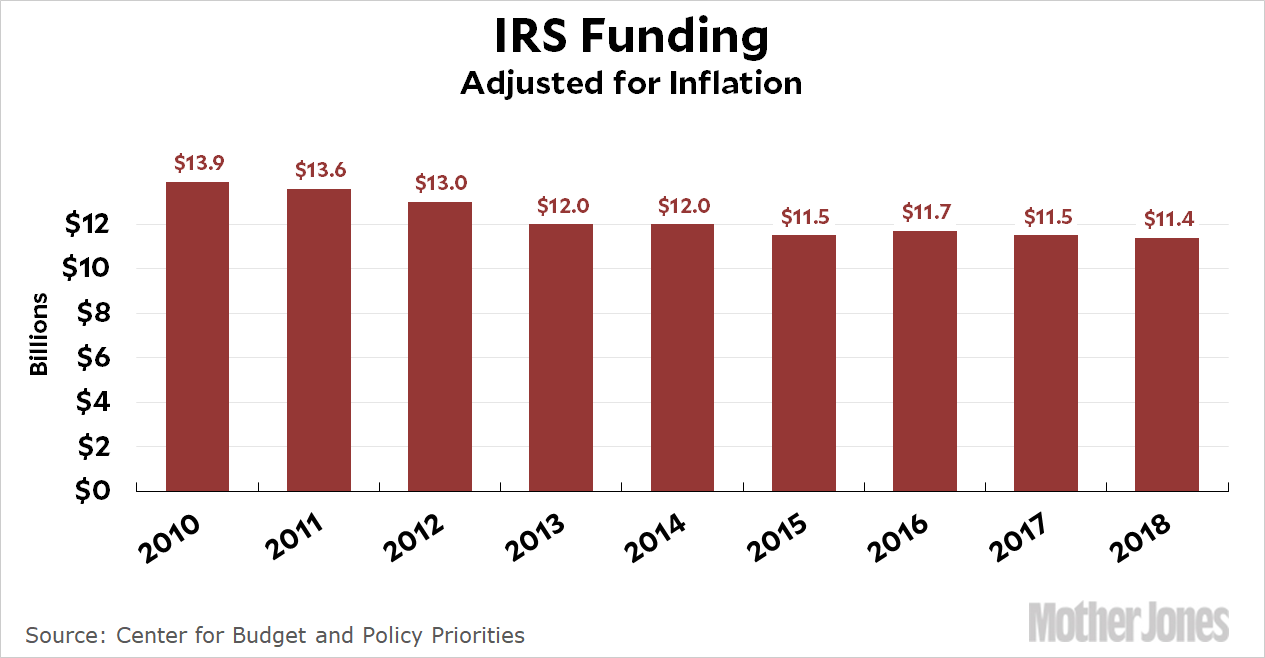
    Hooray! Everybody is getting more money in the 2018 spending bill. Well, almost everybody:

    This comes from Emily Horton of the Center for Budget and Policy Priorities, who says this:

    Policymakers need to recognize the depth of the IRS’s budget and workforce depletion, as well as the multi-year and multi-dimensional nature of the response required to successfully implement and enforce the new tax law. Rather than continue squeezing the agency’s funding, policymakers should give the IRS sufficient resources to perform its core functions of collecting revenues and enforcing the nation’s tax laws.

    Unfortunately, our current policymakers do recognize the depth of the IRS’s workforce depletion. In fact, cutting their budget is designed to deplete their workforce. Why? Because our current policymakers are Republicans, and Republicans don’t want the IRS to perform its core function of enforcing the nation’s tax laws. After all, that would mean more audits of rich people, and that’s not something they want.

    This is neither new nor a secret. Republicans have conducted a jihad against the IRS for decades, primarily because they don’t want their rich donors to be pestered with audits. It’s the next best thing to just cutting their taxes outright.

  • Trump Signs Spending Bill, Holds Press Briefing to Gripe About It

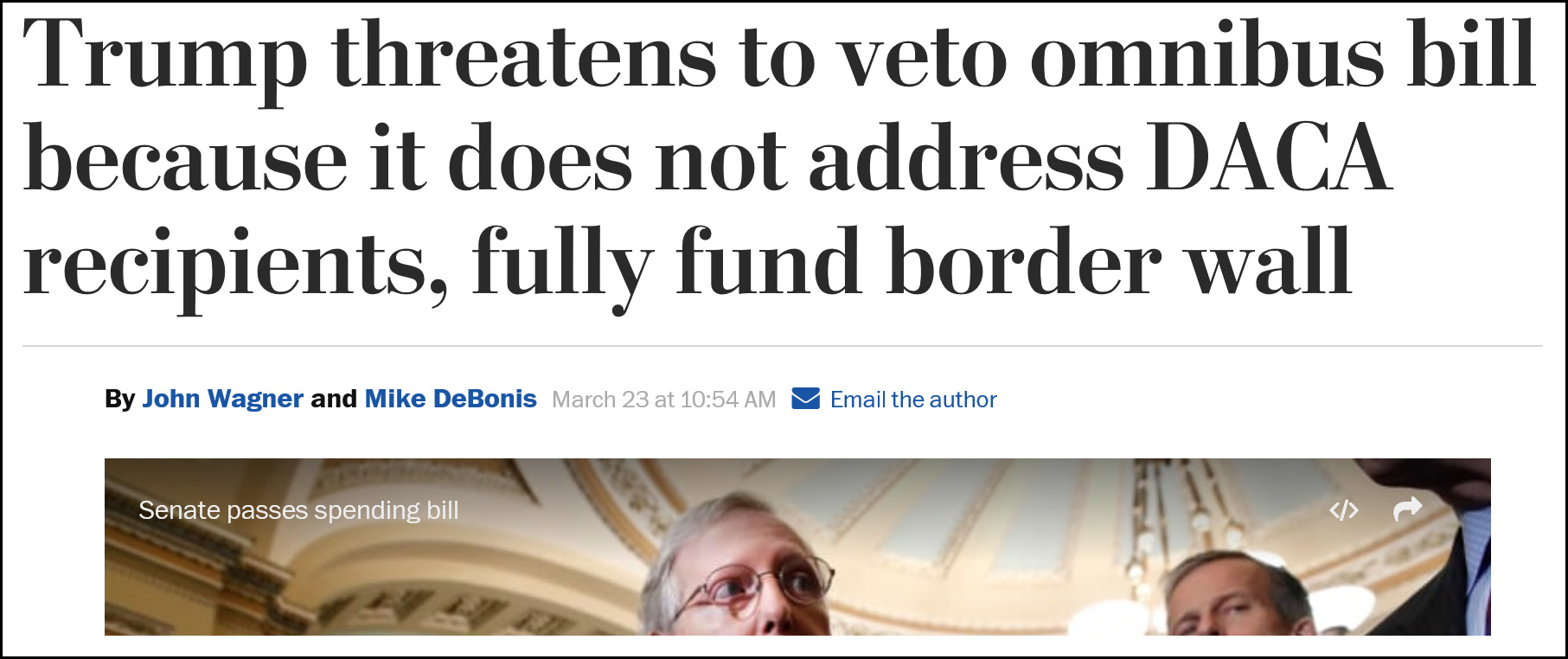
    President Trump has signed the 2018 spending bill, but he wants everyone to know he’s not happy about it. You see, Democrats hate America and keep demanding that we fund domestic programs like national parks and food stamps and clean water and other frills that we don’t need. This makes it hard to build border walls and additional aircraft carriers, especially after cutting taxes by $1.5 trillion. The answer, Trump says, is to eliminate the filibuster so that Republicans can just pass anything they want. Also, he wants a line-item veto, even though that’s unconstitutional.

    So that’s that for the big press briefing.

    UPDATE 1: I’m watching right now, and Trump is laboriously reading off all the various military toys that have been funded by this bill. Helicopters, ships, planes, tanks: you name it, Trump is going to build it.

    UPDATE 2: He’s very happy about “the opioids.”

    UPDATE 3: He’s not happy with the $1.6 billion for the wall.

    UPDATE 4: DACA didn’t get funded because of Democrats. Republicans wanted to fund it, but Democrats just wouldn’t do it. There is not a single Hispanic in the entire country who is going to buy this.

    UPDATE 5: And that’s a wrap. POTUS has left the stage.

  • Teenagers Have Become Lovely Human Beings. But Why?

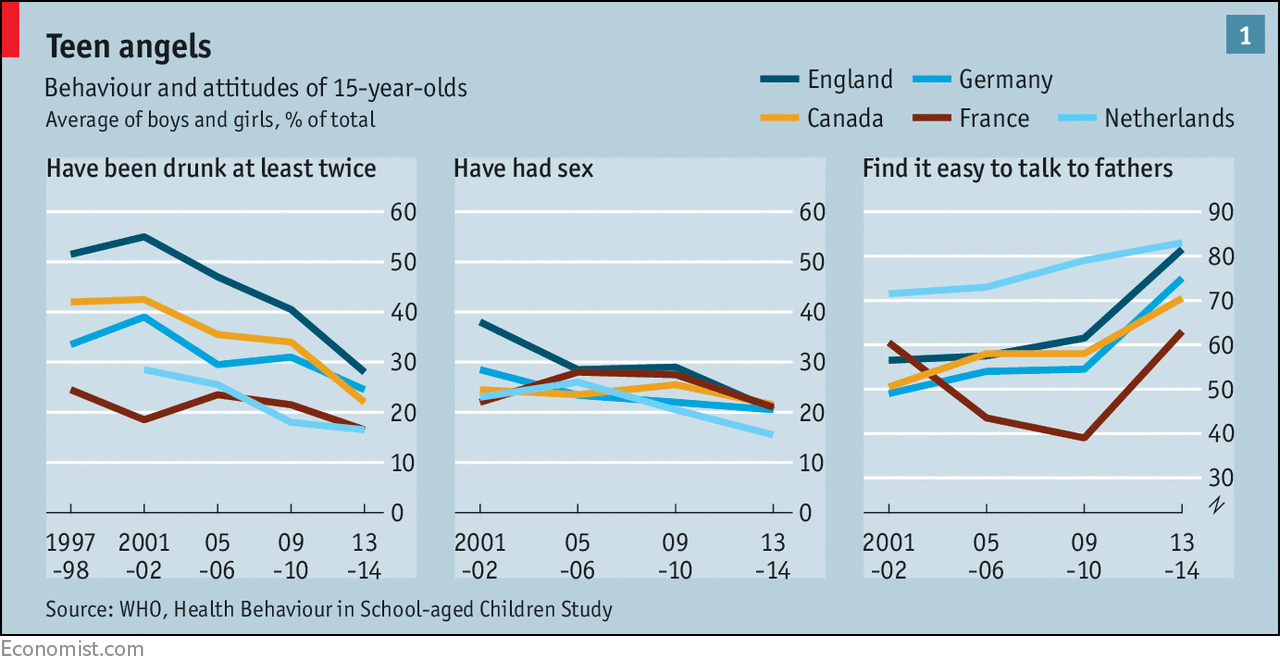
    The Economist discovers that teenagers in the West are a lot less worrisome than they used to be:

    Young people are indeed behaving and thinking differently from previous cohorts at the same age. These shifts can be seen in almost every rich country, from America to the Netherlands to South Korea. Some have been under way for many years, but they have accelerated in the past few … [They] are getting drunk less often … Other drugs are also falling from favour … Fighting among 13- and 15-year-olds is down across Europe … Teenagers are also having less sex, especially of the procreative kind … In short, young people are less hedonistic and break fewer rules than in the past. They are “kind of boring”, says Shoko Yoneyama, an expert on Japanese teenagers at the University of Adelaide. What is going on?

    Indeed. What is going on? The Economist provides a few options:

    • One possible explanation is that family life has changed….Fathers have upped their child-care hours most in proportional terms….Those doted-upon children seem to have turned into amenable teenagers.
    • Another possibility is that teenagers and young people are more focused on school and academic work.
    • Today’s young people in Western countries are increasingly ethnically diverse….Many of those immigrants arrive with strong taboos against drinking, premarital sex and smoking—at least among girls.
    • Social media allow teenagers’ craving for contact with peers to be squared with parents’ desire to keep their offspring safe and away from harmful substances….Teenagers who communicate largely online can exchange gossip, insults and nude pictures, but not bodily fluids, blows, or bottles of vodka.

    Do I even need to bother pointing out that not a single one of these explanations makes any sense? Teenagers from single-parent homes are also better behaved. A focus on school is an effect, not a cause. Non-immigrants are better behaved too. All of this better behavior predates the invasion of social media. And it’s happening mostly in rich countries, not, say, in the Middle East, even though they also have taboos and cell phones. These explanations aren’t even worth tossing out just to knock them down. They’re completely ridiculous.

    The lengths that psychologists, sociologists, and other academics will go to in order to protect their turf is remarkable. The obvious answer here is: Today’s teenagers are the first generation in more than half a century to grow up completely lead free.¹ This is, sadly, not a sociological explanation. It doesn’t provide much scope for grand theorizing.² It requires you to believe in an “essentialist” explanation.³ It will produce no new research papers.

    On the other hand, it has the virtue of almost certainly being true. So there’s that.

    ¹Well, not completely. But pretty close.

    ²In fact, it’s worse than that: it demolishes a whole bunch of pet theories built up over the years by liberals, conservatives, academics, and guys on barstools.

    ³“Essentialist” is generally used to mean something that’s inherent rather than environmental or societal. It has a bad odor thanks to all the people who claim that blacks do worse than whites because they’re biologically inferior: that is, their problems are essential to their genetic heritage, rather than being the result of white racism. Unfortunately, this has made academics suspicious of any non-sociological argument for anything because they’re afraid it provides a slippery slope to claims that blacks are genetically inferior to whites. This is understandable, but considering that everyone accepts the effects of lead poisoning on IQ and schoolwork—not to mention that lead poisoning is environmental, not genetic—it’s a little hard to understand why so many people resist the possibility that it also has other effects.

  • Yesterday and Today in Trumpworld

    Yesterday:

    Today:

    Ha ha ha ha … ha. What an idiot. The bill that was passed yesterday, needless to say, was the same bill as the day before and the day before that.

    The good news, I suppose, is that this is probably based on nothing more than Trump’s love of drama. He wants Mitch McConnell and Paul Ryan to call and beg him to sign the bill. They’ll sigh, make the call, and I suppose Trump will then sign it.

  • Spending Bill Held Up at Last Minute by Dueling Jackasses

    Castle Peak in the White Clouds Wilderness preserve. Despite Sen. James Risch's best efforts at petty revenge against a dead man, it will probably be renamed the Cecil D. Andrus-White Clouds Wilderness preserve in the near future because the House is unlikely to even take up Risch's bill to rescind the renaming.Eric Zamora/VW Pics via ZUMA

    The Senate passed a 2018 spending bill on Thursday night, and President Trump has said he’ll sign it. So there will be no government shutdown. But first we had to have a contest to see who could be the biggest asshole in the Senate. Rand Paul started off strong, but eventually decided he had done enough grandstanding and allowed the bill to proceed:

    But just as Paul stood down, it emerged that he was not the only Republican senator objecting to the bill. Even as Paul was railing publicly against the bill, Sen. James E. Risch (R-Idaho) had been complaining behind the scenes, demanding that congressional leaders remove a provision in the bill naming the White Clouds Wilderness after former Democratic governor Cecil D. Andrus, according to two congressional aides familiar with the dispute.

    Risch and Andrus had clashed when both served in state government. The renaming provision passed the House in February and has the support of Rep. Mike Simpson (R-Idaho), chairman of a House Appropriations subcommittee.

    The last time Andrus and Risch were both in state government was 1988. That’s three decades ago. And here’s the kicker: apparently no one can even remember what their dispute was about:

    Aides in both parties were still trying to figure out what had occurred. At one point, a 2008 profile of Risch’s political rise began circulating that recounted Risch’s time as the majority leader in the Idaho state senate when Andrus, who died last year, was governor. The Idaho Statesman profile noted Risch “clashed with Democratic Gov. Cecil Andrus, particularly over education funding in the 1980s.

    Education funding. Huh. It must have been pretty serious though. Here’s a snippet of a report about a state budget bill from 1989:

    The panel did approve the governor’s request for a secretary, a proposal that was killed at the end of the 1988 session in what many viewed as a parting partisan shot at Andrus by former Senate Republican President Pro Tem James Risch.

    He tried to kill Andrus’s request for a secretary! Apparently Risch is a guy who takes political disagreements personally. But we may never know what really happened back in the 80s. Andrus died a few months ago, and Risch isn’t talking. “What part of ‘no’ don’t you understand?” he told reporters who asked what his objection was. “Do I have a problem with my English? I don’t have any comment.”

    In the end, Mitch McConnell bought off Risch by passing a standlone bill to rescind the name change. However, the House is likely to ignore the bill entirely, which means the renaming will go through. What a pointless and petty waste of energy.

  • Charts of the Day: Here’s Why Republicans Are Terrified About the 2018 Midterms

    Here’s a couple of fun charts to finish off the evening. They’re from Geoffrey Skelley of Sabato’s Crystal Ball, and they show how many members of Congress have retired in previous midterm election cycles. First up is total retirements over time, starting at 600 days before the election and going through 75 days before the election:

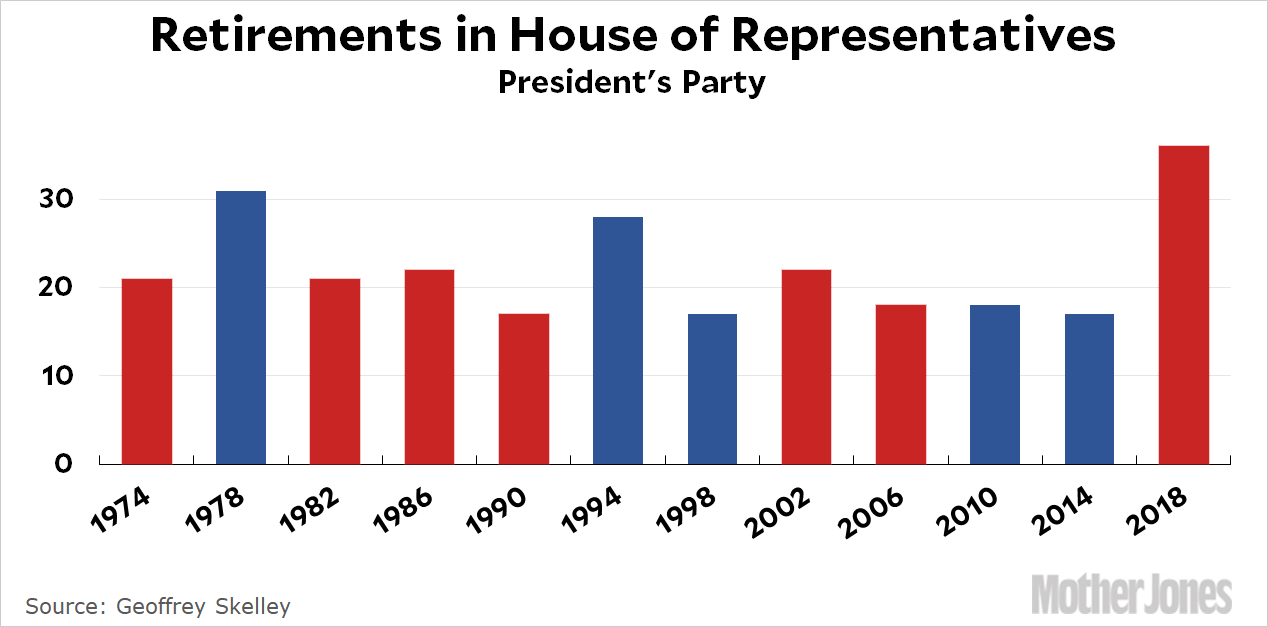
    As you can see, 2018 is already a huge outlier. At 300 days before the election, 52 House members had announced their retirement, breaking the all-time record held by 1978 with months still left to go. And a record number of them are from the president’s party:

    There have already been 36 retirements by Republican House members, well above the previous record. This is, obviously, good news for Democrats on two fronts. First, it demonstrates a general fear among Republicans that 2018 is going to be a landslide defeat, prompting lots of them to simply give up. Second, it opens up a lot of Republican seats, making a landslide defeat even more likely. It’s a vicious circle. And that circle gets even worse when you consider the flip side: Democrats can smell the fear, and that means far more high-quality candidates are running in districts that previously had a hard time attracting people to spend time on what seemed like a hopeless cause.

    And then it gets even worse, because it’s not just Congress at risk for Republicans. As Joan Walsh writes today, there’s also a huge surge of Democrats running for seats at the state level:

    As we head into the first national elections since Trump’s inauguration, Democrats are talking less about “the Trump effect” than they are about “the Virginia effect”—the unprecedented surge of women, minority, and millennial candidates running for seats in their state legislatures, many in deep-red districts long written off by the Democratic Party establishment. These candidates have been buoyed by a raft of outside and resistance groups, including Indivisible, Emily’s List, Run for Something, Forward Majority, Sister District, and BlackPAC, among many others. But party leaders have also taken note of this wave and are finally beginning to invest meaningfully and systematically in local candidates.

    What does it take to get young people to vote? That’s the eternal question for Democrats. But the answer might be: getting young people to run. And it doesn’t hurt to have a racist, sexist, boorish pig¹ as the leader of the opposition, does it?

    ¹Who, by the way, might get us all killed if he happens to get mad at something he sees on Fox & Friends some morning.

  • DNC Hacker Was a Russian Military Spy

    Danil Shamkin/NurPhoto via ZUMA

    Spencer Ackerman and Kevin Poulsen have some interesting news:

    Guccifer 2.0, the “lone hacker” who took credit for providing WikiLeaks with stolen emails from the Democratic National Committee, was in fact an officer of Russia’s military intelligence directorate (GRU), The Daily Beast has learned. It’s an attribution that resulted from a fleeting but critical slip-up in GRU tradecraft.

    The US intelligence community long ago concluded that Russia was behind the DNC hacks and that Guccifer 2.0 was a persona invented by GRU, so in one sense this is nothing new. But if the CIA and NSA knew that the DNC hacker was a GRU officer, then they certainly must have briefed President Trump about it. And yet he continued to insist in public that no one really knew for sure if the Russians were behind the campaign hacks.

    Then there’s the fact that Trump confidante Roger Stone has admitted to conversations with Guccifer 2.0. Did Stone know that he was a GRU agent? I’ll bet Robert Mueller is trying to find out.