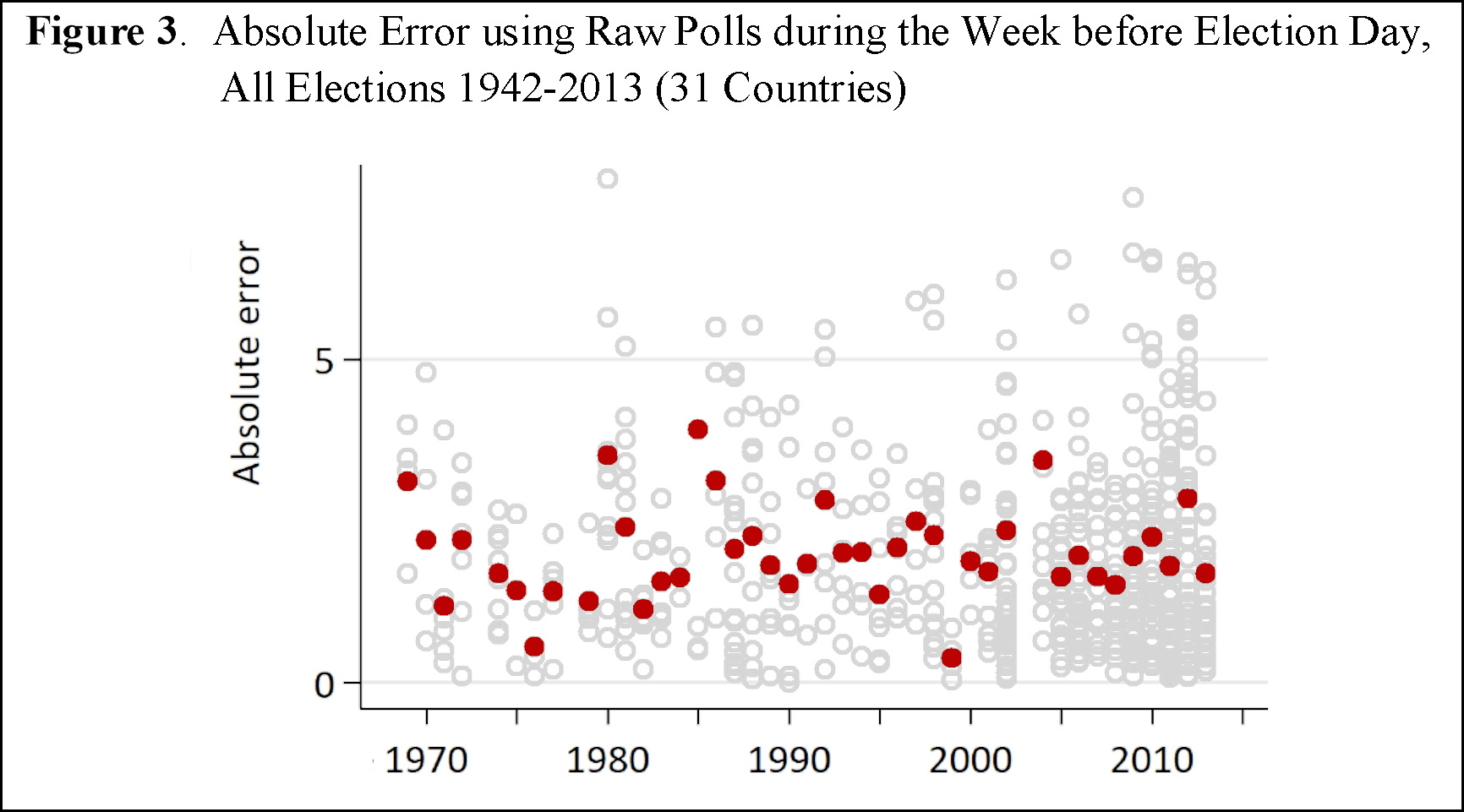
Are political polls getting worse over time? Nate Silver says no:
Not to say there aren’t challenges; declining response rates are a big issue. But if you’re citing Brexit or 11/8/16 as examples of failure—when polls were off by only a few points, well within theoretical and empirical margins of error—you may not know what you’re talking about.
He cites an exhaustive new study by Will Jennings and Christopher Wlezien, who say this: “Our analysis draws on more than 30,000 national polls from 351 general elections in 45 countries between 1942 and 2017….We find that, contrary to conventional wisdom, the recent performance of polls has not been outside the ordinary.” Here’s an excerpt from the money chart:
This doesn’t show the 2016 presidential election, which was off by about two percentage points—well within the normal range. Too bad about that Electoral College nonsense, eh?
Breaking news, folks. A Republican congressional committee says that a Republican president has done nothing wrong:
THE HOUSE INTELLIGENCE COMMITTEE HAS, AFTER A 14 MONTH LONG IN-DEPTH INVESTIGATION, FOUND NO EVIDENCE OF COLLUSION OR COORDINATION BETWEEN THE TRUMP CAMPAIGN AND RUSSIA TO INFLUENCE THE 2016 PRESIDENTIAL ELECTION.
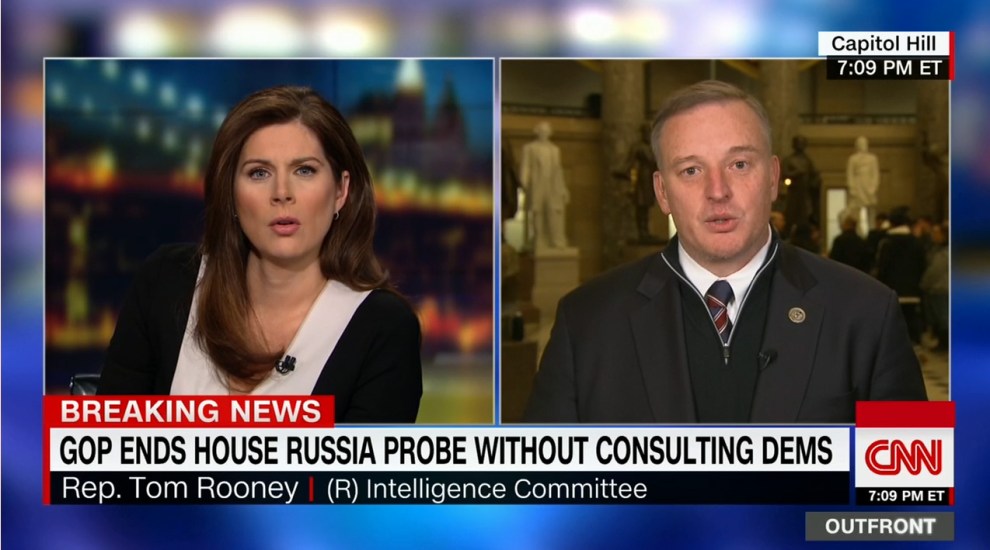
But not every Republican agreed. Rep. Tom Rooney stopped by Erin Burnett’s show on CNN and said the whole investigation was a farce:
Rep. Tom Rooney (R-Fla.), a member of the House Intelligence Committee, said on Monday that “there is evidence” showing the Russians attempted to help Trump during the 2016 presidential election, contradicting a draft report from the panel.
….Burnett pointed out that “the intelligence community had said” Moscow’s intention “was to hurt Hillary Clinton,” and that the Kremlin “wanted to explicitly help Donald Trump.” Rooney responded: “Yes, I believe there’s evidence of everything that you just said.”
….Rooney argued that the investigation needed to end because the committee was losing its credibility. “We’ve gone completely off the rails and now we are just basically a political forum for people to leak information to drive the day’s news,” Rooney said. “We’ve lost all credibility and we are going to issue probably two different reports, unfortunately.”
Do I even need to tell you that Rooney is retiring this year? It’s pretty amazing what Republicans are willing to say once they decide not to run for reelection.
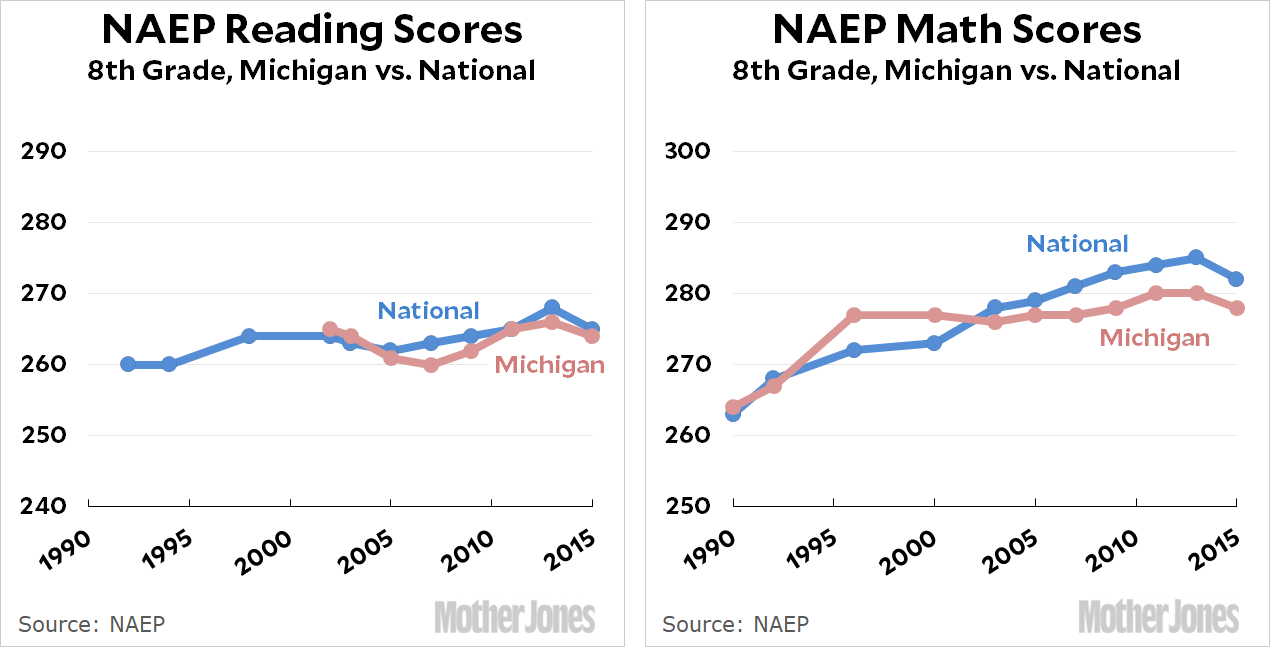
At the request of 60 Minutes, let’s revisit the current state of education in Michigan. The data available to us is limited both in time and in scope, so if we want to get a longer-term handle on things we have to look at overall test scores, not scores just for public or charter schools. Here they are:
Rather than looking at state rankings, it’s more useful to simply look at raw scores. This gives you an idea of whether a drop from, say 20th to 27th, is actually meaningful.
In reading, Michigan’s scores have gone up and down, but on net they’ve been flat, just like national scores. In math, Michigan scores have improved considerably, but the state has lost about five points compared to national averages. The usual rule of thumb is that 10 points equals one grade level, so over the past 25 years the nation as a whole has progressed about half a grade level more than Michigan in math. If you disaggregate by race, the results are about the same.
This doesn’t address the question of whether charter schools tend to improve the performance of nearby public schools—although the evidence seems to suggest that they don’t. However, it does give us some idea of whether the charter reforms in Michigan have improved the overall performance of Michigan kids. The answer is no. Using the national averages as a baseline, the reforms seem to have had no effect in reading and a modest negative effect in math.
Last month I posted a picture of a hummingbird in flight taken with my old camera. Even though I used a fast shutter speed—1/1600th of a second—the bird’s wings were blurred. This led to a comment from our resident bird guru, Steve Schafer: “The wingbeat frequency of a hovering Allen’s Hummingbird is about 60 Hz, although it’s less than that when it’s lifting off, so with a shutter speed of 1/1600, you’re seeing around 1/30 of a full beat, which looks about right. You’d need at least a factor of 10 shorter (e.g., low ambient light with a high-speed flash) to freeze the wing.” Hmmph.
Then karma struck. Last Friday I noticed that our honeybees were back, so I decided to crank up the new camera to 1/32000th of a second and see if that would freeze a honeybee’s wings. But I got lucky: While I was taking pictures of the bees, a hummingbird flew over and hovered in the same spot for a several seconds. Then I got lucky again: the camera was already set for high-speed critters, so I aimed it at the hummingbird and got it dead center. The autofocus did its job and the high-quality lens did its job. I got a burst of good shots of the hummingbird.
As it happens, the sky had gotten cloudy and I had given up on 1/32000th of a second. I had switched to 1/16000th, precisely what Steve had suggested. And sure enough, the wings were frozen. I never thought I’d get a picture like this, but modern technology made it possible. As recently as a few years ago, no camera I had ever owned had a high enough shutter speed or a quick enough autofocus or a fast enough burst mode. It would have been literally impossible to freeze a hummingbird in midair without specialized equipment. Now I can do it with a midrange, off-the-shelf consumer camera. In fact, not only can I do it, I can do it pretty easily. It’s amazing.
Here’s the Friday hummingbird:
Here’s another hummingbird from Sunday. Nice picture, too bad about the busy background.
And here’s a honeybee. A shutter speed of 1/16000th was fast enough to freeze its wings too.
Here’s some news for all my fellow depressives. Aaron Carroll points today to a massive new study on the effectiveness of antidepressants:
The reassuring news is that all of the antidepressants were more effective than placebos….Further good news is that smaller trials did not have substantially different results from larger trials….It also did not appear that industry sponsoring of trials correlated with significant differences in response or dropout rates.
….The bad news is that even though there were statistically significant differences, the effect sizes were still mostly modest. The benefits also applied only to people who were suffering from major depression, specifically in the short term. In other words, this study provides evidence that when people are found to have acute major depression, treatment with antidepressants works to improve outcomes in the first two months of therapy.
Just to clarify this, this was a metastudy focused solely on studies of antidepressants for major depression. It didn’t conclude anything one way or the other about how well these drugs work for those with moderate depression. Also, they warn that Prozac is probably the only antidepressant that works for children and teenagers.
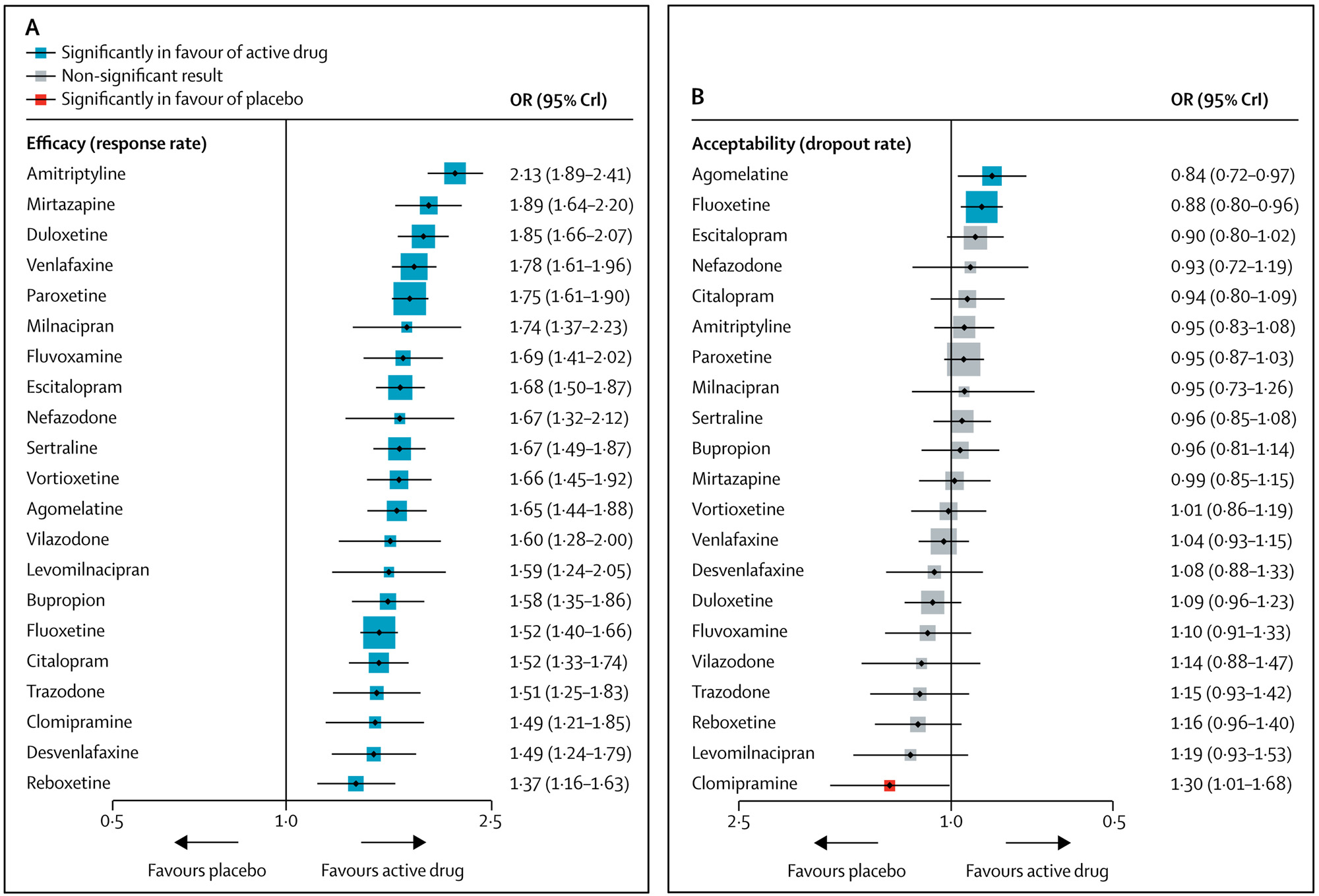
And now it’s time for the payoff to my clickbait headline. How does your antidepressant perform? Here’s the chart:
The left chart shows how well each antidepressant worked. The right chart shows how well people tolerated it. For example, I use venlafaxine (Effexor), which appears to be pretty effective (odds ratio = 1.78). Its tolerability, as measured by how many people dropped out of studies, is about the same as a placebo.
As always, this is just raw data. Different drugs work differently for different people. Only you and your doctor can decide for sure what works best for you.
Last night on 60 Minutes, Education Secretary Betsy DeVos had trouble with a few of the questions. First, Lesley Stahl asked why it made sense to take money away from public schools that were failing. Would that make them better? DeVos said that in Florida, for example, which allows lots of student choice, “the traditional public schools actually– the results get better.”
Then Stahl switched to Michigan, DeVos’s home state, and one that she’s spent years trying to make more charter friendly. Here’s how it went:
Stahl: Have the public schools in Michigan gotten better?
DeVos: I don’t know. Overall, I– I can’t say overall that they have all gotten better.
Stahl: The whole state is not doing well.
DeVos: Well, there are certainly lots of pockets where this– the students are doing well and–
Stahl: No, but your argument that if you take funds away that the schools will get better, is not working in Michigan where you had a huge impact and influence over the direction of the school system here.
DeVos: I hesitate to talk about all schools in general because schools are made up of individual students attending them.
Stahl: The public schools here are doing worse than they did.
DeVos: Michigan schools need to do better. There is no doubt about it.
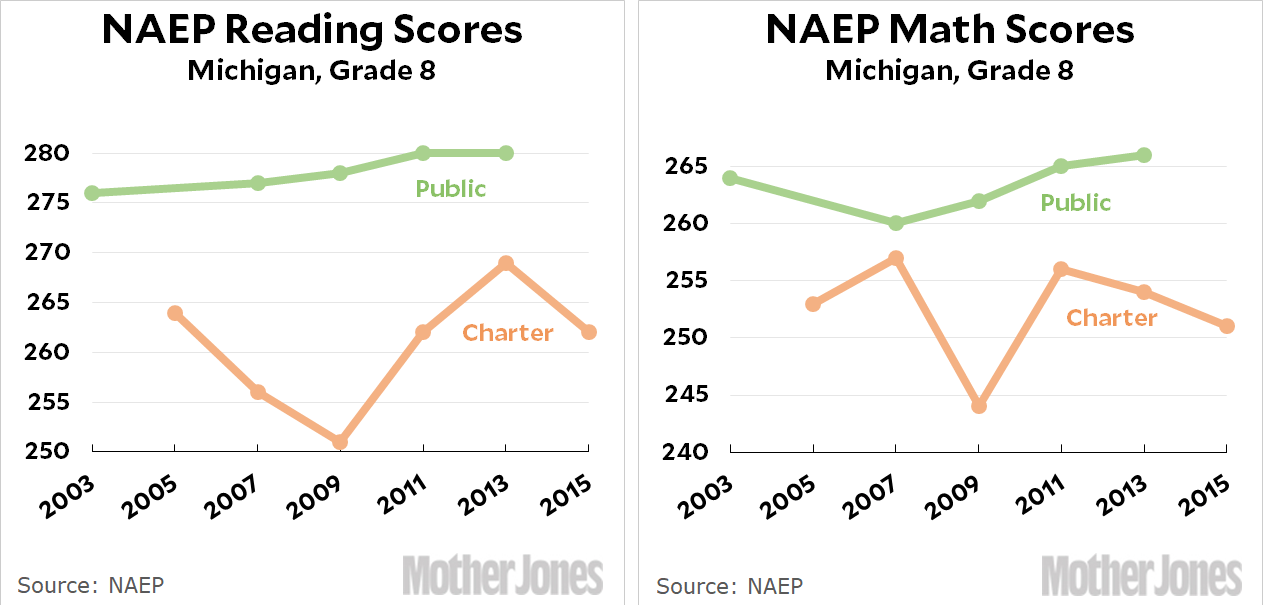
How are public schools doing in Michigan? DeVos didn’t seem to know, and Stahl was quite sure they’re doing worse. There’s no single answer to this question, but one quick way to ground yourself is to look at NAEP scores over time. So I hopped over to the NAEP website, which announced a fancy new data explorer tool, and explored. Here’s the answer:¹
Stahl seemed quite sure that public schools were doing worse, but the NAEP data suggests that in both math and reading they’ve improved over the past decade by as much or more than the national average. DeVos should have known that!
Unfortunately for DeVos, the same data suggests that charter schools in Michigan are doing worse over time. The data is jumpy, but in both math and reading the 2015 scores are below the 2005 scores.
These figures aren’t broken down by race or income or location or any of that, so don’t take them too seriously. Still, they provide a rough look at how Michigan kids are doing, and it sure looks like they’re doing steadily better in public schools but not in charter schools. I think everyone in this 60 Minutes segment should have done a little more homework.
¹I chose 8th grade because there was almost no data for 12th grade. But if Michigan is like the rest of the country, test scores for 12th graders are probably pretty flat.
Banks are required to collect racial data on their loans so that regulators can make sure they aren’t discriminating against blacks and Hispanics. But the banking industry discriminated anyway during the housing bubble of the aughts, claiming that the differences were due to low credit scores, not redlining. So when Dodd-Frank passed in 2010, it required banks to collect more information. This was reasonable: if the real reason is credit scores, then let’s see the credit scores.
Needless to say, banks didn’t like this, and as soon as Mick Mulvaney took over the Consumer Finance Protection Bureau, he set about gutting the rule. But that wasn’t enough. Now, in one of the most egregious rollbacks of Dodd-Frank regulations, Congress plans to eliminate this requirement:
For decades, banks have been required under the 1975 Home Mortgage Disclosure Act to report borrowers’ race, ethnicity and Zip code so officials could tell whether lenders were serving the communities in which they are located and identify racist lending practices such as redlining. But discriminatory practices continued, with the financial industry disproportionately targeting black and Hispanic borrowers with subprime mortgages loaded with high fees and adjustable interest rates that skyrocketed after the stock market crashed in 2008.
….Lenders were supposed to start gathering extra information about borrowers’ ages and credit scores, as well as interest rates and other loan-pricing features in January….But [Mulvaney] said the agency plans to reconsider the new requirements, and that banks would not be penalized for data collection errors in 2018. He also stripped the bureau’s fair-lending office of its enforcement powers. The Senate bill would repeal many of the new reporting requirements, exempting small lenders making 500 or fewer mortgages a year from the expanded data disclosure.
This is ridiculous. Loan data in modern banks is kept on a new invention called a “computer.” All the data is already there, and providing it just means grabbing a few more fields from a database. The real reason for eliminating this requirement has nothing to do with the burden it places on community banks. It’s there so that these banks can continue to discriminate and then pretend that there’s not really any discrimination—and we’d all understand that if we only saw all the other loan data.
What a con. And a dozen Democrats are supporting this.
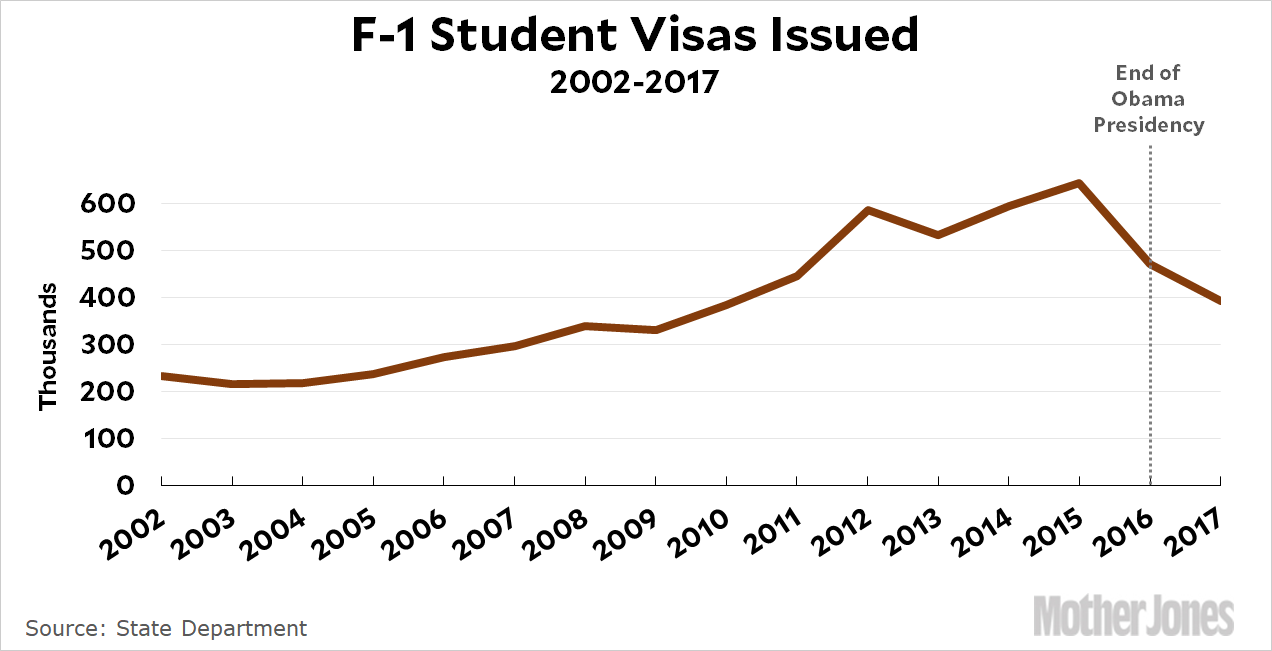
The number of visas issued to foreign students fell markedly last year amid stricter immigration policies, State Department data show….Some of the slide can be attributed to stepped-up competition from schools in other countries and less support for foreign study by some governments. But immigration attorneys and school officials say Trump administration policies are making the U.S. a tougher destination for foreigners and point to stricter scrutiny of those who do apply.
I am, needless to say, ready to believe this, but State Department data (here and here) doesn’t really back it up:
I don’t know what happened in 2016, but that was when the biggest drop occurred—and it happened on President Obama’s watch. The decline continued during President Trump’s first year, but at a lower pace.
Why did the Obama administration reduce student visas by 27 percent in its final year? Or were there simply fewer applicants? The 2016 figures were released after Trump’s inauguration, so all the stories about it were Trump-centric. But the decline itself happened while Obama was still president. What’s the explanation?
The White House on Sunday vowed to help provide “rigorous firearms training” to some schoolteachers and formally endorsed a bill to tighten the federal background checks system, but it backed off President Trump’s earlier call to raise the minimum age to purchase some guns to 21 years old from 18 years old.
….The Trump plan does not include substantial changes to gun laws….Rather, the president is establishing a Federal Commission on School Safety, to be chaired by Education Secretary Betsy DeVos.
….The White House plan released Sunday does not address the minimum age for gun purchases. Pressed by reporters about the apparent backtracking, a senior administration official said the age issue was “a state-based discussion right now” and would be explored by DeVos’s commission.
Who could have guessed that Trump would cave in to the NRA after all his tough talk? That is, other than everyone?
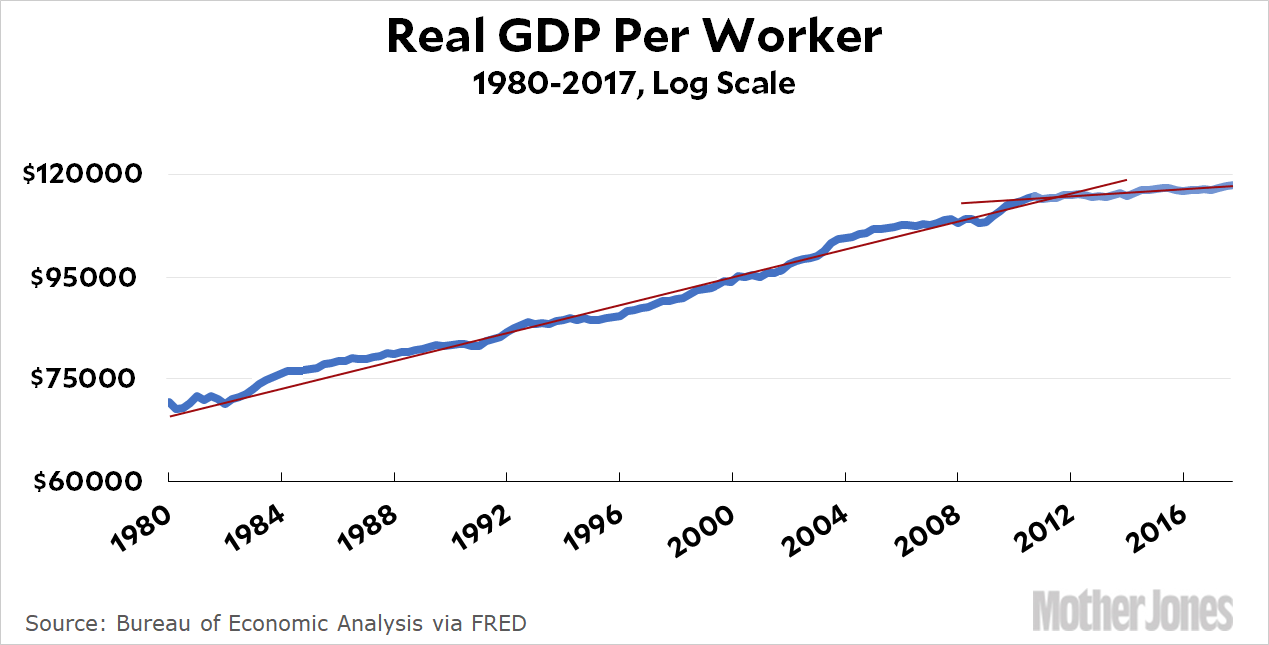
Here is GDP per worker in the United States. It’s on a log scale so that it’s easier to see the inflection point in 2010:
We never really recovered from the Great Recession. Unemployment is down and wages are starting to rise, but worker productivity flattened suddenly in 2010 and never regained its old growth rate. As of 2017, it still hadn’t.
And we respect that! But maybe you’re of a mind to support our work directly instead? We have until December 31 to raise the last $400,000 we need to keep our nonprofit newsroom running at full strength into 2026. Will you make a gift today?
We noticed you have an ad blocker on. Can you pitch in a few bucks to help fund Mother Jones' investigative journalism?
Billionaires own the media,
but they don’t own us.
At Mother Jones we know these aren’t conventional times, and they require unconventional coverage. That’s what deliver every day: fierce, independent journalism you can’t find elsewhere. Perhaps never in the history of our country has that been more necessary than now. But we can’t do it without reader support—your support. Please chip in today.
Billionaires own the media,
but they don’t own us.
At Mother Jones we know these aren’t conventional times, and they require unconventional coverage. That’s what deliver every day: fierce, independent journalism you can’t find elsewhere. Perhaps never in the history of our country has that been more necessary than now. But we can’t do it without reader support—your support. Please chip in today.