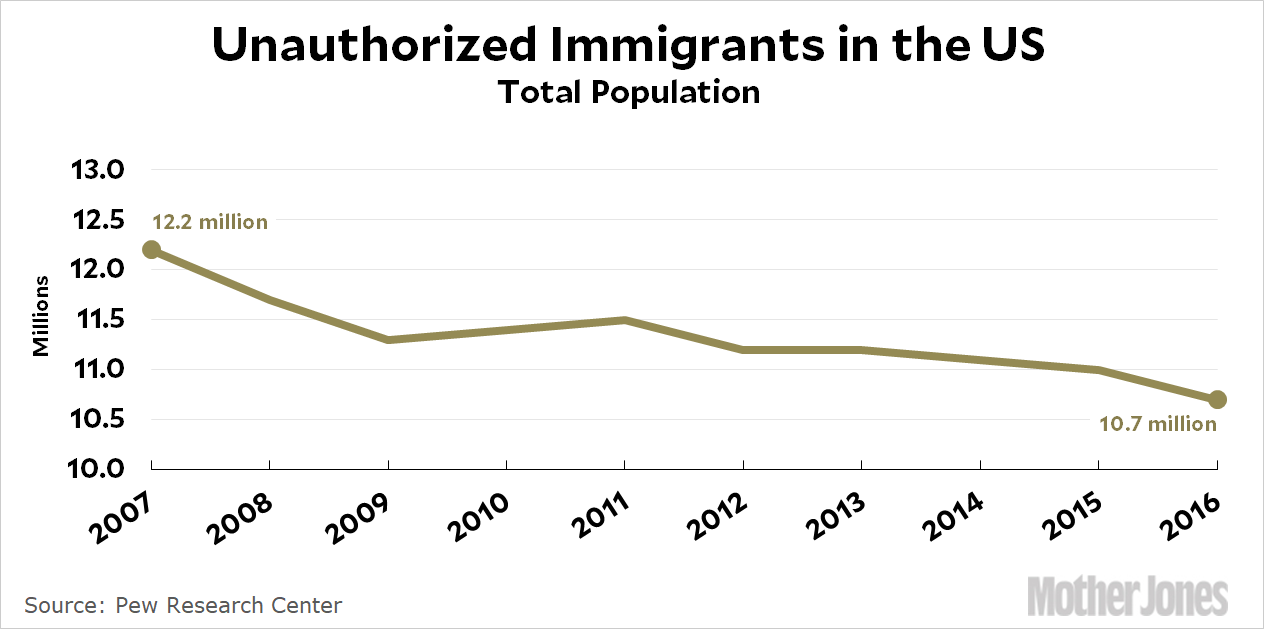
Every year the Pew Research Center releases an annual report on the flow of unauthorized immigrants into the US. A while back—and I apologize for being fuzzy on the details—immigration hawks were all yammering about how 2016 was the year. Based on their read of Census data, 2016 was the year that Pew would finally show an increase in the population of unauthorized immigrants after nearly a decade of decline. But no. According to Pew, at least, it’s still declining:
The full report is here. We now have a full decade of decline following the peak year of 2007. This is why Donald Trump is so hellbent on inciting clashes wherever he can. Without that, there’s just no way to keep his base outraged over the horde of Mexicans invading our borders. After all, Trump’s supporters can read. After a while, even they’ve heard the numbers often enough to figure out that there’s really nothing much to be outraged about here.
Border zealot Mark Krikorian argues that Democrats are too in favor of open borders—asymptotically, anyway:
Although Democrats routinely deny that they’re for open borders — dismissing the very suggestion as an outrageous slur — their reaction to Sunday’s violence by some of the Central American illegal aliens in Tijuana suggests otherwise.
….The border clash was the culmination of a series of policy choices by Democrats over the past several years, asymptotically approaching open borders. Although things are lousy in Central America, it was the Obama administration’s reaction to illegal immigration from there that created this flow. By releasing into the U.S. Central Americans bringing children with them, as well as releasing “unaccompanied” “minors” from Central America who were brought here by smugglers hired by their relatives in the U.S., the prior administration created a powerful incentive to head north.
We are asymptotically in favor of open borders! I love this formulation and plan to use it in the future. Republicans are asymptotically in favor of killing all black people! Ronald Reagan was asymptotically in favor of a zero percent top marginal tax rate! Dick Cheney was asymptotically in favor of declaring war on every country in the Middle East!
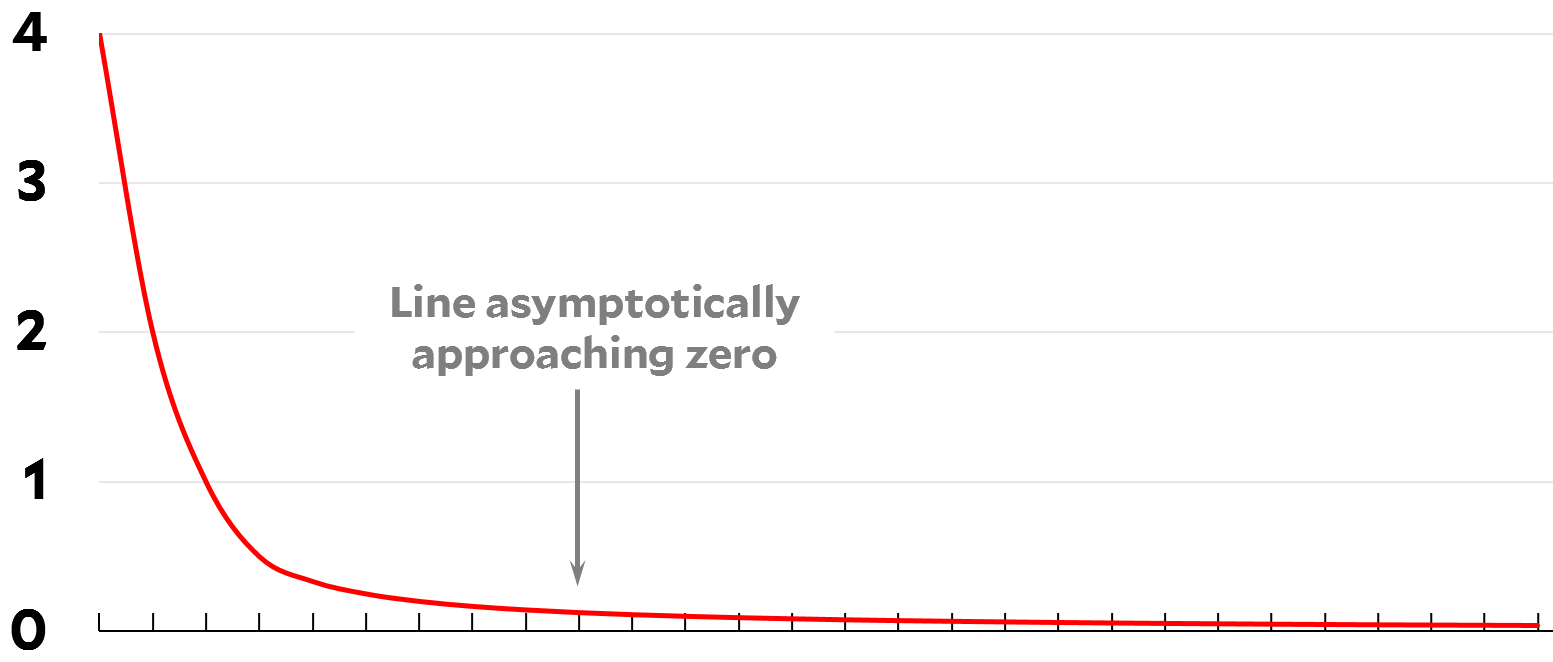
For those of you who snoozed through math class, here is an asymptote:
The line never quite gets to zero, but it gets close enough that it might as well be zero. This is all based on Krikorian’s fantasy that President Obama put out a big neon sign begging refugees to come to the United States and then deliberately allowed them to escape into the vast howling tracts of the American wilderness, never to be seen again by the INS. There must be millions of them out there by now.
Then again, maybe not. Here is good old Politifact checking out the contention that asylum seekers get into the US and then all disappear:
One source of data comes from an Obama-era program that released asylees from detention and matched them with case managers who encouraged compliance with court-ordered obligations. As of April, the Family Case Management Program, or FCMP, had 630 enrolled families. Before the Trump administration ended the program in June, participants had a 100 percent attendance record at court hearings. They also had a 99 percent rate of check-ins and appointments with Immigration and Customs Enforcement, according to a Department of Homeland Security Office of Inspector General report.
“According to ICE, overall program compliance for all five regions is an average of 99 percent for ICE check-ins and appointments, as well as 100 percent attendance at court hearings,” the report said. “Since the inception of FCMP, 23 out of 954 participants (2 percent) were reported as absconders.”
In 2015, the immigration advocacy group American Immigration Council published a report that looked at studies from over the previous two decades that examined how well asylum seekers fulfilled their legal obligations. It found studies showed “very high rates of compliance with proceedings by asylum seekers who were placed into alternatives to detention.”
23 absconders! In other words, things were working OK back when Obama was in charge. The big problem was a lack of immigration judges, which meant that asylum cases took years to adjudicate. That would have been fairly easy to solve, but only if solving the problem were Donald Trump’s actual goal. Instead he deliberately made a hash of everything so that he’d have plenty of immigrant chaos to point to during the midterm election. Trump excels at making a hash of things, so this worked great.
But look: if you want to know the mainstream Democratic view on immigration, all you have to do is look at the legislation they’ve supported over the past decade. They supported compromise reform in 2006 and then again in 2013. They offered a compromise to President Trump, but were turned down when he changed his mind about what he’d accept. In all of these cases, the reason no progress was made was because of opposition from the hardline immigration wing of the Republican Party. You could almost say that, asymptotically, Republicans are opposed to any immigration legislation at all.
In the meantime, I’ll repeat my earlier contention: anyone who is serious about illegal immigration should support mandatory E-verify above all else. The wall doesn’t matter. Quotas don’t matter. Family separations are unnecessary. If E-verify were made (a) mandatory, (b) fast, (c) reliable, and (d) easily appealable, it would solve 90 percent of our immigration problems. If employers are unable to employ undocumented workers except at the risk of a serious fine, they would stop employing undocumented workers and undocumented workers would stop coming across the border. End of story.
So if you want to demonstrate seriousness, introduce a bill that does only one thing: puts in place a truly vigorous version of E-verify. Maybe couple it with a DACA bill so that everyone can feel like they’re being good guys at the same time that they get tough on the border.
I don’t know for sure how Democrats would feel about this. But I know that Republicans would oppose it. They always have. You see, their donors like having lots of cheap labor, and that’s what truly motivates their inability to get anything done. They just don’t want to admit it.
Donald Trump’s former campaign manager Paul Manafort held secret talks with Julian Assange inside the Ecuadorian embassy in London, and visited around the time he joined Trump’s campaign, the Guardian has been told.
….Manafort’s first visit to the embassy took place a year after Assange sought asylum inside [i.e. sometime in 2013], two sources said. A separate internal document written by Ecuador’s Senain intelligence agency and seen by the Guardian lists “Paul Manaford [sic]” as one of several well-known guests. It also mentions “Russians”. According to the sources, Manafort returned to the embassy in 2015. He paid another visit in spring 2016, turning up alone, around the time Trump named him as his convention manager. The visit is tentatively dated to March.
Manafort’s 2016 visit to Assange lasted about 40 minutes, one source said, adding that the American was casually dressed when he exited the embassy, wearing sandy-coloured chinos, a cardigan and a light-coloured shirt.
A Republican who will soon step down as chairman of the U.S. House of Representatives tax committee late on Monday released a sweeping, nearly 300-page tax bill that he said would affect Americans’ retirement savings, numerous business tax breaks and redesign the Internal Revenue Service.
….The 297-page text of the bill covers tax breaks for fuel cell cars, energy efficient homes, race horses, mine safety equipment, auto race tracks and many other items, as well as retirement savings plans such as 401(k)s and individual retirement accounts (IRAs). The bill also “includes some time-sensitive technical corrections” to the 2017 bill that Trump signed into law, Brady said in the statement.
This sounds totally on the up-and-up. Given Republicans’ track record for scrupulous honesty in bill writing, I’m sure there are no secret giveaways or favors for pet industries here. Democrats should join in and just vote for this bill without bothering to look closely at it. Republicans would do the same for us, I’m sure.
Jonah Goldberg offers us a post today about the great divide: those who believe in the perfectibility of man and those who don’t. This time he comments on Thomas Sowell’s version of this argument:
The constrained vision is conservative. It holds that human nature can be bent, but that it cannot be erased. The unconstrained vision holds that humans are not merely malleable but perfectible and therefore so is society itself. The constrained vision, according to Sowell, recognizes that when it comes to most important policy questions, “There are no solutions. There are only trade-offs.” The unconstrained vision is derived in part from what I’ve often called the cult of unity, which holds that all good things need not come at the expense of other good things.
….The trouble with the debate we have now is that one side of the argument not only believes there are no trade-offs, but that even suggesting there are is proof of bigotry and evil. That is not how the argument for more generous or humane immigration policies can be won, but it is how the argument can be lost, as we are seeing in much of Europe right now.
Can someone help me out here? I don’t know if Rousseau really believed that mankind was perfectible, but either way I doubt that anyone since him has believed it in any practical sense. Certainly there are many of us who believe in working toward perfection—which is nothing more than trying to become better—but that’s about it.
So what’s the deal with so many conservatives who seemingly believe that we liberals believe in the perfectibility of mankind? I sure as hell don’t. I believe that humans are, by and large, mean, nasty, greedy, tribal, and ignorant—which is precisely what makes the liberal political program so indispensable. From the Enlightenment onward, Western liberals have done their best to promote a culture dedicated to fighting our worst and basest instincts in order to improve the lot of the destitute and construct a better world. This seems admirable, doesn’t it? Certainly it seems admirable compared to defending the powerful and keeping the poor in their place because, hey, human nature is horrible and there’s no point in fighting it.
As for trade-offs, it’s hard to say anything except huh? Conservative “trade-offs” are almost never anything but thinly-veiled excuses for not doing anything to upset the current order. The modern Republican Party, in particular, is almost entirely committed to the propositions that tax cuts pay for themselves, wars don’t cost anything, social welfare hurts the poor, climate change doesn’t exist, and the unregulated free market magically solves all problems. If there’s ever been a political party more dedicated to selling itself to the electorate on the basis of no trade-offs or sacrifices ever being necessary, it’s the contemporary GOP.
Anyway, Goldberg’s narrow point in his post today is that some lefties believe in open borders, which is something of a utopian stand that denies the existence of trade-offs. And sure, it’s true that the left has always had its small coterie of idealists, who we endure because they act as a prod to keep us pragmatic types from getting too lazy and comfortable. But the same is true of the right. I doubt that anyone on the mainstream right really believes in, say, a world in which abortion has been completely eradicated. Nonetheless, they tolerate the idealists who are working toward that goal.
Bottom line: if you want to belong to a movement that’s practically founded on the notion that although human nature is pretty squalid, human society can still be made better with lots of hard work and trade-offs, become a lefty! We still have room for you.
This is a photo of a D train headed downtown, taken from the northbound platform (I was on my way to the Bronx to visit this cat and his servants). Thanks to the miracle of the internet, I can tell you that this is an R68 car built by Westinghouse-Amrail around 1986. It is 75 feet long and 10 feet wide. Fascinating, no?
The usual story of high-priced drugs goes something like this:
Company develops drug for semi-rare disease.
Company sets really high price for drug because it can.
Public outrage ensues.
Company defends itself, citing high R&D costs etc.
More outrage.
Company shrugs, nothing happens.
But the story goes a little differently for a recent drug designed to cure lipoprotein lipase disorder (LPLD), which affects about one out of a million people. The usual therapy for LPLD is an extremely low-fat diet, but that has limited efficacy. Since LPLD is a genetic disease, women who have it still can’t have children. And even if you follow the strict diet that LPLD demands, you still risk getting pancreatitis, a painful and prolonged problem.
Eventually, you figure that someone would invent something better. If it goes the normal route, it would be a pill or an injection or something that you’d get, say, once a month, and each dose would cost $10,000 or so. That would cause some outrage, but $10,000 isn’t really that outrageous these days—it’s bog ordinary for lots of cancer treatments—so the drug would most likely slide onto the formulary for most insurance companies and become the treatment of choice for yet another very rare disease.
Still, if you add it up, this comes to more than a million dollars over ten years. Sow what if, instead, somebody invented a one-time treatment that completely cured LPLD and then just charged $1 million for it up front? It’s a ton of money, but it works out to be cheaper than the long-term treatments and it’s better for the patients. So why not?
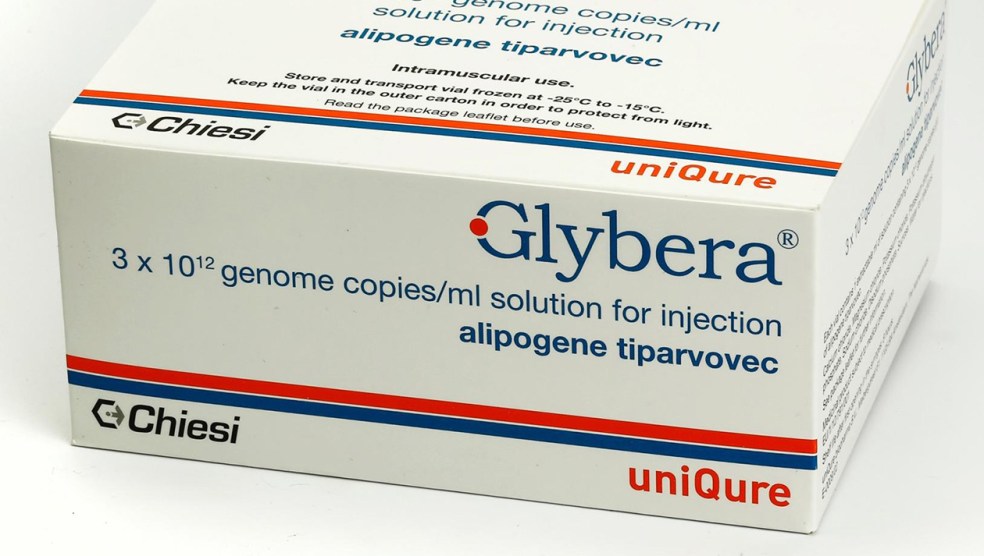
Well, a drug just like this exists. It was approved for sale. It works wonderfully. One treatment cures LPLD completely for at least ten years. It’s called Glybera, and it was invented by a team of Canadian researchers. The CBC tells us what happened to it:
In the 2½ years it took to win EMA approval, AMT, which had no other products to sell and no revenue from Glybera, lost millions of dollars. The company was formally liquidated in 2012. Its assets were acquired by a new private company, uniQure….To raise enough money to launch Glybera, uniQure partnered with an Italian pharmaceutical company, Chiesi Farmaceutici. For 31 million euros, Chiesi acquired the rights to sell Glybera in Europe, while uniQure retained the rights to the Canadian and U.S. markets….When Glybera finally went on sale in Europe in 2015, it made international headlines for its price: approximately $1 million US for a single dose….The price tag made it difficult to convince European governments and private insurance companies to pay for Glybera.
And that was that. There were a few doses of Glybera sitting on the shelf, and they were given away. Nobody makes it anymore and nobody has any plans to.
So what do you think? Glybera is a great drug because it actually fixes the faulty gene that causes LPLD. Women can have babies, and everyone can live their lives without worrying that a momentary slip in their diet will put them in the hospital. On the other hand, it costs a million bucks. That’s not too surprising for a drug that probably has a total customer base of about a hundred in all of Europe and North America, but still: it’s a million bucks to cure a disease that’s generally not life-threatening. Should an insurance company be required to pay that much? Or a government-run health service?
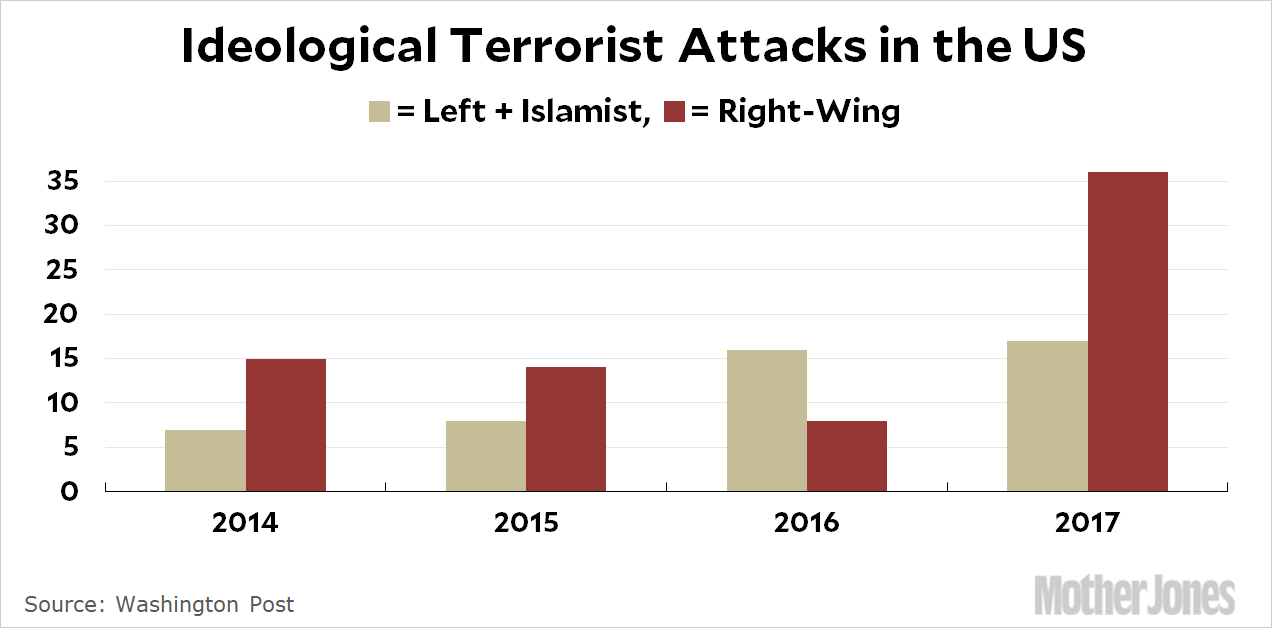
For the last few years, US terrorist incidents motivated by political ideology have remained fairly stable at about 20 per year. Then Donald Trump was inaugurated. This had no apparent effect on left-wing or Islamist attacks (the only other categories aside from right-wing), but it had a huge impact on right-wing violence:
Right-wing terrorist attacks tripled from their previous average during Trump’s first year in office. Thanks a lot, Mr. President.
General Motors said Monday that it planned to idle five factories in North America and cut several thousand blue-collar and salaried jobs in a bid to trim costs. The action follows similar job-cutting moves by Ford Motor in the face of slowing sales and a shift in consumer tastes, driven in part by low gasoline prices.
….The plants include three car factories: one in Lordstown, Ohio, that makes the Chevrolet Cruze compact; the Detroit-Hamtramck plant, where the Chevrolet Volt, Buick LaCrosse and Cadillac CT6 are produced; and its plant in Oshawa, Ontario, which makes the Chevrolet Impala. In addition, transmission plants in the Baltimore area and in Warren, Mich., are to halt operations.
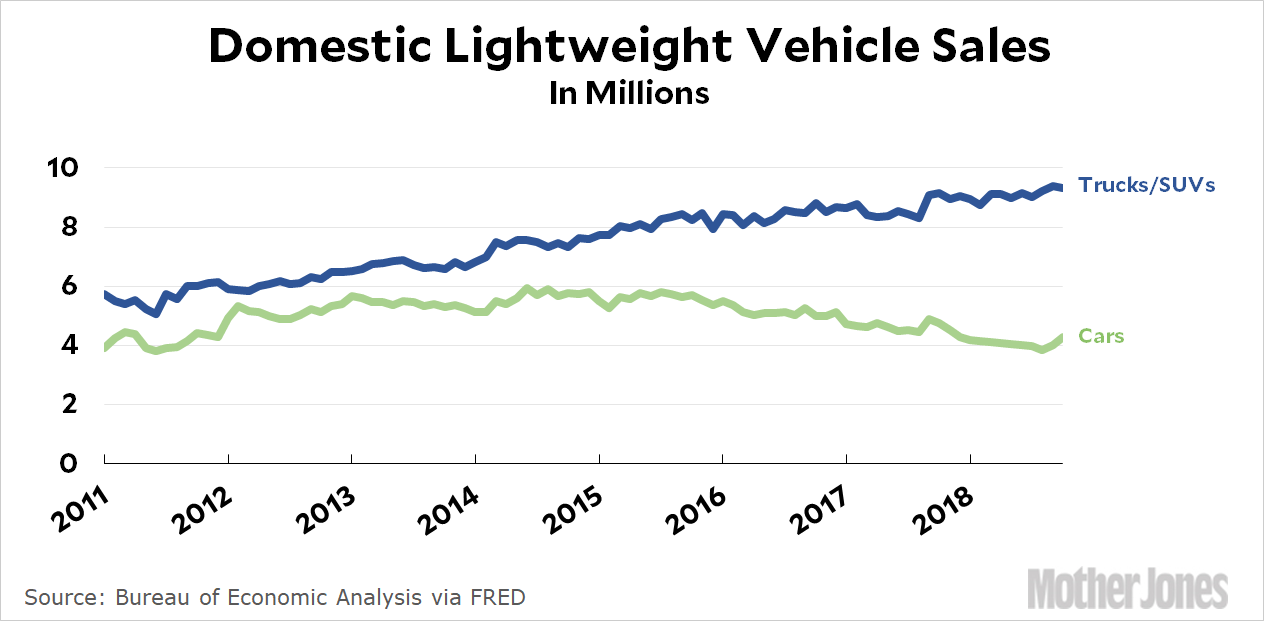
Part of this is due to Trump’s steel tariffs, which have raised the price of cars and trucks, but mostly it’s due to changing tastes brought about by a big drop in gasoline prices in 2015:
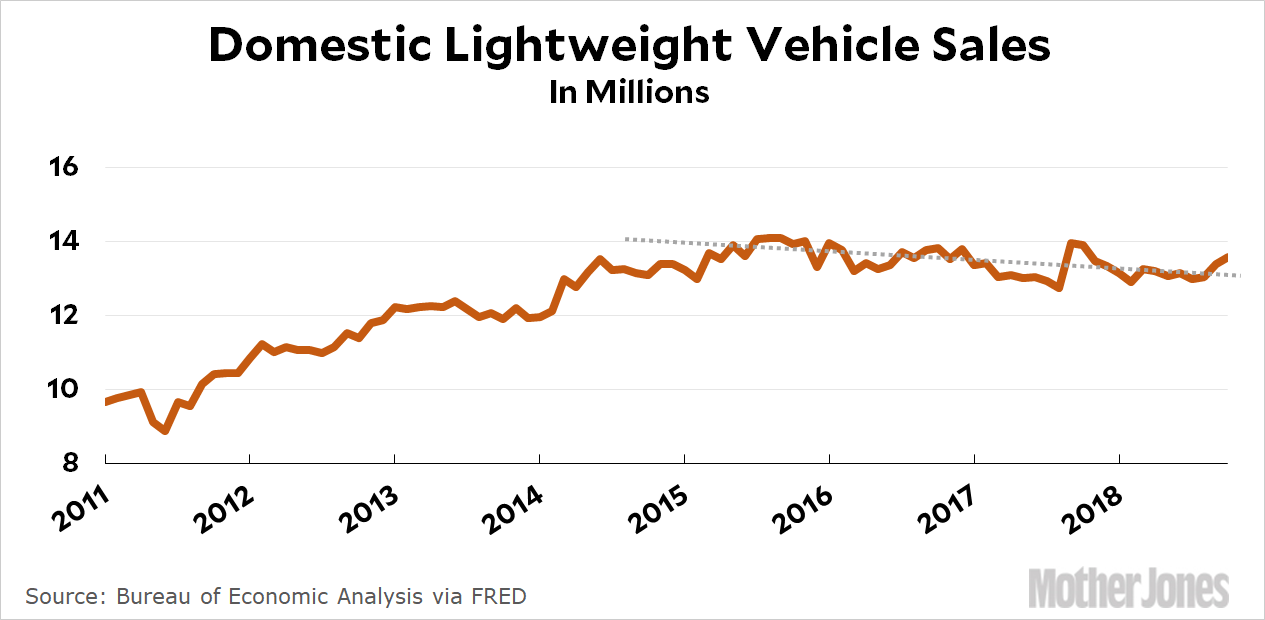
As you can see, domestic auto sales were doing OK up through mid-2014. Then, over the next 18 months, gasoline prices plunged from $3.70 to $2.20 and Americans did what they always do: abandoned gas-friendly autos and went on an SUV binge. Today, trucks and SUVs outsell cars by more than 2 to 1, which is why auto plants are being closed. At the same time, total vehicle sales aren’t exactly on fire either:
The average sales level has dropped by about a million units since 2015. This isn’t disastrous, but it’s hardly what you’d expect in a booming economy, either. The result is plant closures and, before long, the end of virtually all domestically produced cars. The next time gasoline prices rise—and they will, someday—American car companies will have nothing but big piles of unwanted, gas-guzzling SUVs that nobody wants.
Can you pitch in a few bucks to help fund Mother Jones' investigative journalism? We're a nonprofit (so it's tax-deductible), and reader support makes up about two-thirds of our budget.
We noticed you have an ad blocker on. Can you pitch in a few bucks to help fund Mother Jones' investigative journalism?
We’re halfway there, but time’s running out.
With only days left in 2025, we've made real progress toward our $400,000 goal—the funding we need to keep our nonprofit newsroom running at full
strength. But to close the remaining $200,000 gap before December 31, it will take a huge surge in reader support. Whether you've given before or this is your first time, your contribution right now will matter. Will you help us get there?
We’re halfway there, but time’s running out.
With only days left in 2025, we've made real progress toward our $400,000 goal—the funding we need to keep our nonprofit newsroom running at full
strength. But to close the remaining $200,000 gap before December 31, it will take a huge surge in reader support. Whether you've given before or this is your first time, your contribution right now will matter. Will you help us get there?