• Mike Pompeo Goes Postal on NPR Reporter

    Paul Hennessy/SOPA Images via ZUMA

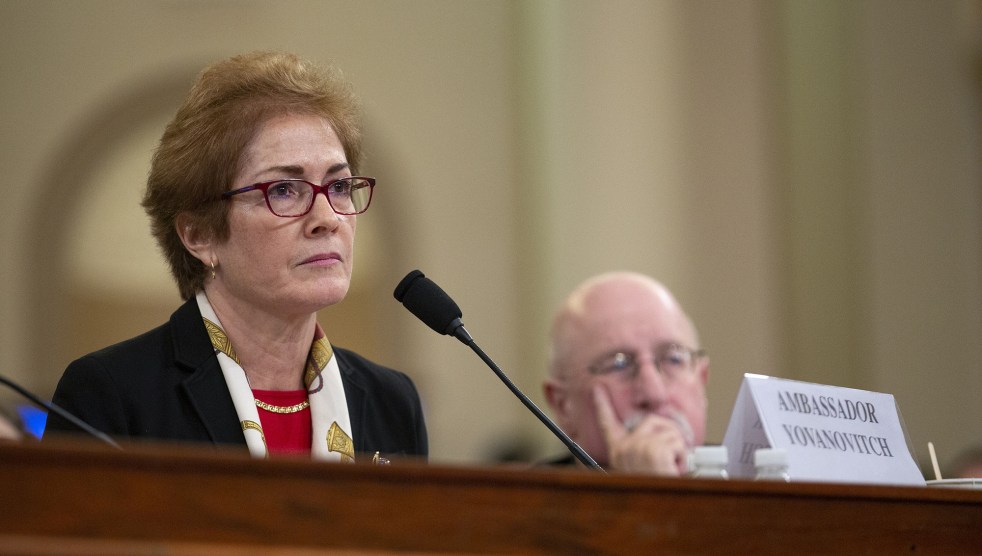
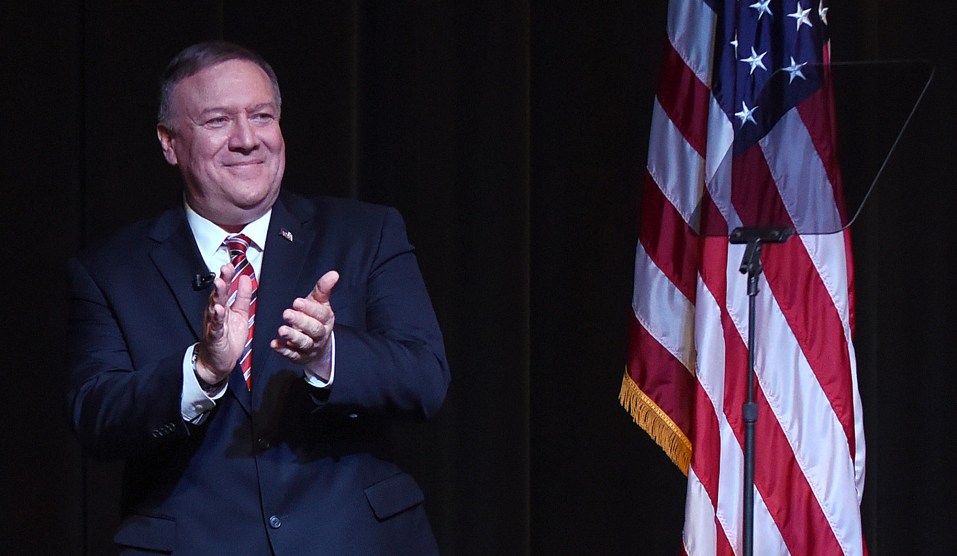
    Now here’s a story. NPR reporter Mary Louise Kelly interviewed Secretary of State Mike Pompeo yesterday. After asking a bunch of questions about Iran, she switched subjects to Ukraine. Pompeo got pissed off even though his staff had agreed that Ukraine could be part of the interview. Kelly asked Pompeo if he thought he owed an apology to Marie Yovanovitch, the ambassador to Ukraine who was fired last year for not being helpful enough with President Trump’s scheme to extort an investigation of Hunter Biden. Pompeo was not happy with the question. Kelly persisted: Should he have defended Yovanovitch? Pompeo said he defended everyone at the State Department. Kelly asked if he could point to remarks where he had defended Yovanovitch. Pompeo abruptly cut off the interview and stalked off.

    But wait! There’s more:


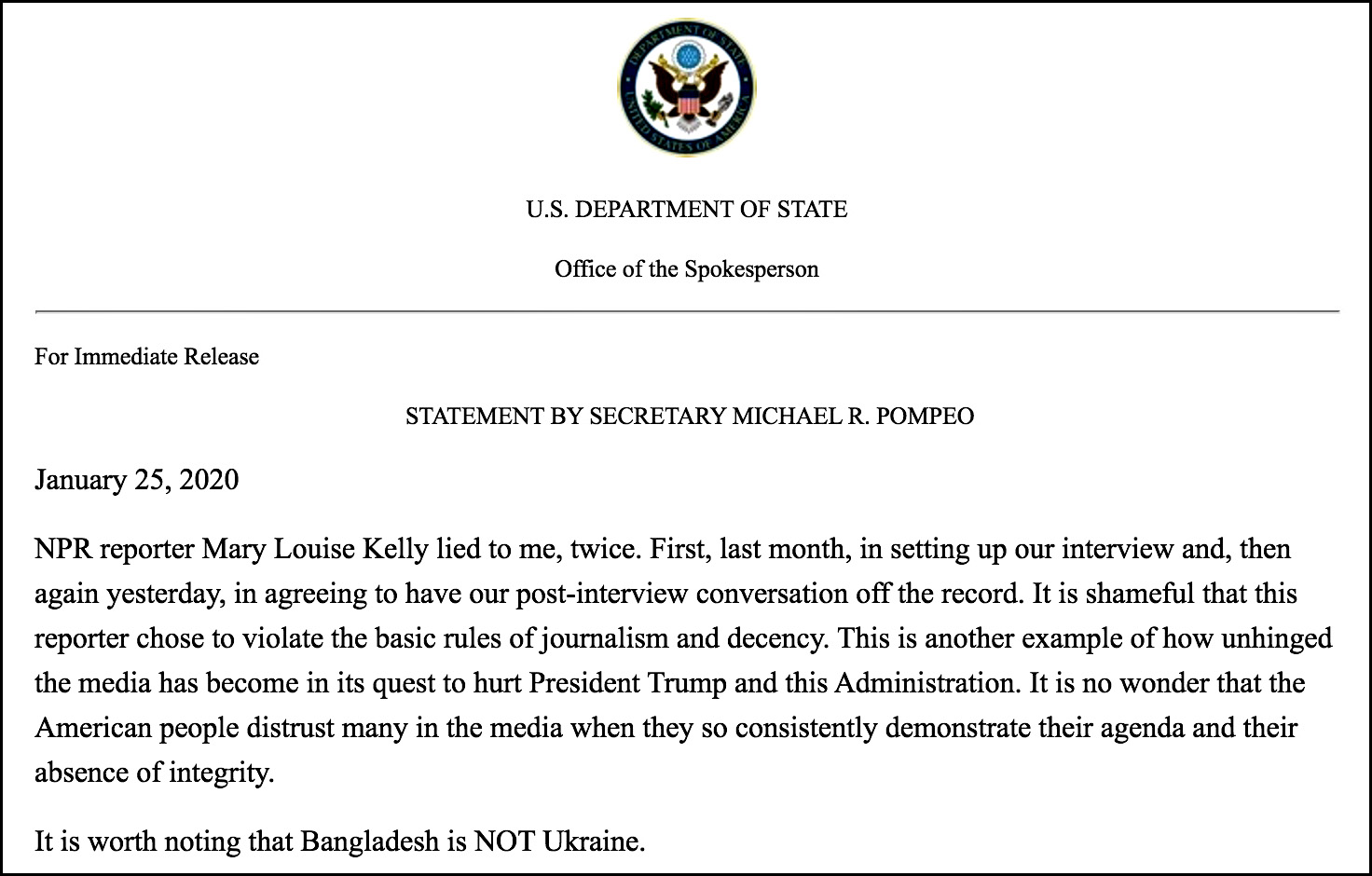
    Pompeo took out a map and asked Kelly to point to Ukraine! With F-bombs! What a dick. But today there’s even yet more:

    So Pompeo accused Kelly of lying twice: first in breaking an agreement to confine the interview to Iran, and second in breaking an agreement to allow Pompeo to have his temper tantrum off the record. Then he implies that Kelly pointed to Bangladesh and thought it was Ukraine.

    I’m going to go out on a limb here and say that Pompeo is the one lying about all this stuff. Kelly set up her interview properly. She was asked to leave behind her recording equipment for Pompeo’s tirade, but not told it was off the record. And she knows perfectly well where Ukraine is.

    Welcome to Donald Trump’s Washington.

  • Lying About Hillary Is Still Our Favorite Spectator Sport

    Sachelle Babbar/ZUMA

    In the Guardian today, former Bookslut editor-in-chief Jessa Crispin takes on Hillary Clinton:

    Hillary Clinton is still trying to sell herself as a feminist icon. Don’t buy it

    It was clickbait, and I clicked. I was a little surprised to find that the entire piece contained only one paragraph related to Clinton, but I was even more surprised when that paragraph contained a grand total of two allegations, both of which were linked to other sources. Here’s the first:

    Hillary Clinton is still trying to sell herself as a feminist icon — as a “gutsy woman,” as she puts it in an interview she did to support the new four-part documentary about her life and career, Hillary, soon to debut at Sundance….“How could we have known?” Clinton asks, when questioned in the same interview about her longstanding friendship and political relationship with alleged sexual predator Harvey Weinstein. Never mind the fact that Ronan Farrow has publicly accused Clinton’s publicist of trying to kill his first story about the accusations against Weinstein.

    That’s the exact opposite of what Farrow said. In the link that Crispin herself provides, Farrow says that although he did get an email from Clinton’s publicist, “The allegation here is not that Hillary Clinton was seeking to squash the Weinstein story.” So let’s move on to allegation #2:

    Or that Lena Dunham has said she discussed Weinstein with Clinton in private.

    Again, it turns out that this is exactly the opposite of what Dunham said. She never claimed to have spoken with Clinton at all:

    In March [2016], Ms. Dunham, a vocal Clinton supporter, said she warned the campaign. “I just want you to let you know that Harvey’s a rapist and this is going to come out at some point,” Ms. Dunham said she told Kristina Schake, the campaign’s deputy communications director….Ms. Dunham says she has “an incredible allegiance to Hillary,” and does not believe the reports ever traveled to Mrs. Clinton.

    This is Crispin’s own link. It’s not like I had to go digging for anything.

    How can people write stuff like this? If you want to go after Hillary Clinton for being naive about Weinstein—or for misstating what she knew and when she knew it—that’s fine. Go ahead and make your case. But if you do this, why would you back it up with two false allegations and then provide the very links that demonstrate they’re false? Is this just life in Donald Trump’s America? A demonstration of poor reading skills? An assumption that you can get away with anything because no one ever clicks on the link?

    Whatever it is, it’s bizarre behavior.

  • Trump on Yovanovitch: “Take her out. Okay?”

    Stefani Reynolds/CNP via ZUMA

    Lev Parnas, as I’m sure you recall, is one of Rudy Giuliani’s henchmen, part of the team responsible for pressing Ukraine to investigate Hunter Biden. Donald Trump has said repeatedly that he doesn’t know Parnas and has never spoken to him, but ABC News has gotten hold of a recording that suggests Trump knew Parnas better than he’s letting on:

    The recording appears to contradict statements by President Trump and support the narrative that has been offered by Parnas during broadcast interviews in recent days. Sources familiar with the recording said the recording was made during an intimate April 30, 2018, dinner at the Trump International Hotel in Washington, D.C.

    “Get rid of her!” is what the voice that appears to be President Trump’s is heard saying. “Get her out tomorrow. I don’t care. Get her out tomorrow. Take her out. Okay? Do it.”

    ….Parnas appears to say: “The biggest problem there, I think where we need to start is we gotta get rid of the ambassador. She’s still left over from the Clinton administration,” Parnas can be heard telling Trump. “She’s basically walking around telling everybody ‘Wait, he’s gonna get impeached, just wait.” (Yovanovitch actually had served in the State Department since the Reagan administration.)

    April 2018! Until now, we’ve all believed that Ukrainegate started in early 2019 or maybe late 2018. But apparently this affair was in the works at least two years ago. I wonder how far back it really goes?

  • Sorry, But Democrats Have to Compromise and Republicans Don’t

    Ezra Klein writes in the New York Times today that Democrats “can move to the left — and they are — but they can’t abandon the center or, given the geography of American politics, the center-right, and still hold power.” And yet, Republicans can abandon the center. That’s unfair!

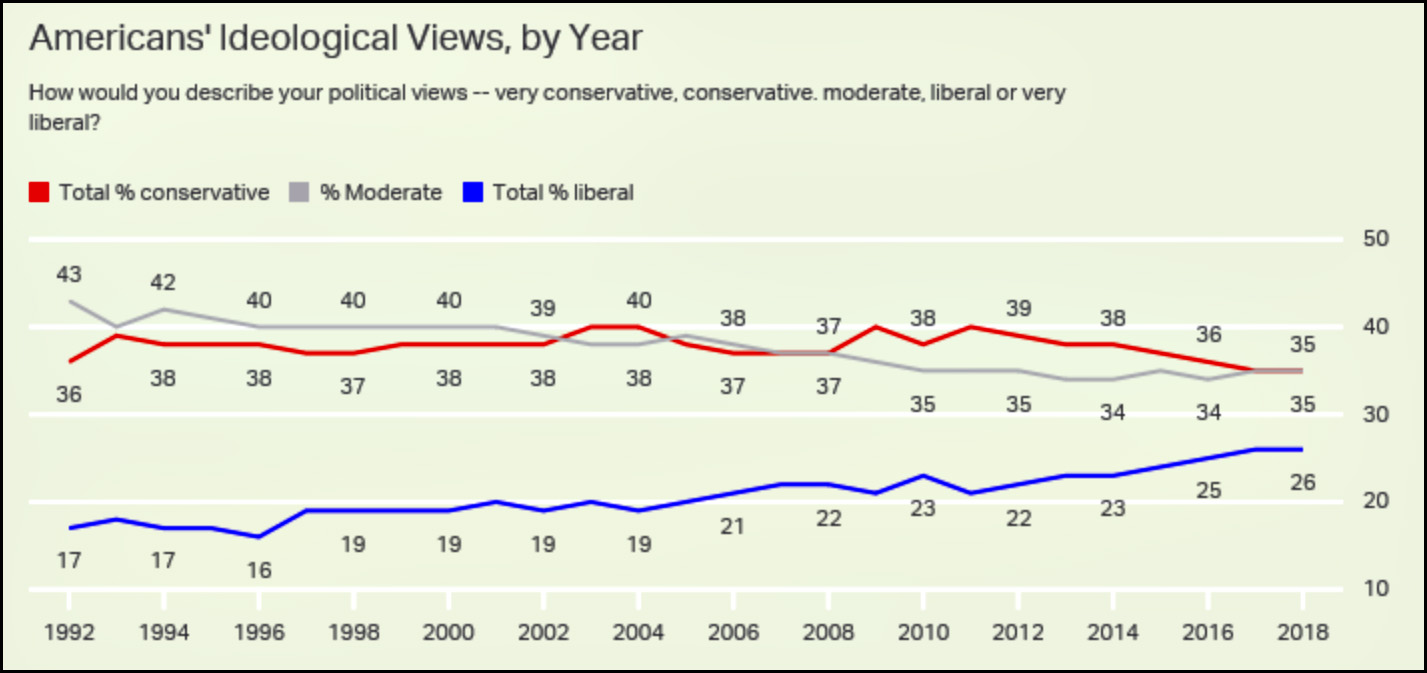
    Yeah, it is. And if you want to find out why it’s true anyway, read Ezra’s piece in the Times. Or, in the spirit of a picture being worth a thousand words, stare at this Gallup chart for a while:

    The liberal share of the population has steadily increased over the past few decades, but it still tops out at 26 percent. That means Democrats need about two-thirds of independents to create a majority. And that means appealing to the center—or in some places to the center-right. It’s the only way to get to 51 percent.

    Republicans, by contrast, start out with 35 percent. If they manage to appeal to just the conservative portion of independents, they can get to 51 percent. So that’s what they do.

    At this point, a bunch of people in comments are going to start going on about how ideological self-ID has changed over the years and centrists are more liberal than they used to be and all the polls say liberal views command a majority, blah blah blah. Just stop it. All you’re doing is kidding yourself. The hard truth is that America is not an especially liberal country, and that means it’s tough being the liberal party. You have to go slow and you have to compromise.

    But how do Republicans get away with being so damn extreme? Shouldn’t that scare off the moderates? Maybe it should, but again, life isn’t always fair. Conservatives, by definition, want to keep things the same, and being extreme about keeping things the same is just not that scary. Liberals want to change things, and being extreme about change is scary. So Republicans can win even with a nutball right-wing caucus making up a big chunk of their party. Democrats can’t.

    This is a drag. But the fact remains that America has historically progressed in tiny spurts: a few years during the New Deal; a few years in the mid-60s; a few months (literally) after Obama was elected president. There are modest wins and modest losses the rest of the time, but that’s all. The American public just can’t handle very much liberal progress at a single time, and if you don’t like that, you need to figure out how to sell liberalism so well that the chart above turns significantly upward. Give me a call when you figure out how to make that happen.

  • Censoring Ourselves

    Kevin Drum

    George Packer thinks that contemporary political writers have gotten afraid of saying what they really believe. There’s just too high a price to pay:

    If an editorial assistant points out that a line in a draft article will probably detonate an explosion on social media, what is her supervisor going to do—risk the blowup, or kill the sentence? Probably the latter. The notion of keeping the sentence because of the risk, to defy the risk, to push the boundaries of free expression just a few millimeters further out—that notion now seems quaint. So the mob has the final edit.

    At a moment when democracy is under siege around the world, these scenes from our literary life sound pretty trivial. But if writers are afraid of the sound of their own voice, then honest, clear, original work is not going to flourish, and without it, the politicians and tech moguls and TV demagogues have less to worry about. It doesn’t matter if you hold impeccable views, or which side of the political divide you’re on: Fear breeds self-censorship, and self-censorship is more insidious than the state-imposed kind,¹ because it’s a surer way of killing the impulse to think, which requires an unfettered mind. A writer can still write while hiding from the thought police. But a writer who carries the thought police around in his head, who always feels compelled to ask: Can I say this? Do I have a right? Is my terminology correct? Will my allies get angry? Will it help my enemies? Could it get me ratioed on Twitter?—that writer’s words will soon become lifeless. A writer who’s afraid to tell people what they don’t want to hear has chosen the wrong trade.

    There’s not much question that Packer is right about this. Certainly among liberals there’s an orthodoxy on certain subjects that everyone feels nervous about questioning. Is it, for example, completely nuts that we are currently discussing whether a white author is entitled to write a novel—American Dirt, for those of you who are blissfully ignorant of this foofaraw—which features Hispanic characters fleeing to America? Of course it is. It’s insane. And yet, not only are we discussing it, we are giving a solemn and respectful hearing to the tiny group of zealots who have suddenly decided that this topic is literally the property of one particular ethnic group.

    But uh oh. Should I have written that? What will my editor think? Will I get pilloried once Twitter learns what I just said? Should I have called these folks zealots? And most important, do I really care enough about this to bother? I don’t, really. It’s not in my wheelhouse and there’s not much point in risking even a small backlash for it.

    Then again, the whole subject of cultural appropriation strikes me as nuts. That is to say, the very existence of the phrase is nuts. Is cultural appropriation bad? Of course not. Not only is it not bad, it’s the very source of our country’s cultural creativity and dynamism. Name practically any art form—food, writing, movies, cars, etc.—and we have all been gleefully stealing from each other for centuries. I for one hope we continue for centuries more, rather than falling into a stultifying miasma of political correctness in which only certain people are allowed to write/paint/cook in certain ways.

    But that’s just liberals. How about conservatives? What orthodoxies are they afraid to address? Let’s hear it.

    In the meantime, it’s worth mentioning that money plays a considerable role in all this. Journalism has never been a very lucrative profession, but these days the life of a journalist is parlous indeed. Ditto for journalism itself. And as it’s become ever harder to survive, it’s become ever more necessary to appeal to a niche you can call your own. That’s not always bad, but the problem it presents is obvious: if you write for a niche, you need to avoid pissing off that niche so much that they stop buying your stuff. We all need to eat, after all. But where’s the limit? I suspect it’s farther off than most editors think, but that hardly matters. The very existence of a limit is enough to scare you away from difficult subjects. And it does.

    ¹For what it’s worth, I want to take Packer to task for this. Sure, self-censorship can make you jittery, but just ask yourself: would you rather live under the regime currently fashionable in the United States, or under the regime currently forced upon writers in China or Russia or Saudi Arabia? There are worse things than insidious.

  • Lunchtime Photo — Throwback Thursday

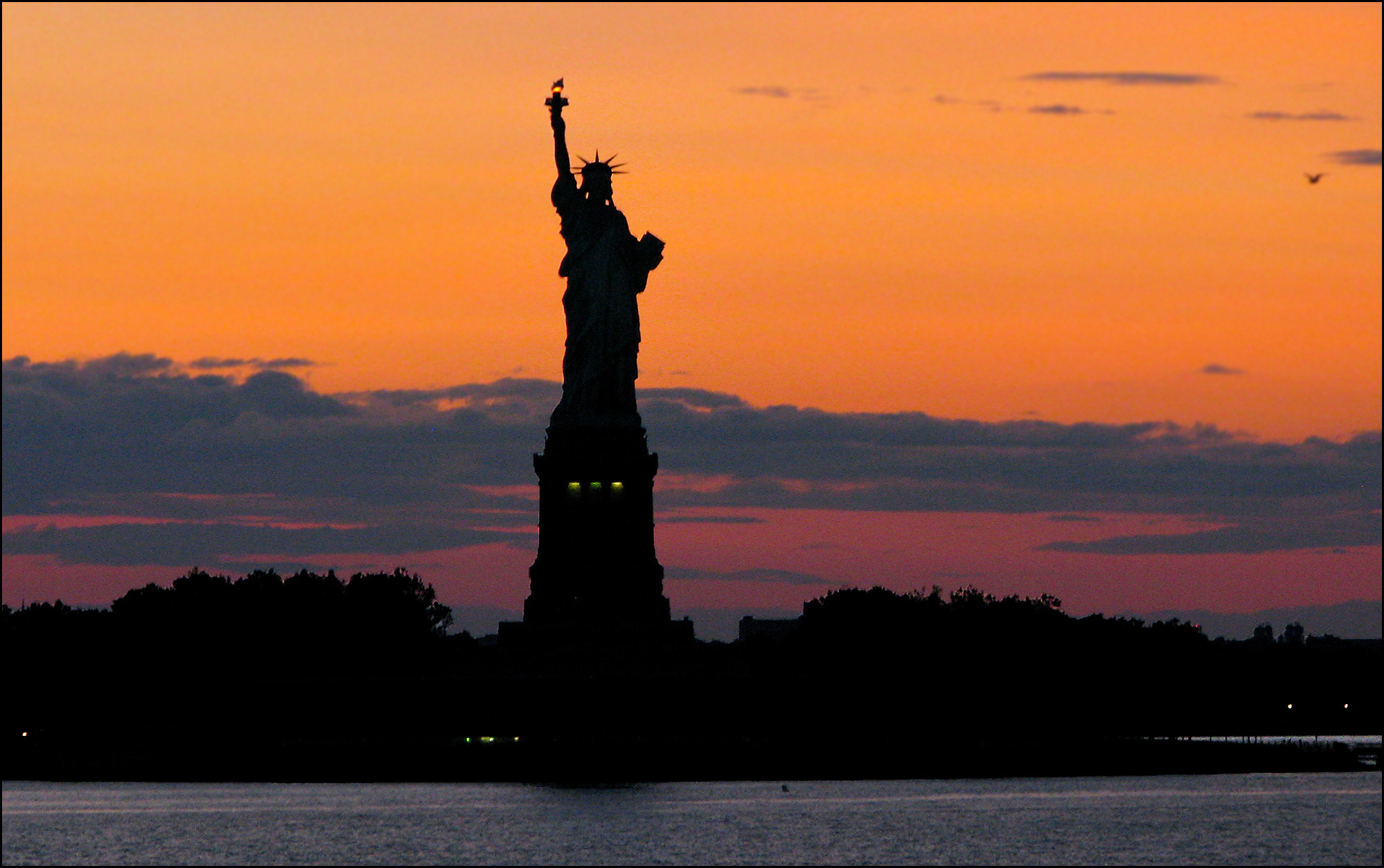
    This is a picture of the Statue of Liberty at sunset taken from the Staten Island Ferry.

    June 27, 2009 — New York, New York

  • Raw Data: Private Sector Union Membership Falls in 2019

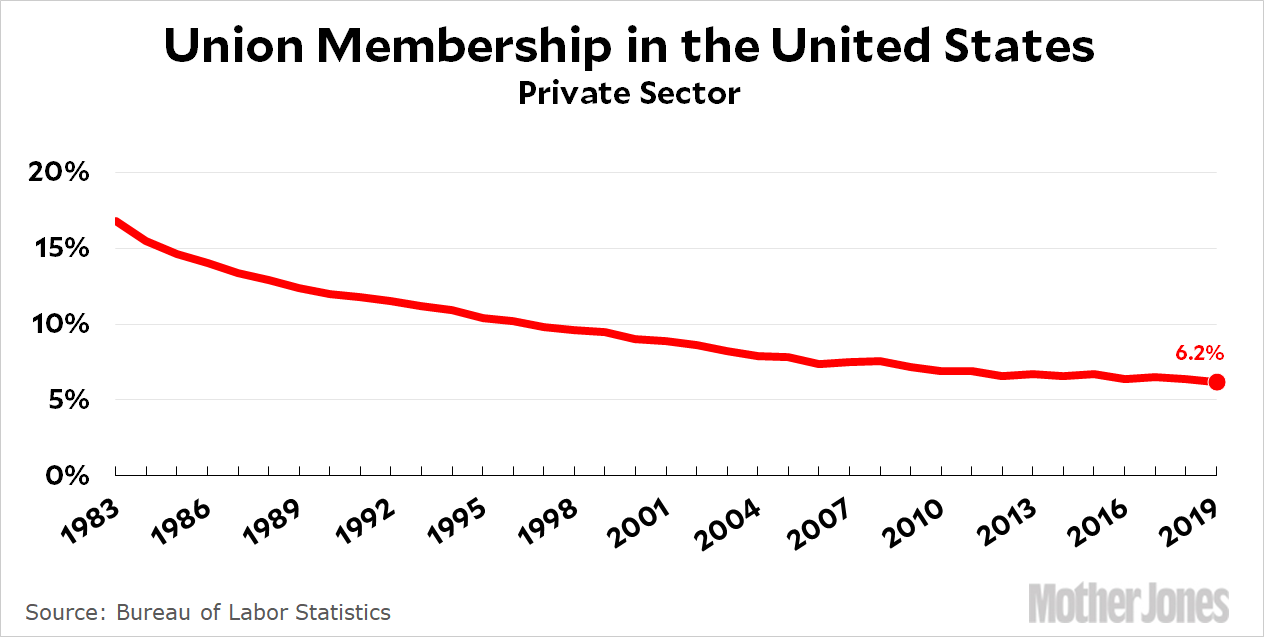
    Private sector union membership continued its long decline last year, falling to an all-time low of 6.2 percent:

    Meanwhile, corporate profits are healthy, cash stockpiles are growing, Wall Street is booming, and the stock market is doing great. Whose side are you on?