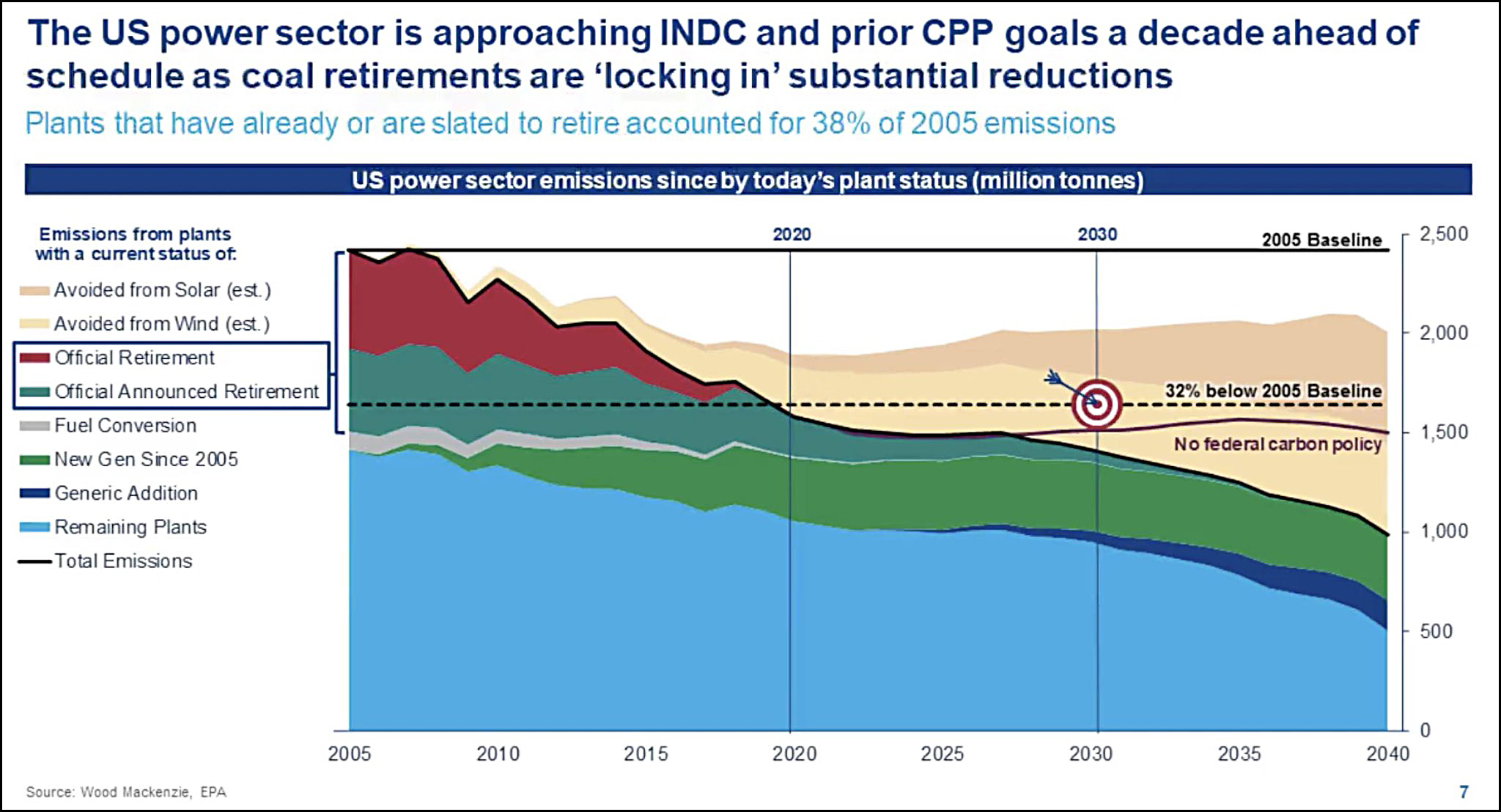
Via Richard Meyer, here’s a chart showing that despite President Trump’s best efforts, retirement of old power plants is nearly at the goal agreed to by Barack Obama in the Paris Accord for 2030, and is closing in on Obama’s goal in the Clean Power Plan for 2022. Trump may think that it’s good politics to pretend that coal will thrive again someday, but it’s not true. Old coal-fired plants are shutting down and no new ones are being built. Coal simply can’t compete with modern gas-fired plants, and increasingly can’t compete with modern renewable plants either.
This is only a small fraction of what we need to do if we want to avoid the worst effects of climate change, but it does show that significant change can be made without serious sacrifice. Someday sacrifices will be needed, and it’s true that I’m skeptical of the global public’s willingness to make them. Either way, though, that’s no reason not to go after the low-hanging fruit and get as much easy reduction in CO2 as we can. As this chart shows, plenty of that low-hanging fruit is still available to us.
This is golden ragwort, which, along with phlox, lines nearly every inch of Skyline Drive and the Blue Ridge Parkway this time of year. For nearly 500 miles the road was an endless symphony of yellow and purple on either side of me.
May 6, 2019 — Skyline Drive, VirginiaMay 6, 2019 — Skyline Drive, Virginia
In 1916 Albert Einstein published a new theory of gravity, which we now call the the General Theory of Relativity. However, although it relied on wildly different mathematical underpinnings than Newton’s familiar theory, it predicted virtually the same results. So how was it possible to prove that one or the other was correct?
There were three possibilities at the time. The first was the perihelion of Mercury, which Newton’s theory got wrong. Einstein got it right, but then, he knew the answer he was looking for beforehand. He wouldn’t have published his theory in the first place if it didn’t produce the right result. So that hardly counts.
Second was the red shift of light. But in 1916 this was very difficult to measure, and anyway, not everyone agreed about what Einstein’s theory actually predicted. So that was out.
Third was the bending of light due to gravity. That could be measured, and Einstein himself had produced a precise prediction for the bending of starlight as it passed near the sun. Now we’re talking!
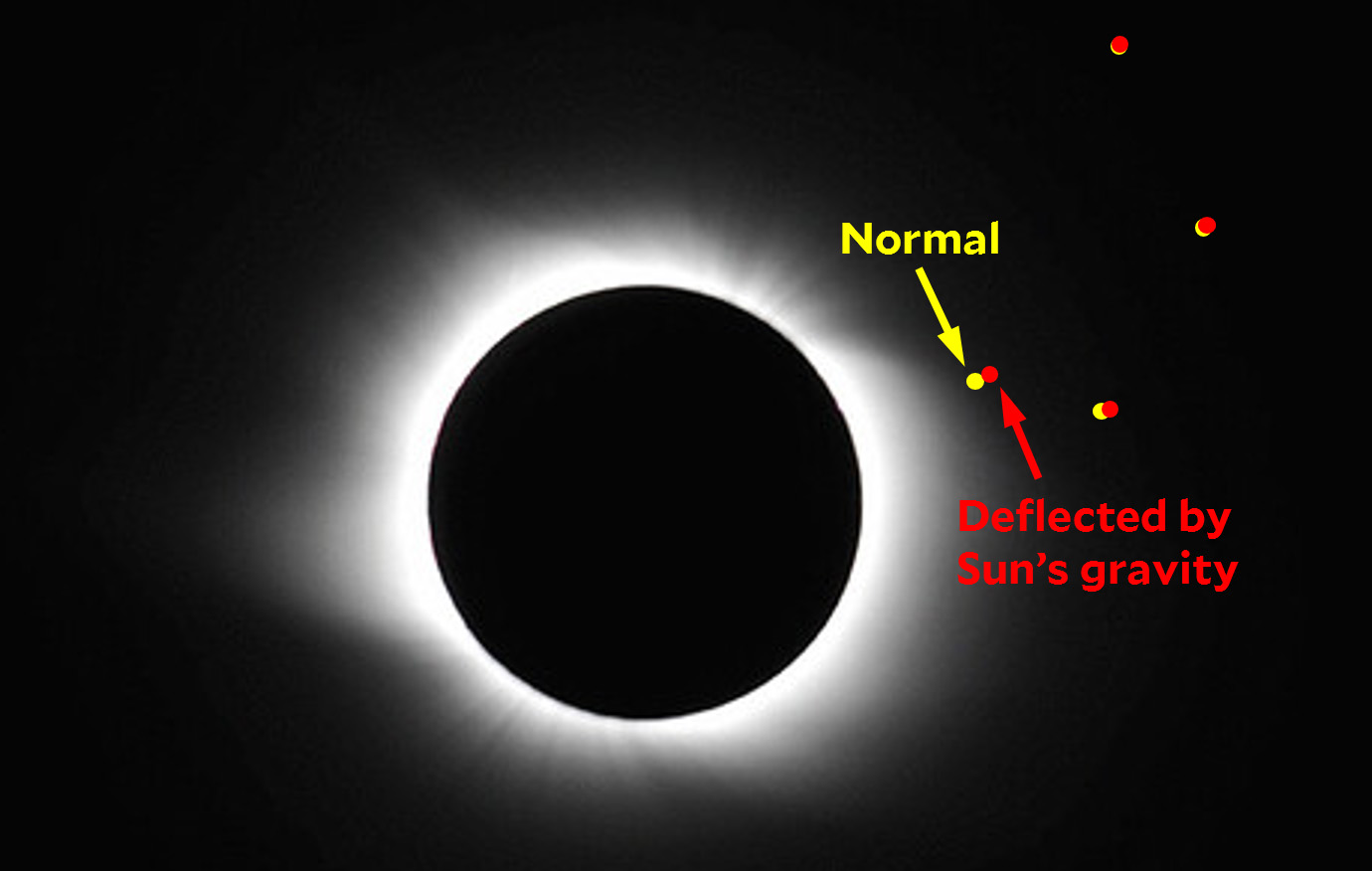
So in 1919, with World War I safely over, the famed astronomer Arthur Eddington set out to measure the deflection of starlight near the sun. In principle, this was simple. First you wait for a total eclipse to come around and you take a picture of the stars near the sun. Then you wait a few months and take a picture of the same stars at night. Finally, you overlay the plates on top of each other. On the picture taken during the eclipse, the apparent position of the stars near the sun should be offset a bit thanks to gravity, while the stars farther away from the sun should be offset much less. Here’s a stylized representation of what you’re hoping to get. The stars in red are from the plate taken during the eclipse. The stars in yellow are from the plate taken months later at night:
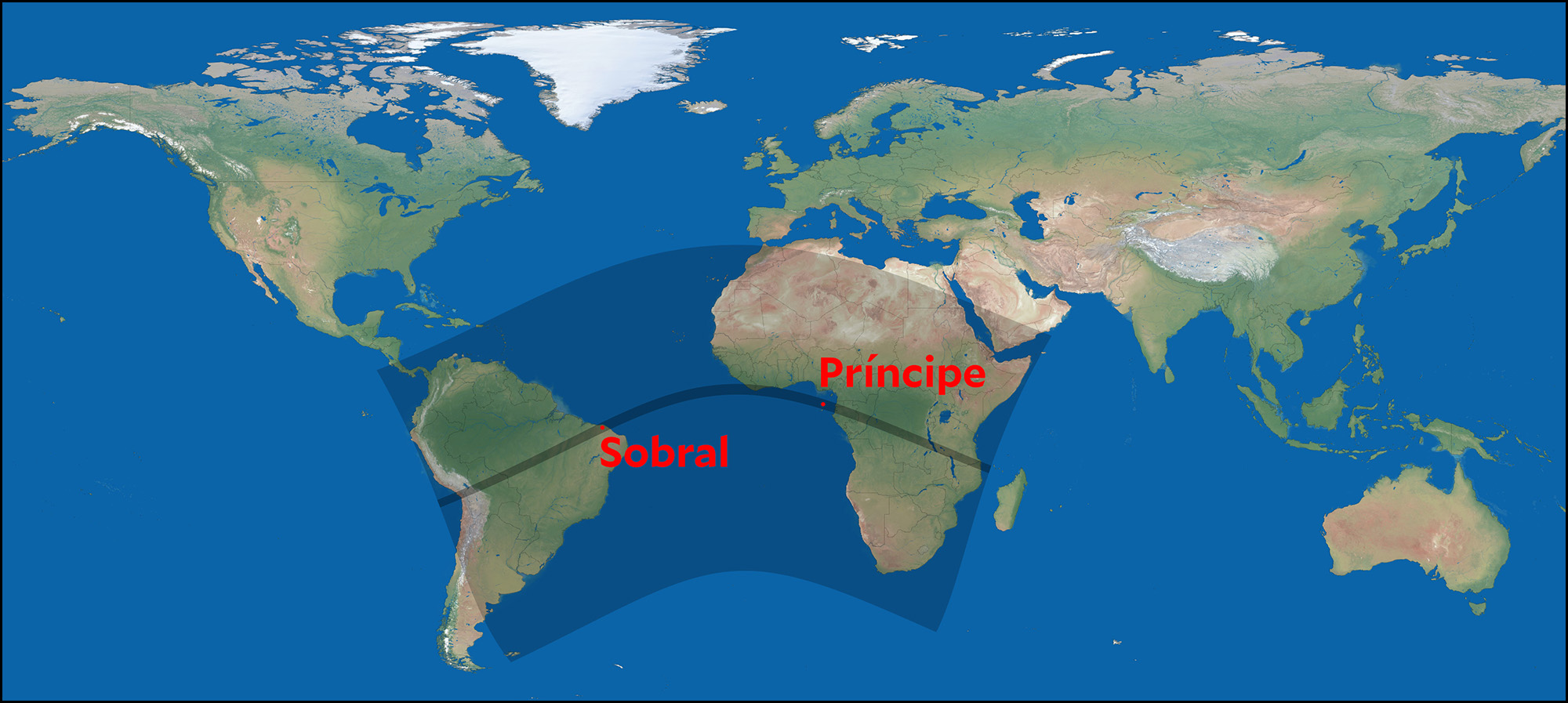
Simple enough! Except that it’s not. If the 1919 eclipse had been visible from the Royal Observatory at Greenwich, that would have been great. In real life, it was out in the middle of nowhere:
But science must be served, so Eddington hauled an astrographic telescope out to the island of Príncipe and set himself up to record the eclipse on May 29. A backup expedition was sent out to Sobral with two telescopes.
Now, these were smallish telescopes. And they didn’t have motorized mounts to account for the earth’s rotation. And, sadly, Príncipe was covered with clouds on the big day, so Eddington got only two usable plates out of 16, both of poor quality.
In Sobral they had a little better luck. The sky was mostly clear, and they got eight good images from their astrographic telescope. They also got 18 images from a 4″ telescope, but all of them were of poor quality.
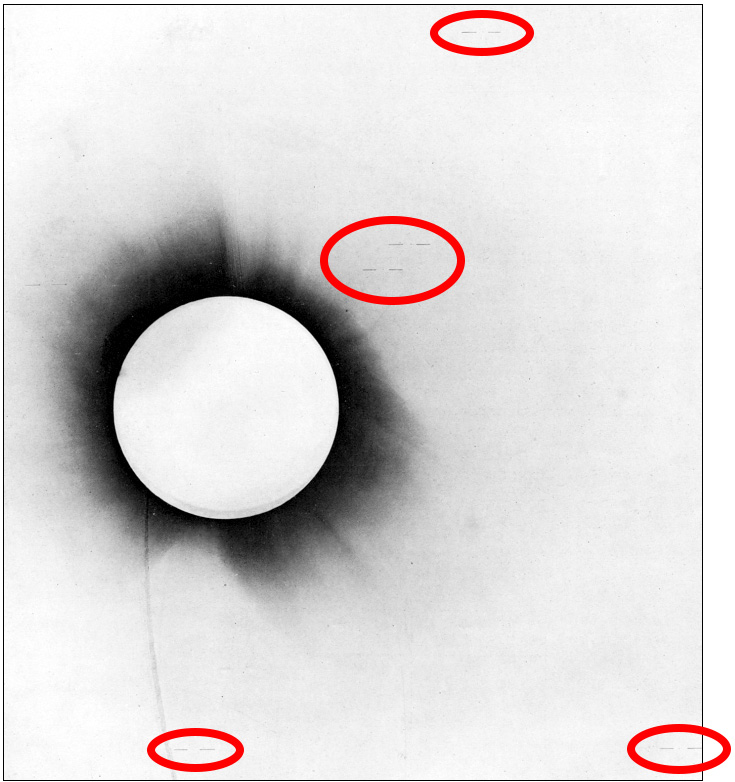
So how did things turn out once the pictures were all taken, the plates were developed, and the overlays were done? Here’s what Eddington presented to the world:
There are several problems here. First, the resolution is poor. Second, there are only five visible stars on this plate, and for technical reasons they really needed six. Third, it sure doesn’t look like the offset is bigger near the sun than farther away, does it?
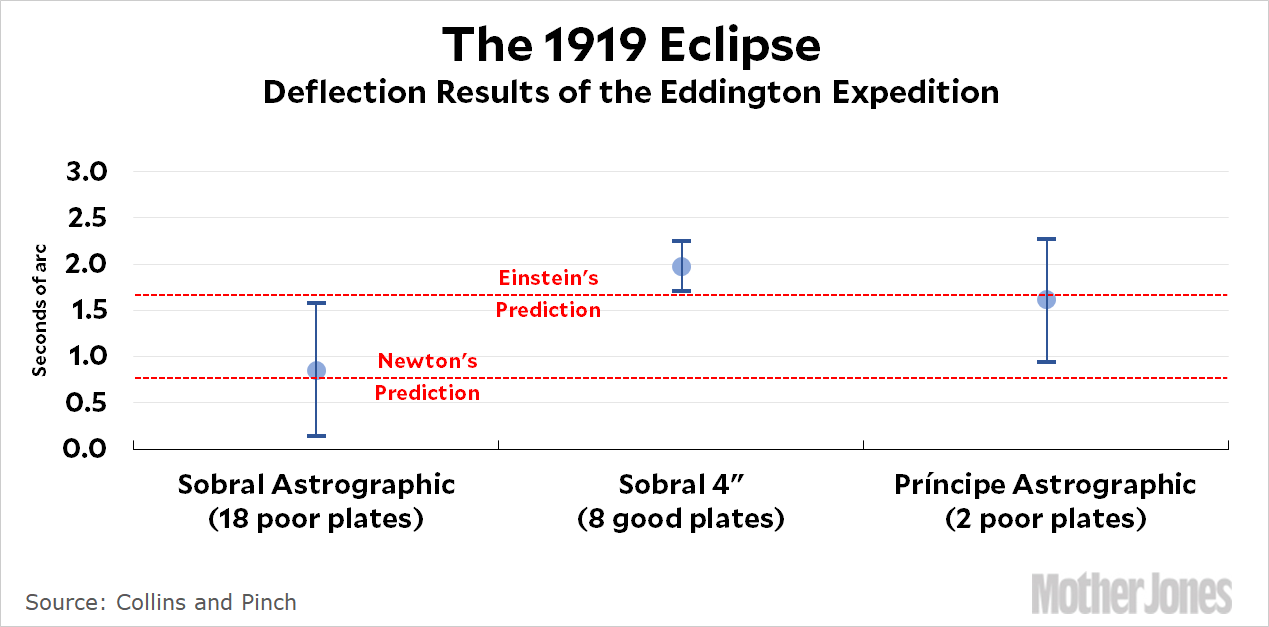
But what we’re really interested in are the raw results. Einstein predicted that stars near the sun would be deflected by 1.7 seconds of arc. Newton’s theory predicted 0.8 seconds of arc. Here are the results:
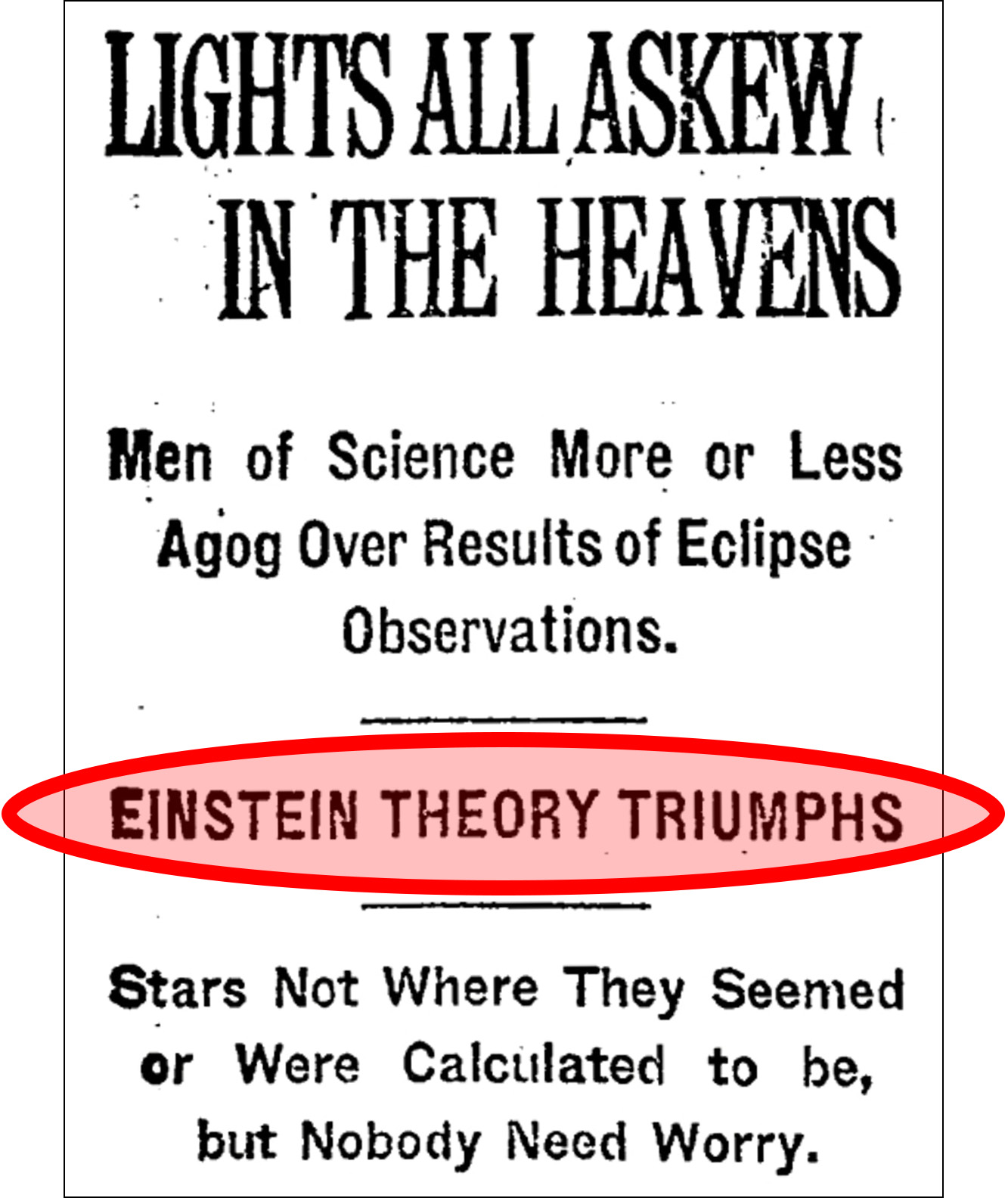
One of the telescopes seems to support Newton’s theory. The second telescope is close to Einstein’s prediction, but not quite there. Only the third one, based on two really crappy plates, hits Einstein almost on the button. This hardly seems like bulletproof evidence in favor of Einstein. And yet, here’s the famous headline from the New York Times:
That’s science for you. It remains a source of controversy about what really happened. Did Eddington fudge his results, throwing out the observations that failed to support Einstein and keeping the ones that did? Or did he have perfectly sound reasons for eliminating some of the observations and averaging together only the remaining ones—which happened to produce a result very close to Einstein’s prediction?¹ Personally, I suspect that Eddington fudged things because he felt so certain that the General Theory of Relativity was right.
And in the end, it turned out that both Eddington and Einstein were right. Subsequent, more accurate measurements have confirmed the deflection of starlight and several other predictions of general relativity. Still, on the hundredth anniversary of the great eclipse, it’s worth pondering not just the genius of Einstein, but the possibility that Arthur Eddington, acting more as PR agent than scientist, fiddled with his results in order to make sure that everyone accepted Einstein’s theory. It would have been a great scandal if Eddington had been wrong, but history is written by the winners and Eddington, it turned out, was a winner.
¹According to Eddington, the pictures from the Sobral astrographic telescope were all thrown out because of temperature control issues.
UPDATE: The diagram at the top of the post showing the deflection of starlight was originally backward. It’s now correct.
Special Counsel Robert Mueller just finished a press conference and said it would be his last and only public comment on his investigation into the Trump-Russia affair. He is retiring from the Justice Department and declined to to take any questions after reading a statement.
In that statement, he reiterated that it was a “longstanding” policy of the Justice Department that a sitting president cannot be charged with a federal crime. “Charging the president with a crime was therefore an option we could not consider.” This appears to be the sole reason that the report made no recommendation on the obstruction-of-justice charges. He also reiterated that if he had found conclusive evidence that President Trump didn’t obstruct justice, the report would have said so.
On the subject of testifying before Congress, Mueller appeared to say that this was off the table. “The report is my testimony. I would not provide information beyond that which is already public in any appearance before Congress.”
Mitch McConnell blockaded President Obama’s election-year nomination of Merrick Garland for the Supreme Court in 2016, but yesterday he smirked that if a position opened up in 2020 he’d go ahead and confirm it. Charles Cooke says this isn’t hypocritical:
McConnell has not actually reversed his position, which was not that Supreme Court vacancies should always be left open in presidential election years, but that vacancies should be left open in presidential election years when the president is of a different party than the majority in Senate.
That’s not how I remember it, so let’s go to the tape. Here’s what McConnell said, starting one hour after Justice Scalia’s death was announced:
February 13: “The American people should have a voice in the selection of their next Supreme Court Justice. Therefore, this vacancy should not be filled until we have a new president.”
February 17: “Responding for McConnell [about a 1970 law review article McConnell wrote]…spokesman Robert Steurer said in an email this week that the senator’s article ‘was not about nominations made by a lame duck president for vacancies that didn’t arise until an election year. What he said on Saturday was that he believes the American people should have a voice in the selection of their next Supreme Court justice and that this vacancy should not be filled until we have a new president, not that the president can’t nominate someone.’ ”
February 23: “My view, and I can now confidently say the view shared by virtually everybody in my conference, is that the nomination should be made by the president that the people elect in the election that’s now underway.”
And McConnell was actually one of the more restrained voices among Republicans. The rest of the caucus was routinely quoted as saying, essentially, fuck you, Obama, we’ll never consider one of your Democratic hacks. Either way, though, the official excuses didn’t say anything about the president and Senate being of different parties, even if that was the obvious subtext. The official excuse was that it was a nigh unbreakable tradition of the Senate to never fill a Supreme Court position that opened up in an election year, full stop.
Why does anyone bother defending McConnell on this? I’m not sure. McConnell has practically built his entire career on hypocrisy, and he’s never really tried to hide it. He just shrugs, says what he needs to say, and moves on. I don’t think he really expects or cares if anyone takes him seriously, but treats public explanations as mere tedious parts of his job. In reality, he believes that whoever’s in power should do whatever they can to get their way, and it’s naive to think there are any other considerations. He doesn’t need anyone’s defense on this score.
Alicia Garza, head of the Black Futures Lab, reports on the results of the Black Census Project, which she presents as “the largest independent survey of black people ever conducted in the United States.” Here’s a snippet from her New York Times op-ed:
Nearly three in four respondents said they voted in the 2016 presidential election, and 40 percent reported helping to register voters….These responses debunk the myth that black communities don’t show up to vote — we do and we bring other people with us.
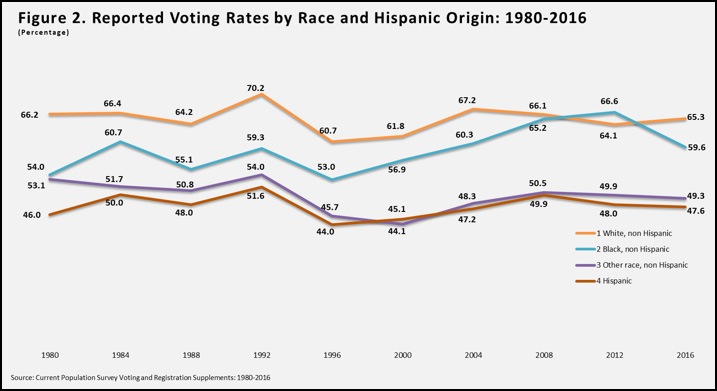
I’m not sure this really debunks anything since it’s not based on a random sample and doesn’t tell us anything about black turnout relative to other groups. However, the Census Bureau has debunked this:
During the 80s and 90s, African-American voter turnout was significantly less than white voter turnout. That was no myth, but it is outdated. Blacks started to close the gap during the Bush administration and closed it completely during the Obama presidency. In 2016 the gap opened up again at a low level, and only time will tell if it gets better or worse over the next few elections.¹
Anyway, this got me curious about the Black Census Project, so I headed over to look at it. The current report is limited to economic issues and criminal justice issues, which means there’s nothing about abortion or reparations or troops in the Middle East or gay marriage or climate change or anything else. Presumably those things will be reported later. Nor is it presented as a traditional random-sample survey:
Because traditional surveys too often erase the diverse experiences of Black people and particular segments of the Black community, the Black Census Project intentionally oversampled certain populations: Black Census respondents are younger, more likely to be female, and more likely to identify as LGBTQ+ than the Black population as a whole. The Black Census sample has a higher educational attainment than the adult Black population nationally (nearly a fifth has earned an advanced degree)….These divergences illuminate the differences within the Black community, enabling the Census to include communities that are often left out and to understand the diversity of the Black community in ways that traditional surveys often fail to capture.
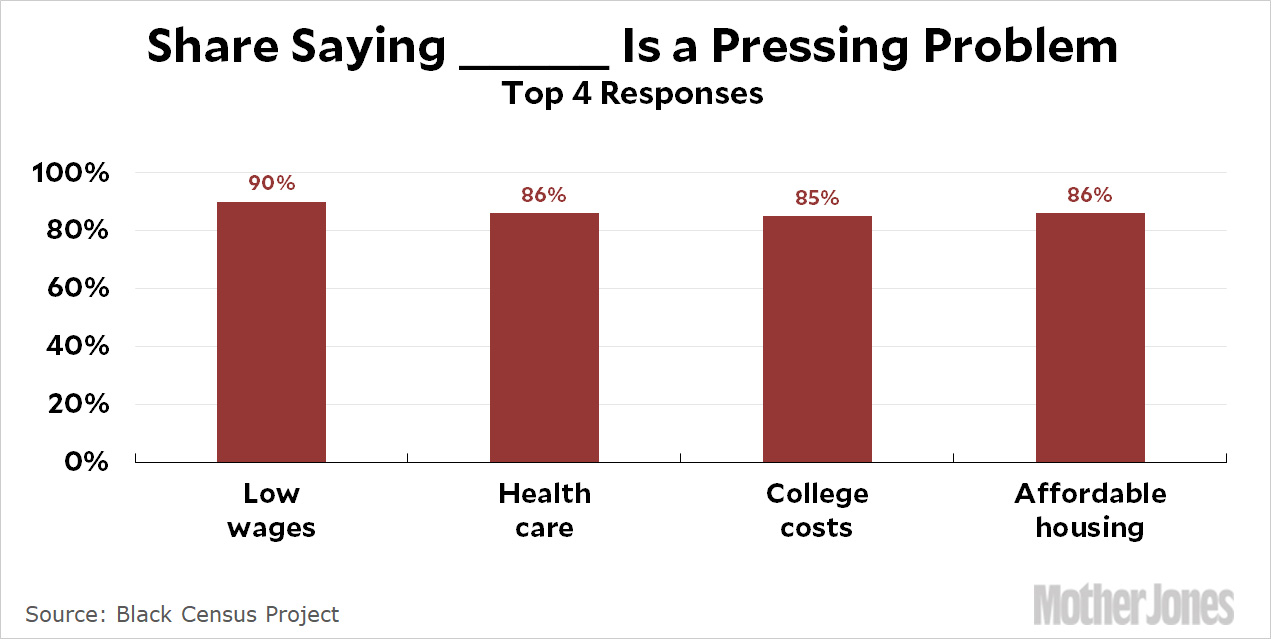
A fifth have advanced degrees! This compares with 8 percent for the black population overall. This is definitely an elite sample that doesn’t represent the broad black population. In any case, here are the economic issues they say they care the most about:
These are roughly the same issues that would come out on top in any survey of progressives. And the most popular policy solutions are similar too: $15 minimum wage, making college affordable, providing adequate housing, providing affordable health care, taxing the wealthy, etc. This is one of the things that makes it difficult to define a “black” economic agenda: nearly all of the things that help blacks also help non-rich whites.
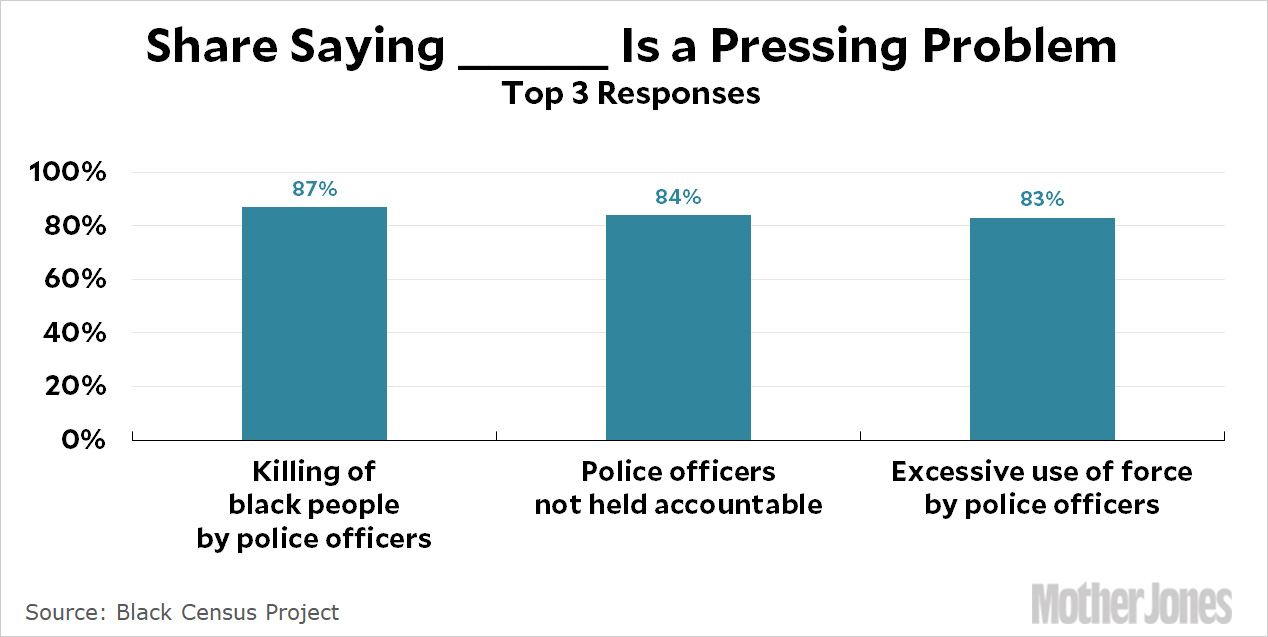
Here are the top criminal justice and policing issues:
The policy solutions that scored more than majority support were body cams, having police officers live in the community where they work, holding police officers accountable, and community boards to supervise the police force. Body cams and community boards were the only things with support above 60 percent. I’m not sure if you’d get different responses from white progressives, but I suspect they wouldn’t be much different.
I’ll confess that I don’t quite understand the overall tone of the report, which is based on the idea that traditional surveys ignore the diversity of black opinion and the BCP fills that gap. I don’t think that’s really true. What’s more, the BCP has diversity problems of its own, since it underrepresents the life experiences of the poorer and more traditionalist segments of the black community. However, if you want to get an idea about the priorities of the politically activist segment of the African American population, it’s probably a good place to start.
¹I’m not sure where you could get the raw data for this, but I’ll bet if you controlled for income the gap never really existed. That is, I’ll bet that blacks have always voted at about the same rate as whites of similar incomes.
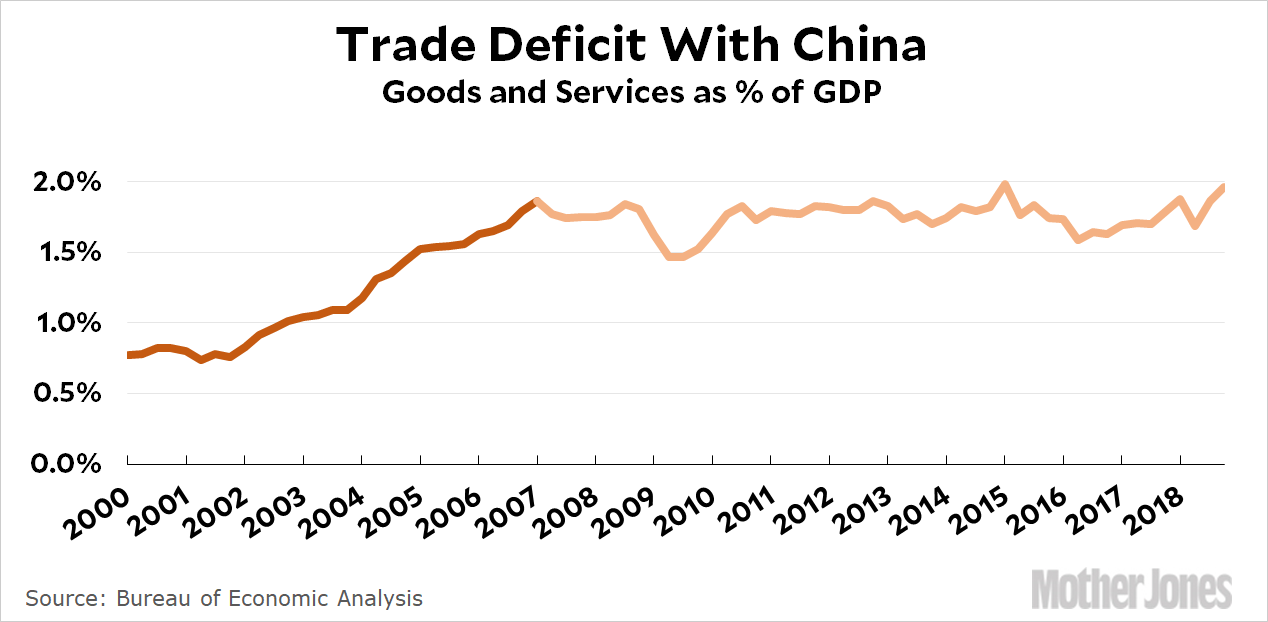
Just in case you’re wondering, here is our total trade deficit with China over the past couple of decades, shown as a percentage of GDP:
Our trade deficit with China more than doubled between 2002 and 2007, but that was it. Since then it’s been dead flat. In 2018 it amounted to $380 billion.
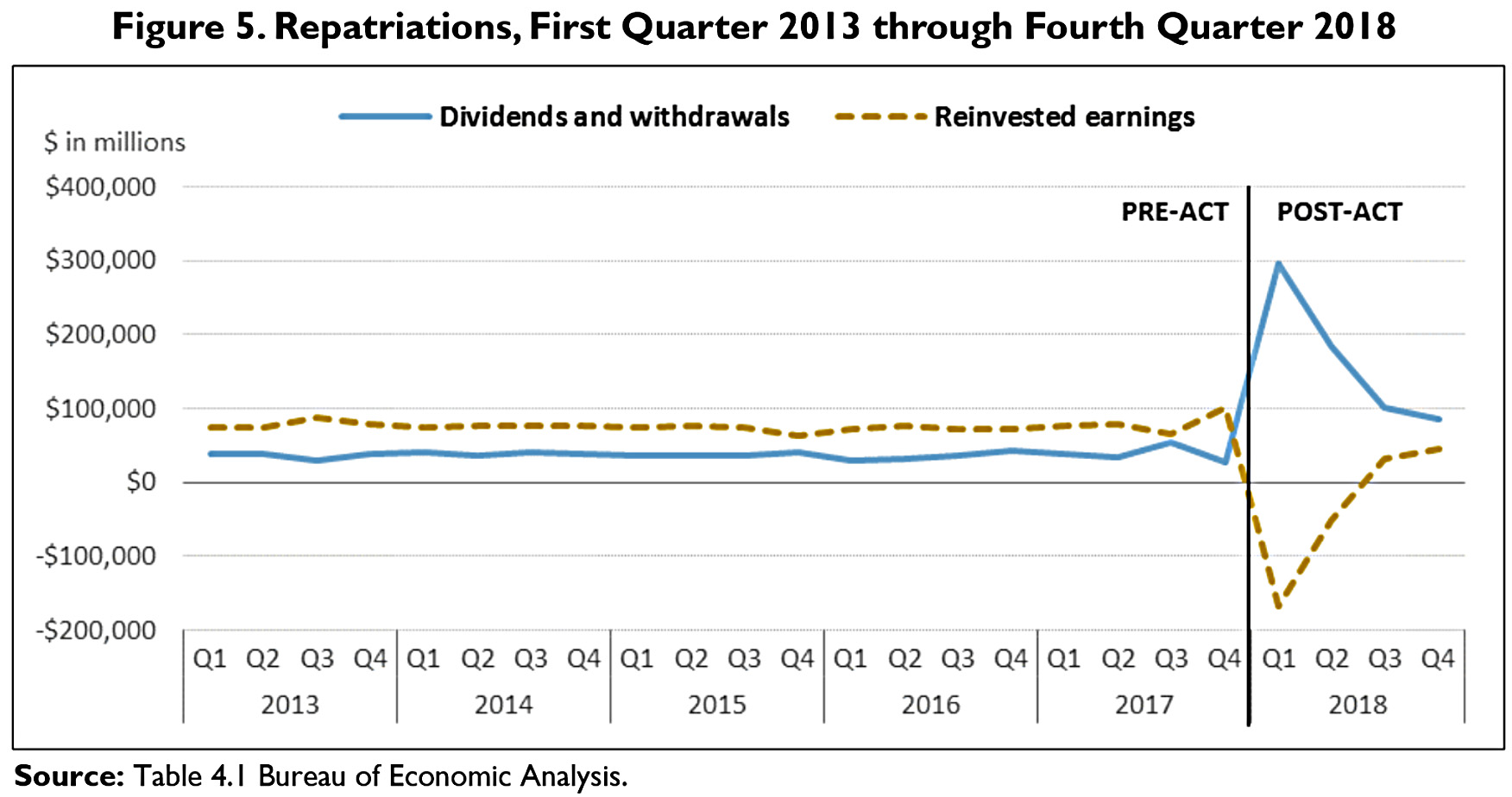
One of the major sources of anticipated increased investment through supply-side effects is international capital flows….Some also argued that eliminating the tax barrier to repatriating funds (as was done with the tax revision) would lead to reinvestment in the United States of unrepatriated earnings held abroad in U.S. subsidiaries.
Let’s check! What happened to all those repatriated earnings?
Companies repatriated more than a half-trillion dollars (blue line), but reinvested earnings actually turned negative for a couple of quarters before returning to the same level as before. End result: bupkis. Nice work, Republicans.
Of course, none of the Republican arguments in favor of the tax act were offered in good faith anyway, so it’s hardly a surprise that it had little to no effect on the economy. As the report puts it, “Fiscal stimulus is limited in an economy that is at or near full employment.” The real goal of the tax act was to reduce the taxes of corporations and rich people. Rep. Chris Collins explained things elegantly: “My donors are basically saying, ‘Get it done or don’t ever call me again.'”
So they got it done. Now their donors are happy and will continue contributing money to Republican candidates. What’s not to like?
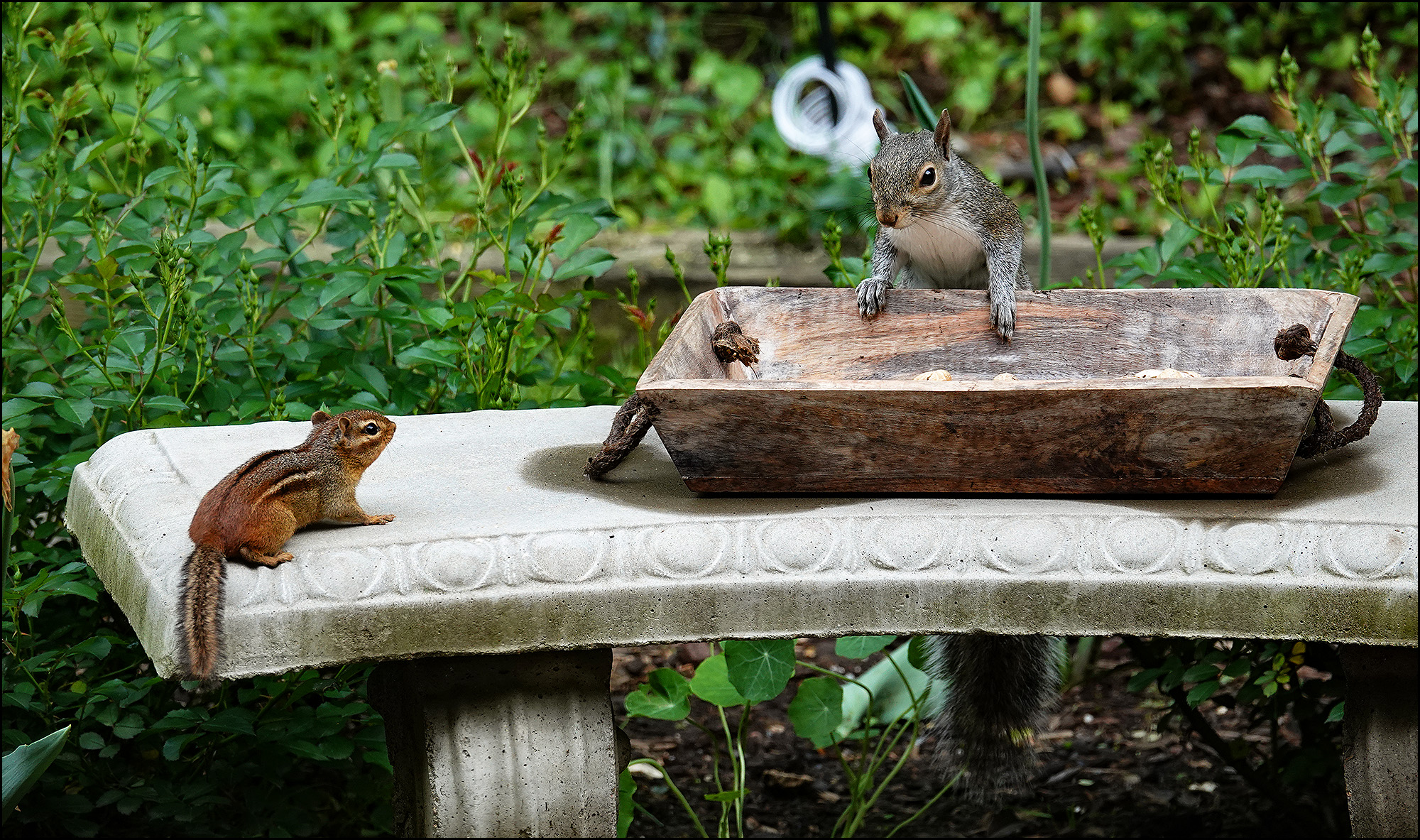
Every morning at my sister-in-law’s house, a new front opens in the long-running peanut war between Chippy the chipmunk and the big, bad bully squirrel:
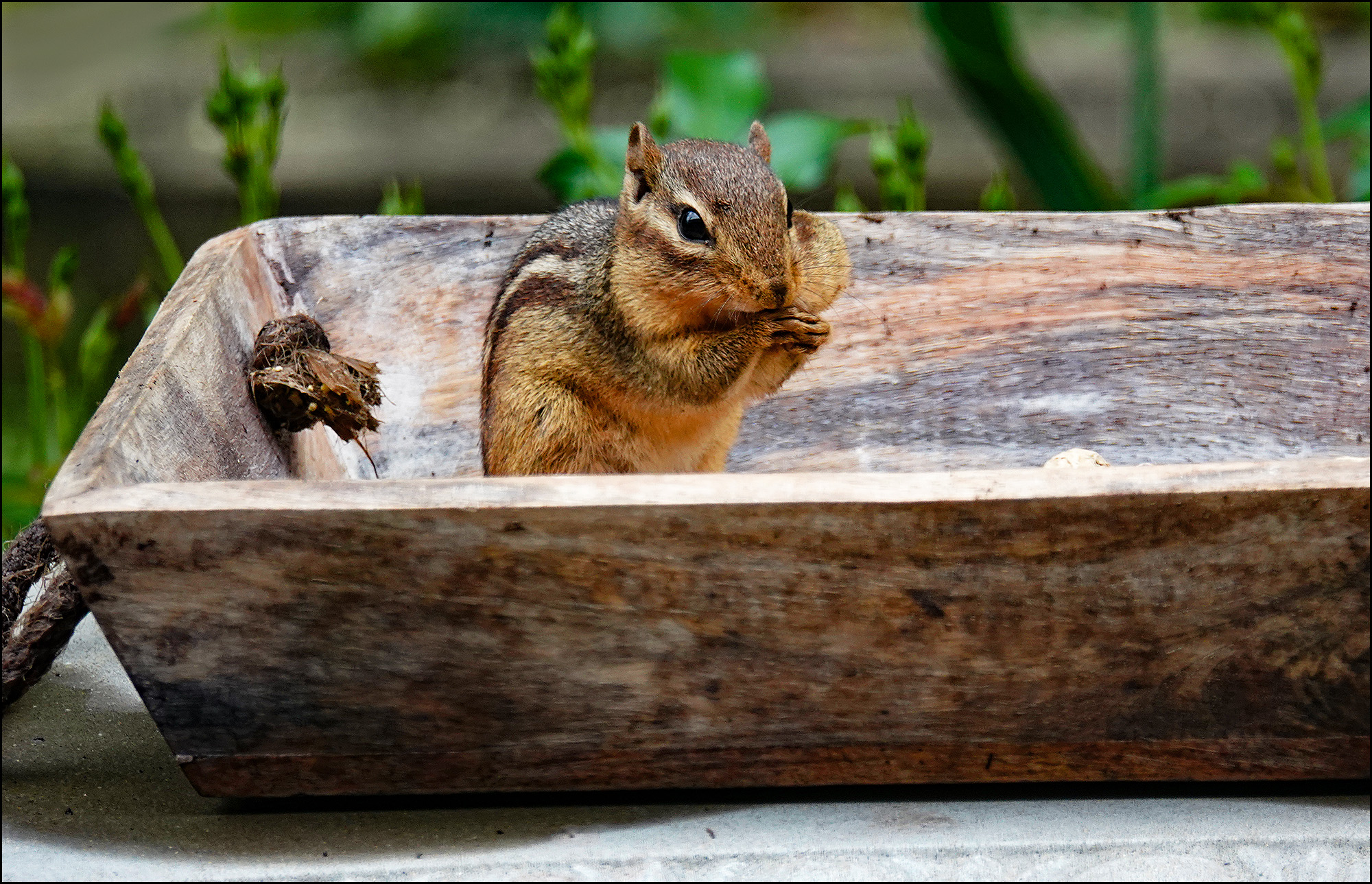
Needless to say, the bully squirrel always wins. But things turn out OK in the end:
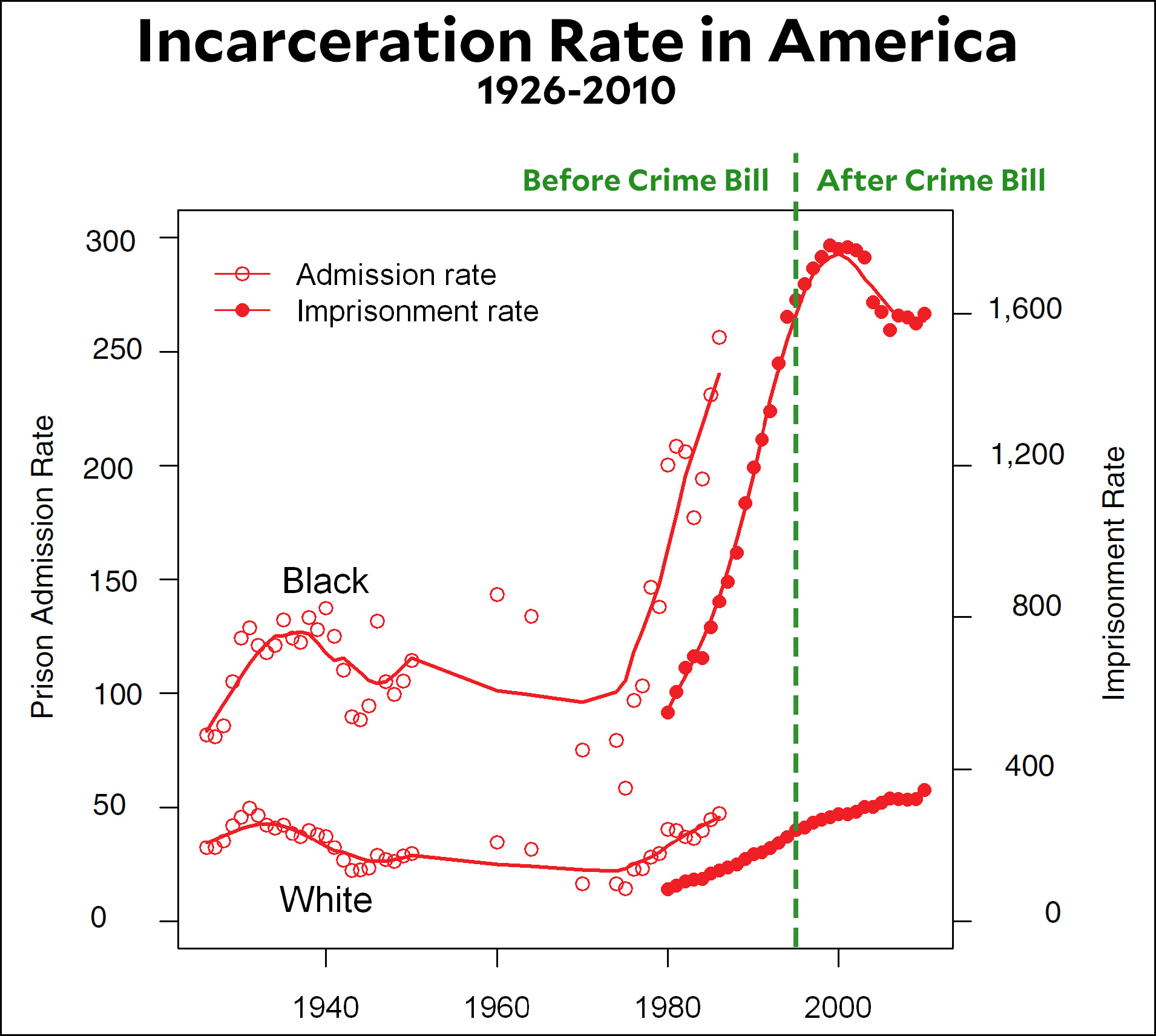
As you can see, the 1994 crime bill had no effect on this trend. Incarceration rates started skyrocketing in the late 70s as a response to rising crime rates, and after the crime bill passed the increase in incarceration started to slow, eventually peaking in 2000.
The crime bill, of course, deserves credit for slowing incarceration no more than it deserves blame for increasing it. It was a null factor. Incarceration increased as crime rates increased, and then started to fall about a decade after crime rates started to decline. Mass incarceration in the US was a panicked response to mass crime, and the 1994 crime bill had little effect on it one way or the other.
I don’t really care what anyone thinks of Joe Biden, but liberals should stop inventing reasons to blame him for things he isn’t responsible for. The 1994 crime bill (a) included a lot of good ideas, (b) included some bad ideas at the insistence of Republicans, (c) had nothing to do with skyrocketing incarceration rates, (d) was supported by most black lawmakers, and (e) was a reaction to the fact that violent crime really was high, and nobody at the time had any reason to think this was likely to change.
And we respect that! But maybe you’re of a mind to support our work directly instead? We have until December 31 to raise the last $400,000 we need to keep our nonprofit newsroom running at full strength into 2026. Will you make a gift today?
We noticed you have an ad blocker on. Can you pitch in a few bucks to help fund Mother Jones' investigative journalism?
Billionaires own the media,
but they don’t own us.
At Mother Jones we know these aren’t conventional times, and they require unconventional coverage. That’s what deliver every day: fierce, independent journalism you can’t find elsewhere. Perhaps never in the history of our country has that been more necessary than now. But we can’t do it without reader support—your support. Please chip in today.
Billionaires own the media,
but they don’t own us.
At Mother Jones we know these aren’t conventional times, and they require unconventional coverage. That’s what deliver every day: fierce, independent journalism you can’t find elsewhere. Perhaps never in the history of our country has that been more necessary than now. But we can’t do it without reader support—your support. Please chip in today.