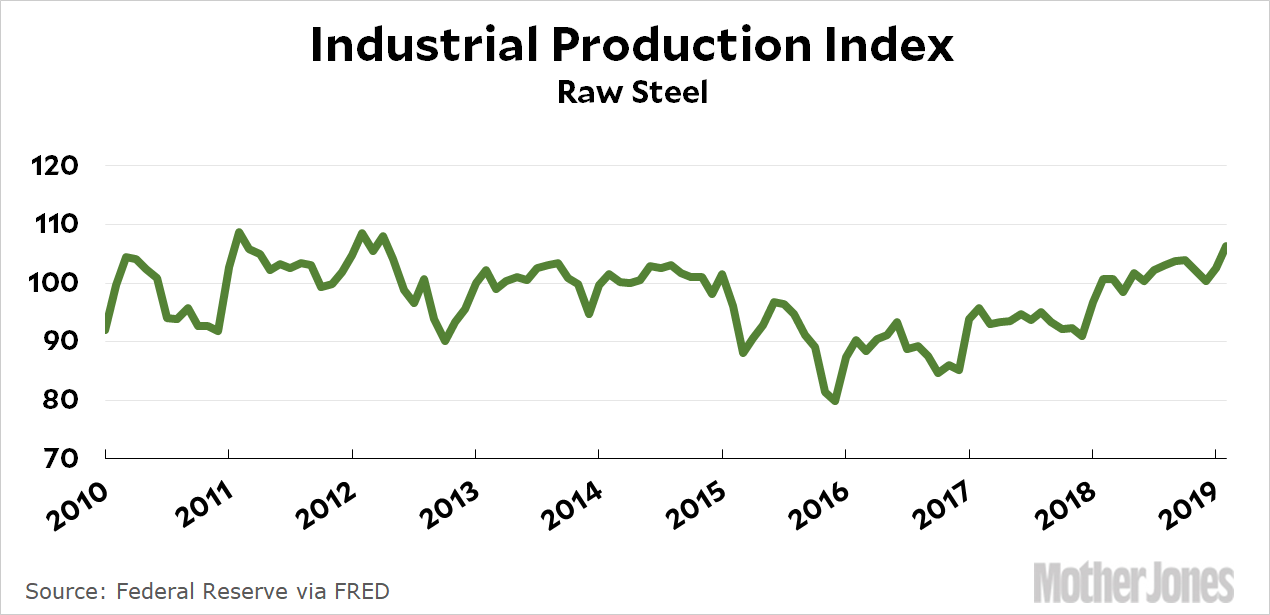
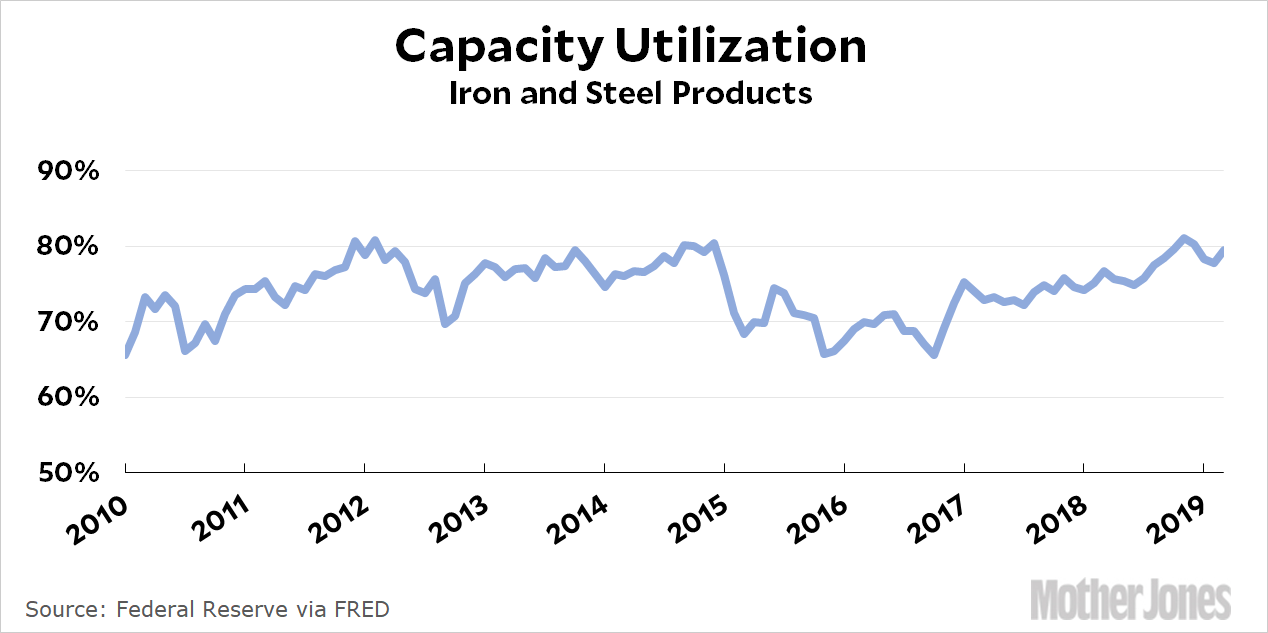
I wonder how the steel industry is doing these days. Why? Just curious, I guess. Here are the basic stats for production and capacity utilization:
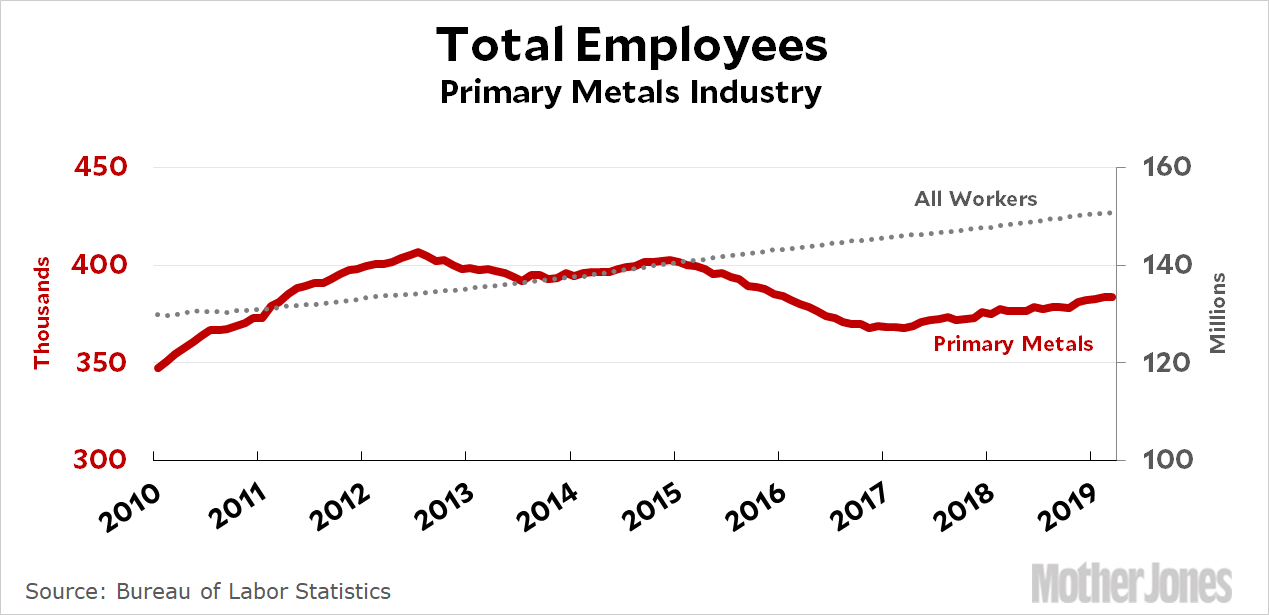
This looks OK. It’s nothing to write home about, but production has increased moderately over the past couple of years and is now about where it was in 2015. But what we really want to know is how this has affected workers and shareholders. Here’s employment in the “primary metals” industry:
This isn’t so great. Employment has increased a bit since 2017, but it’s not growing any faster than the overall economy—and that didn’t change after President Trump announced his steel tariffs in early 2018. How about wages?
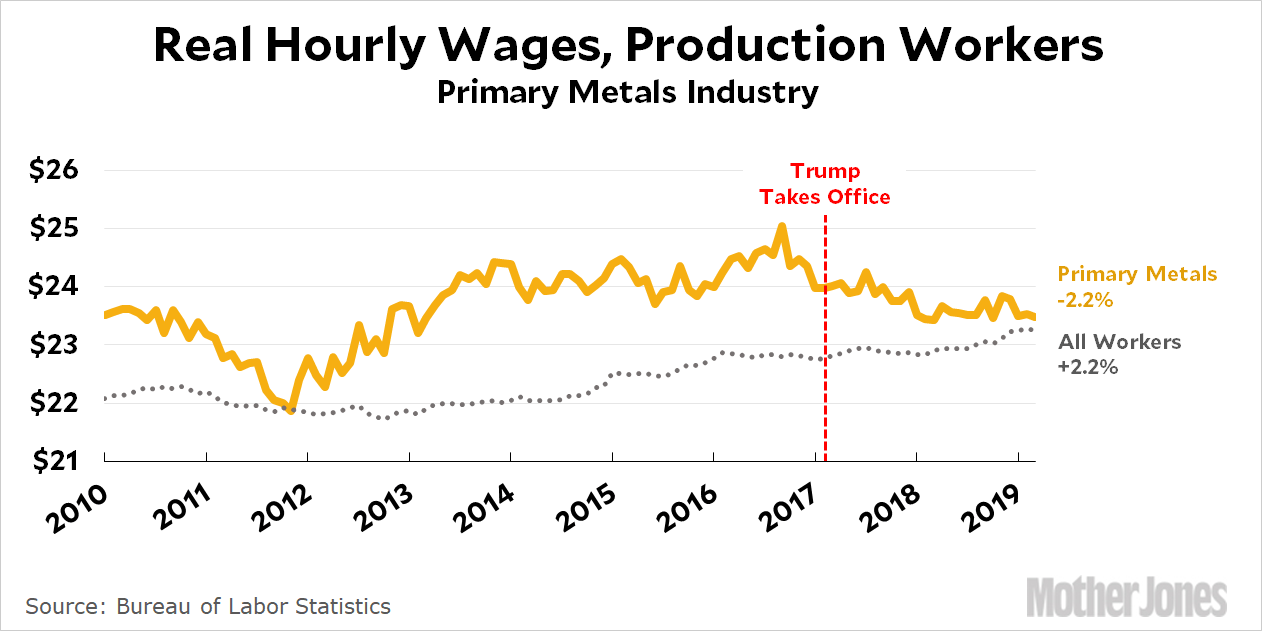
Yikes. That’s pretty dismal. Wages for everyone else have been steadily increasing, but for metals workers they’ve been down ever since Trump took office. So what do investors think of the steel sector?
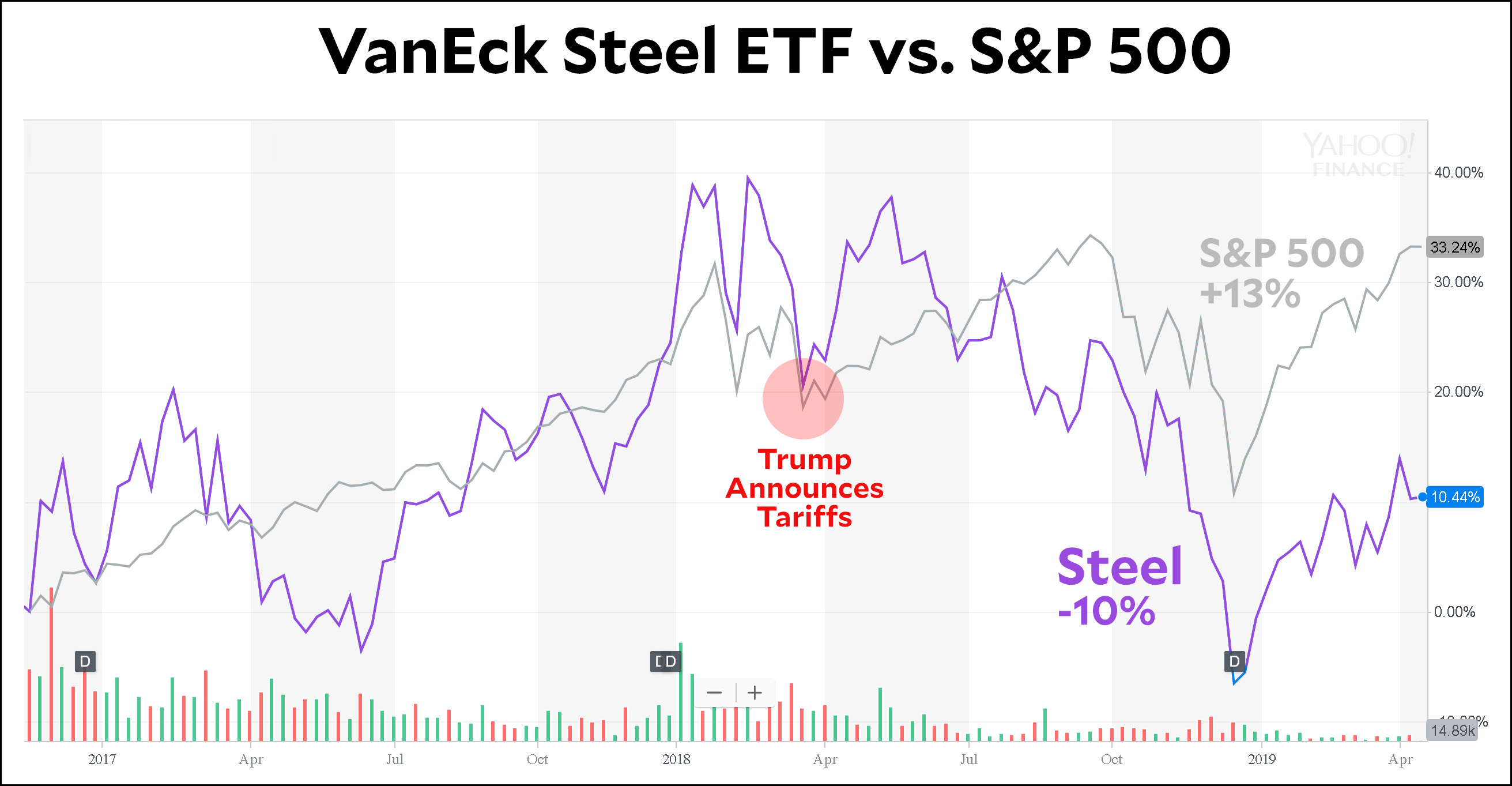
Yikes again. The steel sector was growing at about the same rate as the S&P 500 until Trump announced his steel tariffs. Since then, the S&P 500 is up about 13 percentage points while the steel sector is down about 10 points.
Bottom line: We’re making a bit more steel than we were two years ago, but employment is pretty stagnant, wages are down, and investors have soured on the whole industry. They don’t seem to have much confidence that tariffs are going to do any good going forward.
There’s a lesson here: Every industry that Trump touches ends up worse off. Whatever sector you happen to work in, you should pray daily that Trump ignores you.
I am deliberately not following the Democratic primary race closely yet. I figure there’s no point in getting too worked up at this early stage, and I’ll be better able to make a reasoned judgment later if I try to avoid making strong judgments now. However, I do have gut feelings about what I’ve seen so far. How could I not? So for better or worse, here they are:
Joe Biden: A perfectly fine guy, but he represents a past generation. It wouldn’t kill me if he got the nomination, but I wouldn’t be thrilled either.
Cory Booker: Seems a little too scripted, no? But it’s early days. He has plenty of time to show he can fulfill his potential.
Pete Buttigieg: A pure creation of PR. He’s been carefully building his persona for years, but it’s never been clear if there’s anything behind it. He may be young, white, and articulate, but he’s also massively unqualified.
Kamala Harris: Serious, experienced, and has acquitted herself well in the Senate. Progressive, but not so progressive that she can’t appeal to moderates. I’d be happy to see her nominated.
Jay Inslee: Takes climate change seriously. I love that, but I don’t know much more about him.
Beto O’Rourke: “I’m just born to be in it.” This is not a good reason to think you should be president.
Bernie Sanders: Old, crotchety, and takes himself way too seriously these days.
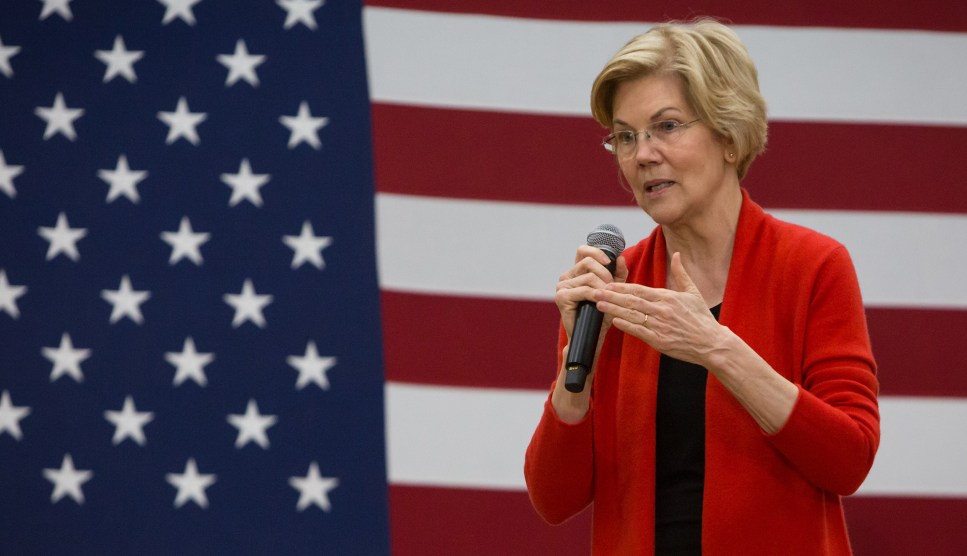
Elizabeth Warren: Serious and principled. A little too much of a single-issue obsessive for my taste, but I’d be happy to see her nominated too.
Julián Castro, Kirsten Gillibrand, Amy Klobuchar: I don’t know enough about these candidates to have even a sense of whether I like them.
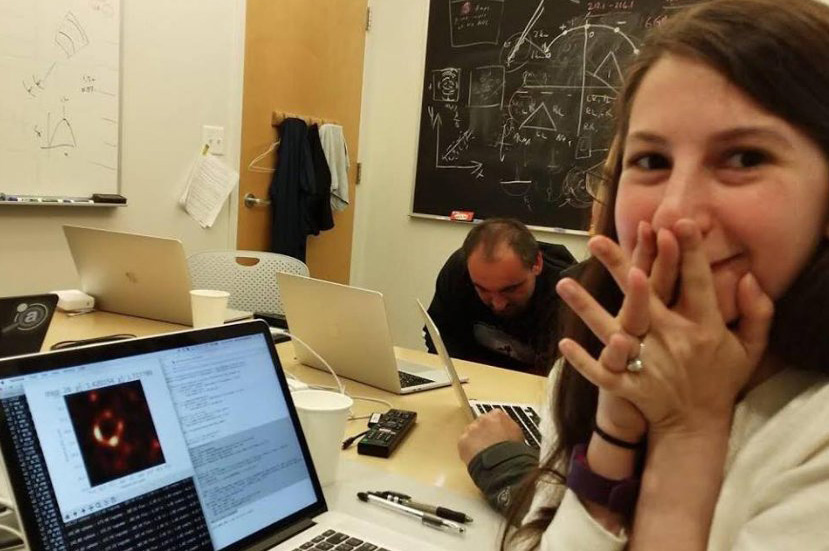
Harvard postdoc Katie Bouman at the moment when the first image of a black hole was processed.MIT CSAIL
Brian Resnick writes about what happened after a picture of black-hole imager Katie Bouman went viral:
But then all the attention became a catalyst for an incredibly sexist backlash on social media and YouTube. It set off “what can only be described as a sexist scavenger hunt,” as The Verge described it, in which an apparently small group of vociferous men were questioning Bouman’s role in the project. “People began going over her work to see how much she’d really contributed to the project that skyrocketed her to unasked-for fame.”
There are two lessons here. First, the world is full of assholes. Second, we would all be better off if we ignored “small groups of vociferous men” on social media. If they can manage to get some attention in real life, then fine. Maybe they should get some media coverage. But there’s no need to help them along the way.
@kdrum Given that Honduras only ended leaded gasoline in 1996, and had the worst concentration of lead in its gasoline in the world, can you devote a post to lead poisoning’s role in this horrific violence?
Until Honduras eliminated leaded gas, there was no country in the world with a higher concentration of lead per gallon of gasoline. In some parts of the capital, lead levels in the atmosphere exceeded international standards by 500 percent and lead concentrations in blood were rising, especially among children.
In 1996, a campaign by Aire Puro finally convinced the government to ban leaded gasoline, and by 1999 it had been completely phased out. The lag between childhood lead exposure and crime rates later in life is between 18-25 years, which suggests that we’d expect crime in Honduras to peak sometime between 2014 and 2024. And since the lead concentrations before 1996 were very high, we’d expect the peak crime era to be pretty brutal.
This is about all we can say so far. At best, Honduras is a few years past its crime peak, a period when we in the United States were still obsessing over “superpredators” because we didn’t yet realize that crime was declining. At worst, crime is still increasing in Honduras and won’t start to decline for several more years. The middle case—and probably the most likely one—is that crime is at its all-time peak right about now, which goes a long way toward explaining why violence is endemic there and so many people are fleeing. Crime will now start to decrease, but it will probably be five or ten years before we start to see a significant change.
Republicans are unhappy about public perceptions of their tax cut. What happened was simple: they paid lots of attention to the business tax cuts and lots of attention to the tax cuts for this rich, but not so much attenton to the tax cuts for the working and middle classes. The middle classes, of course, pay the bulk of their federal income tax via withholding, and they don’t always notice small weekly changes. What they do notice is their tax refund at the end of the year.
Long story short, the supposed party of the common man didn’t realize that. So when Trump’s Treasury Department changed the withholding schedules, they withheld less in hopes that people would notice that their paycheck was bigger. They didn’t. But the reduced withholding also meant that tax refunds would be smaller than usual. People did notice that. Thus the public perception that they got screwed by the tax cut. Over at National Review, Ramesh Ponnuru tries to explain this away:
The Times article that Robert VerBruggen highlights below suggests that Democrats have been successful in misinforming the public about how many Americans have gotten a tax cut from the Republicans. But it’s probably not just political spin, or the design of that tax law, that caused people to underestimate the extent of the tax cut. Previous tax cuts have landed the same way. President George W. Bush, in his first term, passed two tax cuts that cut tax bills for everyone who paid income tax and raised taxes on nobody. In 2004, a New York Times/CBS News poll found that fewer than one in five Americans thought they had gotten a tax cut.
So here’s the thing. As Republicans are fond of pointing out, about half of all Americans don’t pay any federal income tax. They’re students, or they’re poor, or they’re on disability, etc. Another 20 percent pay so little in taxes that tax cuts are virtually invisible. So right off the bat, somewhere around 70 percent of Americans really didn’t see any benefit from George Bush’s tax cuts. That’s not very far off the number in the Times poll.
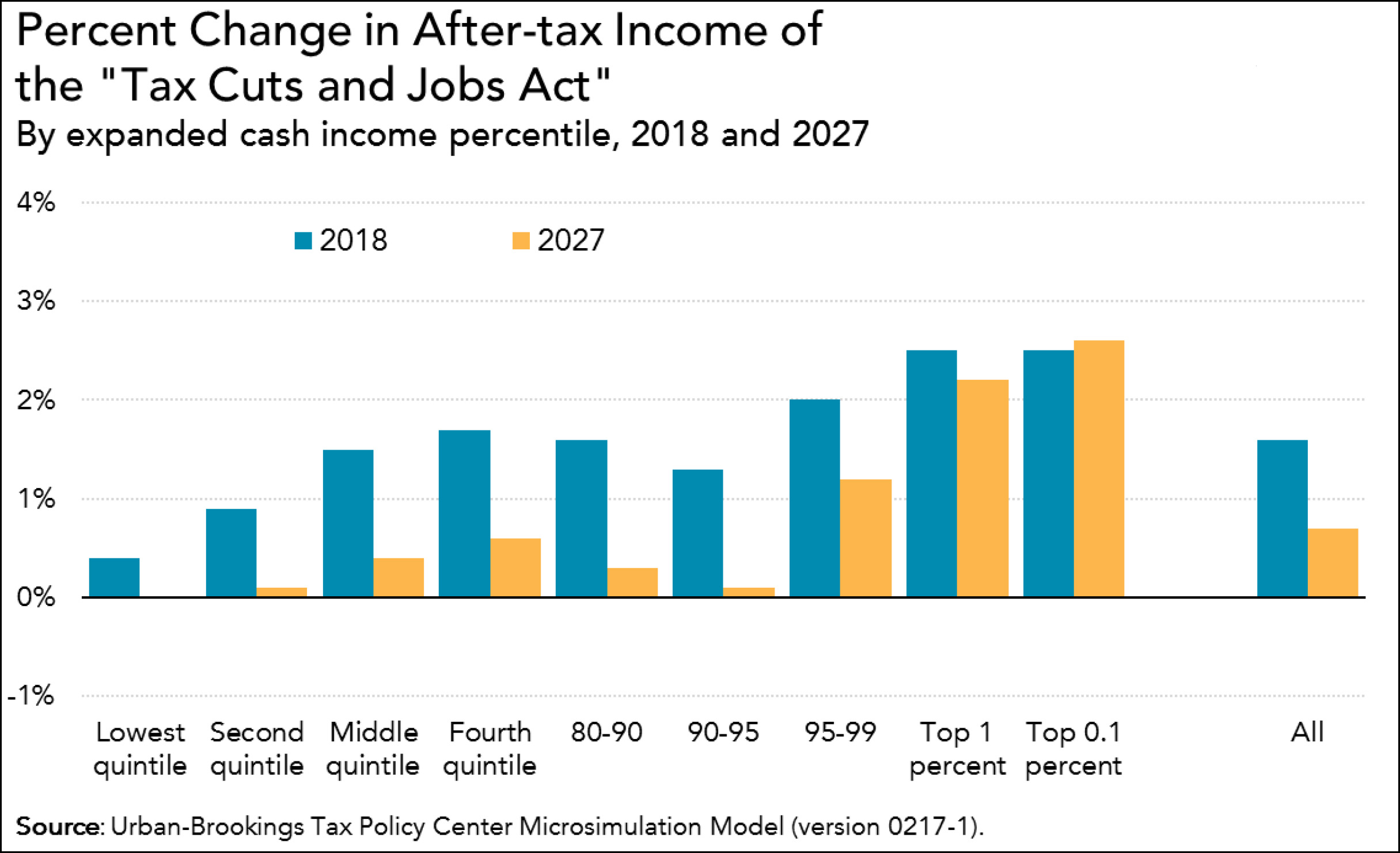
Roughly the same is true of the 2017 Republican tax cut. The working class saw a tax cut of less than 1 percent on average (second quintile in chart below). That comes to maybe $300, or about $6 per week. Is it any surprise that these taxpayers aren’t exactly brimming over with excitement?
Republicans gave the working class (and the middle class) a temporary and minuscule tax cut while the rich got a big, permanent one. Then, because they don’t really understand the middle class at all, they futzed around with the withholding tables so that lots of people got smaller refunds. Then they wonder why ordinary people aren’t impressed. The answer is simple: it’s because they got close to nothing except a big surprise on tax day. Why would you expect them to be anything but resentful over that?
This is our favorite white duck flapping herself dry after a busy session of swimming around in our local lake. Why is she our favorite? Because she and her hubby have been around for years and are adorably dedicated to each other. This is probably true of many other duck pairs too, but all the rest of them look pretty generically identical so there’s no way to tell. These two, however, are the only white ducks in our little lake, and they never let each other out of their sight.
A friend of mine texted recently to say that he was worried about Democrats holding a purity contest during the upcoming primaries. “If Medicare for All is a litmus test for the Democratic nomination, Trump will win a 2nd term.”
This is not my worry. As near as I can tell, Bernie Sanders and the left have won this particular battle: everyone in the field supports universal health care this year. There will, of course, be Puritans who insist that anything other than their vision of universal health care is a sellout, but those kind of folks have always been around and will never change. It’s not something to worry about too much, especially since universal health care is basically a popular position.
But I do have a related worry. The Trump folks recently told a few reporters that they were eager to run on health care in 2020, but it’s pretty obvious that they aren’t going to do that. They’re going to run on Trump’s usual calling card of the brown hordes from Mexico, the brown hordes from Muslimstan, and assorted other appeals to racism and kulturkampf. This is what Trump does. He doesn’t have any other game plan.
And I’m OK with that. As I argued at greater length last year, I believe that Trump’s victory in 2016 was a fluke. Eight years of a black president produced a backlash among working-class whites, and this was enough (along with Comey, the Russians, etc.) to pave the way for Trump to win. By 2020, however, white racial resentment is likely to be back to its normal level, and this means Democrats can talk about racial tolerance and related issues without worrying that they’re losing a big chunk of the vote along the way. Over the past couple of years, Trump’s ever louder appeals to white racism have become a net negative, as we all saw in the 2018 midterms. Polling evidence backs this up.
But.
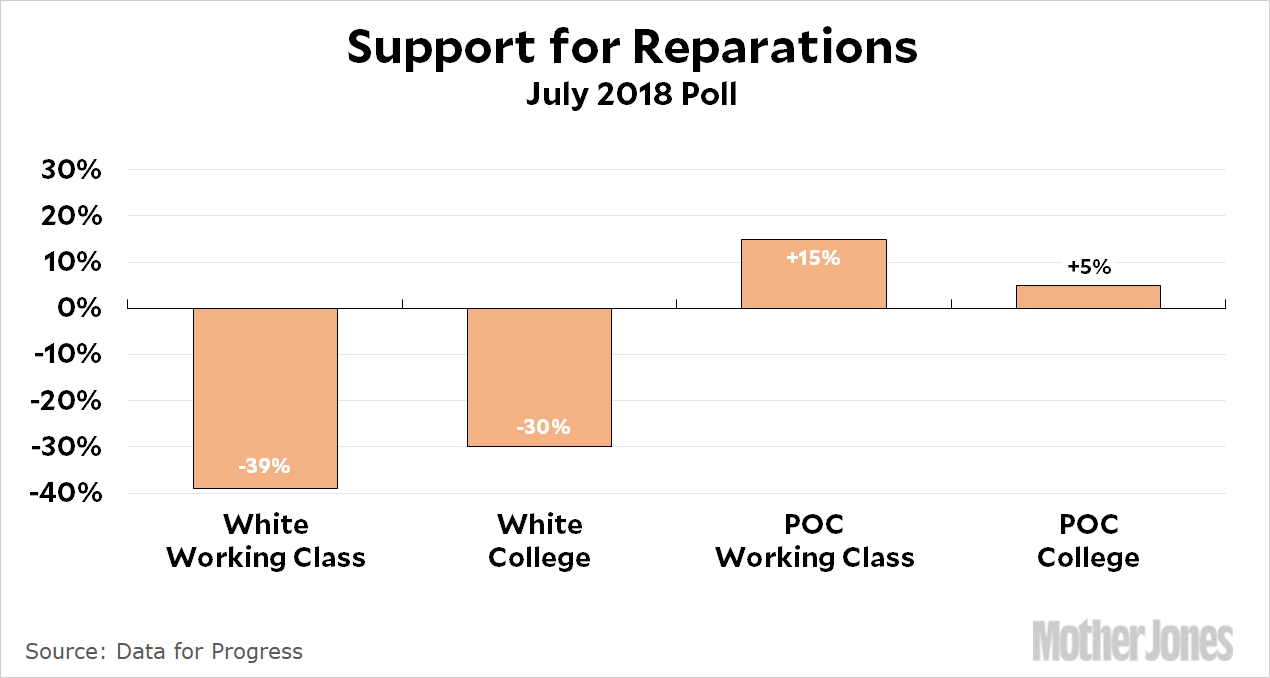
There’s a way this could become a net negative for Democrats, and that’s if it becomes a purity test during the primaries. We’ve already seen signs of this in the bandwagon support for reparations, a racial issue that’s decidedly not popular:
Even among college-educated whites, who are among the strongest supporters of racial equality, reparations are hugely unpopular. Among the white working class, it’s even worse. So what happens if a purity contest breaks out, and candidates are no longer allowed to fudge around by saying they support baby bonds or universal safety-net programs as “reparations”? What happens if they feel forced to flat-out support cash reparations? Donald Trump would laugh all the way to a second term, that’s what.
I chose reparations as an example because it’s been in the news lately, but there are plenty of others. Liberal social views, it turns out, are generally popular and there’s no reason for Democratic candidates to avoid them. But the extreme versions of those social views aren’t especially popular, and Trump could make a lot of hay out of them. The answer, of course, is for Dems to stay kind of vague on the tricky wedge issues, but this will work only if they’re allowed to stay vague. If the purity police start to demand support on unpopular issues rather than popular ones, it’s entirely possible that white backlash will increase again and we’ll see a rerun of 2016.
Everyone has to decide for themselves where they stand on issues like this. Reparations are an easy one for me since I don’t support them in the first place. It’s a lot harder if you do support reparations but understand that it’s a huge electoral negative. I’d suggest letting it lie. Conversely, you might believe that this is what you’re told every year, and it’s time to finally make a stand. But if you do, be sure to do it with your eyes wide open.
The Justice Department expects to release on Thursday a redacted version of special counsel Robert S. Mueller III’s report on President Trump, his associates and Russia’s interference in the 2016 election, setting the stage for further battles in Congress over the politically explosive inquiry. Kerri Kupec, a spokeswoman for the department, said Monday that officials plan to issue the report to Congress and the public on Thursday morning.
The White House, of course, has already gotten a copy. After all, it’s only fair that they get plenty of time to set the media narrative before the rest of us see it. Right?
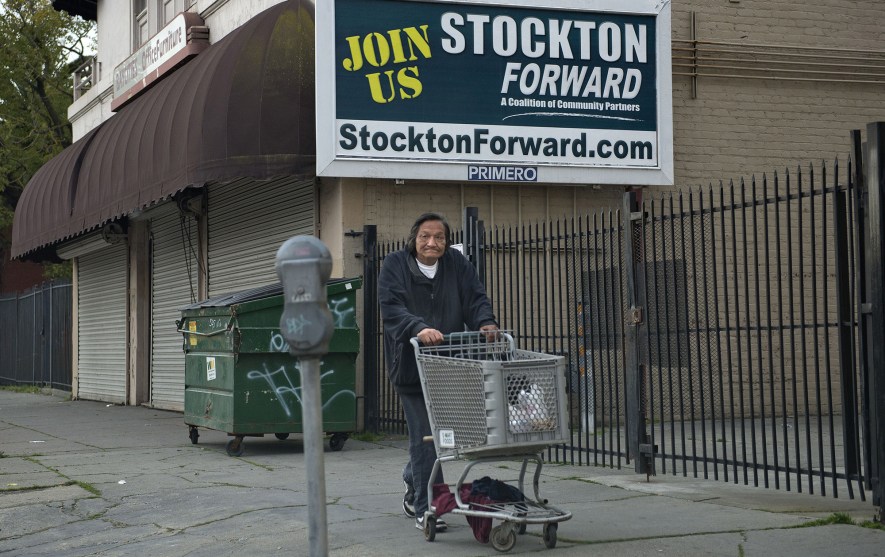
Young, sincere and raised on the edge of poverty, Sukhi Samra has a mother who worked two minimum-wage jobs when she was a kid — days at a gas station and nights at a Subway. Her father is disabled. She knows what an extra $500 a month would have bought her family.
….At 23, Samra is now head of the Stockton Economic Empowerment Demonstration, a pilot program to test a universal basic income. For the next year and a half, 130 residents of this struggling Central Valley city will get $500 every month, with no strings — such as employment or sobriety requirements — attached, in a social experiment that is as much public relations as rigorous research.
I don’t get it. The outcome of this study will probably be the same as most of the others: the recipients will spend the money on food and shelter and it will make them better off. There will be no particular ill effects to report.
But that’s because it’s a test on a small number of people over a very limited time. The big question about UBI is what effect it has if it’s big and permanent. Will it cause people to quit their jobs? Will it motivate people to restart their education? Will it just go to booze and drugs? Etc.
In other words, how will people’s behavior change if UBI becomes something that they expect and that they know will last forever? Nobody is going to substantially change their lifestyle based on an 18-month experiment, but they sure might if they know the money is permanent. This is the experiment we need to run. The problem, obviously, is that it would be expensive. At a guess, I figure it would cost at least $1 billion, maybe twice that. That kind of funding is unlikely, but I’m not sure it’s even worth bothering with anything smaller. Until we know how UBI as an entitlement works, we don’t know anything.
And we respect that! But maybe you’re of a mind to support our work directly instead? We have until December 31 to raise the last $400,000 we need to keep our nonprofit newsroom running at full strength into 2026. Will you make a gift today?
We noticed you have an ad blocker on. Can you pitch in a few bucks to help fund Mother Jones' investigative journalism?
Billionaires own the media,
but they don’t own us.
At Mother Jones we know these aren’t conventional times, and they require unconventional coverage. That’s what deliver every day: fierce, independent journalism you can’t find elsewhere. Perhaps never in the history of our country has that been more necessary than now. But we can’t do it without reader support—your support. Please chip in today.
Billionaires own the media,
but they don’t own us.
At Mother Jones we know these aren’t conventional times, and they require unconventional coverage. That’s what deliver every day: fierce, independent journalism you can’t find elsewhere. Perhaps never in the history of our country has that been more necessary than now. But we can’t do it without reader support—your support. Please chip in today.