• Ben Carson Believes God Helps Those Who Help Themselves

    This was Ben Carson's Florida mansion until he sold it last year. I'll bet it had a $31,000 dining room set too.

    I had a Ben Carson story in my open tabs yesterday but never got around to posting about it. So here it is:

    A senior career official in the US Department of Housing and Urban Development has alleged that she was demoted and replaced with a Donald Trump appointee after refusing to break the law by funding an expensive redecoration of Ben Carson’s office. Helen Foster said she was told “$5,000 will not even buy a decent chair” after informing her bosses this was the legal price limit for improvements to the HUD secretary’s suite at the department’s Washington headquarters.

    But it’s hard to keep up these days. By the time I woke up this morning, there was already more:

    Department of Housing and Urban Development officials spent $31,000 on a new dining room set for Secretary Ben Carson’s office in late 2017 — just as the White House circulated its plans to slash HUD’s programs for the homeless, elderly and poor, according to federal procurement records.

    ….Mr. Carson “didn’t know the table had been purchased,” but does not believe the cost was too steep and does not intend to return it, said Raffi Williams, a HUD spokesman.

    ….Neither Mr. Carson nor his wife — who expressed a strong interest in sprucing up the drab, wood-paneled, 1960s-era secretary’s suite, according to several current and former department staff members — requested that the 50-year-old table be replaced, Mr. Williams said. But he had remarked how the previous table was covered in scratches, scuff marks and cracks. Mr. Williams emailed several pictures of the old table, which looks polished and not visibly scarred, during events held by Mr. Carson’s predecessor, Julián Castro.

    Hahaha. Carson “didn’t know” the table had been purchased even though his wife had “expressed a strong interest” in buying it and he had demoted the person who stood in the way. Sure. Once a grifter, always a grifter.

  • Jared Kushner Gets Demoted to the Kiddie Table

    Bill Clark/Congressional Quarterly/Newscom via ZUMA

    From the Washington Post:

    Officials in at least four countries have privately discussed ways they can manipulate Jared Kushner, the president’s son-in-law and senior adviser, by taking advantage of his complex business arrangements, financial difficulties and lack of foreign policy experience, according to current and former U.S. officials familiar with intelligence reports on the matter. Among those nations discussing ways to influence Kushner to their advantage were the United Arab Emirates, China, Israel and Mexico, the current and former officials said.

    Of course they have. Why wouldn’t they? Kushner is inexperienced, avaricious, and in tough financial straits. He’s an easy mark. That explains this, also from the Post:

    Jared Kushner, senior adviser and son-in-law to President Trump, had his security clearance downgraded Friday, sharply limiting his access to some of the nation’s most sensitive secrets amid concerns raised by the ongoing investigation of his background, two White House officials said Tuesday. Kushner was one of several White House officials who received a memo Friday announcing that because of their interim security clearances, their status was being downgraded from the “Top Secret/SCI” level to the “Secret” level, a far lower level of access to classified information.

    “Secret”? Not even “Top Secret?” Seriously? Nothing of any real consequence is classified Secret. Kushner has been put in about the same category as a sixth grader, and for good reason: because the intelligence community is afraid that foreign countries might try to take advantage of his complex business arrangements and financial diff—

    Oh.

  • Electricity Demand Is Down, But We Keep Building Power Plants Anyway

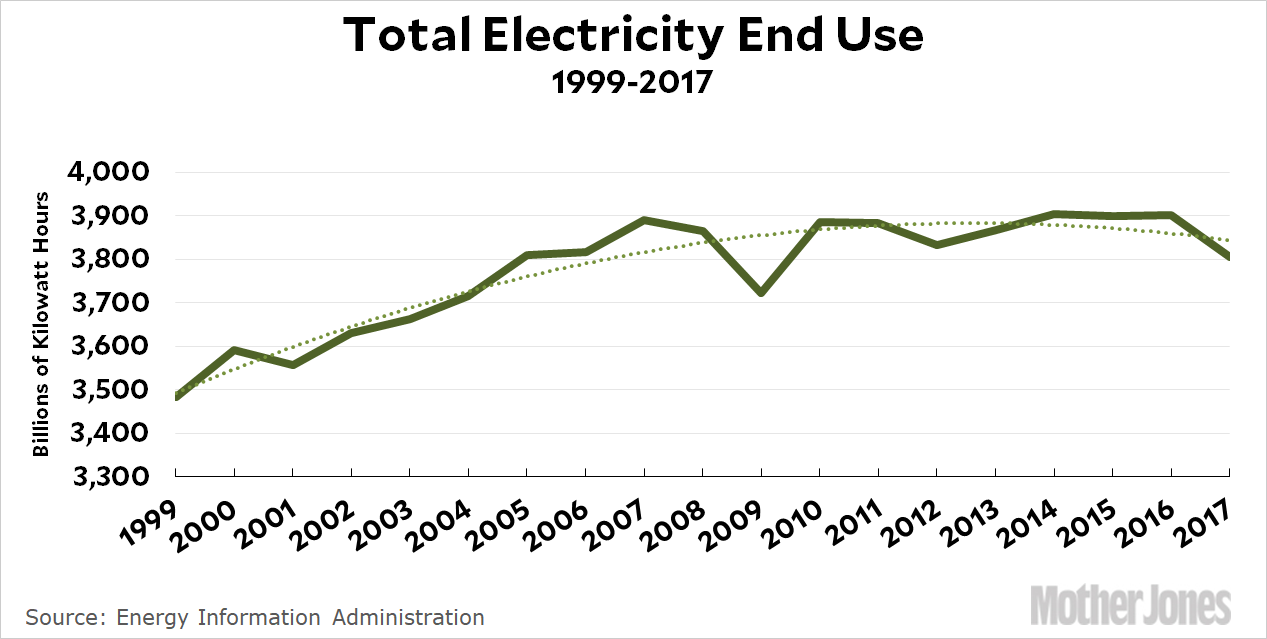
    Dave Roberts has an interesting piece today about the US demand for electricity. Thanks largely to rising energy efficiency and the emergence of rooftop solar, demand is flat, prices are down, and utilities are panicked. Here are three charts that tell the story. First, total end-use electricity demand since 1999:

    Demand flattened starting in 2007 and is now showing signs of actually declining. Here’s the price of electricity:

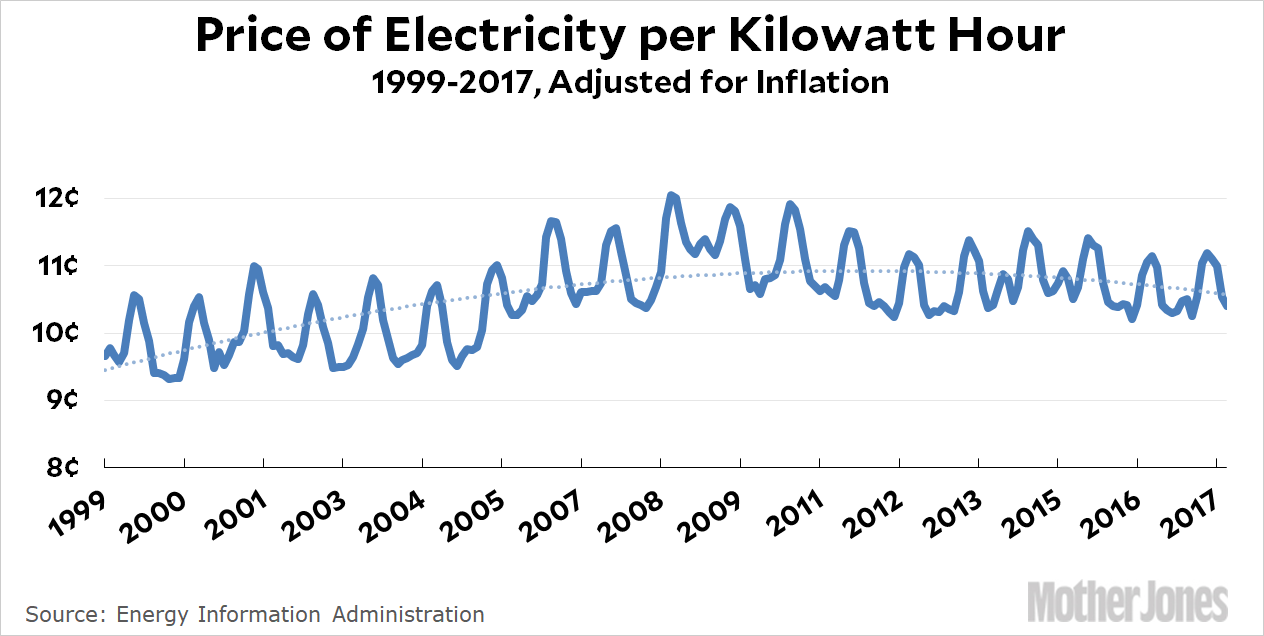
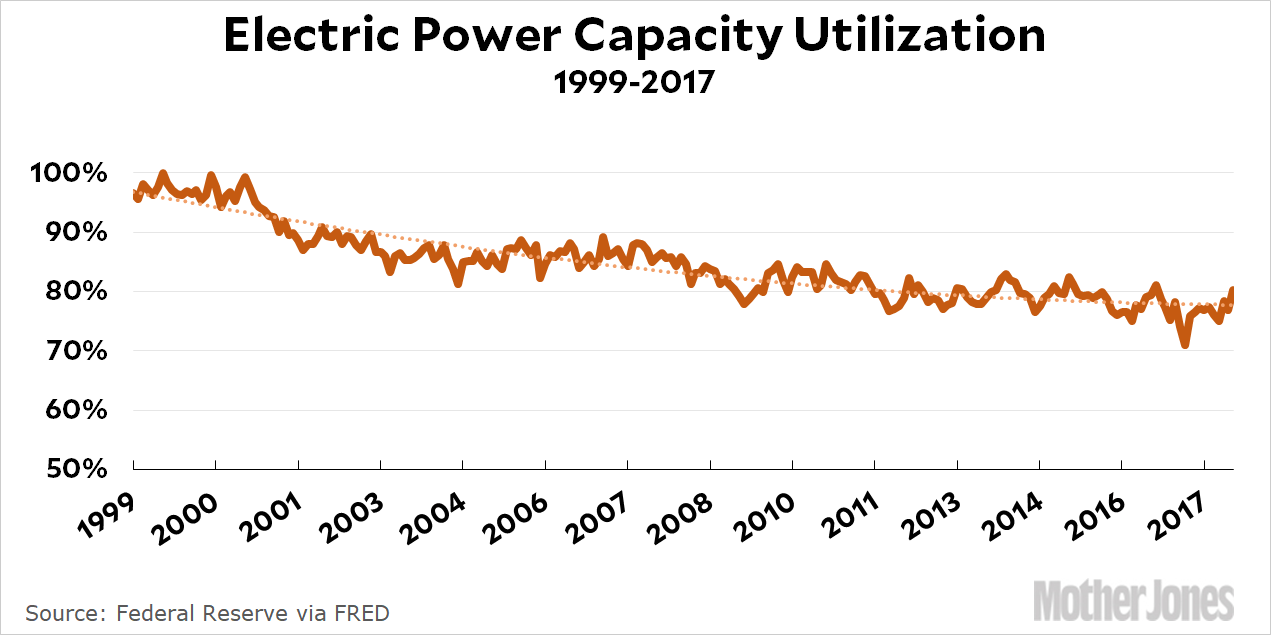
    The price of a kilowatt-hour of electricity has been dropping since about 2008. With demand flat and prices dropping, this means electric utilities are being squeezed. They make money by getting a regulated rate of return on new investment, but obviously they don’t need much new investment. They’ve squared this circle by simply building new capacity anyway. If they need to build more power plants in order to make money, then they’ll figure out some way to wheedle regulators into allowing them to build new power plants. Here’s the result:

    Roberts explains what this means:

    Utilities have been frantically adjusting to this new normal. The generation utilities that sell into wholesale electricity markets…have reacted by cutting costs and merging. The regulated utilities that administer local distribution grids have responded by increasing investments in those grids. But these are temporary, limited responses, not enough to stay in business in the face of long-term decline in demand. Ultimately, deeper reforms will be necessary.

    ….That’s simply a different model than current utilities are designed for. To adapt, the utility business model must change. Utilities need newly defined responsibilities and new ways to make money, through services rather than new hardware. That kind of reform will require regulators, politicians, and risky experiments.Very few states — New York, California, Massachusetts, a few others — have consciously set off down that path.

    Paying utilities to build generating plants made a rough kind of sense when demand was steadily increasing and new plants were always on the horizon. Today it makes no sense at all. It’s time for regulators and state legislatures to change the way utilities are allowed to make money.

    If charts are too bloodless for you, you should read a recent Los Angeles Times report about utilities in California. It explains in detail how utilities here continue to make billions of dollars building new power plants even though California has a glut of electricity. In fact, the glut is so massive that we’re even selling solar power to other states. And yet, the new plants just keep on coming.

  • Lunacy Doesn’t Work As Well for Liberals As For Conservatives

    Hayne Palmour IV/North County Times/ZUMA

    Conventional wisdom says that gun rights are a big political issue not because lots of people are extremists on the issue. There’s actually not all that many of them. Rather, the issue is intensity: the zealots tend to be very, very loud and they make it clear that they’ll punish politicians who step out of line even slightly. Atrios riffs on why Democrats don’t seem to get the same kind of mileage from their issues:

    The thing is that D politicians rarely try to inspire their own intense single issue voters who could be turned out on issues, including, yes, the gun issue. But you can’t turn out single issue reproductive health voters (I mean those who don’t necessarily vote all the time) on “safe, legal, and rare.” You can’t turn out anti-war voters on “kindler, gentler wars, mostly with your pal Droney.” You can’t turn out gun control voters on “um…more background checks and… [thinks hard] raise the age of legally buying a gun that shoots a round 45 times per minute to the Bud Light buying age?” And Dems tend to speak in pundit approved gibberish speak. “Let’s close the gun show loophole.” Um, sure, what the hell is that again?

    ….Maybe these political calculations are correct. Maybe “an abortion cart on every corner” will turn off the totebagging moderates more than it will inspire intense single issue votes. But don’t be surprised when common sense rhetoric about “common sense proposals” doesn’t inspire your base to turn out at midterms….Nobody’s going to vote to bend the cost curve. They’ll vote if you promise them they can go to the damn doctor. Intensity can be there, but it’s gonna require leadership to maintain it.

    I’m just going to toss out a few miscellaneous comments on this:

    • There are issues where Democrats get a lot of mileage from single-issue voters. Reproductive health is one of them. Ancient Clintonian rhetoric aside, virtually every Democrat these days supports more-or-less unlimited abortion on demand—and they’re punished if they don’t.¹ Ditto for gay rights. And increasingly immigration is in this bucket too, because activist groups have made it clear that Democrats will be punished if they compromise more than slightly on immigration legislation.
    • More people self-ID as conservatives than as liberals. They just do. This means Republicans can usually win by attracting maybe a third of centrist voters. By contrast, Democrats usually need about two-thirds of the centrists. Democrats simply have less elbow room to pander to their extremists and still win.
    • For good or ill, Republicans are given more leeway by the media to be lunatics.
    • This problem of intensity often comes up in the context of young voters. How can Dems get them to turn out in bigger numbers? Finding hot button issues might be one of the answers. But another is to stop focusing so much on the college educated. Bloggers are especially bad at this because we and all our friends tend to be verbal, college-educated folks with a lot of interest in politics. Instead, think about a 20-year-old C+ high school grad who spends a lot of time playing videogames or chatting on Facebook—and is, at the very least, nonconservative. What might motivate them to turn out to vote? Free college? Nah. Free health care? Nah. Most of them are pretty healthy. Abortion? For the women maybe, but not the men. Overseas wars? They probably don’t really care that much. These are all issues that appeal to folks who are already politically engaged, but not so much to the Beavis and Butthead vote. So what will? Has anyone asked them?

    Bottom line: sure, Democrats should have a crisper message. But there are some genuine structural reasons that they don’t. Demographics are tough to get around, and the demographics of America today are a lot tougher on lunatic liberals than on lunatic conservatives. Like it or not, we have to do things differently.

    ¹The main exceptions are Dems in red or deep purplish districts, where everyone is willing to leave them alone just to get another D on the roster. But that’s true of Republicans as well.

  • After Tax Bill Passes, Corporations… Reduce Spending on Capital Goods

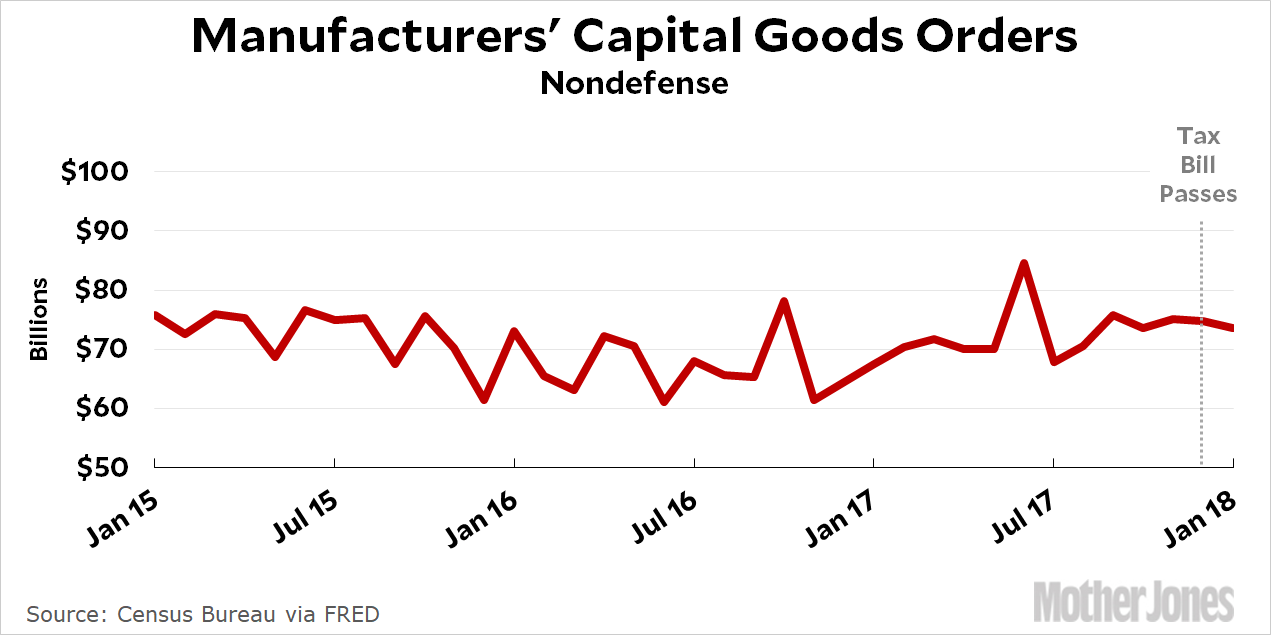
    Despite the Republican promise that their tax bill would supercharge the economy, orders for capital goods fell after the bill passed:

    As Dean Baker points out, this isn’t investment, which can have long lead times, but orders:

    According to data released by the Commerce Department orders for non-defense capital goods fell by 1.5 percent in January after dropping 0.4 percent in December. We get the same story even if we pull out volatile orders for aircraft: a drop of 0.2 percent in January after a fall of 0.6 percent in December.

    ….While investment takes time to put in place, these data are showing us orders. Orders can be made over the Internet or an old-fashioned land line telephone. They don’t take a lot of time….If the tax cuts matter for investment, then companies like GE, Microsoft, and Amazon were making plans as soon as it became clear that the Republican majority in Congress was serious about passing a tax bill. The fact that we are seeing zero evidence of an uptick in investment suggests that tax cuts don’t have much impact on investment.

    Patience, Dean! I’m sure new investment will flow eventually. Corporations just need to figure out first how much money they’ll have left over after lining their own pockets with stock buybacks. That takes some time.

  • Diversity in Hollywood: Some Good News and Some Bad News

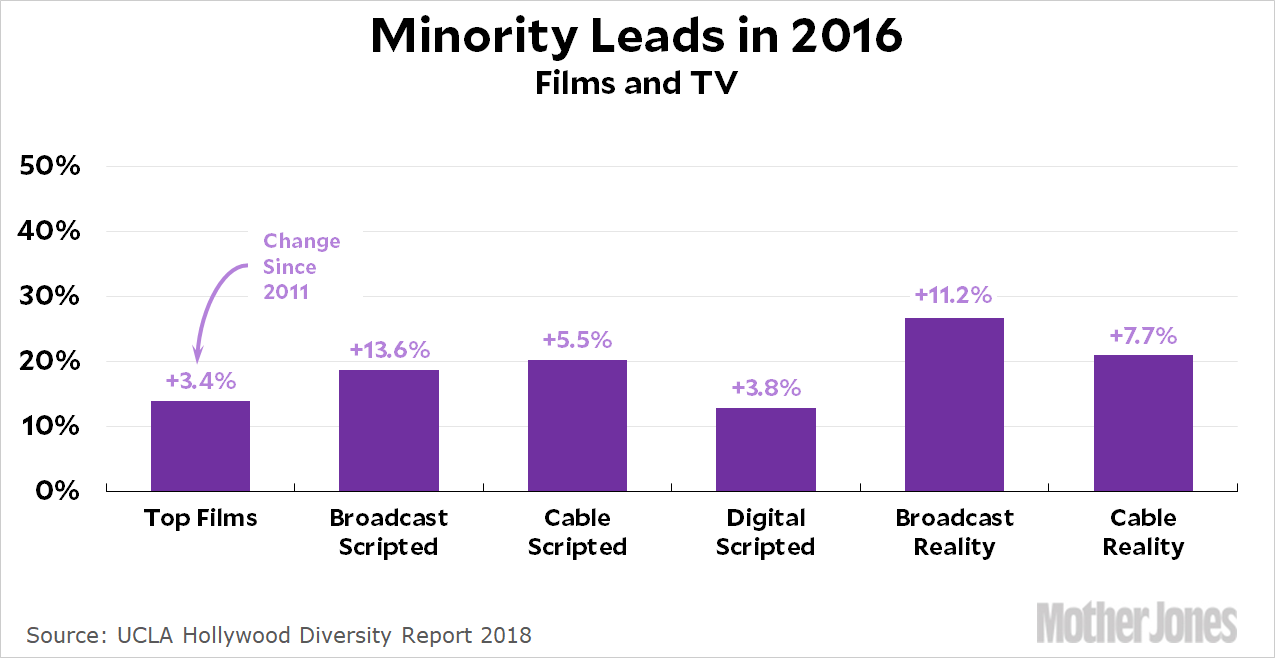
    The UCLA College of Social Sciences has released its annual Hollywood Diversity Report, and the news is mixed. First, here’s the share of minority leads in various kinds of programs:

    The good news: minority leads have increased steadily over the past five years. The bad news: there still aren’t very many. And for those hoping that digital shows might be an antidote to corporate Hollywood whiteness, forget it. They’re actually the worst.

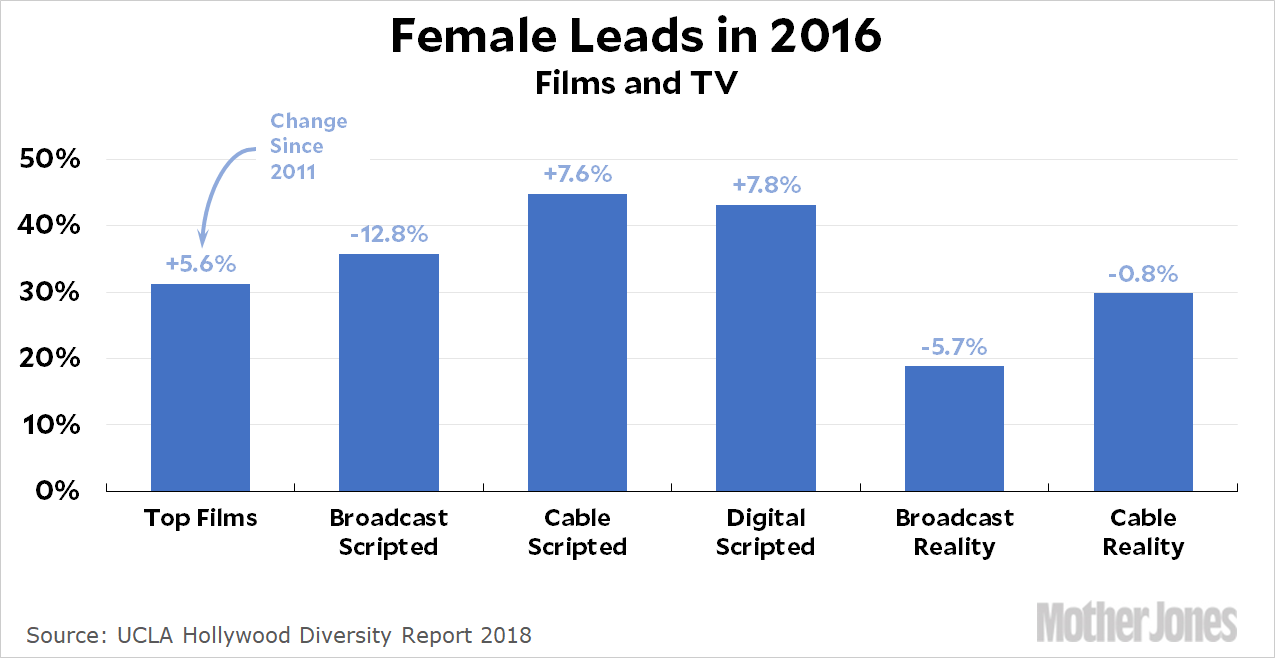
    Here are the same figures for women:

    The good news is that scripted shows on cable and digital are getting very close to 50 percent. The bad news is that the numbers have actually gone down for scripted and reality shows on broadcast TV.

    Behind the camera, as usual, the news is just plain bad. Minority and female representation among directors, show creators, and writers is dismal—and not improving. For example, here are show creators for both broadcast and cable scripted shows:

    And then there’s China, which has an ever-increasing influence on American films. The big question is: Will Chinese audiences go to films starring blacks or Hispanics? Unfortunately, we can’t really say: of all films released in 2016 with black or Hispanic leads, only one was even distributed in China.

    There’s a lot more in the full report. It’s worth browsing through to get a firm grasp on the reality behind the sometimes heated rhetoric. For the most part, it turns out that the heated rhetoric is pretty accurate.

  • Scott Pruitt Kills Agency That Studies Chemicals Harmful to Children

    Tim O'Brien

    Those of us of a certain age will remember the dynamic duo of James Watt and Anne Gorsuch during the Reagan years. As Secretary of the Interior and administrator of the EPA, respectively, they did everything they could to make America friendly to polluters in particular and corporate interests in general. In the end, Watt resigned after mocking a coal-leasing panel (“I have a black, a woman, two Jews and a cripple. And we have talent.”). Gorsuch resigned after being held in contempt of Congress for refusing to turn over Superfund records.

    Today we have Ryan Zinke and Scott Pruitt. Zinke has already slashed the size of two beautiful national monuments and gotten in trouble over his travel habits. Scott Pruitt, meanwhile, has been busy rescinding the Clean Power Plan and getting in trouble over his travel habits—and much more. In fact, Pruitt is so bad that Rebecca Leber’s profile of him, “Making America Toxic Again,” is on the cover of our current issue. Here’s a bit of it:

    Another accomplishment on Pruitt’s list was “science board transparency”—a reference to one of the more obscure ways in which well-established facts have come under relentless assault….On Halloween, to an audience that included few reporters but several industry reps—including Steve Milloy, the former policy and strategy director of Murray Energy and a prominent climate denier—Pruitt announced a new plan. No scientist who received agency grants could serve on the boards.

    ….To replace the departing scientists, Pruitt appointed industry supporters, including Michael Honeycutt, a toxicologist from the Texas Commission on Environmental Quality who has built his career arguing that the impacts of air pollution are overstated. He is now the chair of the Science Advisory Board. Pruitt picked more than a dozen people to fill the empty seats of the 18-member Board of Scientific Counselors and 15 others for the 47-member Science Advisory Board, many of them former executives and staffers from organizations that have a stake in limiting the EPA’s chemical and air quality work, such as the utility Southern Co., Phillips 66, Total, and the American Chemistry Council.

    All of this leads up to Pruitt’s latest effort to make America not just toxic, but specifically toxic to children:

    A federal environmental program that distributes grants to test the effects of chemical exposure on adults and children is being shuttered amidst a major organization consolidation at the Environmental Protection Agency. The National Center for Environmental Research (NCER) will no longer exist following plans to combine three EPA offices, the agency confirmed to The Hill on Monday.

    ….The NCER is largely known for the funding it provides through its premiere program, Science To Achieve Results (STAR). Under the STAR program, grants are given to the Children’s Environmental Health and Disease Prevention Research Centers, which were established in 1988 to discover methods to reduce children’s health risks from environmental factors….A report released by the National Academy of Sciences last year that was compiled at the EPA’s request championed the STAR program for its “numerous successes.”

    You can see the problem, of course. The STAR program has been successful. That means it identifies chemicals that might be harmful to children. And that in turn means trouble for the companies that make those chemicals. We can’t have that, can we?

    I don’t remember who said this last night about the Trump administration, but it’s as if they’re in a contest to see who can be the most evil. For the moment, it looks like Pruitt is in the lead.

  • Surprise! Corporate Tax Cuts Are Making the Rich Even Richer

    Republicans said their big tax cut would spur corporations to invest more and give their employees big raises. Everybody else said it was far more likely that corporations would spend most of the money on stock buybacks, which would increase the value of stock owned by CEOs and wealthy investors. It looks like everybody else was right:

    Almost 100 American corporations have trumpeted such plans in the past month. American companies have announced more than $178 billion in planned buybacks — the largest amount unveiled in a single quarter, according to Birinyi Associates, a market research firm.

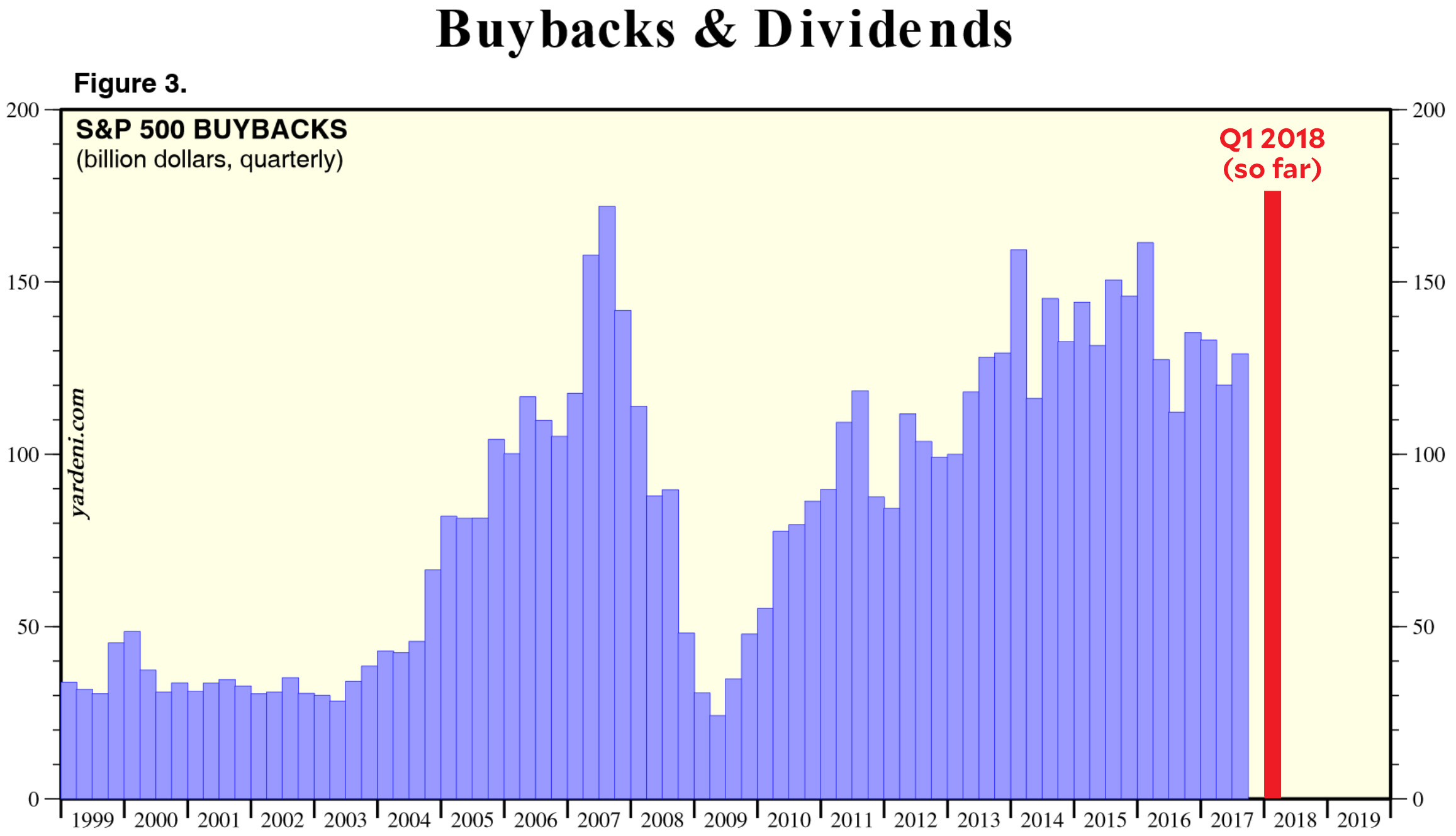
    Let’s put that in perspective by comparing it to buybacks over the past few years:

    As you can see, buybacks have been on a generally downward trend since 2015. But in the first two months of 2018 they’ve already spiked to their highest level ever, beating even the peak of the housing bubble. By the time the quarter is over, buybacks will have not just set a new all-time record, but will have blown past it:

    More buybacks are almost certainly on the way….“I’m expecting buybacks to get to a record for 2018,” said Howard Silverblatt, a senior index analyst with S.&P. Dow Jones Indices. “And if I’m disappointed, there’s a lot of people with me.”

    ….The vast majority of the billions of dollars in planned share purchases will benefit the richest 10 percent of American households, who own 84 percent of all stocks. The top 1 percent of households own about 40 percent of all stocks. Ultimately, the effect of the rising stock market depends on how those wealthy investors use their windfall. It helps the economy more, for example, if they put the money toward productive new companies than if they invest in government bonds.

    This is exactly what happened the last time corporations got a big tax cut, so it’s hardly a surprise. Republicans fully expected this, and all their blather about “capital formation” and “$4,000 in wage growth” was just the usual smokescreen to justify a giveaway to the rich. Back in October, CEA head Kevin Hassett said “I would expect to see an immediate jump in wage growth.” Today he’s singing a different tune: “Right now we’re going to have an adjustment where you see probably more dividends and share buybacks than wage increases.” Wage growth will come later.

    You betcha. We’ll be seeing those fatter paychecks any day now.

    Corporations and the rich were willing to cover their ears and support Donald Trump because they knew it would make them even richer. That’s paid off for them. I hope they’re happy.