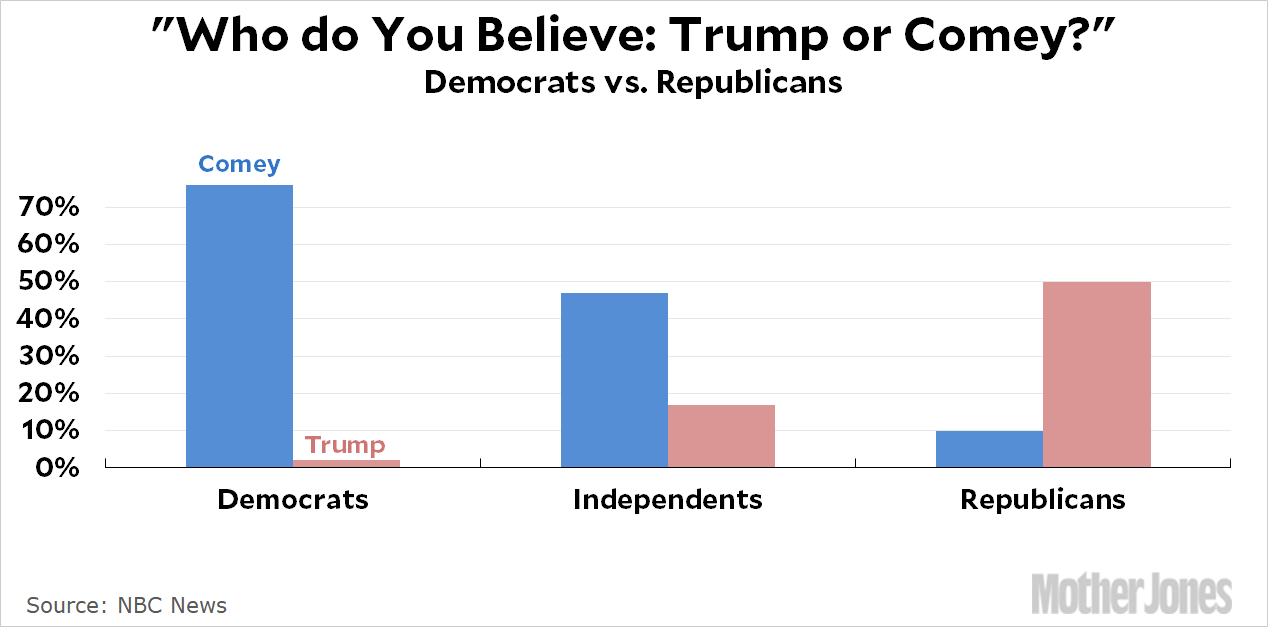
NBC News asked Americans who they believe: Donald Trump or James Comey. The results are pretty much America in a nutshell:
Democrats and Republicans live in different worlds. Democrats believe Comey by a margin of +74 percent. The Republican margin is -40 percent. That’s a difference of 114 percent. I’m not sure I’ve ever seen a partisan gap that wide on anything.
But I guess it’s no surprise. If you get your news from Fox and Drudge and talk radio, it’s obvious that Comey is just a big fat liar who has it in for Trump. It’s Spock’s beard at work.
Medicaid: The Senate bill slashes spending on Medicaid in order to cut taxes on the rich. This is a cruel and unnecessary tradeoff for the richest country in the history of the world.
Death Spiral: It eliminates the individual mandate; reduces subsidies for the poor; reduces benchmark plans to an actuarial value of 58 percent; and increases deductibles and copays. Whatever instability Obamacare currently has, this will make it far, far worse.
Essential Health Benefits: Like the House bill, the Senate bill makes it easy for states to cut essential health benefits, which motivates insurers to offer low-end policies for the working poor that are worthless—but only if you read the fine print.
More Uninsured: It will lead to tens of millions fewer people having health coverage. CBO will provide an exact number in a few days, but we already know it’s going to be big.
Lifetime Caps: Guts protections against annual and lifetime caps, and because of the way the bill is written, it’s likely to do this even for employer insurance, not just for the individual market.
There’s more, like the substantial increase in premiums for older workers and the quiet kickback to insurance company CEOs. And what are the benefits? Unless you’re rich or you really, really want to cut funding for Planned Parenthood, it’s hard to see any.
Saudi Arabia and other Arab states that have severed ties with Qatar issued a list of severe demands to end the worst regional diplomatic crisis in years, telling their Persian Gulf neighbor to close state broadcaster Al Jazeera, curb ties with Iran and end Turkey’s military presence on its soil….The government of Tamim bin Hamad Al-Thani has 10 days to accept the demands, which include paying reparations and providing information on all opposition groups it has supported, the document says, without specifying what penalties the Saudi-led group will impose if Qatar fails to comply.
And there you have it. Does Saudi Arabia really care about Qatar’s tightrope walk relationship with Iran, which it shares a gigantic gas field with? Or the 200 Turkish troops in Qatar? Or its ties to Hezbollah and the Muslim Brotherhood?
Well, sure, they care. But Qatar is just pursuing standard small-country diplomacy, trying to balance its alliances so it doesn’t become a client state of the local hegemon. It’s hardly a threat to Saudi Arabia.
But Al Jazeera is, because it provides a view of the outside world to ordinary Saudi citizens that’s not controlled by the Ministry of Keeping Everyone In Line. That’s really the only thing Qatar does that’s truly threatening.
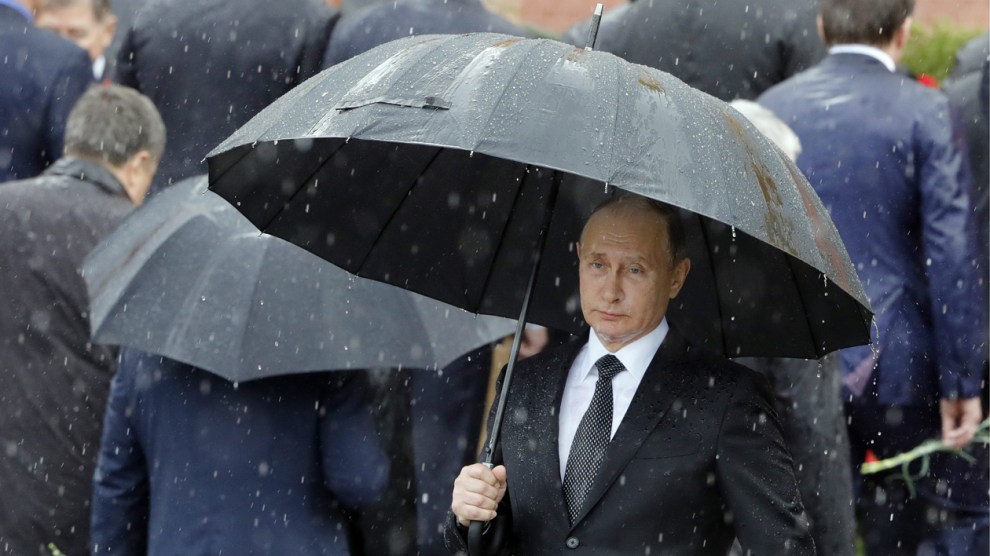
Early last August, an envelope with extraordinary handling restrictions arrived at the White House….Inside was an intelligence bombshell, a report drawn from sourcing deep inside the Russian government that detailed Russian President Vladimir Putin’s direct involvement in a cyber campaign to disrupt and discredit the U.S. presidential race.
But it went further. The intelligence captured Putin’s specific instructions on the operation’s audacious objectives — defeat or at least damage the Democratic nominee, Hillary Clinton, and help elect her opponent, Donald Trump.
….The White House turned to Congress for help….But Republicans resisted, arguing that to warn the public that the election was under attack would further Russia’s aim of sapping confidence in the system.
Senate Majority Leader Mitch McConnell (R-Ky.) went further, officials said, voicing skepticism that the underlying intelligence truly supported the White House’s claims. Through a spokeswoman, McConnell declined to comment, citing the secrecy of that meeting.
Key Democrats were stunned by the GOP response and exasperated that the White House seemed willing to let Republican opposition block any pre-election move.
This is from the Washington Post. Read the whole thing.
Here’s a story for you. My mother grew up in a Republican family.1 When Herbert Hoover was on the radio, everyone listened. But later she became a Democrat. What happened?
Well, she went off to college. But not some bleeding heart lefty bastion. She went to USC, which was even more Republican in 1950 than it is now. She didn’t get indoctrinated by a bunch of fuzzy liberal professors.
So what caused the switch? I asked her once, and she said that during her college years she came to the conclusion that Republicans were just mean. So she became a Democrat.
This struck me because I’ve long used the exact same word in the privacy of my own thoughts. I can write a sophisticated critique of conservative ideology as well as the next guy, but the truth is that it mostly boils down to a gut feel that Republicans are mean. I’ve never said this out loud because it sounds so kindergarten-y, but there it is. I think Republicans are mean, just like my mother did.
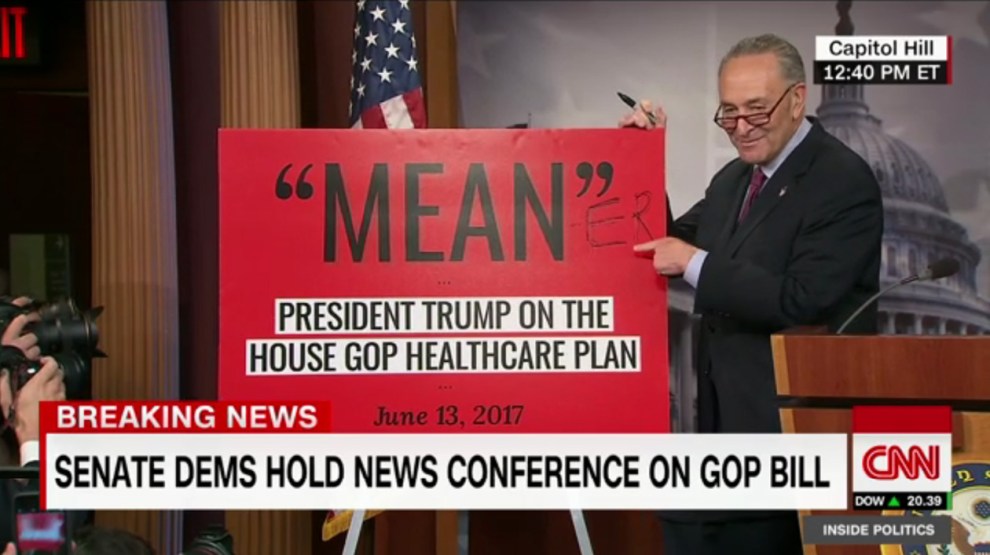
But now our time has come. Donald Trump started it, with his contention that Paul Ryan’s health care bill was “mean.” Today, Barack Obama picked up the ball, writing on Facebook about the “fundamental meanness at the core of this legislation.” And then Chuck Schumer weighed in with a big red poster calling the Senate health care bill “meaner.”
So that’s that. It’s now OK to ditch the ten-dollar words and just spit it out. Republicans are mean.2
1I’ve never figured out what the deal was here. My grandfather was very much a working-class guy, an electrician for Western Union. But he hated FDR. I don’t know why.
2The weird thing about this is that I live in Orange County and I know lots of conservatives. For the most part, they aren’t mean. But put ’em together in a single political party, and it’s all torches and pitchforks.
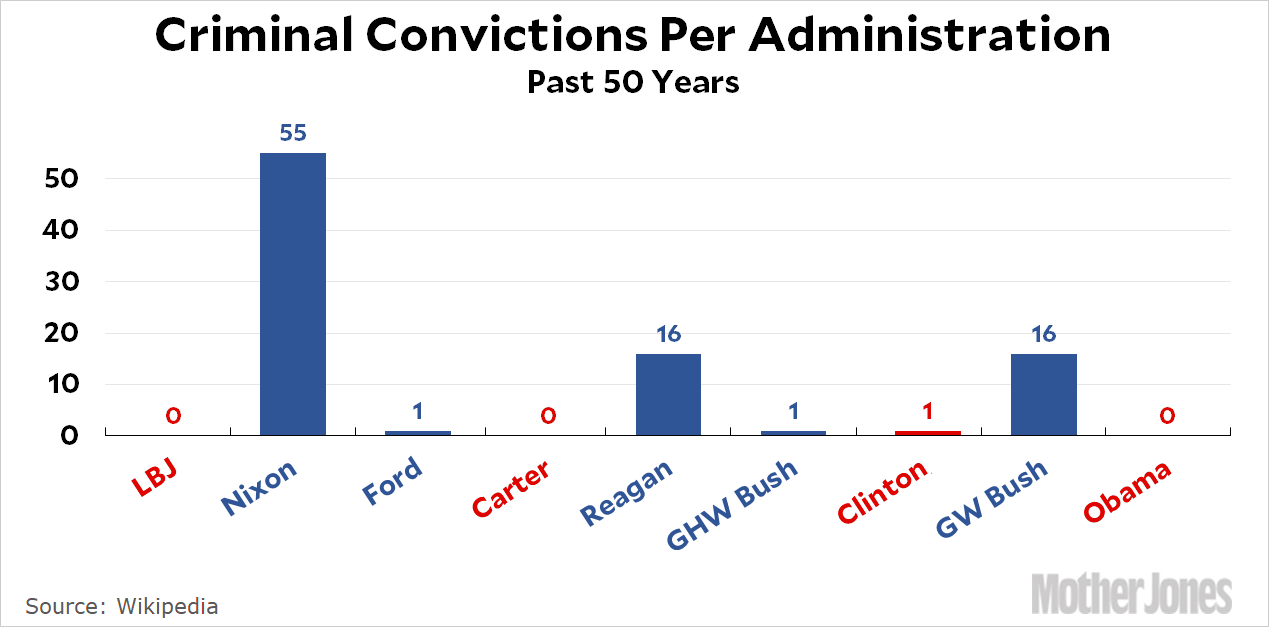
This comes via a 4th-grade friend, who got it from some guy on Facebook, who probably got it from Daily Kos, who got it from Wikipedia:
In the criminal convictions contest, the score is Republicans 89, Democrats 1. And that’s not even counting all the high-level Iran-Contra folks who probably would have been convicted of various felonies if they hadn’t been pardoned by GHW Bush.
Among Democrats, there’s been only one criminal conviction in the past 50 years. The unlucky schmoe is Ron Blackley, who was collateral damage from a special prosecutor who even Ken Starr thought was kind of nuts. The guy ran amuck in a futile attempt to pin something on Secretary of Agriculture Mike Espy,1 and in the process he managed to win a perjury conviction against Blackley, who served as Espy’s chief of staff, for failing to disclose a pittance in consulting fees from a former consulting business in Mississippi.
I wonder if Donald Trump can break Nixon’s record? One thing going against Trump is that he’s barely able to hire anyone these days, and you can’t garner lots of corruption convictions if you don’t have anyone working for you. On the other hand, he’s Trump. You never know.
1He got a grand jury to hand down a bunch of indictments, but his case was so thin that Espy didn’t even bother mounting a defense. The jury acquitted Espy of everything.
The Senate health care bill takes an axe to Medicaid, but it also does a ton of damage to private insurance purchased on the exchanges. It does this in five ways:1
Tax subsidies are reduced right out of the gate by changing the benchmark used from “second-lowest cost silver plan” to “applicable median cost benchmark plan.” The “applicable” median plan has an actuarial value of 58 percent, compared to a minimum of 70 percent for a silver plan. This makes it much cheaper, and thus makes the benchmark subsidies lower.
Subsidies stop entirely at an income of about $42,000, compared to $48,000 currently.
The age band is increased from 3:1 to 5:1, which will increase premiums for older workers.
Obamacare’s essential health benefits are eliminated, which allows insurers to offer crappier insurance.
CSR subsidies are eliminated, which will substantially increase deductibles and copays for poor people.
The end result of all this is that subsidies will go down, coverage will get worse, and deductibles and copays will get higher. Older people will also see an increase in their premiums.
How much does all this add up to? Quite a bit, I’m sure, but we’ll have to wait for the CBO score to put a solid number on it.
1That’s how many I’ve discovered so far, anyway. There are probably other little gems hidden inside the bill that I haven’t caught. I’ll add them to the list when I hear about them.
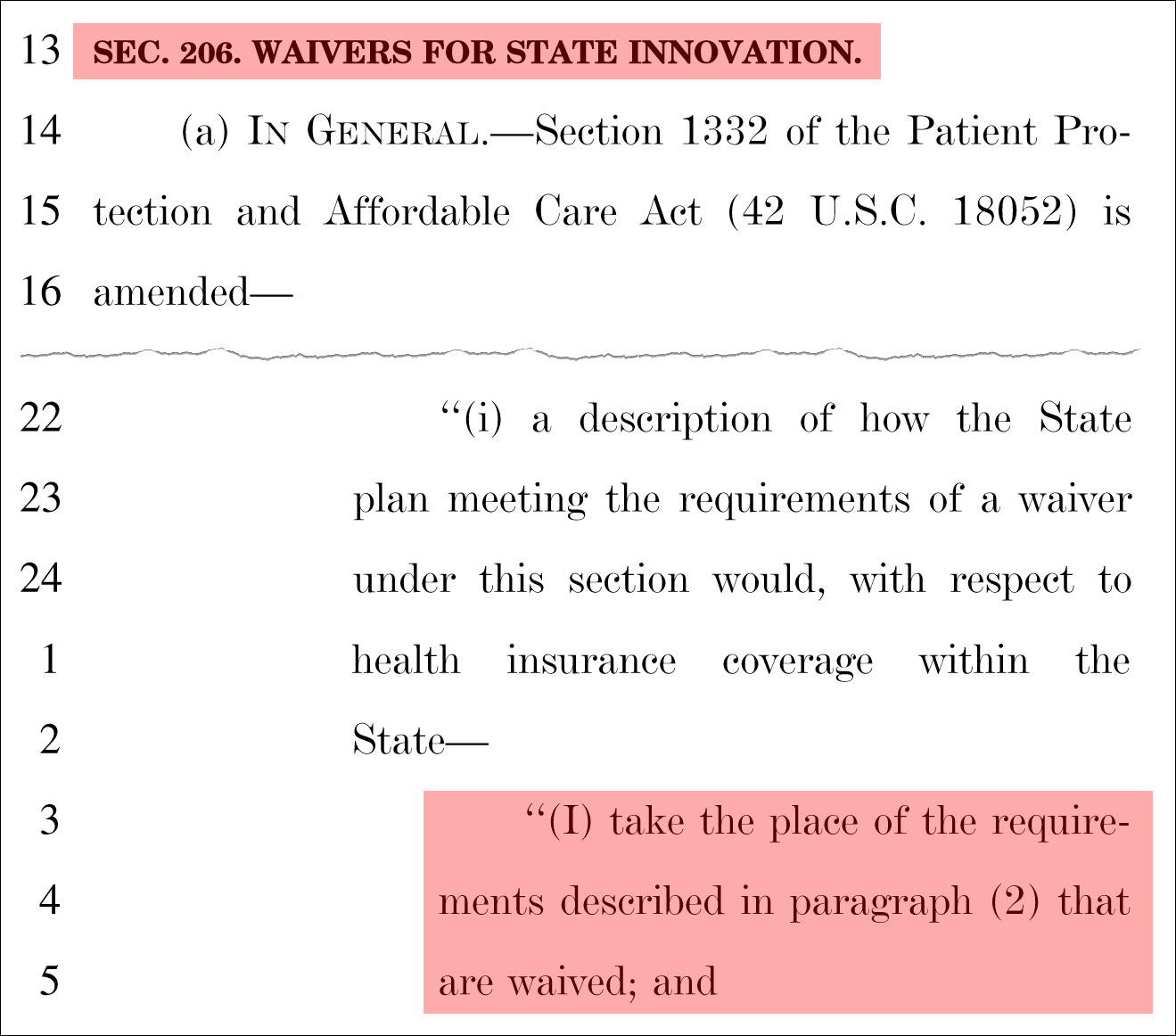
UPDATE: My original post used the wrong excerpt of the bill to illustrate the elimination of essential benefits. It’s actually part of something called a “1332 waiver,” which allows states to apply for an exemption to some of Obamacare’s requirements. Among other things, this exemption can include essential benefits.
Two of the nation’s top intelligence officials told Special Counsel Robert Mueller’s team and Senate investigators, in separate meetings last week, that President Donald Trump suggested they say publicly there was no collusion between his campaign and the Russians, according to multiple sources.
Director of National Intelligence Dan Coats and National Security Agency Director Adm. Mike Rogers described their interactions with the President about the Russia investigation as odd and uncomfortable, but said they did not believe the President gave them orders to interfere, according to multiple sources familiar with their accounts.
This goes further than what Trump asked James Comey to do. He wanted Comey to publicly acknowledge that Trump himself wasn’t under investigation, which was at least true. But he apparently asked the intelligence chiefs to say that his campaign didn’t collude with the Russians, which is precisely what’s under investigation. That’s like asking the district attorney to publicly exonerate a murder suspect while police are still collecting evidence.
This may not have been an order to interfere with an ongoing investigation, but it was sure as hell inappropriate, as both Coats and Rogers obviously knew.
The Stanford Policing Project is a massive effort to collect data on police stops nationwide. It’s basically an attempt to find out whether police unfairly stop and search blacks and Hispanics at greater rates than whites, and they’ve now released the data they have so far.
What they find is that police stop Hispanics at about the same rate as whites, but stop blacks at a somewhat higher rate. Once stopped, both groups are ticketed, searched, and arrested at significantly higher rates than whites. But is this because of racial discrimination? The Stanford researchers used two different tests to find out.
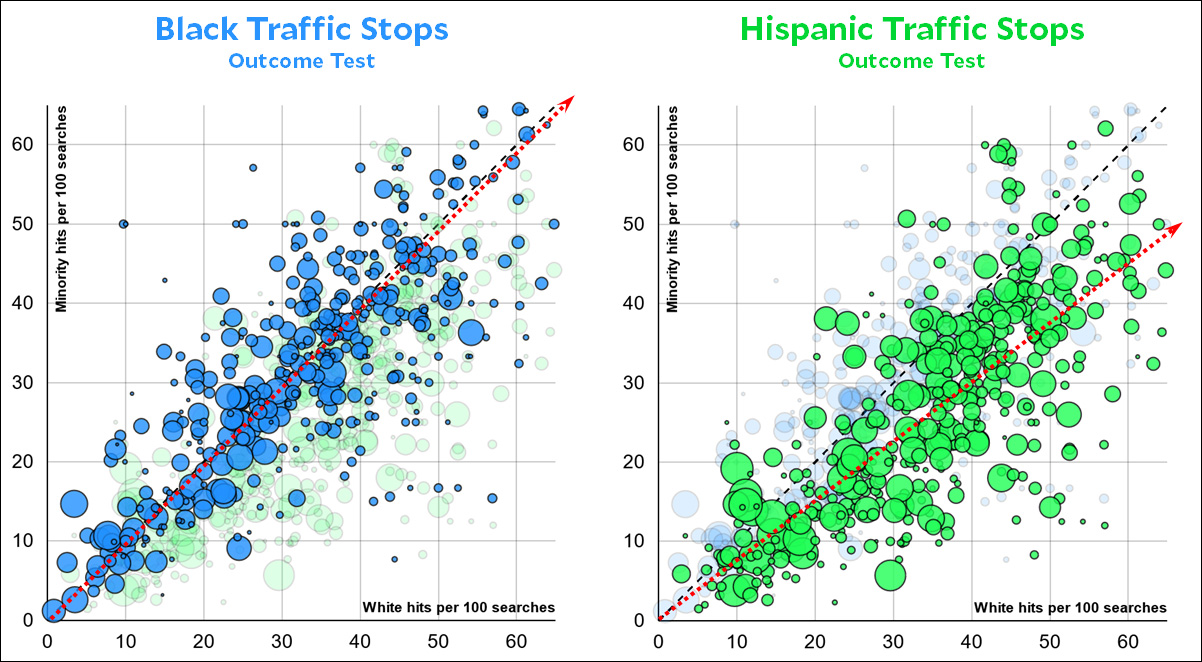
First up is what’s called an “outcome test.” If, say, police search blacks at twice the rate of whites, but also find contraband at twice the rate, it suggests there’s no bias in who they choose to search. They’re using a roughly equal standard of suspicion for both. Here are the results of that test. Note that the dashed black line represents white searches, while the dashed red line is my eyeball guess at the difference for blacks and Hispanics:
Although police search blacks more often than they search whites, they find contraband at about the same rate. They appear to be using similar criteria for both. However, they find contraband at a lower rate in searches of Hispanic drivers. This suggests they’re using a tougher standard of suspicion against Hispanics.
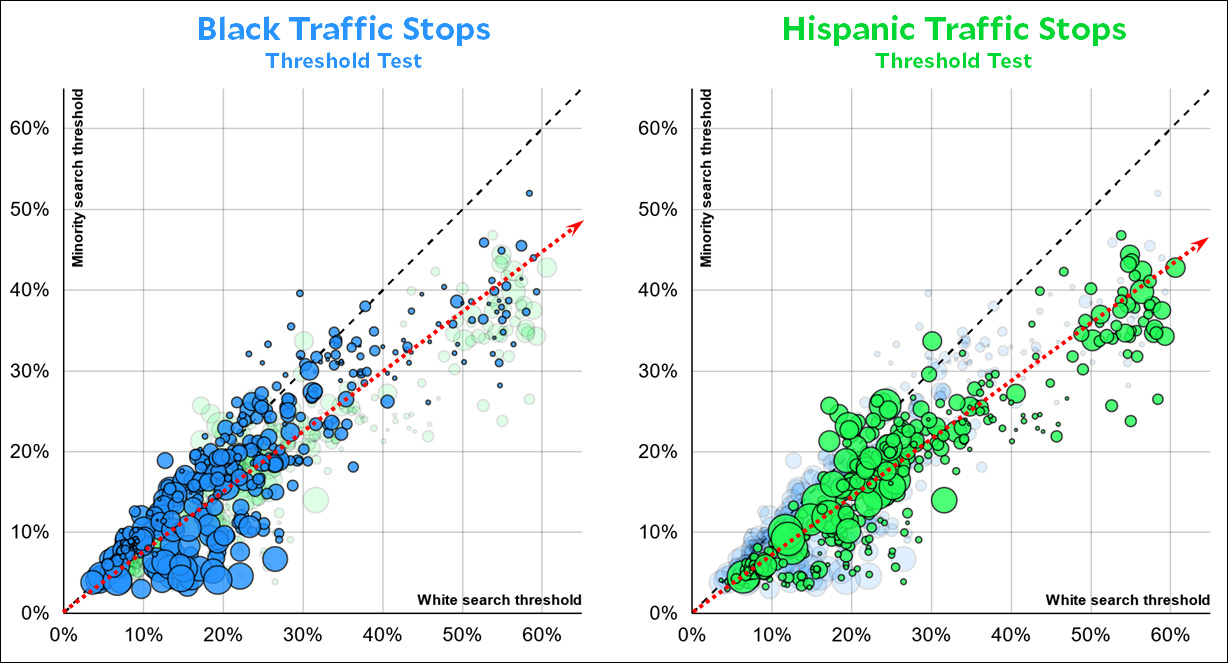
But that’s not all. There’s also something called a “threshold test.” This is a more direct measure of the standard police use to search drivers they stop. Here are the results:
When this more sensitive test of outcomes is applied, it shows that the threshold for a search is lower for both blacks and Hispanics. Very roughly speaking, it appears that police need about a third less suspicion to search black and Hispanic drivers compared to white drivers.
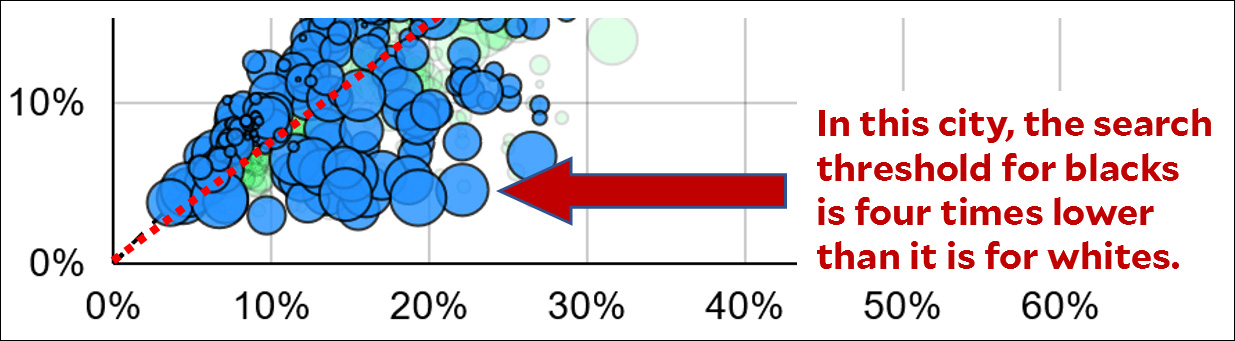
I’m not sure how this compares to previous studies. My initial sense is that it’s less than I would have guessed. Overall, police do stop and search black and Hispanic drivers at unfairly high rates, but not at enormously higher rates—although it’s obvious that in certain communities the stop rate of minority drivers is far, far higher and the standard of suspicion is far, far lower than it is for white drivers:
We’ll certainly find out more about this in the future, since the Stanford researchers have placed their massive database online and made it available to anyone who wants to dive more deeply into the data. They also continue to collect information from police departments around the country.
Billionaires own the media,
but they don’t own us.
At Mother Jones we know these aren’t conventional times, and they require unconventional coverage. That’s what deliver every day: fierce, independent journalism you can’t find elsewhere. Perhaps never in the history of our country has that been more necessary than now. But we can’t do it without reader support—your support. Please chip in today.
Billionaires own the media,
but they don’t own us.
At Mother Jones we know these aren’t conventional times, and they require unconventional coverage. That’s what deliver every day: fierce, independent journalism you can’t find elsewhere. Perhaps never in the history of our country has that been more necessary than now. But we can’t do it without reader support—your support. Please chip in today.