
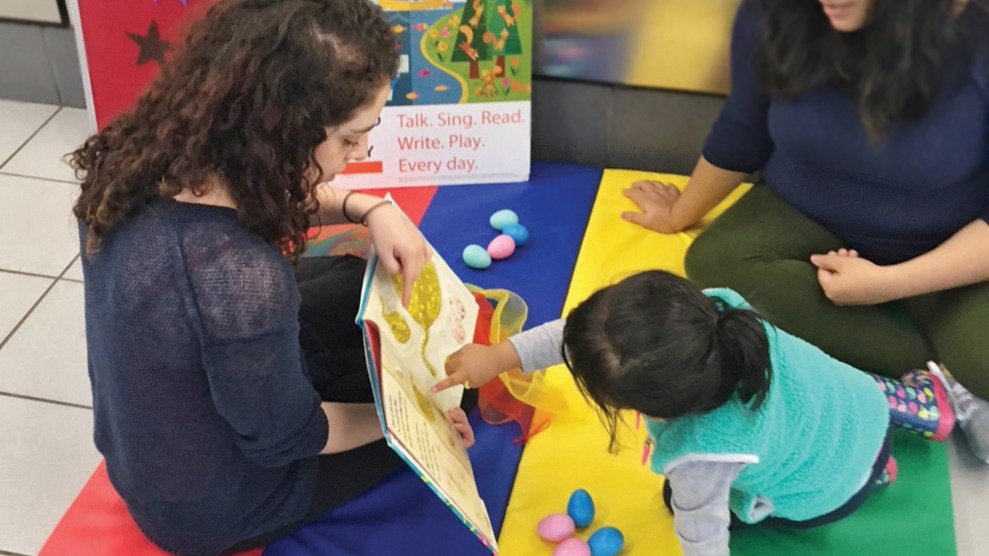
A librarian from Chicago Public Library reads to storytime attendees at Bubbleland laundromat.Courtesy of Chicago Public Library
Welcome to Recharge, a weekly newsletter full of stories that will energize your inner hellraiser. See more editions and sign up here.
As a kid, when my family had a few particularly rough years, we had to make weekly, sometimes soul-crushing visits to the laundromat. Sitting on the hard plastic seats, we’d thumb through old copies of Grit magazine, an illustrated Bible, or the first volume of an encyclopedia, the one you could buy for a penny.
The laundromat was a few steps down in a strip mall from a pay phone—the closest thing our family had to a regular number.
In those days, my little brother and sister and I would have greeted librarian Elizabeth McChesney with joy. McChesney began visiting Chicago laundromats in 1989, with books in tow. She found kids who were unlikely to attend storytime at a branch library but were eager to hear her read as the washers whirred. Her efforts helped inspire a nationwide initiative to bring libraries to laundromats.
Today, thanks to the work of McChesney and a broad-based coalition of nonprofits, thousands of families are benefiting from storytimes and bookshares in laudromats across the country. Adam Echelman, executive director of Libraries Without Borders, a nonprofit that aims to bring knowledge and information to those most in need worldwide, says, “You’re able to hold programs at a time and place that really meets people where they are. You have a captive audience, families return weekly, and it’s open all the time.”
Echelman’s group is part of a coalition working to form laundry literary groups nationwide. “Another thing is that most people don’t go to a laundromat outside of their neighborhood, so you’re working really locally,” he adds.
“Families are now changing their behavior, showing up to do their laundry when the library is going to be there,” McChesney, now director of Chicago Public Library’s children’s services and family engagement, told American Libraries magazine last month. “One little boy just recently said: ‘Let’s do laundry every day, Mom!’”
Thanks to Recharge reader Laurie Putnam for this story suggestion.
Here are some more Recharge stories to get you through the week:
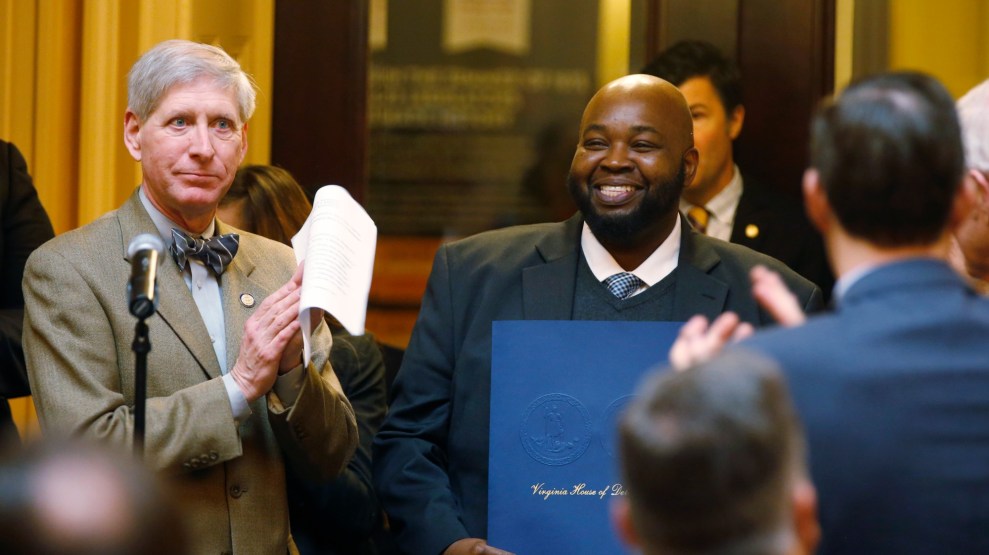
- “My heart dropped.” That was Aaron Mitchum’s reaction after billionaire Robert F. Smith told Mitchum and other 2019 graduates of Morehouse College, an all-male historically black college, he would pay off their student debt. Mitchum estimated it would have taken 25 years to pay off his debt otherwise, adding “it was like a burden had been taken off.” That burden is much higher on black students like Mitchum, according to a 2018 study. It found black students were 85 percent more likely to take on debt than white students—and took much longer paying off the debt. Will rich donors follow Smith’s example? In 2017, Nicki Minaj agreed to help high-performing students cover their education costs, and the following year Michael Bloomberg donated $1.8 billion to Johns Hopkins University so no student would need to take out loans. (Mother Jones)
- A leader in saving women. Rwanda is becoming a model in the global fight to curtail cervical cancer. After nearly a decade, a vaccination campaign against human papillomavirus (HPV) is close to achieving the nation’s ambitious goal to vaccinate all young girls against the most common cause of cancer for Rwandan women. After the devastation of the 1990s genocide that killed more than 800,000 people, Rwanda’s government has focused on improving the health of its citizens, with 45,000 volunteer community health workers nationwide. In February, Rwanda’s Health Ministry reported a 93 percent vaccination rate for young girls against HPV, of which two types are responsible for 70 percent of the nation’s cervical cancer. Officials say the aggressive vaccination campaign will lead to a decline in deaths over the years. (Mosaic)
- Lost and found. Baron Feilzer hadn’t seen his brother Tyson for seven years. He knew his brother was down and out, and Baron had been searching for him. Then, last month, a relative forwarded Baron a photo of Tyson in an article from the San Francisco Chronicle. According to the story, Tyson, now 40 years old and addicted to meth and heroin, dreamed about getting off the streets. Baron immediately raised money to help Tyson and booked him a spot in a rehab center. Baron flew from Ohio to San Francisco, hired an interventionist, and enlisted Chronicle reporter Kevin Fagan to help him search for his long lost brother. They found him in the city’s Tenderloin neighborhood, with heroin needles underfoot. “Want to go for a ride?” Baron asked his brother. Tyson’s answer would determine his future. It was one word: “Yeah.” (San Francisco Chronicle)